Planning and zoning encompasses issues that are among the most important for our region, and for any region. Without careful and informed planning, the face of any community can change dramatically, and not necessarily for the better, in a short period of time. Without well-written and well-implemented zoning regulations, a community has no control over its own destiny. Without regulation, growth, or lack thereof, happens or does not happen randomly, with the end result often being completely disconnected from any vision residents of a municipality may have had before.
Since the November elections, planning and zoning commissions across the region, with some new elected officials and some returning incumbents, have begun their terms of office through their first monthly public meetings with the new commissions on board. Beginnings can be transformational for any such body, but the Planning and Zoning Commission in Salisbury had a particularly controversial transition at their Dec. 1 meeting, with three of the five commissioners joining forces to unseat the longtime leadership and take it over themselves. On the face of it, at the meeting it seemed a surprising turnaround, with the commission chair of 16 years (and member for 26) Jon Higgins being voted out of office rather abruptly.
However, this is how elected commissions work, and with a five-member board, when three commissioners agree on any issue, they rule the day. There is no evidence that the three who voted themselves in as the new leadership (Dan Dwyer, now secretary; Michael Klemens, now vice-chairman; and Cristin Rich, now chairman) had any illegal communication before the meeting, which would have entailed a voting quorum of the commission gathering in person, by voice or e-mail. Rather, it seems any communication happened among all the members of the commission in pairs, and that the vote that happened on Dec. 1, while seeming precipitous, simply expressed the will of the majority.
This is the way the world works in this corner of the country. It would have been, perhaps, more palatable for all concerned if some more graceful care had been taken to recognize the service performed by Higgins for 26 years. Such service is hard to come by in any community, even in Salisbury which has had numerous longterm volunteers, like so many of its neighboring towns. It is certainly arguable that change can be a positive force for any elected or appointed body. It is also arguable that this particular change may well result in new directions that will prove beneficial for the town and its citizens. The beginning, though, could be perceived as callous from the outside looking in at the workings of the commission.
However, Rich, who is a Salisbury native with a master’s degree from Yale in forestry, has served as vice-chairman for two years, and has definite ideas on the way the commission should go forward in order to uphold its mission. She recently worked with other commission members to craft a job description for the town’s zoning enforcement officer (at this time, Nancy Brusie), which had previously been nonexistent. There is also an analysis of the interactions and structure of all planning and zoning in the town, which was done by Don Poland of Connecticut Planning and Development LLC of Hartford. It was released this week and is posted online at tcexctra.com.
This analysis was undertaken after a request to the town selectmen by Jeff Lloyd, chair of the Zoning Board of Appeals. With the two zoning bodies having been at odds over several cases in recent years, two of which resulted in lawsuits, it does seem right that Salisbury’s structure needs some detailed consideration and probably some revision. With the report from an outside expert to guide them, all those in Salisbury with responsibility for overseeing planning and zoning should have a real start to solving some of their historic problems. It will be critical for the new leaders to succeed in order to ensure the success of their town as a whole.
All that said, deep thanks to Jon Higgins for many years of long night meetings working to resolve difficult and complex issues. Such service can only be its own reward, since it is volunteer and generally, like all municipal leadership roles, ordinarily quite thankless.

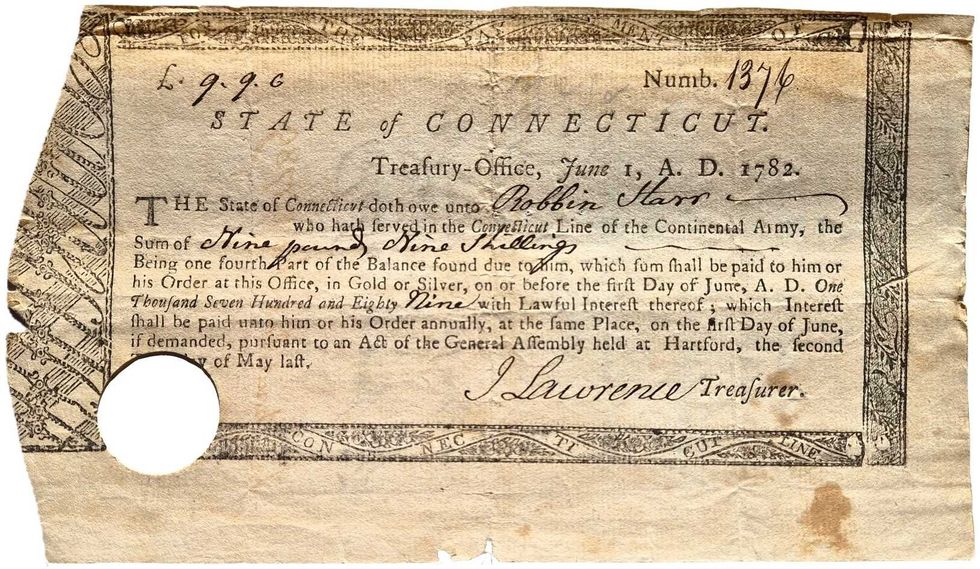 Pay Bill for Robin Starr’s service in the Continental Army.Courtesy the Alex Breanne Corporation
 John Mills speaking at Quinnipiac University.Courtesy the Alex Breanne Corporation
 Stephanie Saetta,with her rescue dog George and Blue (left), a shepherd mix awaiting his forever home.Madi Long
 Blue, a 7 year-old Shepard mix, is waiting for his forever home. Madi Long