SHARON — Ray Donovan passed away earlier this month, on May 2, but his influence on the town of Sharon will continue to be felt probably for as long as the town remains — because for many people, the shopping plaza that Donovan built is the actual center of town. It is home to many of the town’s essential services (post office, pharmacy, diner, grocery store, bank and package store) and as such is also a social center of the town. But five decades ago, nothing was in that spot but a single-family house (where the post office is now) and a 3-acre field.Donovan purchased the property in 1956 and moved his family into the house but already he had a vision of the retail plaza he wanted to build there. Donovan was not originally from Sharon. He was born in 1925 in Addison, Maine, and lived in the part of the state known as “Downeast” until, at the age of 17, he enlisted in the Navy. “He had a tough childhood,” recalled Debbie Donovan, the oldest of the three Donovan sisters, in an interview last week. “It was the Depression and his dad was out of work. His parents had split up when he was quite young; his mother worked at different private schools, so Dad and his sister, Carol, were sent to live with other relatives. Carol lived in Amenia for a very long time. She married Leland Hulst and they had five children, Leland III, Peter, Janice, Cheryl and Curtis. “My grandmother had moved here to Sharon and married Dwight Bierce,” Donovan continued. The family moved to Sharon when Ray Donovan was 13. His future wife, Roberta May Tischofer, became friends with sister Carol. “When my mother met him, she thought, ‘Oh, he’s cute!’” recalled their daughter, with a grin and a twinkle in her eye. Whirlwind romance When he was discharged from the Navy at age 20, Donovan returned to Sharon “and they had a whirlwind romance, about three months, and decided they wanted to get married. Donovan had enrolled (courtesy of the GI Bill) in the Coyne Electrical School in Chicago, and left New England for the first semester of school.“Then he came back and said, ‘Let’s get married.’ The wedding was on Dec. 26 and they left that same day for Chicago. They drove there in a ratty old car with holes in the floorboards.”Clearly his future wife saw potential in her groom, and he seems to have rewarded her faith by not only being, according to everyone interviewed for this article, a hard worker and a visionary entrepreneur but also a kind and devoted family man and excellent father. After their return from Chicago, the Donovans moved into a house on Gay Street and opened an appliance store in the barn out back. The business grew and as Donovan made plans to expand he also began planning out the future shopping plaza. Back in the late 1950s and early 1960s, according to First Selectman (and Sharon native) Bob Loucks, there used to be multiple small retail businesses all around the town.“There were two grocery stores and two package stores on West Main Street,” he said. “There was another grocery owned by Al Jenkins on the Green. And there was one in the Sharon Valley owned by the Middlebrooks, across from the Sharon Valley Tavern.” Several stores in town “Ray was from Maine and in his travels he must have seen that small shopping centers were a thing that was coming,” said Rick Hotaling, also a Sharon native and the owner of Rick’s Wine and Spirits in the plaza. “At that time, there were a number of stores here, Sharon was like other little towns. You didn’t have one big market, you had little markets, where you could get Bond Bread or buy your Red Ball Keds.”Back then, he recalled, what is now the plaza was just a field, with one big house on the corner. “They used to have carnivals there,” Hotaling said. “Someone used to come and sell fireworks out of a bus. I remember playing baseball there. What’s now the Salisbury Bank and Trust branch office was my great aunt’s house. We used to hang out there after school and play baseball. What’s now the entrance to the shopping center across from the bank was home plate.”It got harder to play as buildings began to grow, one at a time in the plaza. At a certain point, Hotaling recalled, “we’d have to stop playing and go get our ball off the roof of the pharmacy.”In winter, he said, “there was ice skating out in front of the laundromat and what’s now the Bodhi Tree gift shop. Once the first grocery store went in, mom could shop at the market and we could skate.”Donovan had laid out the rink with plastic, filled it with a hose and even added lights and music for night skating.The first building to go up was in the space now occupied by the Black Goose Grill. Donovan’s plan was for it to be a restaurant or coffee shop; he made sure to install a take-out window on one wall. But he was his own first tenant, moving his appliance store in until a restaurant took over the space. Then he moved to the back of the building (what is now the salon) and began adding on new retail spaces, usually deciding what kind of business he wanted and then setting about finding a tenant. Carwash One of his innovations was the addition of a carwash in the spot where his house had been (that house was picked up and moved to the very end of Still Meadow Road in September 1964). The carwash was later closed down and a new building was erected for the post office, which up until that time had been housed at Town Hall.“My dad really wanted the post office in the plaza,” his daughter said. “The Postal Service said you can have the post office there if you can have it ready in 90 days. So he tore down the carwash and he and my mom worked every day painting the new building and getting it ready and it was finished in 90 days.” Much of the masonry work there and throughout the plaza, according to everyone in town interviewed for this article, was done by the Amerighi family. “He was fearless,” Debbie Donovan said of her father. “He knew what he wanted.”But he was the proverbial iron fist in a velvet glove, according to most accounts. His daughter said he was wonderful to live with, and had a terrific sense of humor. Both Hotaling and Loucks said he was a quiet man, soft spoken, but, said Hotaling, “When he said something, you really wanted to be listening.”And as is often believed to be the case with a man who gets a lot done, much of the credit for Donovan’s success goes to his wife. Donovans were a team“He and Roberta worked as a team,” Loucks said. “And they were a tremendous team.”They ran the plaza together until about five years ago. Now the operations are handled by the three daughters, Debbie Donovan, DeeDee Mandino and Rindy Higgins. The sisters have upgraded the plaza and succesfully enticed the Choe family and their Sharon Farm Market as the anchor grocery store.Now they are trying to find a replacement business for what used to be the laundromat (“It’s too expensive to run a laundromat at the plaza,” Debbie Donovan said, “because water in Sharon is so expensive.”). The family is hoping that perhaps someone will open a housewares/hardware/kitchen supplies business. Because the family members have expertise in retail, they are willing to guide and coach a new owner. Town residents do seem to be aware of it when storefronts are empty in the plaza. It’s not necessarily the tax impact. According to Tax Collector Donna Christensen, the plaza itself barely makes the list of the top 100 taxpayers for the entire town, ranking at number 97 (with a combined tax bill of $17,324.68). The individual businesses each pay a few hundred dollars in property taxes (although Webster Bank pays $2,983.24). Harbinger of economy There seems, rather, to be a spiritual sense that when the plaza is thriving, so is the town.“The plaza is the heart of our town,” Loucks said. “We felt that when we were missing a market for a year and a half, the impact it had on the town.”Ray Donovan’s legacy lives on in the plaza. But for those who remember him and for his wife, family and friends, his death is still a loss. “I had a lot of respect for the guy,” Loucks said. “We were friends. I miss him.”
Latest News
Sharon voters split opioid settlement funds between ambulance, regional programs
Alec Linden
Sep 02, 2026
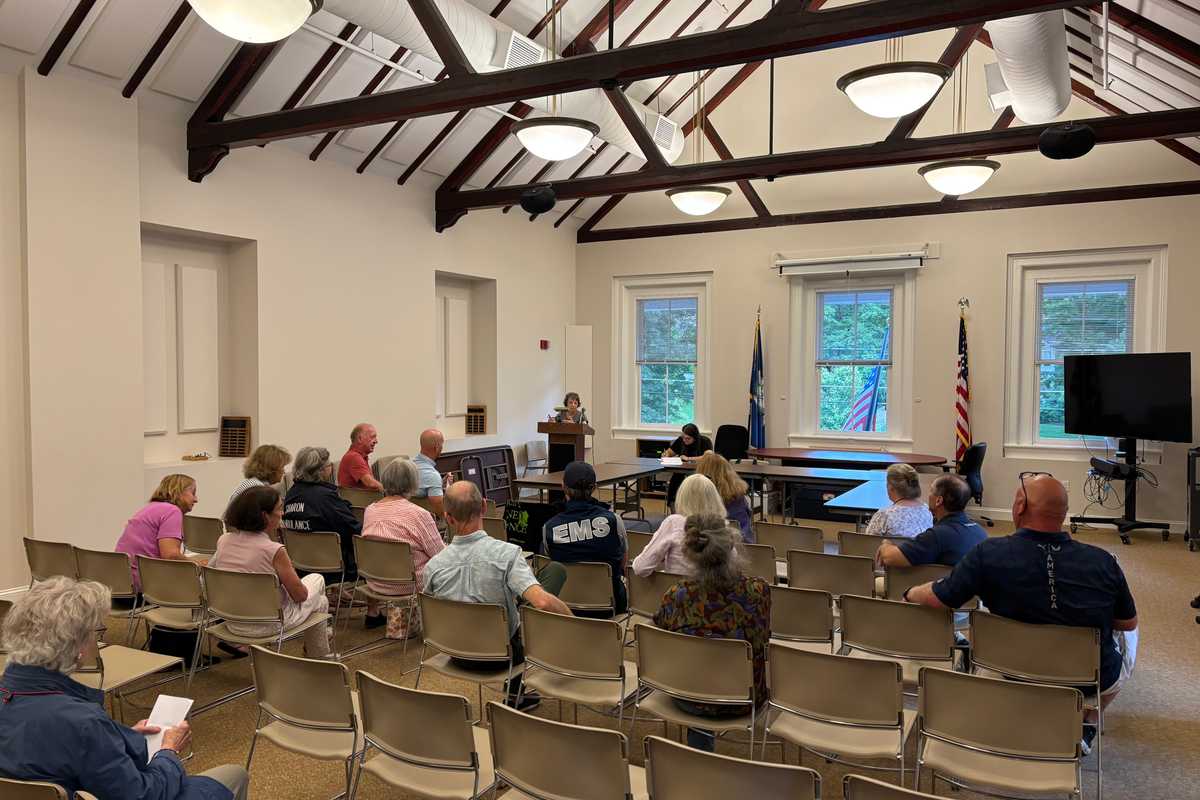
Sharon voters approved splitting $24,000 in opioid settlement funds at an Aug. 27 town meeting.
Alec Linden
SHARON — Sharon voters unanimously approved splitting $24,000 in opioid settlement funds between the town’s ambulance service and a regional fund supporting addiction prevention, harm reduction and mental health services.
The decision Thursday, Aug. 27, came two months after voters rejected an earlier Board of Finance-backed proposal, 27-11, at a June 18 town meeting. Residents had expressed concern about directing all the money, which must be used for opioid remediation, to a regional organization rather than supporting the town’s emergency medical service.
The revised plan allocates $14,000 to Sharon Ambulance and $10,000 to the Regional Opioid Response Fund, or RORF, managed by the Northwest Hills Council of Governments.
As additional settlement payments arrive through 2039, the town will have to vote again on whether to continue splitting the money between the two groups or adopt a different distribution plan.
Sharon Ambulance has said it intends to use its share to purchase and maintain equipment used during overdose responses.
The RORF supports harm-reduction initiatives and broader mental health services across the Litchfield Hills intended to reduce addiction risks and provide resources to vulnerable residents, according to Leonardo Ghio, the council’s director of rural health.
To date, the fund has received $175,000 in opioid settlement money from towns in the region and spent approximately $133,000 on harm-reduction supplies, addiction-awareness programming, mental health support and other initiatives.
Several towns, including Kent, Falls Village and Norfolk, have allocated their entire settlement payments to the RORF. Others, including Cornwall and North Canaan, have split the money between the regional organization and local mental health and substance-use disorder services, such as Greenwoods Counseling and Referrals.
Salisbury has yet to establish a distribution plan for its funds, which total approximately $40,000 to date.
Ghio attended Thursday’s meeting with Julia Jagger, an outreach and recovery navigator with Greenwoods whose position is funded by the RORF.
Jagger previously worked from a Greenwoods outreach site at Sharon Hospital, but the service ended because of funding changes. She said she plans to resume working from the hospital with support from the settlement funding.
Jagger said her role is to connect with people in need wherever they are.
“I can go directly to people’s homes,” Jagger said. “I can meet them somewhere out here. … The whole goal of my position is to try to reduce people feeling like they need to go to Torrington or Poughkeepsie for services that they can get access to now.”
Greenwoods is not a crisis-response service, however, and in an emergency, “it’s going to be first responders that are responding,” Jagger said.
Ghio said the regional fund’s strength lies in its ability to pool payments, which are distributed unevenly among towns and often arrive in small amounts from companies implicated in the opioid crisis, including Walmart, CVS and Purdue Pharma. Combining the payments allows the council to fund more substantial regional initiatives, he said.
Ghio estimated that Sharon will receive approximately $62,000 over the full settlement-distribution period. Nearby Washington, which directs all its opioid settlement money to the RORF, has already received $52,000, he said.
By comparison, Ghio projected that Morris will receive only about $3,500 by the time all the payments have been distributed.
“What in the world is Morris going to do that will be impactful with $3,500 alone?” he said. “Pooling the money together allows us to just have that greater impact across the region, knowing that we share borders and neighbors, and that people travel from one town to the other.”
Keep ReadingShow less
At Peggy Mercury, prep meets punk in ‘Imaginary Concerts’
D.H. Callahan
Sep 02, 2026
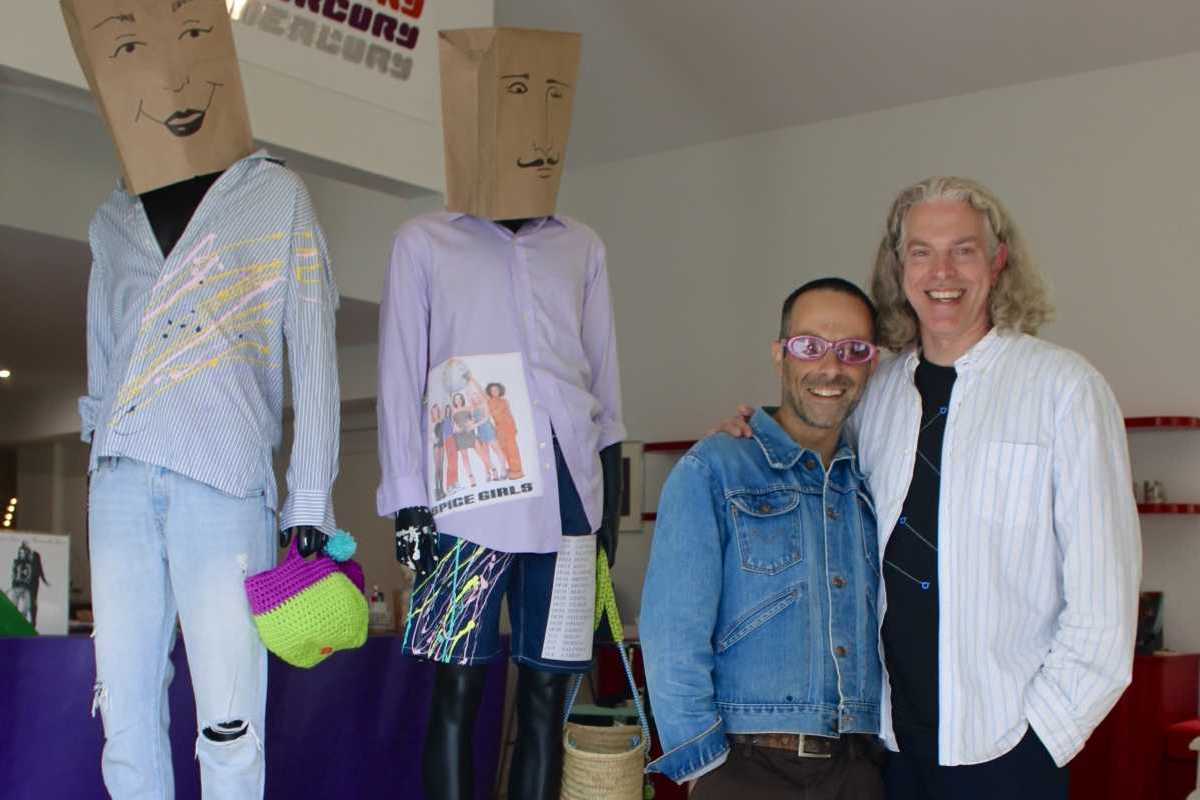
Greg Fricke and James Boehmer, co-owners of Peggy Mercury in Kent, recently launched their first fashion line, “Imaginary Concerts.”
Provided
Last month, James Boehmer and Greg Fricke of Peggy Mercury launched their first fashion line, “Imaginary Concerts,” wearable art sold exclusively at their store in the Kent Barns section of Kent, Connecticut.
The two fashion industry veterans opened Peggy Mercury more than two years ago, and a quick visit will tell you that people are finding what they’re looking for at the beauty and lifestyle store. But what they’re looking for is never standard.
Fricke and Boehmer are not there to stock their shelves with the same products customers find at standard makeup retailers. They’re there to help customers find what works for them. That usually means asking customers about themselves and learning about their beauty habits, skin, style and the way they like to present themselves. Fricke and Boehmer believe it’s their job to help customers bring out the qualities that suit them and determine what works best for their look.
So much of the Peggy Mercury world is about emboldening people to become more creative, and possibly bolder, versions of themselves. Some of this comes through the store’s creative collaborations with artists, designers and stylists.
It’s part of an ethos that encourages them and their friends to use the shop as a kind of laboratory, trying out new creative experiments without knowing how they might turn out. Whether in fashion, painting, fiber arts or photography, the projects almost always turn out marvelously.
A line of sterling silver charms they sell started as a small project by their friend Nolan Percival. In the beginning, the pieces were for close friends and loved ones. But Boehmer and Fricke encouraged Percival to get a little more serious about the project and create a whole line for the store. Today, it’s one of their top-selling collections.
“Imaginary Concerts” has the duo taking their own advice.
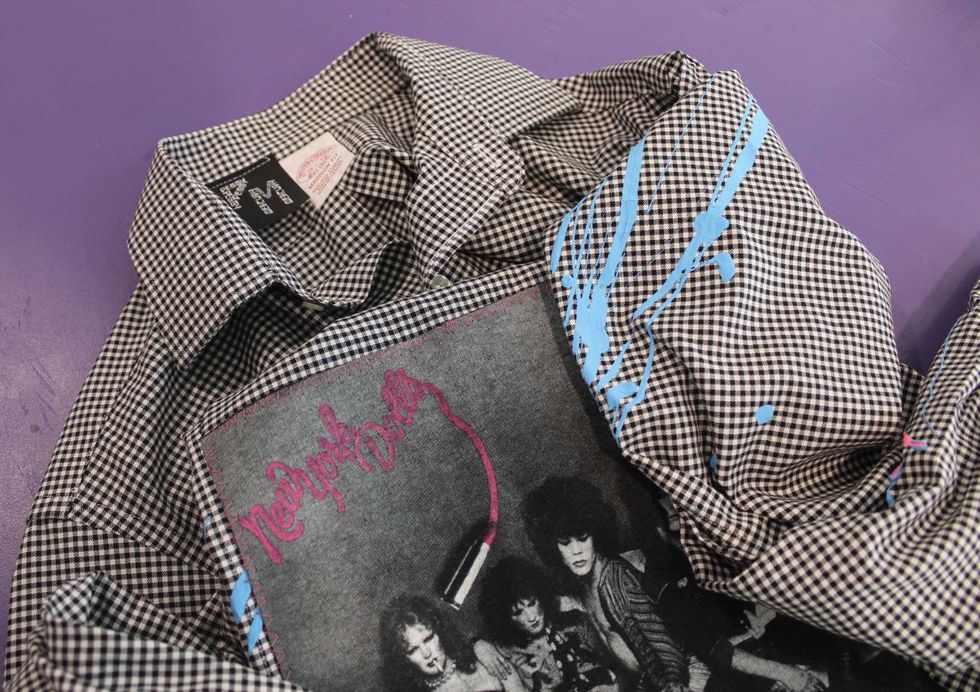
The project started as a way for Boehmer to connect with his mother, who had been diagnosed with Alzheimer’s disease. Taking old concert shirts from his own collection, Boehmer and his mother began cutting out the graphics with the idea that they would make a quilt together. Unfortunately, she died before they could complete the project in 2025. The pieces, which were ready for production, were put on the back burner as Boehmer and Fricke dealt with their loss and the whirlwind of projects that never seemed to cease at Peggy Mercury.
But the harsh winter of 2026 presented an opportunity to take some time and focus on themselves. Part of that meant revisiting and redefining the concert T-shirt project. This time, instead of looking to the warmth and comfort of a quilt, they turned to another passion — fashion.
Taking a page from their own book, they wanted to create something that felt comfortable to them. They took two disparate loves — one rooted in simple preppy style, with clean lines and classic silhouettes, and the other in the nitty gritty worlds of punk rock and pop — and blended them together to create something entirely new. Pulling from the staples of vintage Brooks Brothers and Charvet collections, they applied the graphic elements with bold stitching reminiscent of punk jackets of the ‘70s and ‘80s, but with a much more sophisticated air.
But the remixing isn’t just the pairing of prep and punk. The pieces are not canon. They take liberties with the realities of concert tours, combining one band’s dates with another band’s logos, mixing them all up until the reality is lost and imagination is the only truth.
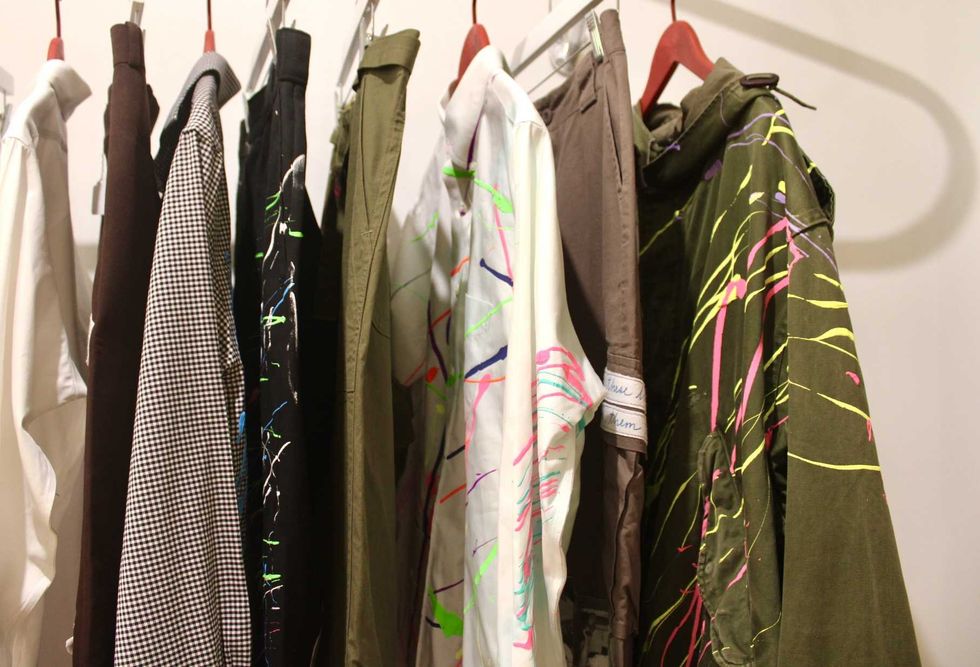
Adding to the mix is an element of perpetual creativity. Art can be messy, both figuratively and literally, and many of Fricke and Boehmer’s artist friends carry evidence of their work on them at all times. As a nod to these tireless creatives, the duo added haphazard splashes of bright color, giving the line an even more distinctive feel.
For them, “Imaginary Concerts” passes the “Peggy Test.” The mythical Peggy Mercury is a fictional figurehead for the company, a character who thrives on creativity and change. The name, much like the clothing line, is a mixture of interests: Mercury is a planet, a deity and an elusive, transformative element, while Peggy is the wonderfully stylish and boundary-pushing Peggy Guggenheim.
Everything Fricke and Boehmer put in their store has to pass this test: Would Peggy Mercury approve? For their first collection, the answer is a resounding yes.
Peggy Mercury is at 9 Maple St., Unit 2, Kent.
Keep ReadingShow less
“Girlbomb” at 20
Natalia Zukerman
Sep 02, 2026
Photo by Jessica YurkoMillerton author Janice Erlbaum will celebrate the 20th anniversary of her memoir “Girlbomb” at Black Rabbit Dispensary on Sept. 5.
With memoir...the character only knows what the character knows.
—Janice Erlbaum
In “Girlbomb: A Halfway Homeless Memoir,” published in 2006, author Janice Erlbaum wrote about the years after she left her family’s Brooklyn apartment at 15, moving through shelters, group homes, squats, clubs and the streets of 1980s New York while somehow continuing to attend high school. The book has sold more than 75,000 copies, stayed in print for two decades and continues to find new readers.
Now Erlbaum, 57, lives in Millerton and on Saturday, Sept. 5, at 7:30 p.m., she will celebrate the 20th anniversary of “Girlbomb” with a reading at Black Rabbit Dispensary. The event is open to the public and will be livestreamed on Instagram.
There is another reason for the celebration. Erlbaum has collaborated with her longtime friend Douglas Broughton of Black Rabbit Farms on a cannabis strain named Girlbomb.
“I was an early adopter of cannabis,” Erlbaum said. “I’m smoking weed throughout the entire book, so it made sense to collaborate with my longtime friend and come up with a special Girlbomb strain.”
Erlbaum said Broughton was the first person she knew when she began contemplating a life outside New York City.
“I wanted to move near somebody who knew what the hell they were doing already,” she said with a laugh. A “true New Yorker,” Erlbaum still doesn’t even drive a car. “I was like, ‘I’m not just gonna move to a farm.’”
Now well settled in Millerton, having moved to the village in 2021, the city girl has discovered something she never expected.
“I have discovered such joy in nature,” she said. “I look at a flower and I’m like, ‘I know what flower that is.’”
She laughed.
“And it’s also great for a writer. You get a lot of peace and a lot of quiet.”
The girl who walked away
“Girlbomb” begins with a girl making a decision.
Looking back four decades later, Erlbaum describes the moment she left home not as a grand plan but as something purely instinctive.
“It was really the first time that my true survival instinct kicked in,” she said. “There was all of a sudden a clarity of like, ‘Oh, I’m leaving.’”
She was 15.
All along, Erlbaum kept journals and calendars. She saved notes passed between friends. Those scraps of the past became part of the architecture of the book — and now, 20 years later, part of its afterlife.
Erlbaum has been publishing excerpts from those old journals on her website as “the girl bomb diaries,” calling them an “unofficial sequel” to the memoir. Her site is also marking the anniversary with photographs and stories.
She was, she said, a writer almost before she knew what that meant.
Not knowing it would become integral to her survival, her parents gave her a typewriter when she was 9.
“I read and I wrote. That’s what I did,” she said. “So that part wasn’t ever really in question for me.”
But writing “Girlbomb” was not easy. Erlbaum began and abandoned versions of the story in her 20s before finally completing the memoir in her 30s. She had been writing autobiographically, performing slam poetry and comedy, going to therapy and trying to make sense of the life she had survived.
The actual writing, she said, was painful.
“It was rending,” she said. “Kind of like method acting, you have to do method writing. You have to put yourself in the mind space that you were in.”
Sometimes she had to close the laptop and walk away.
“And then I would nap,” she said. “I took a lot of naps.”
Twenty years later
Erlbaum now sees parts of “Girlbomb” differently. She is candid about the privilege and blind spots of the woman who wrote the book in her 30s.
“I’ve grown over the past 20 years,” she says. “I see now a kind of insensitivity.”
But she also refuses to rewrite the consciousness of the girl she was.
“It’s difficult with memoir because the character only knows what the character knows,” she said. “And if you butt in and you’re like, ‘Little did I know,’ then that’s just intrusive.”
That honesty is part of what has allowed the book to endure.
And if the 15-year-old Janice could meet the 57-year-old Janice now?
After a long pause, Erlbaum said, “I think she would think I was a fraud.”
The teenager, she imagined, would look at this woman who is comfortable in the world and think it impossible.
“I would have thought that it was impossible to get to a point of not being miserable all the time.”
But she did.
Not without regret. Not without grief. And not without looking directly at the harm she caused herself and others.
When Erlbaum visits high schools to talk about writing, domestic violence or homelessness, she said students often ask whether she has any regrets.
“They want me to say no,” she said. “And I say, ‘Yeah, I regret the harm that I did to myself, and I regret the harm that I did to others. And if I could do it again, I would do things differently.’”
Twenty years later, “Girlbomb” is still a book about survival but with the hindsight and wisdom of years, it’s also a book about what comes after.
“Looking back, I know that today I would do things differently. And that’s how I’m able to forgive myself.”
For more information and to order a copy of “Girlbomb,” visit JaniceErlbaum.com
Keep ReadingShow less

Want more of our stories on Google? Click here to make us a Preferred Source.

Spencertown’s 21st Festival Of Books
D.H. Callahan
Sep 02, 2026
Joshua Jelly-Schapiro, author of “Daylight Come: Harry Belafonte and the World He Made” is one of thefeatured authors at the Spencertown Academy Festival of Books on Saturday, Sept. 5.
Mirissa Neff
On Saturday, Sept. 5, the Spencertown Academy Arts Center in Spencertown, New York, will host its 21st annual Book Festival.
With over 20,000 gently used books, CDs, DVDs and vinyl donated by the community, it took volunteers 45 days — and an estimated 750 hours —to set the whole thing up. Most of that time was spent sorting through the vast troves of donations and organizing them by category.
The event is a fundraiser for the Spencertown Academy Society, which was founded in 1972 after the Academy Building was shut down as a working school. Since 1847, when the Rev. Timothy Woodbridge, a blind pastor from a local church, opened a teaching college, the building had been used for education. Today, it serves Chatham residents as a gallery and performing arts space.
The Festival started in 2005 as a way to raise money for the Society, and help support the upkeep of the building. Over the years, the Society has added appearances by featured authors. This year’s lineup is particularly robust, with a focus on nonfiction, along with several fiction writers and even one cookbook author.
In the nonfiction category, the festival will feature James Baldwin biographer Nicholas Boggs, whose book “Baldwin: A Love Story” is a New York Times bestseller and winner of the National Book Critics Circle John Leonard Prize as well as the PEN/Jacqueline Bograd Weld Award for biography.
Historian and author James M. Bradley, known for editing “The Encyclopedia of New York City,” and the Papers of Martin Van Buren project, will discuss his new book, “Martin Van Buren: America’s First Politician.”
Featured author Joshua Jelly-Schapiro was a member of Yale University’s first Ethnicity, Race and Migration program and earned his Ph.D. in geography from the University of California, Berkeley. His award-winning doctoral thesis explored the global impact of Caribbean culture. His new book, “Daylight Come: Harry Belafonte and the World He Made” was released in August.
“Lincoln’s Lady Spymaster” by Gerri Willis was a New York Times bestseller when it was released last summer. Willis, known for her financial reporting on CNN and Fox Business,tells the story of a Southern Belle inspired to help the Union during the Civil War.
Willis isn’t the only author who wrote about women spies in wartime. Michelle Young, an award-winning journalist, author and adjunct professor of architecture at Columbia University’s Graduate School of Architecture, Planning and Preservation, is best known as the founder of online magazine “Untapped New York.” She’ll be in Spencertown to discuss her 2025 book, “The Art Spy: The Extraordinary Untold Tale of WWII Resistance Hero Rose Valland.”
Pivoting to fiction, “Hazel Says No” is the first novel by author and Vassar graduate Jessica Berger Gross. The novel shifts perspective and voice from one family member to another. Her first book, “Estranged: Leaving Family and Finding Home,” was an intimate memoir about leaving her close-knit family in search of a healthier, more independent life.
Fulbright Scholar Casey Scieszka will discuss her novel, “The Fountain,” which was named one of the most anticipated books of the year by publications including The Boston Globe, Literary Hub, Book Riot, Goodreads and Town & Country before its release in March. Scieszka runs the Spruceton Inn: A Catskill Bed & Bar, known in part for its artist residency, which hosts painters and award-winning authors.
But one local hotelier isn’t enough for Spencertown. Cook, food stylist, photographer and bed-and-breakfast owner Melina Hammer will discuss her cookbook, “A Year at the Catbird Cottage: Recipes for a Nourished Life,” which draws on her work with local, natural ingredients prepared for guests at her Hudson Valley home.
Rounding out the appearances will be children’s book favorite Pete the Cat. The Pete the Cat series was created by Eric Litwin and James Dean (not that one) nearly 20 years ago and has spawned an animated series with holiday specials. Notable voices in the series include Elvis Costello, Diana Krall, Dave Matthews and Jason Mraz. For this appearance, though, expect one big, groovy cat.
To learn more about the Book Festival and become a member, with early access to the sale, visit spencertownacademy.org.
Keep ReadingShow less
Paul Newman racing doc to screen in North Canaan on Sunday
D.H. Callahan
Sep 02, 2026
“Winning: The Racing Life of Paul Newman,”will be screened Sunday, Sept. 6, at the Colonial Theatre in North Canaan.
Provided
On Sunday, Sept. 6, Lime Rock Park will host a screening of the documentary “Winning: The Racing Life of Paul Newman” at the Colonial Theatre in North Canaan at 7 p.m.
Newman was one of the most celebrated actors of the 20th century, known for films including “Cat on a Hot Tin Roof,” “Hud” and “Cool Hand Luke.” His 1969 film “Butch Cassidy and the Sundance Kid” also began a decades-long friendship with co-star Robert Redford.
That same year, Newman starred alongside Robert Wagner as a race car driver in “Winning.” Director James Goldstone wanted the actors to drive real race cars, so they were trained for the role. Wagner didn’t much care for the experience. Newman, however, fell in love.
While he didn’t start out as a particularly good or fast driver, he couldn’t stop. Soon, he was jumping at every opportunity to get behind the wheel. Since he lived in Connecticut, there was one place with the challenges he needed to practice: Lime Rock Park.
Newman started racing in his mid-40s, an age when most drivers have already retired. But his patient, studied approach saw him improve with every turn. Soon, he was winning races against drivers half his age, who didn’t have all the Hollywood hubbub to distract them.
Exploring the highs and lows of Newman’s lesser-known career as a race car driver and team owner, “Winning: The Racing Life of Paul Newman” features original interviews with Redford, Jay Leno and racing legend Mario Andretti.
Another of Newman’s passions was philanthropy. Known for his Newman’s Own line of snacks, sauces and salad dressings, the company gives 100% of its profits to charity, supporting nutrition education and school food programs, Indigenous food justice and the Hole in the Wall Gang Camp in Ashford, Connecticut.
The camp, named after Butch Cassidy’s Hole in the Wall Gang, was founded by Newman in 1988 as a place where children with serious illnesses could simply be kids.
The documentary screening is part of the 44th Lime Rock Historic Festival, and half of the proceeds from ticket sales will go to benefit the Hole in the Wall Gang Camp.
Tickets are available at canaancolonial.com.
Keep ReadingShow less
Community to take center stage at Dive Barn
D.H. Callahan
Sep 02, 2026
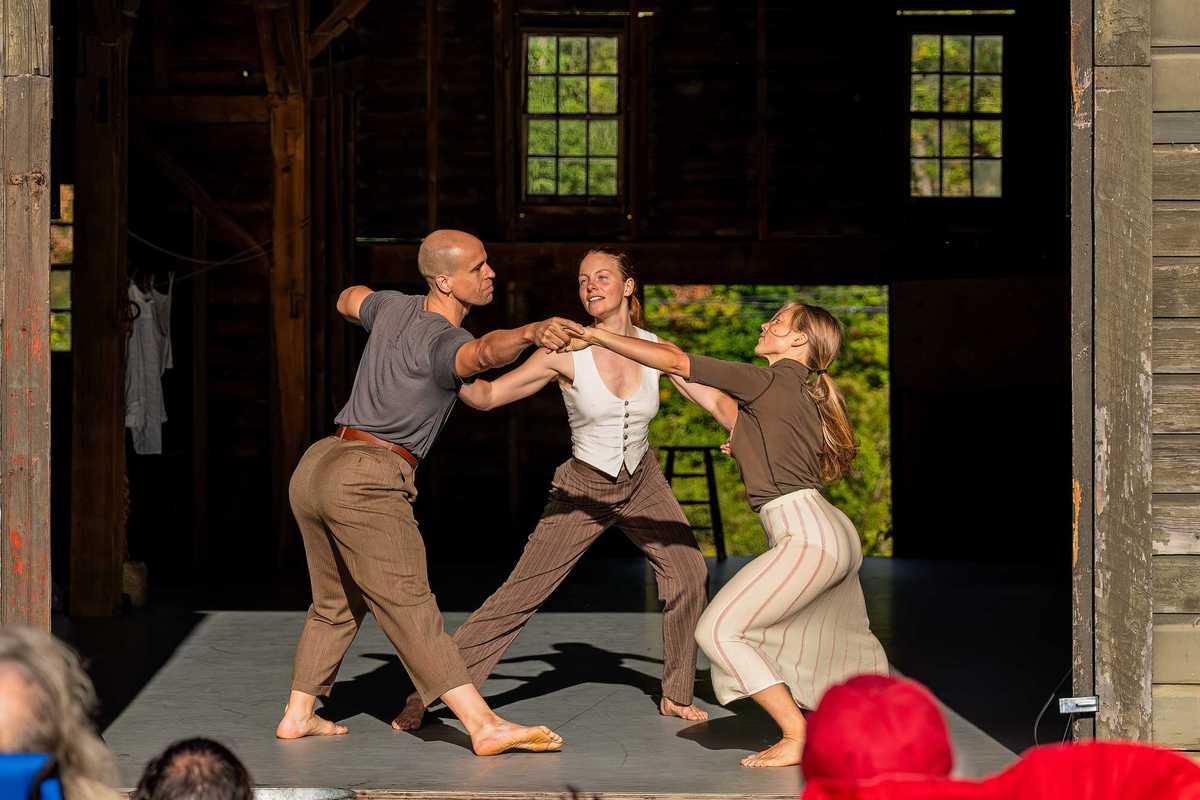
A scene from last year’s Dance Barn.
Steven Tayler
On Sunday, Sept. 6, PS21 in Chatham, New York, will host a celebration of community through dance at its second annual Dive Barn performance at the organization’s Dance Barn.
Dive Barn is the brainchild of dancer, teacher and choreographer Sayer Mansfield, who has dedicated her life to contemporary and experimental dance. She studied in the Department of Dance at NYU Tisch School of the Arts and at the Salzburg Experimental Academy of Dance. She’s performed with companies including Pilobolus, Compagnie Marie Chouinardand Mark Morris Dance Group. Her work has been featured in films including “Little Women,” “Maestro” and “Sproutland.” She has served on the faculties of Jacob’s Pillow, Phillips Academy Andover, as well as Harvard and Yale Universities.
Recently, though, Mansfield’s been focusing on her community in Columbia County, New York. As has been a theme since the COVID-19 pandemic, a groundswell of creative people have pulled up their city roots to plant itself in the fertile soil of the countryside.
For the past year, Mansfield has been teaching these recent transplants and lifelong residents alike to dance at her Tuesday Night Dance group, or TND, as it’s known at PS21.
The group became so popular that she had to add a second night, so now TND can mean either Tuesday or Thursday Night Dance. Each group has a rotating enrollment of 30 to 60 locals, fueled by fervent word of mouth, but the classes can get even bigger. They meet at the Dance Barn at PS21, Mansfield’s new home away from home. There, she teaches actors, painters, musicians, desk workers and farmers how to get comfortable moving their bodies.
Dive Barn will feature two unique performances, both choreographed by Mansfield, with music by local musicians Raena Jade and Elori Saxl. One dance will be a more intimate performance by Mansfield and her collaborator, actor and dancer Ashley Hill. The other will feature a large group of her class regulars, most of whom have never performed dance onstage. This is a chance for many non-dancers to show what they’ve learned through the TND group classes and celebrate the diverse mix of bodies that Mansfield’s been molding over the past several months.
Dive Barn is part of a bigger multiday event at PS21 called Commonground. PS21 describes it as a “free festival of large-scale live performance and spectacle” taking place Friday, Sept. 4, through Monday, Sept. 7. Alongside Dive Barn will be world premiere performances of “FIELD” by director, writer and electronics artist Andrew Schneider, which was commissioned by PS21, as well as “SUPERDRUM X.”
SUPERDRUM has been an ongoing project by Dutch musical arts collective Touki Delphone. For this iteration, the collective collaborated with theater company Veenfabriek to build 100 self-playing drum machines that use found twigs from forests and sidewalks as drumsticks. The drums are connected to a system that can control them all together or individually. Each night, a human drummer will collaborate with the piece.
As if all of this weren’t enough, PS21 will open its expansive campus to the community before the performances, offering apple picking, lawn games, West African food from Chez Diarra and free ice cream. “FIELD” will be presented Friday, Saturday and Sunday. “SUPERDRUM X” will take place every day of the Commonground Festival.
To learn more about Dive Barn, PS21 and to get tickets to Commonground, visit ps21chatham.org.
Keep ReadingShow less

Want more of our stories on Google? Click here to make us a Preferred Source.

loading