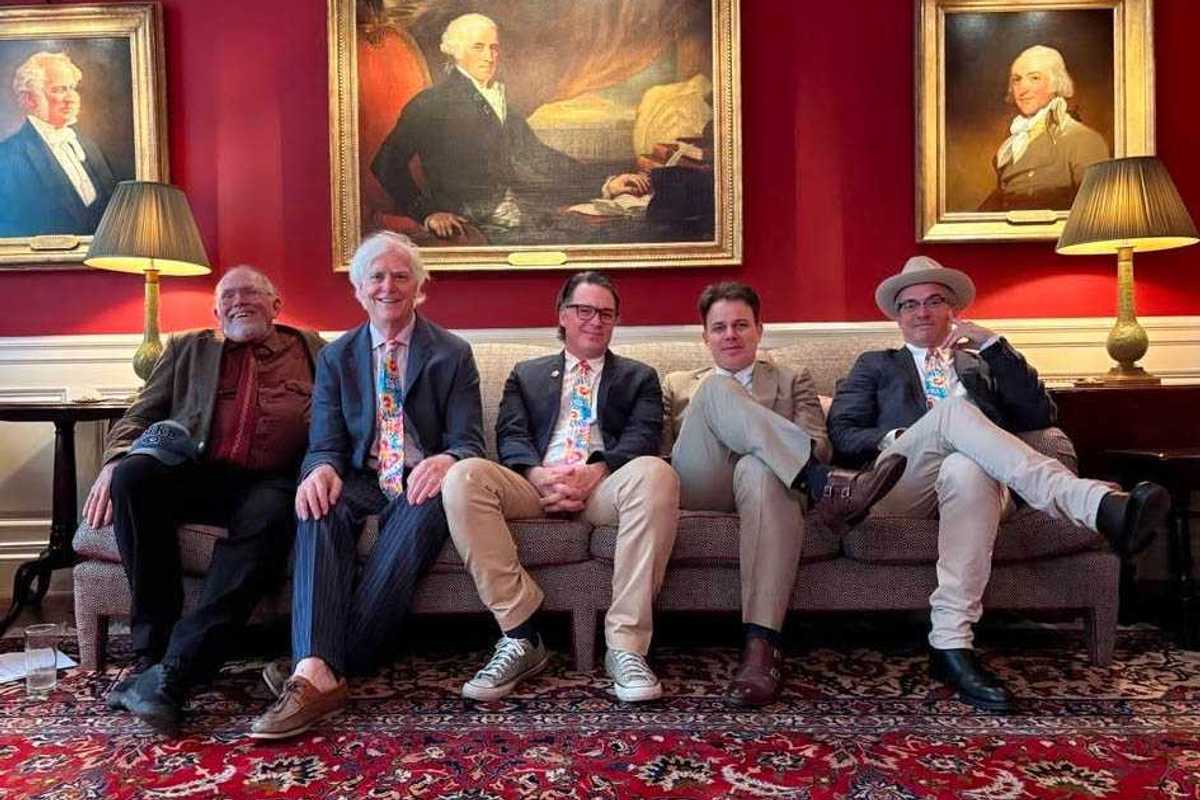
SALISBURY — Ezra Carruthers, a Loyalist from North Carolina, explained why he chose to fight for the English against the American colonists during the Revolutionary War at the Scoville Memorial Library Sunday, Feb. 1.
Tom Key of Salisbury stood in for Carruthers.
The talk was part of the ongoing Salisbury READS series of events, presented in partnership with the Salisbury Association Historical Society in connection with the community reading of “Revolution Song” by Russell Shorto.
Speaking in 1830 from a coastal English village where he had a career as a schoolteacher, Carruthers said he grew up in North Carolina and still misses it.
His father fought with the British army in the French and Indian War, and subsequently sold his officer’s commission, a common practice at the time, and bought land in the North Carolina mountains.
Unlike the “lowlanders,” the senior Carruthers had a modest amount of land suitable for raising pigs and corn, not the more lucrative rice and indigo produced at lower altitudes. Carruthers had two, not hundreds, of slaves, and “we worked in the fields with them.”
Ezra attended William & Mary and studied classics, and also picked up double-entry bookkeeping.
He found work in Richmond, Virginia when Thomas Jefferson was governor. Ezra met Jefferson and formed an unfavorable opinion of the governor, one that persisted.
When the Revolution started and it was necessary to pick a side, Carruthers assessed the situation.
First, he did not approve of mob action, such as the tarring and feathering (if not worse) of Loyalists in cities like Philadelphia. “Mobs were doing what individuals would never do on their own.”
Second, the French influence on the revolutionaries. “I don’t think that needs any explanation.”
Third: Jefferson. Carruthers did not like or trust the man.
He also decided that the Loyalists valued peace, order and government, while the “rebels” (as he insisted on calling the colonists) were enamored of the somewhat amorphous “life, liberty and the pursuit of happiness.”
An American at the time was a Loyalist by default, Carruthers reasoned. Being a rebel required disavowing the King of England and the Church of England.
As a member of the Church of England, Carruthers knew or suspected that many of the rebels were either Deists, Freemasons or Presbyterians, none of which sat well.
And there was Jefferson, who wrote that all men were created equal, yet owned 400 slaves.
Politically, Carruthers considered the colonists pre-revolution to be the freest people in the world at the time.
He also noted that most of the laws that infuriated the rebels were in effect for short periods of time, and subsequently repealed or heavily amended after public outcry.
So he joined a Loyalist regiment headed by Patrick Ferguson, who had some success in recruiting men to fight for the Crown, but wasn’t much of a military tactician. Ferguson and his regiment were soundly defeated at the Battle of King’s Mountain, and Ferguson was killed.
Carruthers survived and found his way to Benedict Arnold’s force, where he participated in the burning of Richmond.
When the war was over, Loyalists were sent packing to wherever they’d be accepted — Africa, the Caribbean, India, Canada and the British Isles.
Carruthers wound up in England, where he kept up with his native land by subscribing to newspapers and periodicals.
He eventually came to wish the United States well but had some observations from afar.
He noticed the periodic unrest of Shay’s Rebellion and the Whiskey Rebellion. He followed the continual fighting between Alexander Hamilton and Jefferson, with George Washington stuck in the middle.
And he noted with disapproval “Jefferson’s love affair with France.”
From the vantage point of an exile in 1830, Carruthers said that republics formed after revolutions are rare, and republics that last rarer still.
He attributed that to the influence of Washington, two large oceans on either side of the country, and being “harder than hell” on the Native Americans.
Most importantly, the American Revolution produced the American Constitution, “which has held up very well.”
Unlike soldiers from other countries, fighting for their homeland or monarch, “if you’re an American, you’re fighting for the Constitution.”

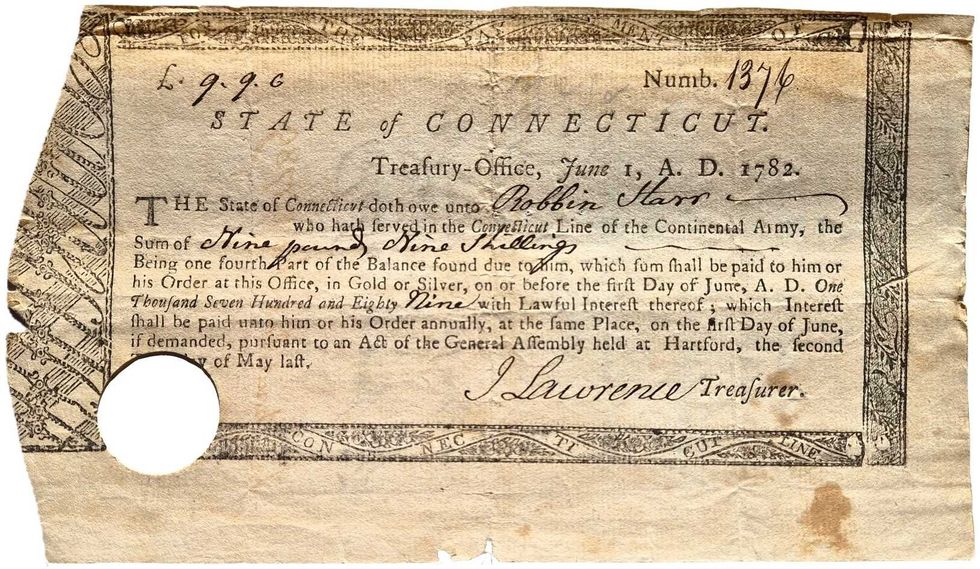 Pay Bill for Robin Starr’s service in the Continental Army.Courtesy the Alex Breanne Corporation
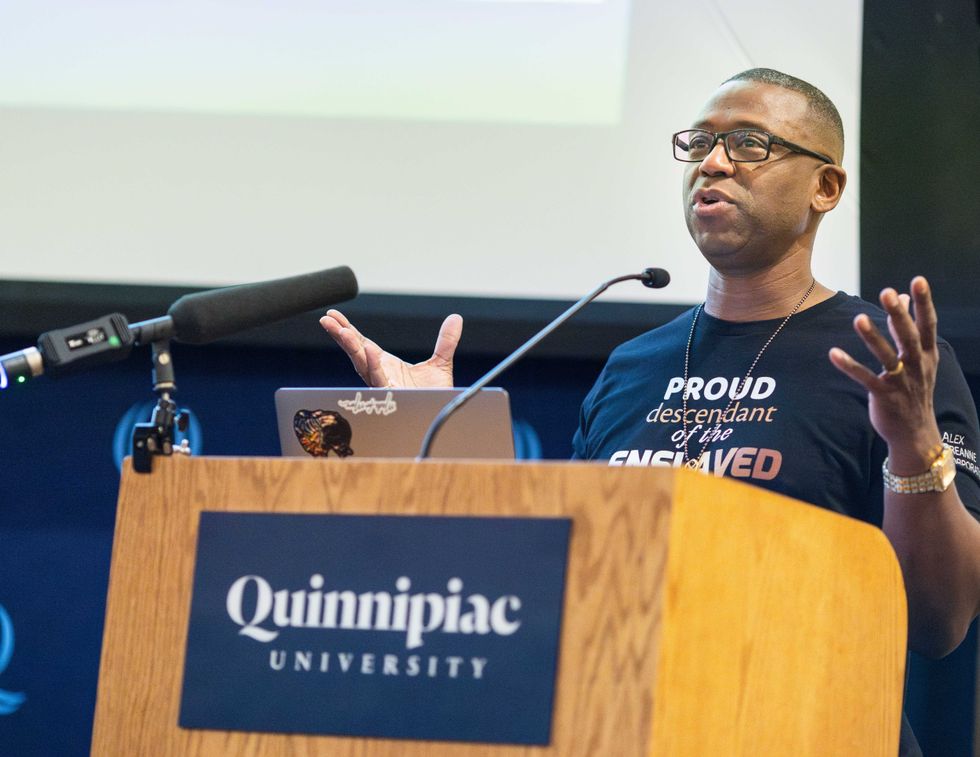 John Mills speaking at Quinnipiac University.Courtesy the Alex Breanne Corporation
 Stephanie Saetta,with her rescue dog George and Blue (left), a shepherd mix awaiting his forever home.Madi Long
 Blue, a 7 year-old Shepard mix, is waiting for his forever home. Madi Long