Thank you!
Your support is sustaining the future of local news in our communities.

Research and development on the river

Research and development on the river

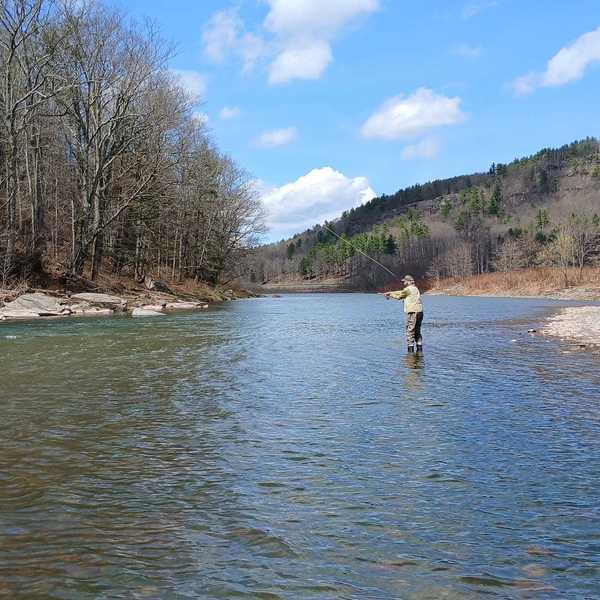
Research and development on a cold, nasty day on the Beaverkill in New York. The author was particularly pleased his new right hip didn’t present any difficulties.

Gary Dodson

Successful fly-fishing involves research and development.

A few weeks ago, on a chilly, raw morning on a somewhat swollen Beaverkill River in New York, Gary Dodson and I rolled up expecting to have the area to ourselves.

We did not.

There were four anglers clumped together right under the covered bridge where famed angler and fly-tier Theodore Gordon did a lot of his research and development. Gordon did his in the late 19th century, when R&D was a little easier in the sense that getting to the river meant walking or catching a ride from a passing horse and buggy. It would have been unusual to see four anglers anywhere, never mind in a bunch.

We bypassed these researching developers and made our way downstream. The river was high enough to make wading tricky and cold enough, at 48 degrees, to make the trout sluggish and uninterested in participating in R&D.

I managed a couple of bumps on small, heavy nymphs, and Gary caught a handful of dinker browns who, he said, had trouble getting their little mouths around a size 12 soft-hackle wet.

The important thing here was that my new right hip didn’t give me any trouble.

“Let pain be your guide,” said the doctor, Yoda-like, when he took me off the injured reserve list.

And by golly, he was right.

It is traditional to complain about the weather. It is also boring, so I won’t do it, except to say that in the last few weeks sometimes it was cold and sometimes it was unusually hot, and none of it helped.

But it was good R&D.

Example: I was wet-wading the Housatonic and environs by the third week of May. This is the earliest I can recall doing this.

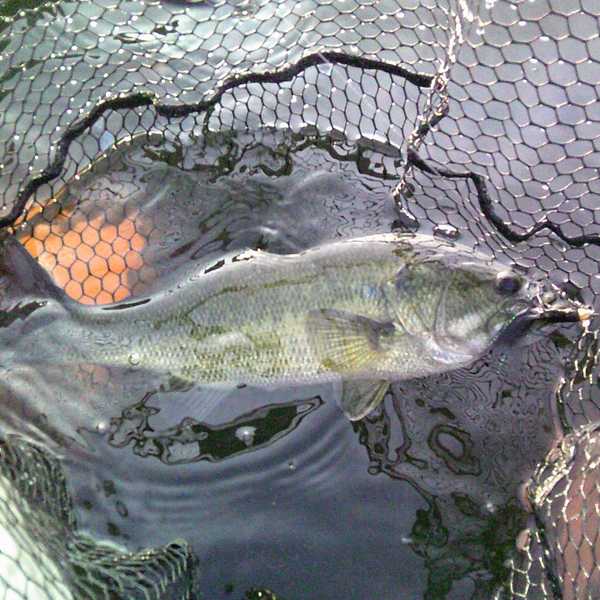
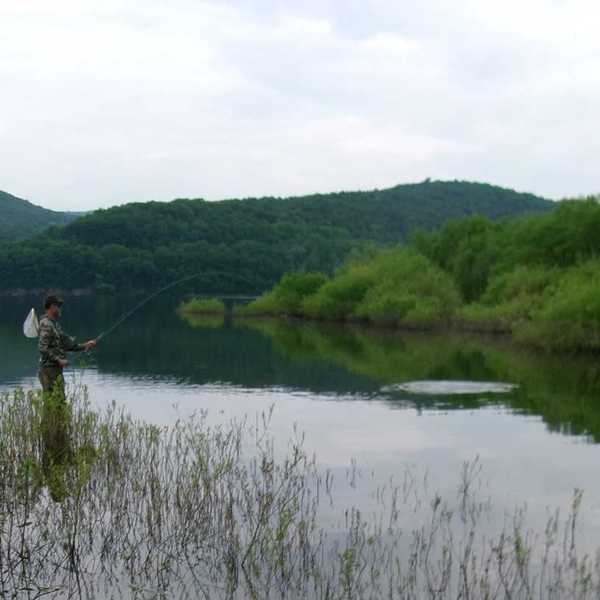
The Hous water temp was at or near 70 on May 20, which made me think it was time to deploy the Woolly Buggers in search of smallmouth bass. Since I had the wrong rod for the job, this was a sloppy and cumbersome maneuver. It resulted in one rainbow trout of modest size, no doubt a recent arrival from the hatchery, and precisely what I was trying to avoid.
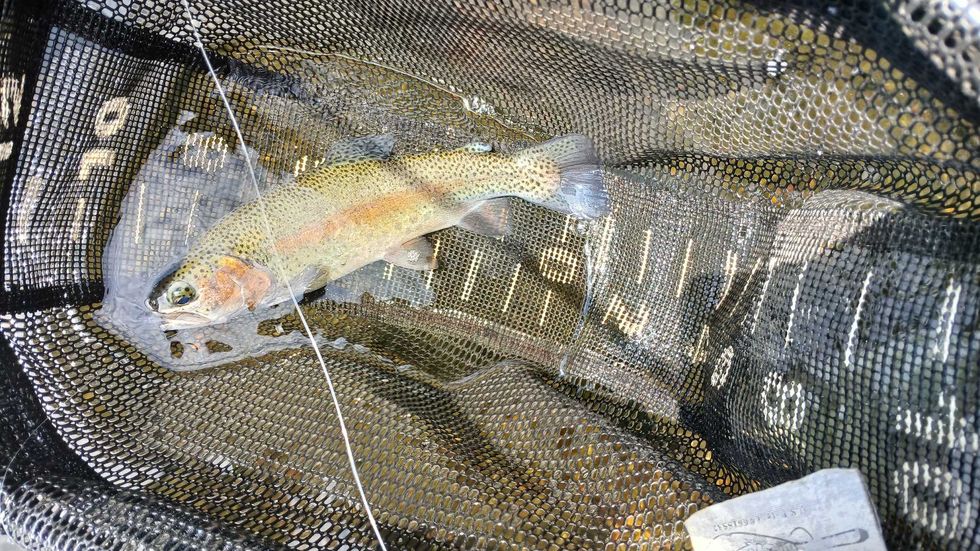
The basic hatchery rainbow as plucked from the Blackberry River. This one was hanging around in the most aerated water available, and took a heavy, sparkly Surveyor nymph. Patrick L. Sullivan

But it was momentarily satisfying to have some development to go along with the research.

My friend Dave Edgerly came up, and we took a whack at the Blackberry, where the water temps hadn’t reached the danger level, and we plucked a few from the foamiest, most aerated water we could find.

Years of R&D have taught me that, given the choice between breathing and any other activity, trout opt for the former.

So if things are slow in the long, slow, deep pools, find the white water and watch for a few minutes. Chances are you’ll see trout sticking their heads up, grabbing whatever bugs are coming down the pike.

In a situation like this, I take it straight to them, with a couple of heavy nymphs — one drab, one gaudy — launched straight into the foam.

How big and how heavy?

“Let pain be your guide.” Or, in this case, “let getting hung up on a rock and having to rerig be your guide.”

Start with the big ones. If you’re getting snagged, switch out to the smaller ones. Eventually, through careful application of research and development, you will find the answer.

Or not.

Failure is a big part of R&D. If it starts to get on your nerves, just remember this:

In most endeavors, if you fail 70% of the time, someone will suggest a new line of work.

In baseball, a hitter who fails 70% of the time over a 20-year career goes in the Hall of Fame.

Fly-fishing is like baseball in this sense.

So relax and get on with the R&D, en route to the HoF.
Latest News

Angry bees close Mudge Pond Beach

Angry bees close Mudge Pond Beach

Officials closed the Sharon town beach at Mudge Pond on Wednesday, July 15, after a fallen tree limb exposed a large beehive. The beach is expected to reopen Thursday.

Alec Linden

SHARON – The town beach on Mudge Pond closed on Wednesday, July 15, but the cause wasn’t the smoky haze drifting in from Canadian wildfires – it was angry bees.

According to Sharon’s Parks and Recreation Director Bryan Failla, a large limb fell from an old tree near the lifeguard stand overnight, exposing a hole that houses a large beehive. He said the town made the decision to close the beach Wednesday morning “out of an abundance of caution.”

Keep ReadingShow less
Millerton dressmaker forged path as early businesswoman
Mary Kisselbrack, left, and her husband, George.
Provided

If you’ve driven down Main Street in Millerton, you’ve passed the former home and shop of one of the village’s earliest female entrepreneurs. At a time when most businesses were owned by men, Mary Kisselbrack made a name for herself in the late 1800s as a well-respected milliner and dressmaker.

On April 11, 1891, train conductor George Kisselbrack purchased a 124-by-232-foot vacant lot at 54 Main St. and hired locally renowned builders Beers and Trafford to design what would become their home and Mary’s business.

Keep ReadingShow less
Wastewater project coming to fruition after decades of debate

Millerton’s business community will soon see the completion of a public wastewater system, addressing what local officials and business owners have called a major constraint on commercial development in the community for decades.

The $13.8 million project, which is expected to serve the core of the Village of Millerton and a commercial stretch of the Town of North East along U.S. Route 44, represents one of the largest infrastructure investments in the community in decades, and brings an end to calls for a sewer system that stretch back to World War II. Officials say the system will safeguard local waterways while creating a foundation for long-term economic stability.

Keep ReadingShow less
google preferred source

Want more of our stories on Google? Click here to make us a Preferred Source.

Millerton Moviehouse marks 120 years with structural upgrades

Wooden beams made from tree trunks comprise the load-bearing structure under Millerton’s Moviehouse.

Graham Corrigan

There are a handful of buildings that have stood the test of time over Millerton’s 175-year history. But if there’s one that stands out as a singular representation of the town, it’s the Millerton Moviehouse and its iconic clock tower.

Built in 1903 as a grange hall, it was soon converted into a movie theater with a second-floor ballroom. It was one of a handful of buildings that came to define the town in the following decades, standing tall across the street from the Episcopal Church and Millerton Inn, next to Terni’s, and up the hill from Millerton’s train station.

Keep ReadingShow less
Irondale Schoolhouse: a piece of living history

Ralph Fedele sits at a desk in the historic Irondale Schoolhouse, which he led the effort to relocate to downtown Millerton.

Aly Morrissey
“It was in dire straits. Right on the road, but beautiful. I remember thinking, ‘Wouldn’t that be a great building to move into the village?’” —Ralph Fedele

A one-room schoolhouse sits on Main Street along the Harlem Valley Rail Trail, offering an opportunity for locals and visitors to step inside a piece of living history.

The Irondale Schoolhouse that now sits in downtown Millerton was not originally located on Main Street. The building was first constructed in 1858 along what is now Route 22 in the Irondale section of town, defined by Irondale road and the Old Mill that still sits along Webatuck Creek. At the time, the schoolhouse was one of 14 that served the Town of North East’s children.

Keep ReadingShow less
New Water Department building expected by summer’s end

Millerton’s former Water Department building, ravaged by fire, as it awaited demolition in summer 2025.

Aly Morrissey

Nearly 18 months after a fire destroyed Millerton’s Public Works building, which housed the Highway Department and Water Department, construction is expected to begin within weeks on a new Water Department facility and pumphouse.

The new building would restore the village’s full water pumping capacity and allow officials to end the state of emergency declared after the fire. Village officials are also planning a separate Highway garage, with details of that project still being finalized.

Keep ReadingShow less
google preferred source

Want more of our stories on Google? Click here to make us a Preferred Source.

google preferred source

Want more of our stories on Google? Click here to make us a Preferred Source.