LAKEVILLE — State Sen.Andrew Roraback (R-30), speaking to the Salisbury Rotary Club Tuesday, Jan. 11, at the Boathouse restaurant in Lakeville, talked about several bills he is planning to introduce during this year’s legislative session.
One bill was prompted by a request from Falls Village First Selectman Pat Mechare, whose town is faced with a dilemma: the need to finance a new firehouse ($2.5 million is the figure under discussion) at a time when, due to increased enrollment from the town at Housatonic Valley Regional High School, the town’s share of the Region One education budget is up significantly, and will be for the next few years.
State law restricts towns to issuing 20-year bonds, although 40-year federal loans from the U.S. Department of Agriculture are available if used for water or sewer projects.
Roraback is looking for a way to expand options for towns.
For the unitiated, when a legislator gets a request such as this one, he typically does not sit down with a big pile of law books and start writing. In an interview after the Rotary visit, Roraback said that, in a nutshell, he describes what he wants to accomplish and the staff lawyers who work for the General Assembly handle the heavy lifting.
“Mercifully,� added Roraback.
Asked if there might be opposition to such a measure, he said, “Locally, people might object on policy grounds. I just want to give towns the option.
“If there is opposition in the legislature,� he continued, “then it’s my job to explain why Falls Village would need it.�
Also in the works:
• Providing a free admission pass for state parks for disabled veterans.
• A bill to allow for secret ballots for volunteer fire department elections.
• A bill to allow towns to apply as a group for state Small Town Economic Assistance Program (STEAP) grants. This would be helpful for the eight towns (the six towns of the Region One school district plus Norfolk and Goshen) who are members of the Northwestern Connecticut Planning Collaborative.
• A bill allowing one parent to sue a negligent parent over injury to a child, prompted by a case where a child overdosed and died while in the care of a custodial parent and the other parent had no recourse.
• Roraback said he would try to find a way to help the North Canaan Elementary School hire a media specialist, when the candidate is certified K-6 but the position requires a K-8 certificate. “We’ll try to get the bureacracy to lighten up a little.�
Roraback took questions from the audience at the Rotary lunch. Asked about the state’s underfunded pensions, he replied that Connecticut has 300 $100,000-plus yearly pensions on the books — including a retired professor from the University of Connecticut whose yearly pension is $277,000.
“This at a time when the homeless shelter in Torrington is seeing its state aid reduced. This shocks me.�
As far as solutions go, Roraback said, “Taxes are the only way to fund pension systems — short of changing the benefit packages.�
And he wasn’t optimistic about that prospect, noting that an effort last year to change the system for new hires “was met with hostility� from labor leaders.
“Our pension system could be bankrupt by 2018. We’re about $60 billion to the bad now.�
He also noted that state unions did agree last year to a one-year freeze on wage increases.
One Rotarian asked about what he said was a perception that Connecticut is unfriendly to business. Roraback mentioned a previous bill that required paid sick days and said that while well-intentioned, the bill had unforseen consequences.
“It takes it out of collective bargaining, for one thing,� he said, adding that at least one union official complained that his membership preferred the deal they had negotiated on their own.
“Is there any other state that does this?� asked Roraback rhetorically. “No — but San Francisco does it.
“The reality is that gestures like that send the message. It’s the kind of thing that gives Connecticut a bad name.�
It wasn’t all gloom and doom. Roraback, who noted that the last time he was in the Boathouse was when the building housed the Lakeville IGA in 1974, gently kidded the Rotarians. “All of you have aged much more gracefully than I have.�
This prompted a few catcalls. “It’s not an election year,� Roraback protested. “So I’m speaking the truth!�

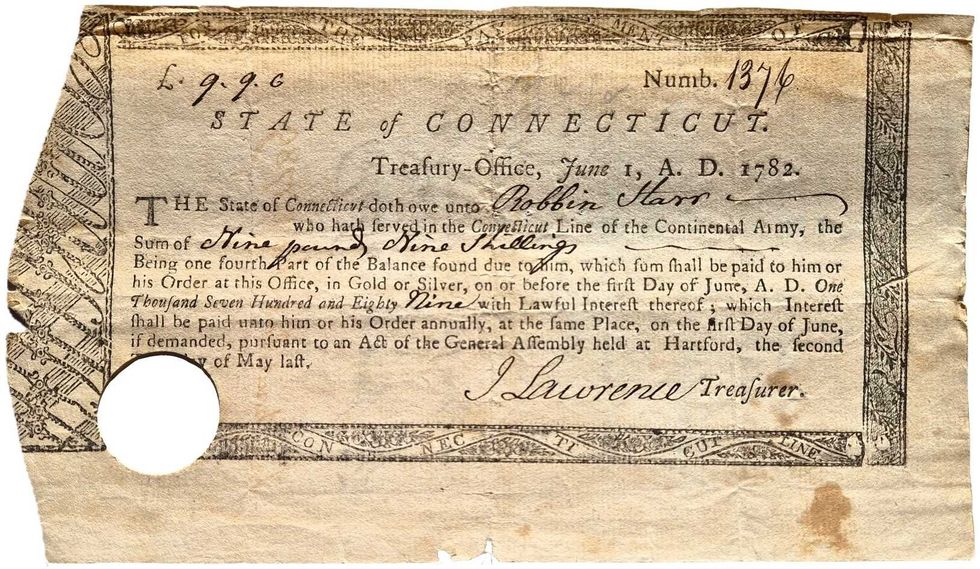 Pay Bill for Robin Starr’s service in the Continental Army.Courtesy the Alex Breanne Corporation
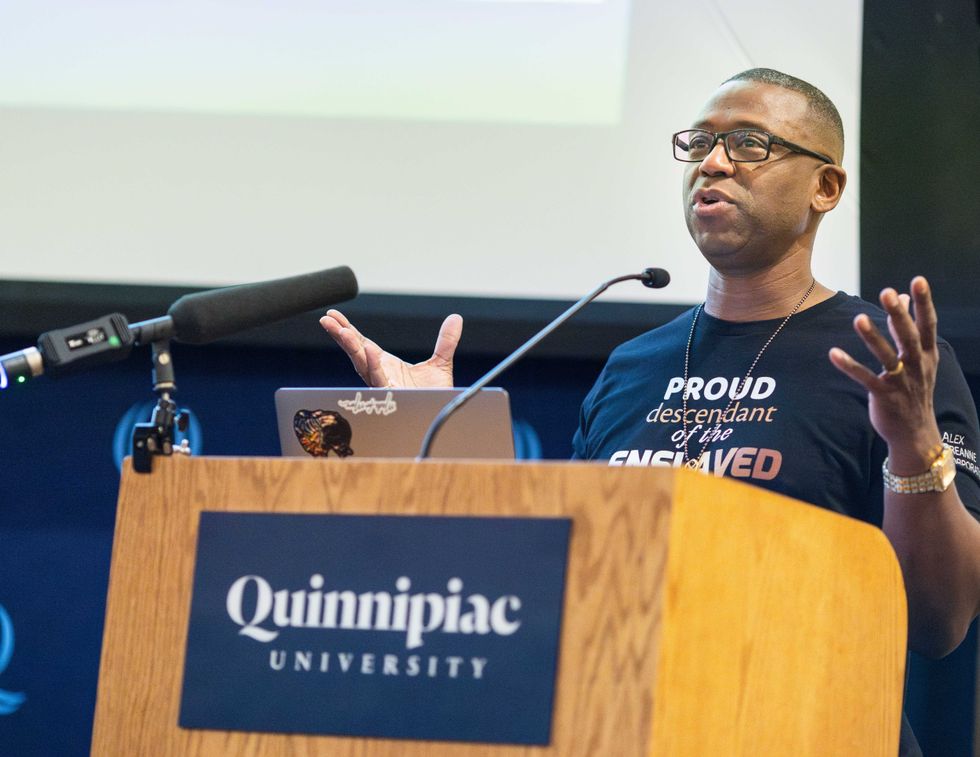 John Mills speaking at Quinnipiac University.Courtesy the Alex Breanne Corporation
 Stephanie Saetta,with her rescue dog George and Blue (left), a shepherd mix awaiting his forever home.Madi Long
 Blue, a 7 year-old Shepard mix, is waiting for his forever home. Madi Long