WINSTED — State Sen. Andrew Roraback (R-30) told selectmen last week that they may be making a grave mistake by underfunding the town’s school system.Roraback had been invited to attend a special Board of Selectmen’s meeting at Town Hall on Wednesday, May 11, to discuss issues surrounding Winsted’s proposed 2011-12 school district budget. State Rep. John Rigby (R-63) was also invited but could not attend.The proposed $30.7 million budget, which is going to referendum on Saturday, May 28, includes $18.6 million for the school district.The proposed amount is below the town’s most recent minimum budget requirement (MBR) of $20,049,466, an amount estimated by the state in late April.If the budget is passed, members of the school board say, the school district will have a funding shortfall of $1,361,094 below the MBR. “The philosophical grounding behind the MBR is that when the state is a partner of funding education, there are strings attached to it,” Roraback said. “The philosophical opinion is that when we provide you with some of those funds, we don’t want you [the town] to reduce the amount of money you spend on our nickel.”Roraback told the selectmen that he understands why the town wants the MBR to be reduced.“But the MBR says it doesn’t matter how [the town] is able to save or whether you are able find ways to save that it doesn’t impact instruction, you still have to spend the same amount of money this year that you did last year,” he said.Roraback said that, as of May 11, the state has not passed MBR legislation for fiscal 2011-12.However, he added the state passing MBR legislation is inevitable.“If the state capitol burns down and if the Legislature does not go back to work this year, starting on July 1 there will not be an MBR,” Roraback said. “But the last time I checked, the fire sprinklers were working and the [capitol building] is made out of granite. So, a fire will not happen anytime soon.”Roraback told the selectmen that he asked other representatives in the General Assembly if there were any circumstances where a town was given relief from an MBR.“They all said no,” Roraback said. “Then I asked if they were given relief if a town closes a school. The people in the know said it is likely that a Legislature would recognize a school closing if it has a material impact on a district’s financial picture.”At a meeting on April 29, the Board of Education voted against closing one of the three school building’s in the district for the upcoming school year.Roraback added that if a town has a special situation with the MBR that calls for attention, more than likely the state’s commissioner of education would investigate it, and not the state’s General Assembly.“The thinking in the Legislature is that we are not equipped to undertake the evaluation necessary to come to a thoughtful conclusion to what changes to an MBR should be permitted,” Roraback said. “We [the representatives] will do whatever the Board of Selectmen asks us to do. If they are not united, then it will be hard for us. The first question [other representatives] will ask is if the Board of Selectmen are united. If the answer is no, then it makes a steep hill even steeper.”After Roraback spoke, Selectman Ken Fracasso, who supports the proposed budget, handed out to his fellow selectmen a report titled “Amending Winchester’s MBR Is Fair, Reasonable and Has Nothing To Do With Politics.”While he presented the report to the selectmen, he did not give copies to the audience. Fracasso did read through portions of the report to the audience.“The previous MBR reflected a school system that had 20 percent more students than we will have in 2011-12,” Fracasso said. “At some point in time we have to draw a line. Do we keep the MBR at $20 million when we have less students? We have experienced a dramatic decline in enrollment for the past three years. At what point do we keep funding at a level this high when student enrollment is declining?”In his report, Fracasso states that the district’s student enrollment will go down from 955 this school year to 669 during the 2011-12 school year.A reason cited for the declining enrollment is due to the seventh and eighth grades’ move to the town’s semi-private school The Gilbert School.“Our school buildings have the capacity for 2,436 students,” Fracasso said. “Through this [move], we should have closed at least one of the school buildings. We have three times the capacity that we need to teach the students that are left over.”Fracasso said that the $18,600,000 in the proposed budget for the school district is “right on target.”“Any future MBR should reflect the long-term changes we have made in town,” he said. “The MBR should not penalize us for recent changes made in this town through the efficiencies we have tried to expedite. The state is looking at a $3 billion deficit and I think they would embrace some of the things we have done in this town in order to save money. In no way do I think that this is detrimental to the education of these students. I think the real problem is on the Board of Education side, but that’s a topic for another day.”Following Fracasso’s report, Selectman Glenn Albanesius, who also supports the proposed budget, complained about criticism residents made earlier in the meeting.“A comment was made to us that we don’t have children in the school system,” Albanesius said. “I had three kids who went through the district and they all worked hard and met the challenges. This is an economic decision. Nothing more, nothing less. If you choose of your own volition to say that we are being mean to children and we don’t care, I think you are extremely off base.”Albanesius cited the town’s financial state as one of the reasons he supports the proposed budget.“This town is a couple hundred thousand dollars away from going out of business, and that’s reality,” he said. “This town is almost bankrupt. The fact of the matter is that we have to make decisions to keep the town afloat. This is crunch time for you and me and everyone sitting here. We didn’t make these decisions because we’re angry at the Board of Education. That gets floated around and it makes me angrier than you have any idea.”Selectman Lisa Smith said she supported what Albanesius and Fracasso said.“We need an MBR that reflects the changes that we have made,” Smith said. “In this district we have to look for efficiencies that other districts have been implementing. I know Region 7 passed their budget for $18.2 million for the same amount of students we have.”Mayor Candy Perez, who previously voted against the proposed budget, blamed unfunded federal and state mandates for increased costs to the school district.“It seems that every year that we have more No Child Left Behind expenses,” Perez said. “Now we are dealing with Race to the Top legislation that has come to the state. Training has started [for the programs] and it has cost a lot of time and personnel time. Even though our enrollment has dropped, a lot of people do not see what has happened internally. If I went to my father and I told him that we spent $3,000 for a speaker to help with bullying, his generation would say to me that we are crazy.”Selectman Karen Beadle agreed with Perez that unfunded mandates are a budgetary problem.“The in-school suspension program has cost a lot of time and additional costs for teachers,” Beadle said. “To place the burden on towns to come up with the MBR and to steer where the funding will go by mandate is wrong. You are taking the power away from the school district and town [with the MBR] and force us to fund it and that’s also wrong. Maybe the MBR would be okay if we didn’t have to deal with other mandates.”
Latest News

Jane Herold’s beautifully simple dinnerware.
Cornwall ceramicist Jane Herold explained that there’s quite a lot of enthusiasm for Clay Way among the region’s ceramic artists.
“We all need work space, which is hard to find or afford in urban areas. The wood-fire crowd needs lots of wood and outdoor space. This area is great because it’s rural enough for us, but has a wonderfully enthusiastic and supportive population of pottery [patrons].”
While many of the artists are returning from previous years, the loose collection of unofficial organizers likes to keep the event manageable for the public, limiting the number of artists and studios each year. A direct drive from the southernmost point at Ann Heywood’s studio in Wingdale to Herold’s big barn in Cornwall is under 40 minutes. But if you want to catch it all, plan for a full day’s worth of art exploration along some of the most beautiful roads in New England.
Starting at its northernmost point, Herold’s studio will host Matin Malikzada of Afghanistan, whose polished, modern interpretations of traditional forms are instantly recognizable. They’ll be joined by wood-fired ceramicists Steve Johnson, with his raw, organic forms, and Harry Levenstein, whose works relate closely to Johnson’s while making even more direct references to nature.
Herold herself creates work that is both beautiful and utilitarian. Her prolific output of objects is intended to be used by everyday people as part of their daily lives.
Moving south is Todd Piker of Cornwall Bridge Pottery. Piker has been making pots in his giant wood-fired kiln since 1971. The kiln looks more like an ancient blast furnace than something designed to transform clay into ceramics, but over the years, he’s mastered its intricacies and produces an impressive amount of fine work.
 A ceramic vase by Kathleen Heidemann.Provided
Piker will host Sanah Peterson, who works at Cornwall Bridge Pottery and draws inspiration from both her time with Piker and her time traveling the globe as a child. They’ll be joined by Stephanie Haines, whose vibrant, eye-catching work features underglaze illustrations of birds, fruit and the bounty of nature.
Further along in Warren, Jessica Dubin’s pieces will be on display at the studio of Christine Owen. Both artists seem to appreciate the chaos and unpredictable nature of clay but find ways to refine it all using their own unique methods.
Heading east to Washington, Conn., Will Talbot’s creates intricate work while allowing for the unpredictable nature of clay to play a role. His studio will house Tom Knox and his wide variety of textures and forms, as well as New York City-based Alex Lebedev, who lets music and the nature of improvisation guide his work.
There will be two studios participating in South Kent. Alison Palmner, whose page on the Clay Way website states she “strives to achieve a lighthearted meld of human forms, animals and the vessel.” Her studio will host Ben Eberle, who trained under the guidance of legendary potter Toshiko Takaezu; James Guggina, whose intricate work can appear both deliberate and whimsical; and Paula Shalan, who blends rough, unrefined surfaces with polished precision in individual pieces.
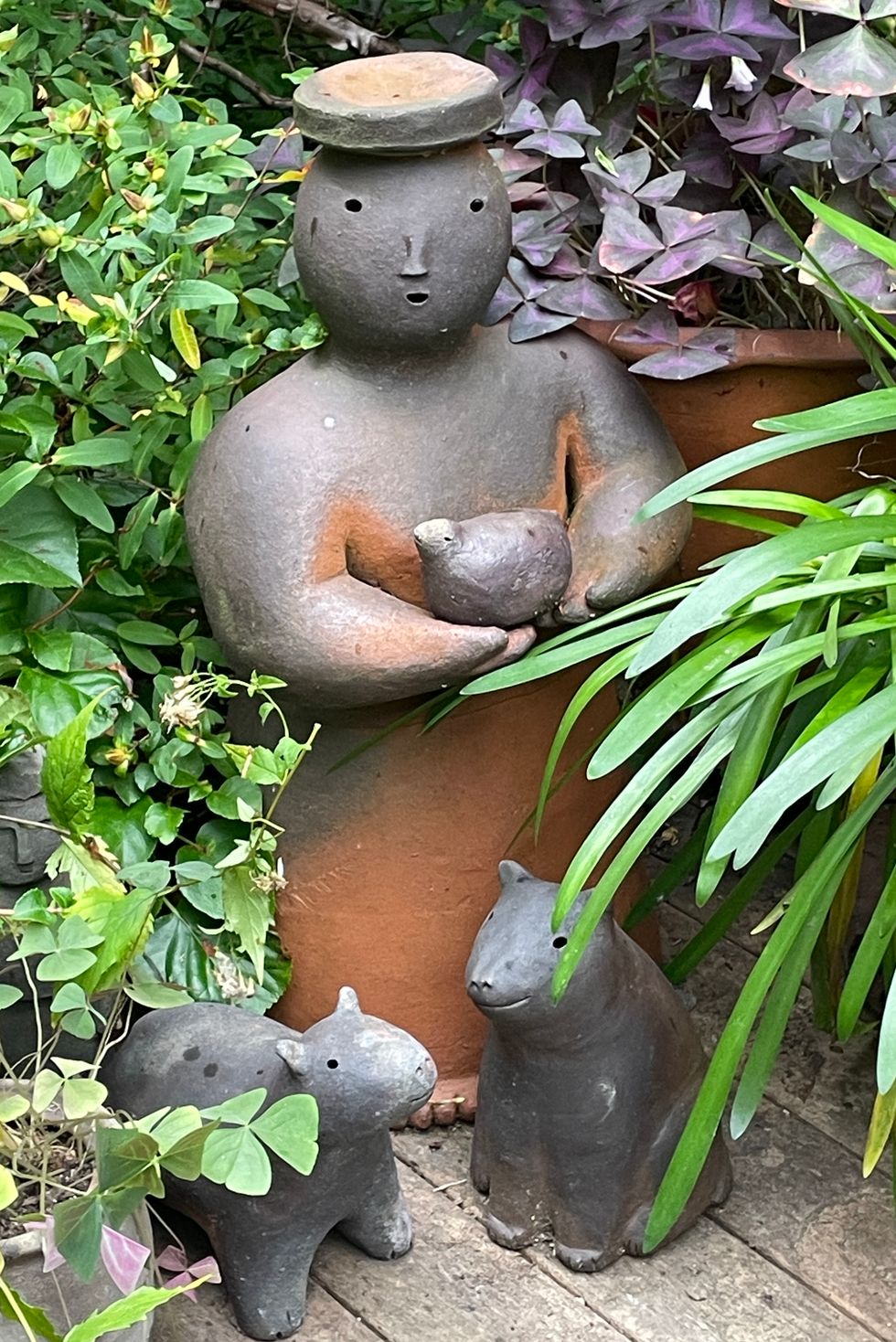 Joy Brown’s delightful ceramic sculptures.Provided
Nearby is Joy Brown, whose work have become a staple of the area, with her figurative sculptures dotting the Northwest Corner. Brown’s studio will also feature Bonnie Levine, who taps into the beauty of chaos and destruction in her work, and Brendan Moore, whose more utilitarian forms are perfect for everyday use.
Finally, the tour crosses the border into Wingdale, New York, where the studios of Drew Montgomery, Ann Heywood and Amy Brenner will host Jackie Sedlock, Lynn Behrendt,and Kathleen Heidemann.
Brenner creates some of the most colorful and vibrant pieces on the tour, while Behrendt’s work is among the most studied and precise. Heywood creates carefully considered, intuitive forms, while Heidemann moves from simple minimalism to intricate textures. Montgomery and Sedlock both find new ways of playing with traditional forms, producing delightfully distinctive pieces.
To learn more about the artists and download a map of participating studios, visit clayway.net
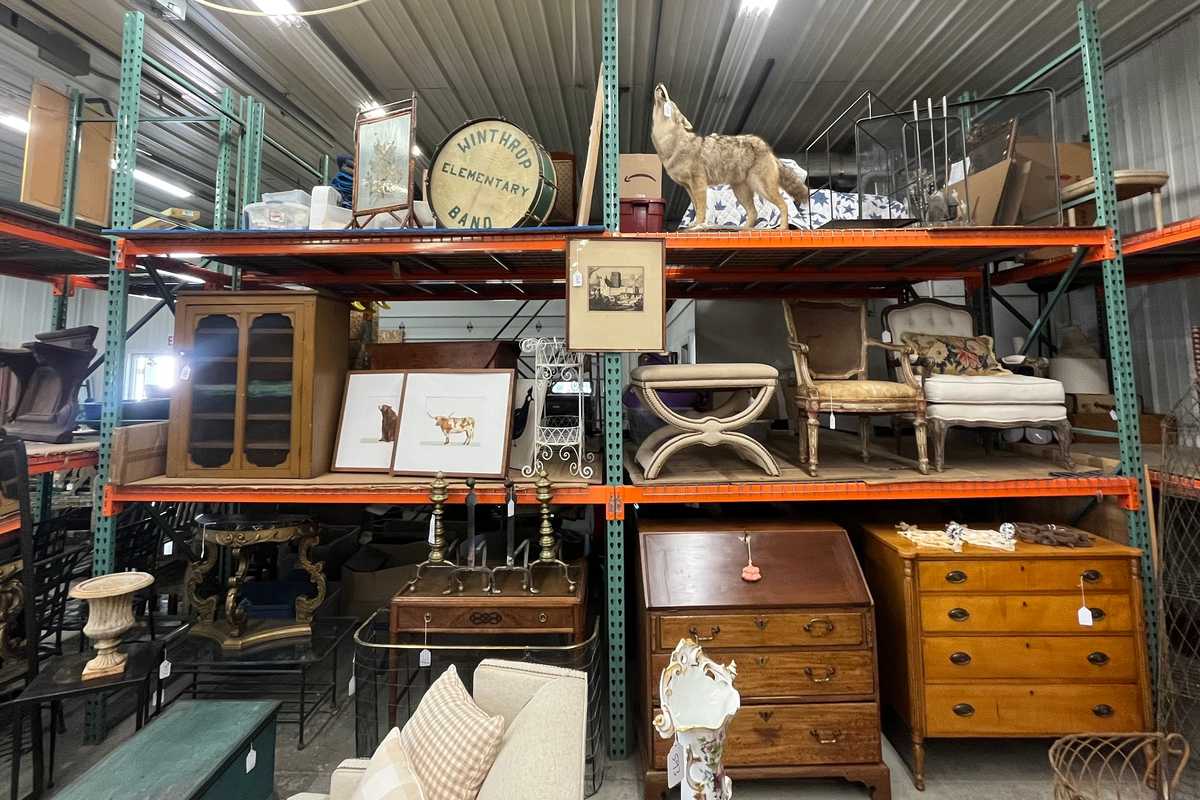
Matteo works as the ever-enthusiastic auctioneer, and he puts on a real show. In just a few hours, he presents and sells hundreds of items, from antique furniture and rugs to art and decorative items, even taxidermy, jewelry and other odds and ends you probably wouldn’t expect. Community is part of the show, with Matteo joking around with regulars. Attendees congratulate each other on their purchases, and even educate each other about the items as matteo keeps the momentum going. If items aren’t moving, Matteo will remind the room that he’s got alimony to pay, and it’s up to everybody in the room to help him raise the funds.
For the past 15 years, this has all happened in that highly visible building at the main intersection in North Canaan. Now, Mattea, Kolbacher and their Stateline Auctions crew have moved off the beaten path. For some frugal bidders, this might seem like a good thing. After all, the fewer people who know about the auction, the fewer people they have to bid against when their lots come up.
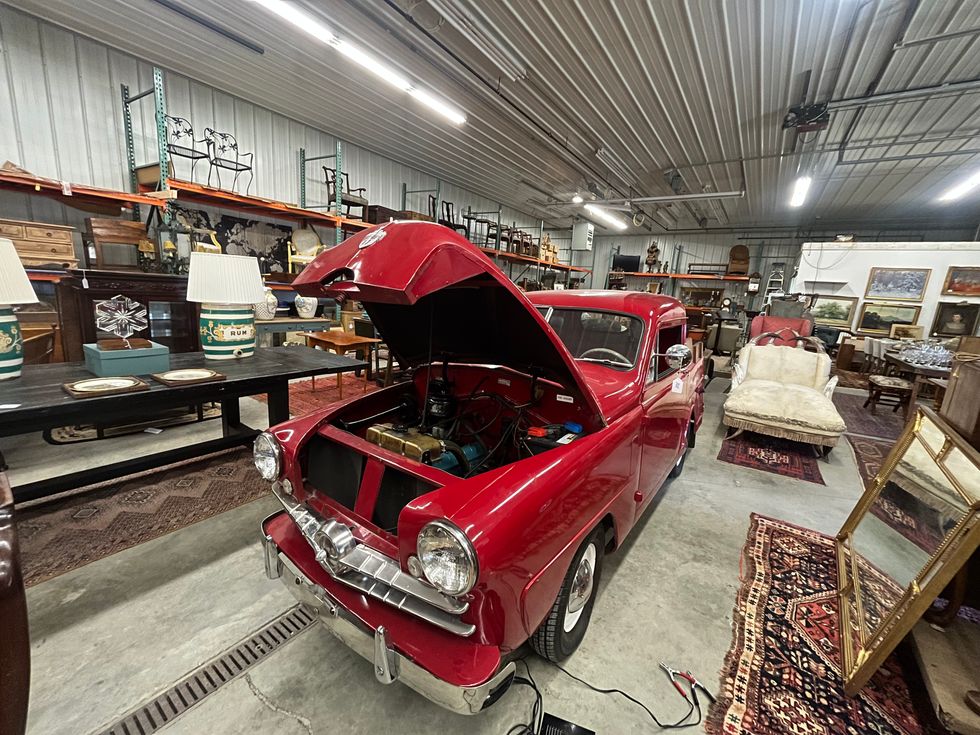 Hundreds of items at Stateline Auctions, including a candy-apple-red Crosley pickup truck.D.H. Callahan
Unfortunately for those who consistently show up, the competition these days is less in the room and more online. Stateline has been running simultaneous auctions through the real-time auction website and app LiveAuctioneers.com, where the entire event is streamed live. Throughout the eight-hour event, the online viewership rarely, if ever, dips below 600 individual users. This technological development creates more potential buyers for Stateline and also allows busy bidders to keep an eye on their lots while out and about.
The new space, still in North Canaan, just barely south of the Massachusetts border, is a sizable warehouse packed to the ceiling with precious finds. It’s bigger, brighter and has ample parking.
The auction on Oct. 11 featured all kinds of lots, including three cars. A candy-apple-red Crosley pickup truck grabbed every eye in the room and even more attention online. Amid all the enthusiasm, it was heartwarming to witness the entire audience erupt in applause as young bidder Molly Seitz burst into tears after winning the truck. The beautiful vintage vehicle had belonged to her grandfather, who had given her driving lessons in it before he died.
Between resellers, collectors and the casually curious, the performance that is a Sunday at Stateline Auctions is a delightful way to breathe new life into old items. There’s rarely a set date for the next auction, but it generally takes about six weeks before they’re ready with their next round of goods. This time, Matteo predicts a sale after Thanksgiving, but if you want to be safe, follow their auction on liveauctioneers.com.

Want more of our stories on Google? Click here to make us a Preferred Source.