Rudy Vavra, Lily Al-Nemri, and the gallery you didn’t know you needed

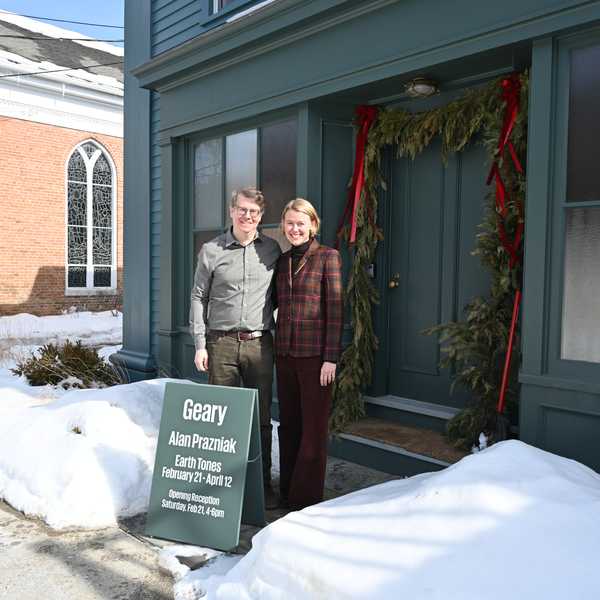
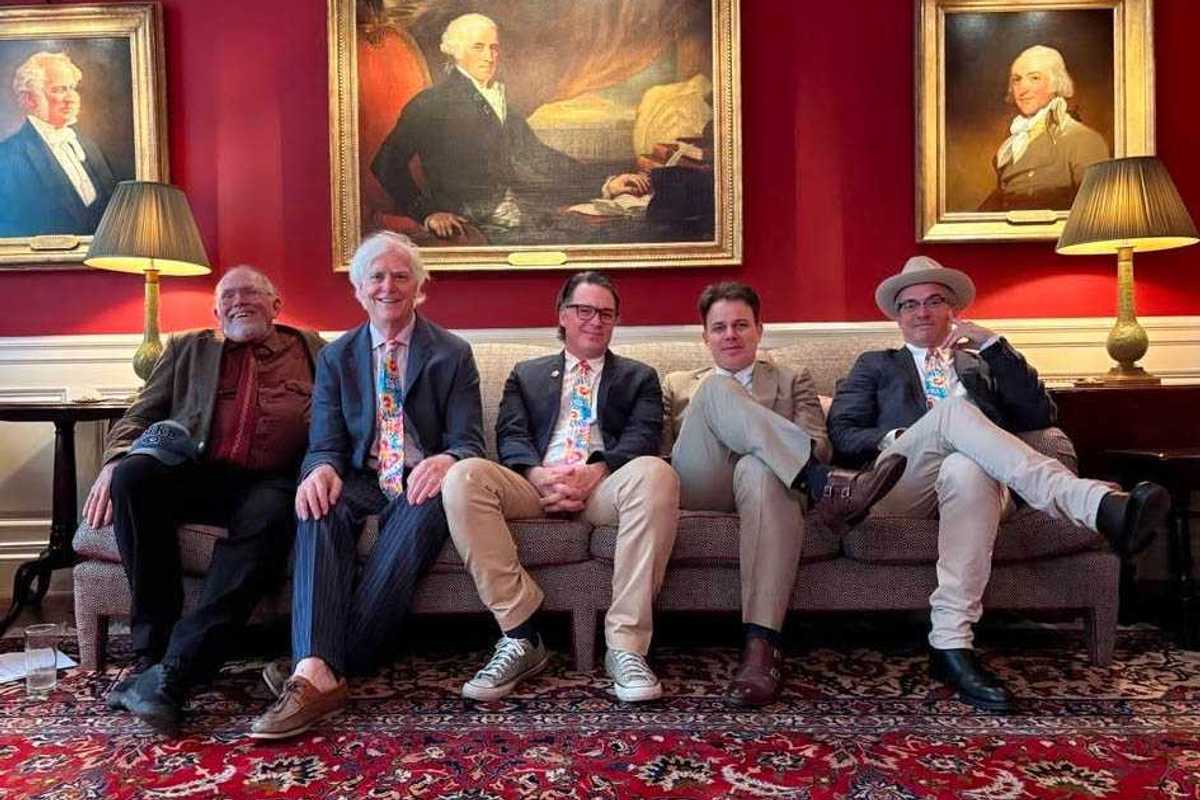
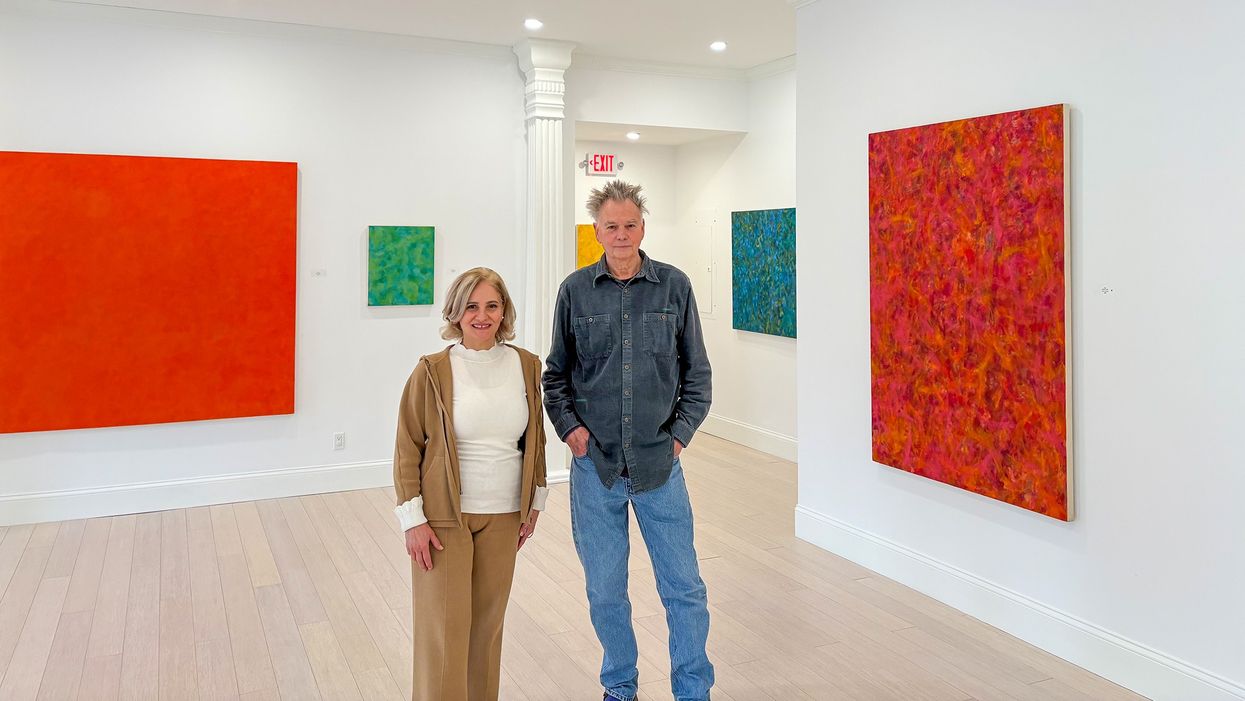
Lily Al-Nemri, founder and owner, and artistic director and painter Rudy Vavra at Tyte medispa and gallery in Millbrook.
Natalia Zukerman

Lily Al-Nemri, founder and owner, and artistic director and painter Rudy Vavra at Tyte medispa and gallery in Millbrook.
The painter Rudy Vavra once created floor collages in Texas. You could, in theory, lie on them. Now, years later and much farther north, his work graces the walls of a medispa in Millbrook, New York where he also serves as the artistic director. You can still lie down, just not on the art. Instead, you might be undergoing an EmFace non-surgical facelift while surrounded by twenty-two of Vavra’s paintings.
The space, Tyte Medispa in Millbrook, is equal parts gallery and treatment center, the brainchild of Lily Al-Nemri, a medical aesthetician and now gallery owner. She also owns the nail salon, Bryte, down the street on Franklin Avenue. A few years ago, feeling she was outgrowing that space, she looked to expand and, just a few blocks away, found this rather sprawling maze of rooms with the gallery that now inhabits the grand central ballroom. “This used to be a gym,” she said. “It was way more than I was looking for, but I went for it.”
Vavra, a self-professed “painter’s painter,” has spent decades layering pigment in his barn-turned-studio in Milan, New York. “I find paintings as much as I make them,” he mused. “Some happen quickly, others are slow.” Of this latest collection, he said, “Some people call them busy. I think they’re slow.” His marks accumulate with a kind of devotional persistence, like petals left at a shrine. “A while ago, I saw a photographic image of a shrine,” Vavra said. “I don’t know if it was a Buddhist shrine or what, but there were colors on the ground all around it, and I realized they were the stains of flowers left in the worship. That’s very similar to the way I paint.”
The collection of paintings on view at Tyte — some as large as a shrine — are meditations on color, inviting the viewer to slow down. Or speed up. Whether viewers are activated or soothed by the images is neither Vavra’s intention nor within his control. Still, he said that watching people interact with the work has been a real treat. “Now that I have my paintings here, I get to see them all together,” he said. “It’s only when they’re all together that I see how they talk to each other. It’s interesting to see people come in and go to have a treatment and come out. It’s a very interesting connection.”
And what is the connection? What could be a disjointed pairing — aesthetics and aesthetic medicine — has become, improbably, a perfectly logical continuum. “They’re related in a sense,” Vavra said.
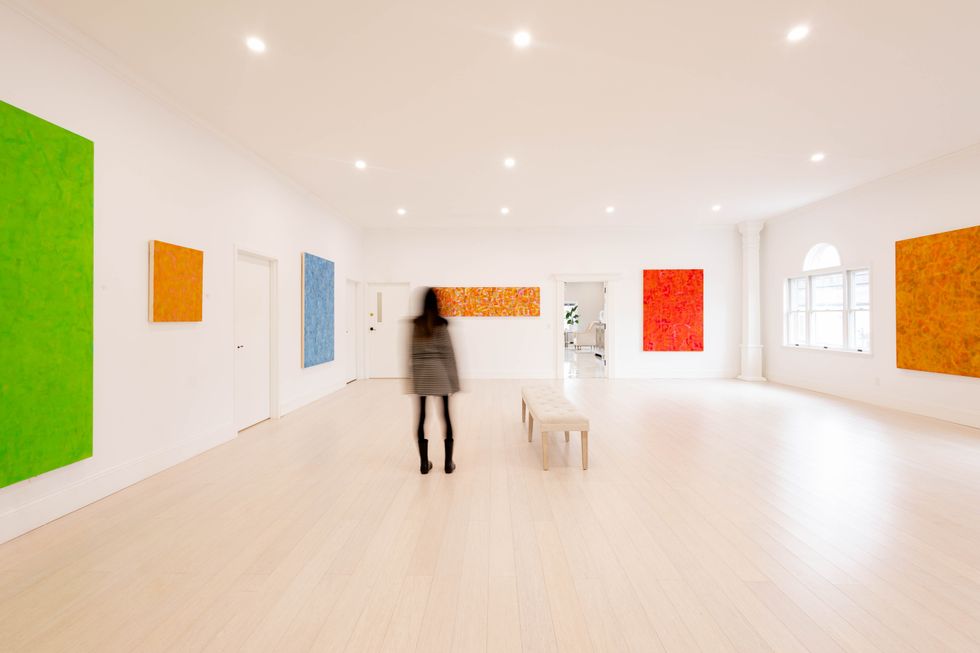
Al-Nemri, a former radiologist who taught for over a decade at Westchester Community College, is no stranger to layering, precision, or the quiet rigor of care. Her incredible menu of services — Botox, body contouring, pelvic floor therapies — are the cutting edge of the industry. Of Vavra, Al-Nemri said, “I fell in love with his work, and we just hit it off.” It’s a kind of kismet that seems to hover over the place. Pilates mat classes take place twice a week in the main gallery space and both Al-Nemri and Vavra have loved watching clients pause, eyes caught by a stripe of cerulean or a vibrating cluster of brushstrokes. “Something will catch their eye,” said Vavra. “They’re looking for something in it.”
So, this gallery-meets-spa (or is it the other way around?) has plans. Vavra will be curating six shows a year. Laurie Adams’s photographs will be hung in June, a group show of local artists will share the space in July and August, and a Fall show will feature twenty women artists, which Vavra is eager to anchor with a piece by Judy Pfaff. “There’s nothing like this on this side of the county,” he said of the light drenched space. “It’s been a bit sleepier here. We want to wake it up.”
He means it kindly; sleep certainly has its place. But here in Millbrook, amid the low drone of machines designed to rejuvenate, something unexpected has emerged. Perhaps that’s what both Al-Nemri and Vavra are really after — not the quick fix or the final image, but the suspended moment, the long look. A face seen anew. A painting revealed slowly, in silence.
As for Vavra’s curatorial process? “I just unpack the paintings, lean them against the wall, and look,” he said. “Eighty percent of the time, they’re already where they’re supposed to be.”

The Community Closet at HVRHS is open for students to take clothes for any reason during the school day.
What started with one unexpected donation of clothes has grown into a quietly impactful resource for all students at HVRHS: the Community Closet. Now located in a spacious area above the cafeteria, the closet offers free clothing to any student for any reason.
The idea began a few years ago when a community member reached out to the former superintendent wondering if anyone at the school could benefit from used clothing that would otherwise go to waste. The superintendent then got in contact with Rachel Novak, the school social worker. “Once I had all those bags of clothes in my room, I was like, ‘I should put this in a space,’” Novak said. Her simple idea eventually became a full-sized closet accessible to all students.
From the beginning, Novak envisioned the closet as an inclusive space. “It’s open to anybody, it’s not just based on economic needs,” she said. Sustainability also plays a role. “Thinking about the environment, some students like to thrift and just get clothes that way,” Novak said.
After the initial donation, contributions continued to grow. “I reached out to our staff members and faculty,” Novak said. The most consistent donations come from the faculty at HVRHS and a few community members who learned about the closet. Finding teenage-appropriate clothes has been a challenge. “I get a lot of donations that are nice, but I don’t think teenagers would want to wear them,” Novak said.
Another ongoing obstacle has been awareness. Many students don’t know the closet exists at all. “That’s been the hard part,” Novak said. “Getting it out to the wider community of the school.” Novak is looking for students and staff to spread the word. “It helps because our school nurse knows and other faculty members,” she said. “When they know a student needs something, they just bring them up.”
Looking ahead, she hopes to promote the space more actively. “When we come back from this break, I do plan to … get fliers and all that up and going,” Novak said. There may even be an upcoming expansion — she has discussed the possibility of turning part of the area into a food pantry. “That would be more of a need-based system for students,” she said. “But right now, promoting it is where I’m at.”
The Community Closet is well-stocked currently. “Just because of the amount of clothes I have, I’m not accepting any more donations until I clear some stuff out,” Novak said. She is still willing to make room for more fashionable, teen-friendly items donated by students. “That way I’ll have more teenager approved clothes.”
Above all, she wants students to know that no one is limited to using the space. “Sometimes there’s a stigma around it … like, ‘I don’t need help. I don’t want to take away from anybody else that may need it,’” Novak said. Due to the amount of clothes, students should feel welcome to use the closet for any reason. Some students even grab items last minute for sports and activities. “It’s important for kids to know it’s for everyone.”
Whether a student wants to thrift clothes sustainably, forgot to pack clothes for an after-school practice, or is in need of a new outfit, the Community Closet is a resource for all.
Sophomore Eliana Lang enjoys her Housy Shack cookie.
Now in its second year, the Housy Shack is a hit among students. The special education department-run store that sells warm cookies, drinks and other snacks to students and teachers draws people to a room in the back hallway every time it’s open.
The smell of warm cookies welcomes visitors to the store with snacks, drinks and even Housy merchandise for sale. The cookies are definitely the favorite, sometimes lines go out the door to get one before they sell out.
The cookies are so popular that the store had to increase prices from 50 cents to a dollar and implement a four cookie per person maximum. The Shack sells about 40-100 cookies per day and has about 20-60 HVRHS customers visiting per day.
Julie Browning and Heather Strid, two of the HVRHS faculty members that help run the Shack, said their goal was to create real-world job experiences as well as real-world shopping experiences for students at HVRHS. “Learning the skills to work in the world can be taught in a classroom, but the lessons are more meaningful and valuable when they are applied in real work situations, which is what we create through the school store,” Browning said.
The original purpose for the store seems to be working, as several students are learning important skills. Students said the store taught them skills like counting money, checking inventory and cleanliness along with social skills and customer service that could help in the professional world after high school.

As the store quickly became a hit, organizers were faced with the challenge of finding funding. “When we started planning to start the school store two years ago we needed money to buy equipment, supplies and food to start it up but were not sure how to get it,” Browning said. “Mrs. Strid came up with the idea of applying for a grant from the 21st Century Fund to help us get started and they were so generous.” That grant has been crucial to the success and growth of the school store.
Not only does the Housy Shack benefit the special education department, students said it fosters a sense of community throughout the school. “School store cookies are my favorite thing ever. They brighten up my day,” said Eliana Lang, a sophomore at HVRHS. Dayana, one of the student staffers at the Housy Shack, said her favorite part of working in the school store is when students come in to make purchases. She enjoys talking to them and ringing up their orders on the cash register. The Housy Shack brings people together and offers the opportunity for students to connect with each other.
As the school year continues, the members of the school store look forward to expanding their inventory by creating and selling a variety of Housy merchandise — t-shirts, sweatshirts, water bottles, and more. “I have had several students put in requests for certain hats, key chains, etc. … so there will be more of that to come,” Browning said. Last school year, profits were all invested back into the school store. “This year we are hoping to make more of a profit and will look to use the money that we make for field trips, outings as well as opportunities to donate and give back to the community,” Browning said. They also would like to use the school store to fundraise for other causes. “Right now we are collecting donations for The Little Guild Animal Shelter, so if anyone has pet supplies they would like to donate please drop them off in exchange for a cookie,” Browning said.