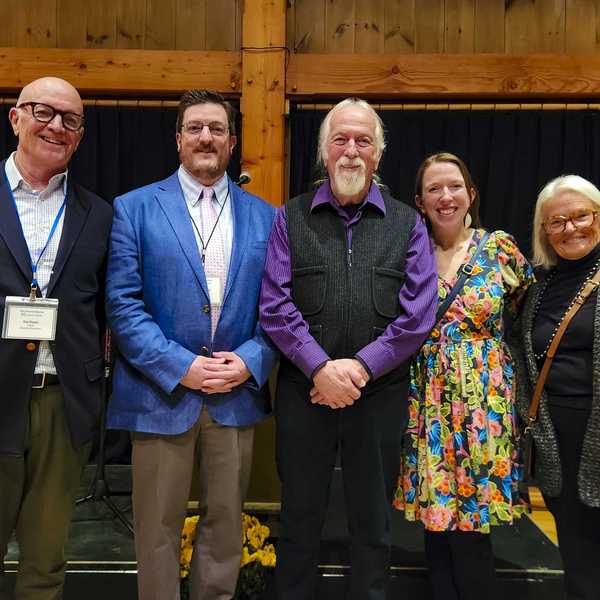
SALISBURY — Peter Vermilyea, a social studies teacher at Housatonic Valley Regional High School and author of “Hidden History of Litchfield County,” started his remarks with a confession.
The history, he said, isn’t really hidden.
“But in our 50-mile-per-hour world, we don’t stop to look at the history all around us.”
Vermilyea was speaking at the Scoville Memorial Library on Saturday, Nov. 15, about the Salisbury Asylum and how Northwest Corner towns provided a social safety net long before the advent of federal programs such as Social Security.
The names of roads is a good starting point for a Northwest Corner historian, Vermilyea said, noting that Torrington recently changed the name of Dump Road to Vista Drive.
Vermilyea grew up in New Milford, where there is a Town Farm Road. Other towns have similarly named roads. Salisbury has Old Asylum Road.
He said he didn’t know what the “town farm” phrase meant until he visited Old Sturbridge Village and observed a re-enacted town meeting on the subject of establishing a town farm, meaning a place for the town’s poor.
Sharing the caring
Vermilyea said that despite the popular image of the early Americans as rugged individualists, there really was a social safety net in the 18th and 19th centuries.
And earlier. In 1673 the Connecticut Colonial Legislature passed its first law concerning the poor, and in 1680 it reported back to the British government that every town was responsible for providing for its poor residents.
The Legislature defined “resident” as someone who had been in a town for three months.
The towns added their own laws — for instance, prohibiting adding people to households without the permission of the rest of the town.
“I think they were not talking about the natural way,” Vermilyea said to laughter. Rather, it was to prevent householders from adding adults or children who might become wards of the town. Records from the town of Canaan refer to voting on admitting 10 families to town.
Idleness was a crime, punishable by a trip to the stocks.
Another law threatened a $70 fine for bringing a pauper into town. “That’s an immense amount of money for the time,” Vermilyea said.
In 1758, one Simon Moore, a transient, was arrested for refusing to leave Salisbury. (Although if the idea was to get Moore to leave, detaining him seems a somewhat Phyrric victory.)
The various laws in the towns, designed to limit the town’s liability, made moving to a new town in Connecticut risky, Vermilyea said. It was more likely that a family would leave the state than move within it.
Caring for the poor caused fiscal problems for the towns. In 1740 both Goshen and Barkhamsted petitioned to be relieved from their ordinary Colonial taxes because of the cost of taking care of the poor.
In the late 18th century, a system arose that replaced direct grants for aid to the poor.
Called “the vendue system,” it was “almost a reverse auction, a pauper auction,” Vermilyea said.
If, for example, the Smith family (two parents and three teenagers) fell on hard times, at the vendue auction bidders competed to put in the lowest bid to take care of the Smiths. The winner of the auction was obligated to provide food, shelter and clothing, for which they were reimbursed at the agreed rate.
The winner was also entitled to the labor of the Smith family.
Vermilyea said the vendue system was not popular. It reminded people of livestock or, worse, slavery.
And as the abolitionist movement grew in the 19th century, vendue became hard to defend.
Which still left the problem of the care of the poor. The solution was the town farm.
The town farm was to be “unseen, forgotten and in theory self-sufficient,” Vermilyea said.
The inhabitants, called “inmates,” would be rewarded by “a feeling of industriousness.”
In 1829, there were 14 paupers in Salisbury, and it cost the town about $1,000 per year to care for them. (Vermilyea noted that, unlike many towns, Salisbury has excellent records on the town farm.)
Salisbury’s town farm
On March 23, 1829, the town farm (or asylum) was established at town meeting. A committee was formed (proving that some things never change) and was charged with finding a location for no more than $5,000.
The committee found 236 acres between Wells Hill and Farnam roads.
The land was leased from Yale University. The lease was for 999 years, to expire in 2828. (This lease was subsequently renegotiated.) The rent was 5 percent of the asylum’s value annually.
The facility featured a “bettering room” for evildoers.
The asylum manager was required to provide comfortable conditions for the aged, the infirm and the destitute, and assumed — often with complete justification — that these people were not long for the world, much less the asylum.
There was a work requirement for the able-bodied.
The rules: The inmates had to keep the house and their persons clean. No alcohol was allowed, nor profane behavior or unexcused absences.
The opposite sexes were required to keep their distance from each other.
Inmates arose at dawn and went to bed at 9 p.m. Breakfast was at 6 a.m. in the summer and 8 a.m. in the winter; lunch was at 12:30 p.m., and dinner at sundown.
There was no smoking in bed allowed. The manager visited every bedroom at night to check on lights and fires. “I’ve chaperoned enough field trips to know what they were really doing,” Vermilyea said.
Violations were punished with solitary confinement, bread and water rations, extra work and corporal punishment.
In 1920, a state inspector came to Salisbury and noted the old farmhouse, with few modern conveniences, no running water or indoor plumbing.
But it was clean and well kept, the inspector wrote.
Who sought asylum
The 1860 census shows 18 residents at the asylum. These were 11 inmates (seven males, four females) and manager Hercules W. Thorpe, his wife, their two children, two employees and a child in the care of the Thorpes.
Vermilyea said the average age of inmates was 64; the average stay 18 months; and death was the most common reason for leaving.
“It was sort of a 19th-century hospice,” he said. There are several examples of a stay only lasting a few days.
There are also records of single women checking in for a few days and leaving with a child, so the asylum served another social function.
By the early 20th century, the problem of the poor in Connecticut was growing. The 1910 census cited Connecticut and New Hampshire as having the highest rates of “pauperism” in the country.
The advent of the railroads and, later, the automobile made the population more mobile, and the poor in a small Litchfield County town were less likely to be from that town.
The “outside poor,” as they were known, did not qualify for the town farms, but nonetheless became a serious drain on towns. Some towns hired them as day laborers.
In 1876, Salisbury spent $1,415 on the town farm and $1,417 on the outside poor. In 1896, the town spent $2,827 on both categories.
And by 1929, the town report mentions the declining need for the town farm. The Salisbury Asylum closed that year.
The town built a new almshouse on Lincoln City Road, where Salisbury Central School is today. The almshouse, managed by Mrs. Edward Stanton, opened in 1929 to four inmates.
The alms house hosted a lot of transients, or “tramps.”
Tramps coming though town got a bed, a couple of meals and a wash, and were on their way.
There were a lot of them. In 1939, records show 172 tramps visiting the almshouse.
And as late as 1951, 211 tramps came through.
By 1952, the town was receiving $20,000 in grant money for the poor. The Board of Selectmen thought the money would be put to better use by sending the inmates to a new county facility.
Between that and the advent of state and federal anti-poverty programs in the mid-1930s, the town farm approach was over in Litchfield County.


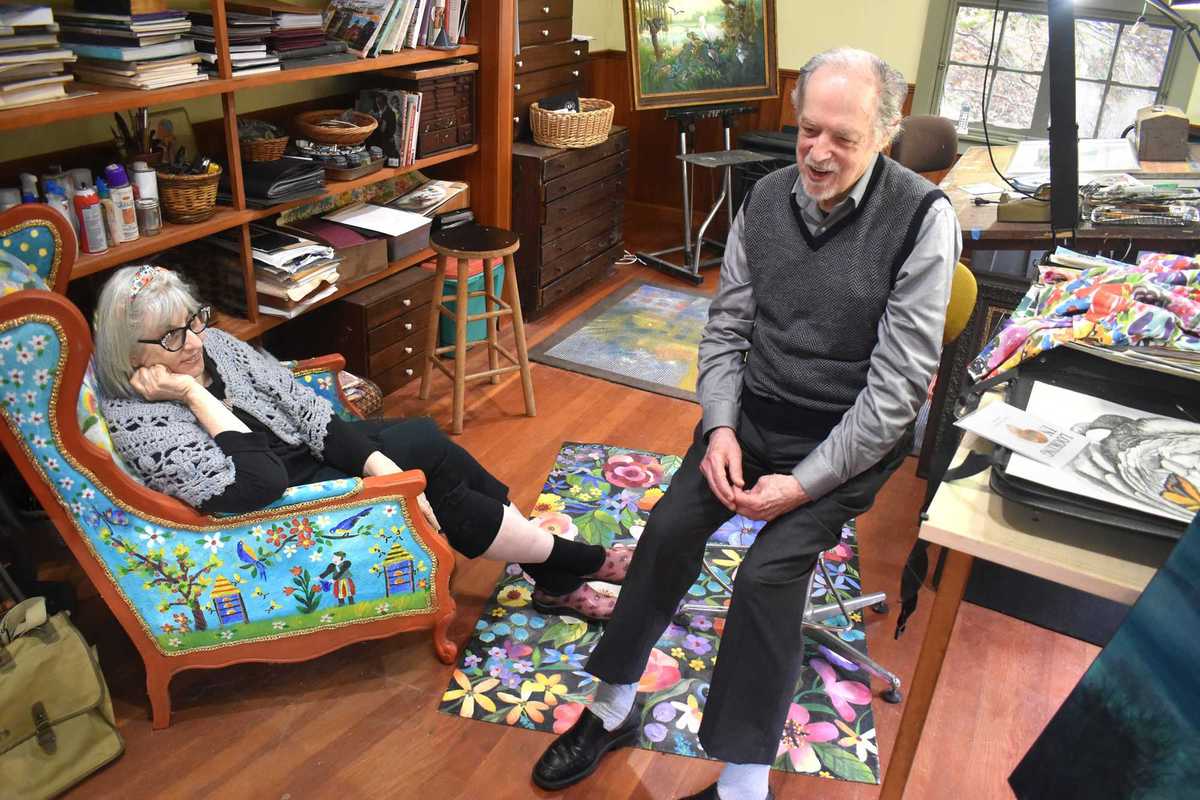
 Justine and Victor Valla in their studio with a painting of Victor’s,”Jonah and the Whale.” Robin Roraback


 A ceramic vase by Kathleen Heidemann.Provided
  Joy Brown’s delightful ceramic sculptures.Provided