Thank you!
Your support is sustaining the future of local news in our communities.

Selectmen move ahead on River Road study and Housing Trust lease

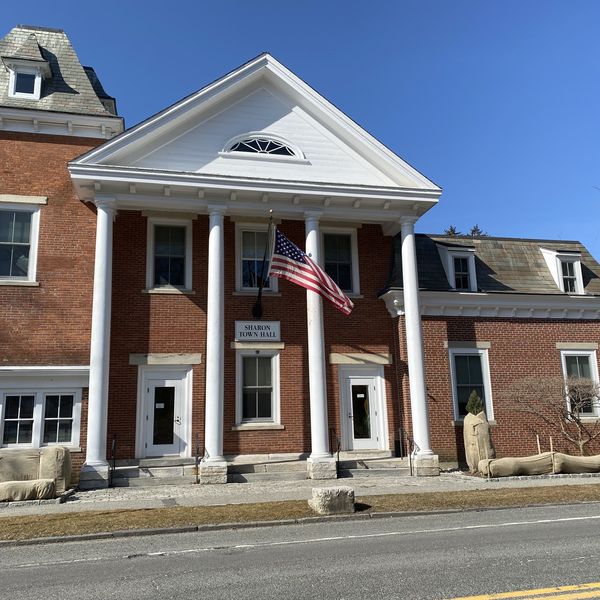
SHARON — Continuing momentum to find a solution for the significant erosion along a stretch of River Road, the Sharon Board of Selectmen discussed the need for a comprehensive engineering assessment at their regular meeting on Tuesday, Jan. 9.

First Selectman Casey Flanagan reported that Cardinal Engineering has performed an initial assessment and recommends the next step of taking field borings to determine the presence of stabilizing ledge beneath the surface. Cardinal estimates that borings on the east side of the road, the Housatonic River side, would cost $21,000 to complete, but they also recommend similar borings on the west side of the road for an additional $7,500.

If the stabilization is to be done on the east side that is eroding away, plans could call for a retaining wall structure, but if underlying ledge can be found on the west side of the road, away from the river, then the road could be shifted a bit to the west. A stumbling block to that plan is that boring work would need to occur on a patch of private property, a vacant lot, where the town has been unable to locate the property owner for access permission.

Flanagan recommended pursuing the study on both sides of the road, expecting that the town will continue efforts to reach the property owner.

An option to lease the Community Center property for one year to the Sharon Housing Trust was approved by the selectmen, who sent the proposed contract on to the Board of Finance for review.

Flanagan explained that the lease option would afford the housing trust a year to develop estimated costs of renovation to the building if it is to be converted into four affordable housing apartments.

Seeking to clarify how the town enters into contracts in general, the Board of Finance has moved to study the process of how contracts are awarded.

Finance board vice-chair Jessica Fowler had created a list of questions inviting responses from the selectmen.

“We want to support you with a better understanding of the town’s contracts,” Fowler said, indicating that the finance board wants clarification on existing town contracts, suggesting a future joint meeting between the Board of Finance and the selectmen to cement that understanding.

Flanagan sought a definition of “large impact” contracts. “Different contracts carry different impacts,” he said, citing a yearly fuel contract as opposed to something like Town Hall upgrades.

“It’s all impactful,” Fowler said, suggesting that the discussion begin with the selectmen’s replies to the list of questions.

“It’s about transparency,” Selectman John Brett said, praising the effort.

“This is sensible,” agreed Selectwoman Lynn Kearcher, who expressed concern that a new process might become cumbersome and create a bottleneck.

Latest News

Benjamin Franklin’s glass armonica comes to the Berkshire Opera Festival

Dennis James plays the glass armonica in Colonial costume.

Dennis James

In the early 1760s, Benjamin Franklin was one of the most popular people in the world. The writer, printer, inventor and electricity pioneer was known throughout the British Colonies in America, as well as in Europe, as a respected intellectual and diplomat. While we know him as one of the Founding Fathers of the United States, he spent almost a third of his life in Europe. Eight of those years were spent in France, working to secure support from the French military during the Revolutionary War. But before that, he spent 18 years in England as a diplomatic representative from the colonies.

It was during that time when Franklin first witnessed a musician play a series of glass bowls by wetting his fingers and drawing them across the bowls’ rims. The sound was haunting and otherworldly — like nothing he, nor anyone else, had ever heard before. But as Franklin was transfixed by the sound, he saw what many great innovators see when witnessing something new: inefficiencies. The musician was moving all over the place, working far too hard to make these angelic sounds. So Franklin went about fixing the problem.

Keep ReadingShow less
More than movies: Jeremy Boviard found his calling at The Moviehouse

Jeremy Boviard, General Manager at the Moviehouse in Millerton.

Annette Stover
There’s something special about sharing a story in a room full of other people.
— Jeremy Boviard

Spend a few minutes talking with Jeremy Boviard about movies and you’re likely to forget what time it is.

Ask about a favorite film and he’ll happily explain the first time he saw it, how it was made and why it matters. One story leads to another. His enthusiasm is infectious. For Boviard, movies are far more than entertainment – they’re one of the best ways people connect.

Keep ReadingShow less
The mycelial web of nature, creativity, science and magic at Berkshire Mushroom Festival

Presenters at the 2025 Berkshire Mushroom Festival.

Daniel Shankin

“Mycelium is Earth’s natural Internet,” says mycologist Paul Stamets. He also calls fungi “the grand recyclers of the planet” and says, “Fungi are the interface organisms between life and death.”

If that sounds like a pretty good argument for paying more attention to what’s happening under your feet, the Berkshire Mushroom Festival is hosting a weekend made for you.

Keep ReadingShow less
google preferred source

Want more of our stories on Google? Click here to make us a Preferred Source.

From grave to stage: “Zombie Prom” lights up the Sharon Playhouse

(From L to R) Jakob Kerr-Lucero (Jake), Charlotte Wise (Candy), Richie Crane (Joey), Brianna Vivace (Coco), and Vivian Burnham (Stage Manager) in rehearsal for Sharon Playhouse’s “Zombie Prom.”

Michael Kevin Baldwin

Jonny is dead. He’s also still dating Toffee. And he has every intention of making it to the prom.

That’s the basic problem at the heart of “Zombie Prom,” the gloriously campy musical comedy coming to the Sharon Playhouse Aug. 21-23.

Keep ReadingShow less
The flood that changed Winsted forever
Jack Lutris presented “Inundated” Connecticut’s Great Flood of 1955 at the American Mural Project in Winsted.
Jack Sheedy

The flood of 1955 was more than a natural disaster for Winsted, Connecticut. It was a defining event that changed the town forever, according to historian Hamish Lutris, who discussed the flood and its aftermath during a presentation Aug. 7 at the American Mural Project.

“For Winsted, this is really the operative event in their post-World War II history,” Lutris said. “Winsted, for better or worse, has never really been the same since that flood. Half of Main Street got kind of wiped out.”

Keep ReadingShow less
google preferred source

Want more of our stories on Google? Click here to make us a Preferred Source.

google preferred source

Want more of our stories on Google? Click here to make us a Preferred Source.