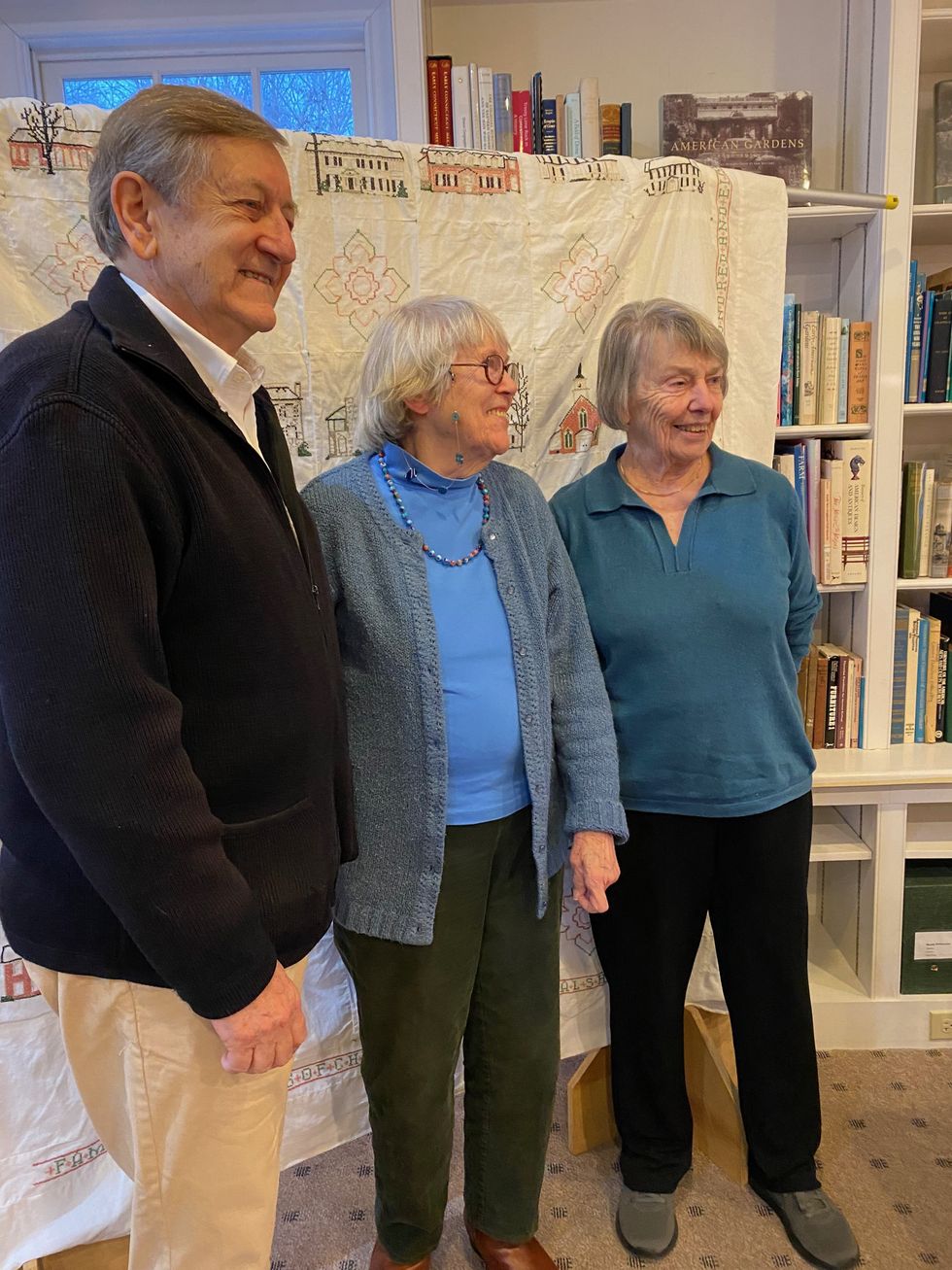
SHARON — Although interviewed one at a time during the “Voices of Sharon” program presented by the Sharon Historical Society on Saturday, Feb. 4, two extraordinary residents shared stories and opinions that intersected when it came to love of the town and the value of volunteerism. Each had offered decades of service and held a firm belief in the town’s bright future. A capacity audience attended the event.
Sharon Historical Society board member and broadcast journalist Brian Ross engaged in conversation with Betsy Hall and Jano Fairservis, asking questions that would coax memories of Sharon and explore how their considerable volunteerism shaped their perspectives. Both had well-developed bits of wisdom to impart, and they did.
The Hall view
Betsy Hall went first. She and her husband, David, moved to Sharon in 1971 and have remained for 50 years. She noted, however, that they did move away twice, but came back.
“I hope the people moving here now will realize how important it is to volunteer,” she said. Having a diversity of residents is always a plus, she added, urging new residents to contribute their time and talent to their town.
At first, Hall recalled that she was reluctant to join the Sharon Ambulance Squad, part of the Sharon Fire Department. Nevertheless, she trained to become an EMT, and served for decades (44 years). “The people you are serving and working with are your family and friends,” she came to realize, finding that there can be 20 to 30 trained people helping at an accident scene.
“First you have to turn off the shock of it all, then you get into the routine. You did not cause the problem you are being called to; you are there to do something about it,” she explained.
“It’s vital for the Sharon Hospital to remain a full-service hospital,” she urged. If the hospital changes its service levels, it will affect the volunteer services throughout the area, Hall said, indicating that the town is growing in population and stressing the need to retain the rural aspect.
“We don’t want a lot of build-up,” Hall said, while acknowledging the current pressing need for affordable housing.
Hall described Sharon as a “place of security. There is freedom and opportunity here that you don’t find in a city,” she added.
“The shopping center is what saved the town Green,” she said, in response to Ross’ question about factors that have preserved the integrity of the green. Hall recalled that at one time, there were stores located around the green, pleased to have seen the advent of the shopping center.
Since the town was founded in 1739, the green has remained essentially the same in appearance, Hall noted, with the bordering homes seeing minimal change.
Ross asked Hall’s biggest worry. “I worry about people losing interest in working together for the town. People don’t know how to talk with one another anymore,” she said, citing a lack of eye contact in communication and reliance on messaging devices.
“There is enough concern and love that it’s going to be OK,” she said of the town’s future.
“I’m very involved and would like to continue. When you are active, it helps you to grow old,” Hall concluded.
Next, Ross interviewed Fairservis.
The view from Fairservis
Beginning by noting that her name is Scottish, Fairservis who is now enjoying life at 95, said that she and her husband, Walter, came to Sharon when he became the head of the Anthropology Department at Vassar. College They had first met at Lakeville’s Camp Sloane as students in the 1940s. She was in her freshman year at Skidmore College. When he was at the camp, Walter was studying archeology.
Her husband was an avid book collector and she was just as avid about her costume collection, Fairservis said. They both worked at the Sharon Playhouse, putting on a production of “Murder in the Cathedral” in 1968. In the 1970s, they put on a Christmas pageant on the town green with all of the local churches participating. There were even live animals, she said, envisioning the memory.
The Sharon Playhouse has been a significant focus for Fairservis from its inception. Speaking of the present day educational program at Sharon Playhouse, Fairservis said, “The value of pretending to be someone else is valuable for young people.”.
Prompted by Ross to comment on her decades living in Sharon, “In many ways, Sharon is much the same,” she said, although she remembers an abundance of lilac bushes planted all around the green.
“The whole aesthetic of the town is so appealing,” she said.
For the interview, Fairservis was seated in front of a quilt that she designed depicting all the homes around the Green. The quilt was stitched by the Episcopal Church Women’s group in 1987. She noted, as had Hall, that the houses around the green have not changed.
Asked by Ross whether the people have changed, Fairservis said, “I don’t know.”
People who volunteer, though, are part of the celebration of community, she said. “It hits you in the heart. It’s fascinating work.”
She and Walter raised “four adorable blonde girls,” in town. Their home had a barn and there were ponies and plenty of room. The home had a feeling of safety, even without door locks.
Ross asked what keeps the town vibrant.
“In our isolation there has not been a sense that we have to grow,” Fairservis said. “There has been stability among farmers and shopkeepers who are not driven by greed. It is important to teach younger generations that the dream of being a millionaire is not the same as having a good life.”
“Contributing whatever energy, talent and good luck you may have should go into making a better world,” Fairservis said.
Prompted by Ross to consider the future, Fairservis said, “I’m hoping that because so many love the beauty and the trees, they will be making contributions to the Audubon, and getting away from fossil fuel and getting a feel for solar power.”
“I’m not a scholar, but I’m enthusiastic about telling the story of the town”, she said, praising the work of the Sharon Historical Society.
“It’s important to care more about the world as a whole,” Fairservis advised.
Brian Ross is a member of the board of The Lakeville Journal Foundation.

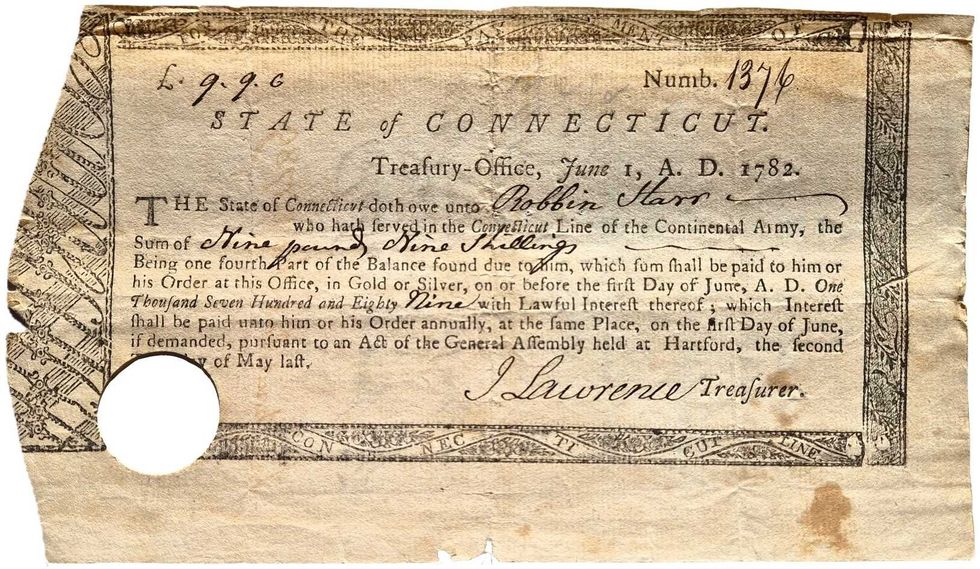 Pay Bill for Robin Starr’s service in the Continental Army.Courtesy the Alex Breanne Corporation
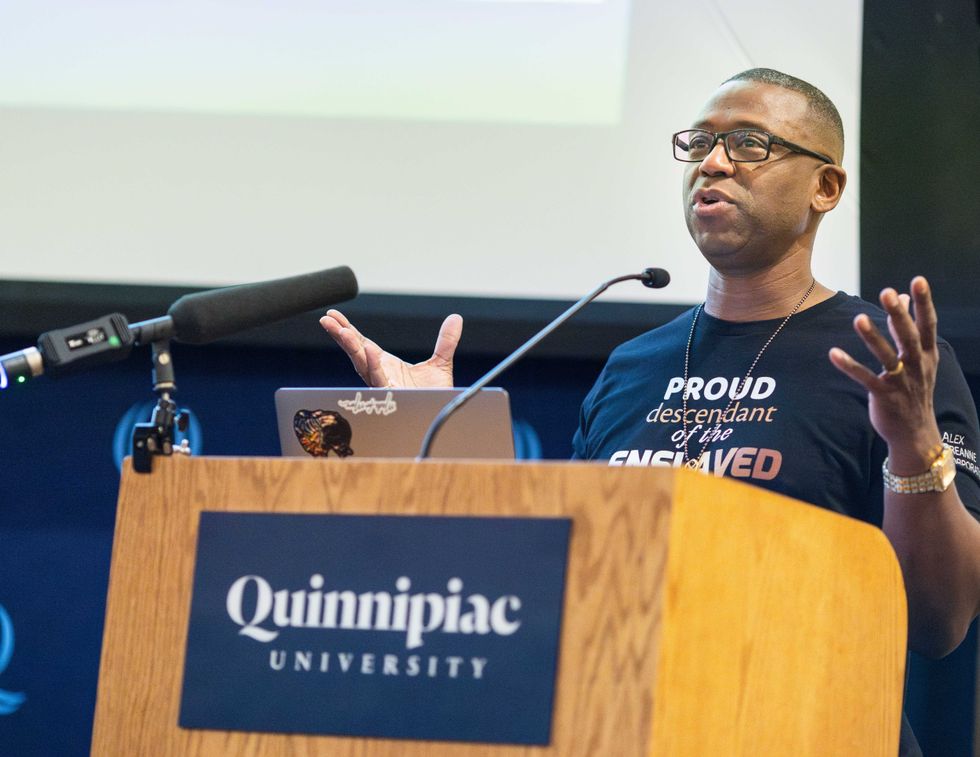 John Mills speaking at Quinnipiac University.Courtesy the Alex Breanne Corporation
 Stephanie Saetta,with her rescue dog George and Blue (left), a shepherd mix awaiting his forever home.Madi Long
 Blue, a 7 year-old Shepard mix, is waiting for his forever home. Madi Long