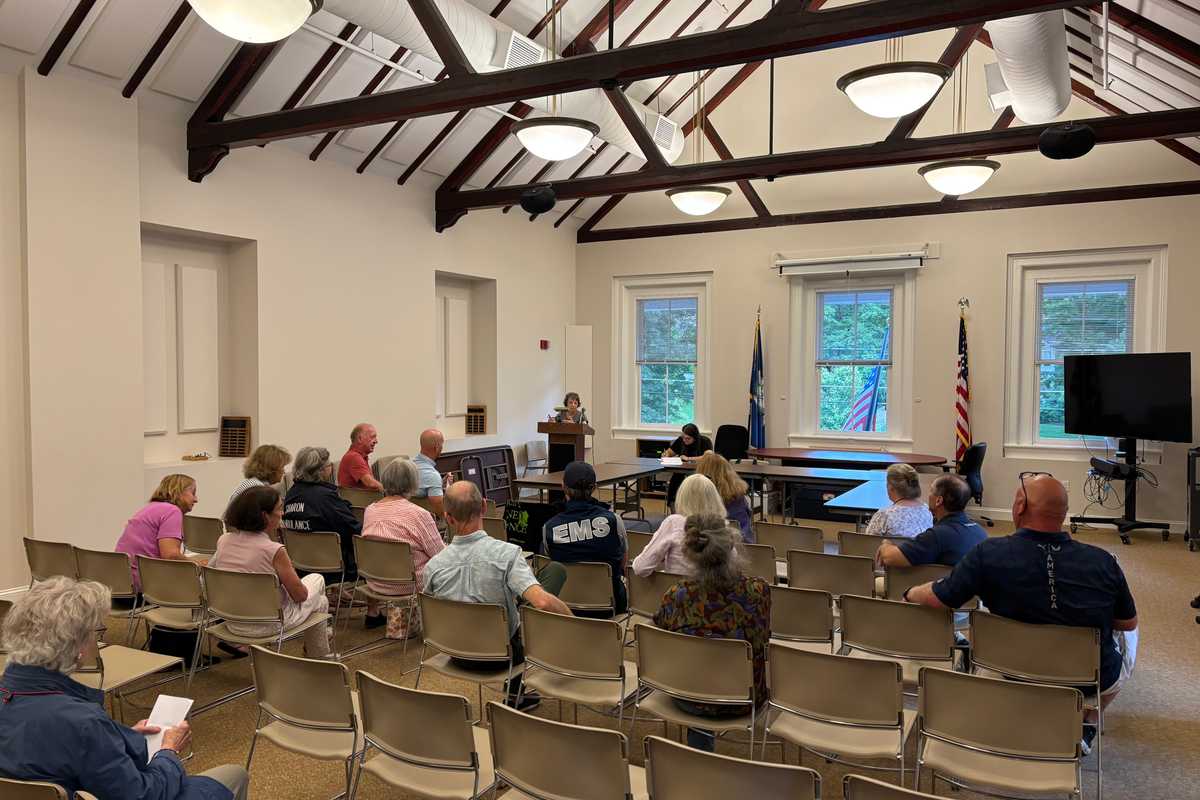
NORTH EAST — Nearly 40 people turned out for a special meeting of the Town Board on Wednesday, Aug. 26, at the town’s highway garage on South Center Street in Millerton. The purpose of the meeting was for Town Engineer Ray Jurkowski to present details of a plan to possibly purchase Dutchess County Diesels and convert it into a new Town Hall and highway garage.
Facts and figures
The total project cost to buy and renovate the 3.89-acre site came in at $3.13 million. (During the presentation Jurkowski said the site was 2.89 acres, an error he realized after the crowd dispersed.) The cost breakdown is as follows:
Purchase price: $1.75 million
New salt and sand shed: $72,000
General interior construction: $550,400
Demolition: $51,000
General exterior construction: $75,000
Electric, communication, generator: $125,000
Heating/AC: $156,400
Plumbing: $58,000
Construction subtotal: $1,087,800
10 percent contingency: $109,000
Soft costs (engineering, inspections and contract administration): $179,000
Total project cost: $3,125,800
Jurkowski told the audience that the Town Board has considered a new highway garage since at least 2003 (and records indicate the search goes back years earlier), and that the $3.13 price tag is more cost effective than other alternatives.
In 2013, a study was done to evaluate the Millerton Elementary School building (also known as the Little School). Jurkowski said last week that he updated the numbers to reflect current costs and inflation, and that constructing a new highway garage at that site would cost the town $2.2 million. Combined with costs to retrofit the building as a Town Hall it would cost closer to $4.2 million, despite the fact that the building could be purchased from the North East (Webutuck) Central School District for $1.
“We’re right now we’re at $3.1 million,” said the engineer. “That’s one of the reasons why the town feels this is a unique opportunity that should be pursued.”
The town would want to bond the project, ideally for 30 years but possibly for 25, depending on what it qualifies for. Jurkowski noted that the town is about to complete debt service for the landfill remediation project, for which $1.2 million was owed. The last payment of $95,000 will be made in October of this year. The town has a $35,000 annual budget line to help with that expense.
Based on the $3.2 million figure, with a 3.8 percent interest loan for 30 years, the annual payment for the project would come in at $156,584. If the town maintains the $35,000 debt service payment the net amount would be $121,584. That would amount to .22 cents per $1,000 of assessed value for homeowners. If one owns property assessed at $150,000, the yearly tax increase would be $33.12; if one owns property assessed at $200,000, the yearly tax increase would be $44.16.
The time crunch
“Ultimately the decision of whether to move forward with this project falls on the shoulders of voters,” said Jurkowski. “We hope to get it on the November ballot so we can get a cross-section of voters of this town. If voters vote it down it won’t be pursued.”
Additionally, if something “unforeseen” occurs with the site the town has the option of not pursuing the deal.
If a referendum is not pursued on the November ballot the town would likely put the issue to vote in a special election. The board, the engineer and Attorney the Town Warren Replansky all agreed doing so would not be advantageous. That’s because it costs thousands of dollars to hold a special election and voter turnout is usually much lower than in general elections.
A laundry list of problems
The problems with the current highway facility are many, said the engineer. The building was built in the 1920s, with an addition built in the 1950s. It’s on roughly one acre of land with a trout stream running adjacent to it. The interior space measures 5,700 square feet — too small for the needs of the highway department, according to Jurkowski.
“Materials and equipment are stored outside. The sand piles for de-icing remain generally uncovered. The water course runs directly adjacent to the property,” he said. “Plows must be removed when trucks are put inside because the doors are not wide enough and the space is too small for the plows and wings. There’s insufficient room for proper equipment maintenance. The height doesn’t allow for [some dump truck bodies to be raised]. There’s no oil/water separator. The floor drains have been filled in. All the water collects and has to be squeegeed outside or workers must work in the mud and water.”
There’s also limited ventilation in the garage, which is problematic when the trucks start up and emit copious amounts of exhaust.
The existing windows are single pane and not energy efficient. The overhead insulation is saturated with diesel soot. The garage is expensive to heat (about 3,000 gallons of fuel was used to heat the facility this year).
The roof leaks. The electrical service is inadequate. There are no showers or eye wash stations for emergencies. The building itself is cracking at the foundation.
Town Hall inadequacies
The Town Hall, meanwhile, consists of two parcels on a half-acre of land total. It was built around 1910 as a residence and was later converted into the municipal building.
“The meeting room itself is very small and has limited space. The offices are shared by multiple departments. There’s no handicap accessibility on the second floor. There’s limited file storage and the floor loads of the original building were not built for [its current use] and there are cracks in the floor joints,” said Jurkowski.
The building at Dutchess County Diesels that would be converted into a Town Hall is presently a garage. It’s 11,858 square feet and has multiple floors. There are two garages on site that would be used by the town: One was built in 2002 and one in the 1960s. The second garage totals 9,440 square feet.
In addition to being fully heated there’s already an oil/water separator on site which will give the town the chance to wash its equipment at the garage — inside — which is key during winter months.
Jurkowski said if the town doesn’t use the nearly 12,000 square feet for its Town Hall that’s OK. It can be used for storage, additional highway needs or even rented out to another municipality or organization. If the town acquires a generator the space could also be used as a warming station in the winter.
The town is also interested in building a salt/sand shed on site. It has proposed a 40-foot by 80-foot building.
Public concerns
Following the presentation the floor was opened up to public comments.
One question came from village Planning Board member Peter Greenough, who asked if Dutchess County Diesels would come off the town’s tax roll.
“As it pertains to Dutchess Diesels, taxes paid are a little over $8,000, so that would be eliminated,” said Jurkowski, adding that the town’s total assessed value is around $550 million. Additionally, about $14,000 in school taxes would be eliminated once Dutchess County Diesels was removed from the tax roll.
Village Trustee Christine Bates asked about interest and construction rates rising.
“Construction costs on a yearly basis, even during the downturn in the economy, see a 5 percent increase annually … and as we continue to delay the process … your construction costs will go up. And the likelihood is that interest rates will go up too,” said Jurkowski.
Planning Board member Chip Barrett asked about a recent highway garage built in Stanfordville. He said he heard it was completed for $1 million.
“Stanfordville was a $2 million project,” said Jurkowski. “We [Morris Associates] were the engineer for that.”
Concerns about water quality, and the proximity of the proposed location near town wellheads, were also raised.
“The Dutchess Diesel site is within the floodplain zones,” said Greenough.
The engineer replied that the Federal Emergency Management Agency (FEMA) will conduct mapping and pay attention to elevations. Any project would also have to be approved by the Department of Environmental Conservation (DEC).
Village Clerk Amber Jordan asked about the soil.
“We’re conducting Phase I environmental studies and looking at past uses, if there are buried tanks, etc., during the review,” said Jurkowski. “The consultant will say they’re either satisfied with Phase I or we may go into Phase II.”
Village Trustee and former town supervisor Dave Sherman asked why the town didn’t complete an environmental review prior to that night’s meeting.
“We needed to be sensitive to the business owner, who has employees,” said Jurkowski. “And he had to make the decision whether he was going to move forward with the sale.”
Dutchess County Diesels owner Gary Funk informed The Millerton News that while in negotiations with the town he’ll continue with “business as normal.”
Questions about what will happen with the current highway garage and any attempts by the town to sell it were asked.
“Obviously the town is going to seek whatever funding is available,” said Jurkowski. “A brownfield, I doubt, will be available.”
He said the DEC will dictate how the town should cleanup the potentially contaminated garage site for sale.
Kristen McClune asked if the new garage would provide sufficient facilities for highway workers.
“There will be adequate space to create administrative offices, showers, a break room,” said Jurkowski. “We believe there is enough space in the garage itself, and in worse case it could [expand] into the existing building.”
Dave MacMillan directed his question to Highway Superintendent Robert Stevens.
“Bob, do you believe there will be enough room there for the guys to be comfortable and to store the equipment?”
“Yes, it will,” replied Stevens.
Village Zoning Board of Appeals (SBA) member DeLora Brooks asked how long the transition could take if the project earns voter approval. Jurkowski said it could take 12 to 18 months, and the highway garage would likely be set up before the Town Hall is moved from its current location at 19 North Maple Ave.
“I think this is the best thing we have done in a long time,” said Brooks. “To make us really happy in the community go to the facts on paper on a website, otherwise it’s just not going to work. I want you to put facts on paper so I can blame you if there’s a problem. You’ve got to be accountable.”
Final details
The public comments ended. Replansky then said the town has to get on the ballot to pass the resolution prior to Sept. 3. A bonding resolution was passed by the board. A short form Environmental Assessment Form (EAF) was also completed. The board passed a motion to be lead agency in the project. Another resolution was passed, naming the project as an unlisted action under the State Environmental Quality Review Act (SEQRA).
It was then noted by Replansky that the Dutchess County Diesels property is not zoned for the project.
“The property is technically not zoned for a highway garage or Town Hall use,” he said.
Therefore, the town will have to engage in the Monroe Balancing Test, which allows the town to balance the benefits to the municipality by pre-empting zoning.
“I think the Town Board can conclude the [benefits] of rezoning,” said the attorney. “We don’t feel it’s inconsistent with the comprehensive plan.”
The board also had to make a determination of significance under SEQRA, which resulted in a negative declaration. That means there are no perceived negative environmental impacts as a result of the project.
More public informational meetings, meanwhile, will be scheduled in the future as the project progresses.

 Classic styles, bold colors, and creative concerts make up the “Imaginary Concerts” line at Peggy Mercury.Provided
 Shirts from Peggy Mercury’s first fashion line, “Imaginary Concerts,” hang on display.Provided