Latest News
North Canaan resident launches online hub linking shoppers with local farms
Alec Linden
Jun 17, 2026
Ford Farm on Route 44 in East Canaan offers a variety of highway-side farm products.
Alec Linden
NORTH CANAAN – As consumers in the Northwest Corner often piece together groceries from a mix of grocery stores, farm stands and seasonal markets, a North Canaan mother is trying to make shopping a little easier. Sonya Reeve, a mother with a background in technology and sales, said she hopes to ease the interface between local farmers and buyers.
“If you do a two mile loop, you're going to have probably 60% to 70% of your grocery order filled right from your neighbors,” Reeve said. “That's kind of cool.”
When she noticed the gap between local consumers and producers, Reeve took matters into her own hands by launching NOCA Exchange, an online platform connecting farm producers and clean eaters across the region.
Just weeks old, the platform is still in its experimental phase, she said, but she’s looking forward to its future as more consumers and farmers join.
The website currently features a map and directory of farm stands and farmers markets across the region. Through an accompanying Facebook group, Reeve, local farmers and community members share updates about what products are in season and available for purchase.
As of June 12, Reeve said NOCA Exchange, named after her home town of North Canaan, had about 17 farms on board, ranging from flowers to beef and beyond, plus a Facebook audience of more than 70.
The end goal, she said, is hopefully “a little resource for somebody who might want to go for a cruise on a Sunday afternoon and hit a back road” in search of wholesome goods. “Because who knew that there are turkey and quail eggs for sale in East Canaan, just off of 44!” she exclaimed.
Ultimately, Reeve hopes the Facebook group will promote connections between farmers and buyers, but she’s letting the community steer.
“We’ll see where it goes!” she said.

Reeve recalled that the idea had an unlikely genesis: a conversation at a CrossFit Gym.
“It took months before I realized that a member of the gym’s wife owned Beavertides Farm in Falls Village, and they did beef and lamb and beeswax,” she said. “It just spurred some curiosity.”
After learning another acquaintance happened to own Howling Flats Farm in North Canaan, Reeve said she realized that there was a gap between the wealth of farm-produced foods and buyers in the region.
“Maybe some people know,” she said, “but I think a lot of other people don't, so this is just bringing awareness to that.”
Reeve said the core of her interest comes down to her own family’s values of “making smarter choices, trying to support the community, and prioritizing grassroots movements wherever we can,” and that she believes others in the region feel the same.
Part of the appeal of buying local is seeing where your food comes from, an increasing rarity in a world dominated by global food markets.
“I can go to the stand and largely see the field where the item was grown,” she said, “and there's just something kind of magical about that.”
Keep ReadingShow less
Women were sewn into the fabric of colonial history
Ruth Epstein
Jun 17, 2026
Alexandra Lally Peters displays a humorous version of the John Trumbull painting in which women replace men signing the Declaration of Independence.
Ruth Epstein
SHARON – Though history books and official records often focus on stories of Colonial men, historian, speaker and sampler collector Alexandra Lally Peters argued that women played a major role in shaping early America – and while they may not always appear on paper, they show up in needlepoint.
In a lecture sponsored by the Sharon Historical Society Sunday, June 14, Peters proclaimed, “Absence from the records is not an absence from history.” Women’s contributions weren’t always documented or celebrated, she posited, because history tends to exclude home and domestic life.
“The most important structure in colonial life was family and I focus on appreciating the value of what women did,” she said.
Peters was emphatic that she wasn’t disparaging men, but that society doesn’t understand how to publicly value domesticity.
Samplers, or textiles featuring often intricate needlework, provide evidence of competence, vision and pride, she said. Tens of thousands of samplers have survived from that time period.
She provided the audience a glimpse of several of the samplers in her personal collection, which numbers more than 200. They can be large or small, generally designed from linen or silk – occasionally wool – and made to be displayed. They were most often created at school and then brought home.
“Textiles are critical to human life,” Peters said. “And they are almost always made by women.”
The first sampler she ever saw was made by Agnes Brayshaw in 1788. She was so impressed because it showed her identity by describing herself.
Lidy Hanson (1722-1824) lived to 102 and witnessed enormous amounts of change. Miriam Lord (1748-1831) was Nathaniel Hawthorne’s grandmother. He saw her sampler on the wall and wrote about needlework in his classic “The Scarlet Letter.” His aunt Mary Dodge also created samplers, so he saw needlework all around him.
Clarisa Butler of Wethersfield used a mixture of linen and wool for a sampler. Her biography noted she was excommunicated from the church for having a child out of wedlock.
Family registers that listed relatives were often placed on samplers. One depicting the Comstock family showed they came from Kent and then moved elsewhere. One of Peters’ favorites is a Heuston Genealogy. They were a Black family from Maine and samplers from Blacks were very unusual.
“They had 12 children,” she said. “I’d never seen another sampler showing all 12 children had survived. The children, even the girls, were educated. I’ve become friends with one of the descendants.”
“Samplers are telling you something,” said Peters. One work by Patty Livingston showed the family crest. She came from Red Hook, NY, but is buried in Hillside Cemetery in Sharon.
Samplers also speak of sorrow. The Stetson family register shows they had five living children in December and by February, they had lost four of them. “It was common to lose children,” Peters said. “Kids worried all the time about dying and that was sometimes reflected in their needlework.”
Peters listed the skills needed to create samplers, including literacy, mathematical ability, dexterity, creativity and self-discipline. She said children were not coerced to make them, but did so with pride.
“I live with the creative energy of these girls,” she said.
Keep ReadingShow less
Colonial voices come to life in local cemeteries
Ruth Epstein & Patrick L. Sullivan
Jun 17, 2026
Bunny McGuire takes on the role of Abigail Burrall Lawrence at Mountain View Cemetery in North Canaan on June 14.
Ruth Epstein
NORTH CANAAN – Voices from Revolutionary War times welcomed guests to Cemeteries in Falls Village and North Canaan Sunday, June 14, as part of the towns’ continuing 250th anniversary celebration of the Declaration of Independence.
At Grassy Hill Cemetery in Falls Village, members of the Falls Village-Canaan Historical Society dressed in period costumes, gave biographical information about residents who served in the armed forces and on the home front.
Throughout the presentations, the guides reminded visitors that at the time of the Revolution, the current towns of North Canaan and Falls Village were one town, called Canaan.
Johanna Mann spoke about Thomas Judd (1754-1846). Born in Danbury, Judd enlisted in 1775 and served in New York City, Fort Ticonderoga and Canada. He also participated in the 40-day siege and capture of Fort Saint Jean in Quebec in 1775.
Judd returned to Danbury and civilian life, only to rejoin to the army in April 1777 after the British burned the town.
He settled in Canaan in 1802.
Judy Jacobs, dressed as Betsy Ross, told the story of Major John Webb (1756-1829). A member of Gen. Horatio Gates’ staff, Webb was present for two major events: the difficult winter of 1777-78 in Valley Forge, Pennsylvania, when Gen. George Washington’s troops were struggling with food shortages and freezing temperatures, and at West Point in 1780 when British spymaster John Andre was captured trying to get back to the British lines after a meeting with American tractor Benedict Arnold.
Webb moved to Canaan in 1794.
Bill Beebe had several ancestors buried at Grassy Hill. “There are 45 Beebes buried here, and I’ll be the 46th.”
Beebe spoke in front of the headstones of Lt. Asahel Beebe (1731-1806), Capt. Daniel Beebe (1744-1821) and Isaac Beebe (1972-1833).
He noted that Asahel Beebe had 24 children, many with similar names.
At Mountain View Cemetery in North Canaan, Bunny McGuire took on the role of Abigail Burrall Lawrence, the widow of Nehemiah Lawrence, a member of the Lawrence family that settled in Canaan. In 1778, the Connecticut General Assembly appointed him captain of the
North Company of the Canaan Alarm Company, which was not a regular military unit. Its members were charged with responding immediately when danger threatened.
“If an alarm was raised, they were to leave their homes, farms and businesses and march at once,” said Lawrence’s widow.
Pat Graf, speaking as Mary Rood, wife of Mariner Rood, Jr., described a town meeting held on Christmas Day 1780, when the citizens of Canaan elected Mariner to “class” the town.
That role carried great responsibility, she explained. “The town had to be assessed and organized so that men, provisions and resources could be fairly apportioned for the war effort.
Canaan may have been a rural community, but it was not insignificant in the war efforts. Farms supplied food to the Continental Army, iron furnaces produced materials essential to the war, and from the beginning of the revolution, the people of Canaan had shown strong support for the cause of American independence.
Keep ReadingShow less

Want more of our stories on Google? Click here to make us a Preferred Source.
Flag flies over towering liberty pole in North Canaan
Ruth Epstein
Jun 17, 2026
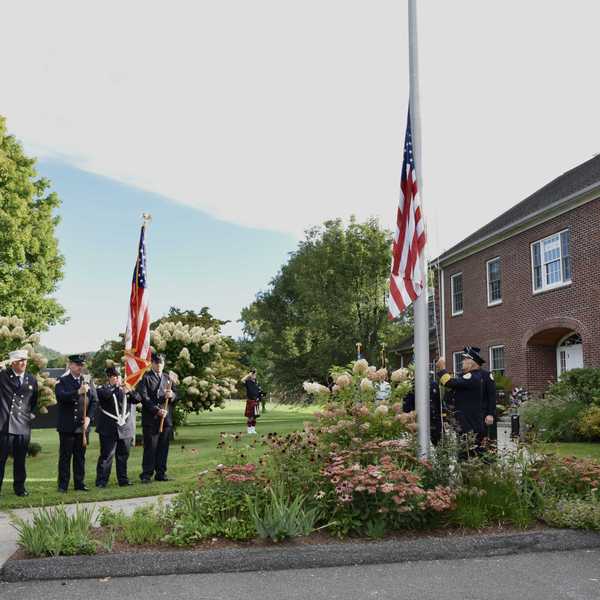
Reenactors raise a massive flag on the liberty pole Saturday, June 13, commemorating the patriotic demonstration that took place in Canaan before the Revolutionary War.
Ruth Epstein
NORTH CANAAN – Residents reflected on the past, present and future of North Canaan during the raising of a liberty pole Saturday, June 13, recreating an act of resistance against British rule that first took place more than 250 years ago.
The reenactment marked the first time the flag had flown in centuries. The event was held in honor of the nation’s 250th anniversary.
The patriotic celebration extended beyond the ceremony with a community picnic called “Life, Liberty and the Pursuit of Appleness” at Bunny McGuire Park. American favorites like hot dogs and apple pie were served.
Kathy Keane, the chair of the town’s 250th Anniversary Committee, addressed a crowd that gathered on the grassy corner of Routes 44 and 7, near where the original flag raising took place in 1774.
“What will it be like 250 years from now?” Keane asked, reflecting on future generations. “Our greatest resources are our kids. We need to celebrate our past and our future.”
First Selectman Jesse Bunce welcomed attendees. He had cut down the tree, which was donated by a descendant of one of the town’s first settlers, Isaac Lawrence, and formed it into the pole, placing it 10 feet into the ground to ensure its stability.
Historian Tim Abbott gave a synopsis of the pole’s history. In June 1774, the Port of Boston was closed by the British in retaliation for the Boston Tea Party. The closure was part of the Intolerable Acts imposed upon the colonists, which included restrictions on property rights and the honoring of bills of credit.
“Connecticut folks began saying that if it can happen in Boston, it can happen here,” Abbott said. “In August 1774, Canaan decided to show its dissent.”
He said details of the Canaan liberty pole were gleaned from the Connecticut Courant. It was described as being 78-feet tall and 15-feet wide, dimensions replicated in the current pole. It was scarlet in color, with the words “LIBERTY and PROPERTY” printed in large capital letters.

Abbott said many colonists believed their ability to govern their own affairs was being undermined by British authorities. The liberty pole served as a way of signaling that local residents felt neglected and opposed policies being imposed from afar.
“We know it was put up around this spot,” Abbott said. “It’s also known that after the flag was raised, those involved went to a local tavern to toast their deed and then they went peaceably home.”
Abbott also described the involvement of several Canaan residents in storming the court house in Great Barrington in August 1774. The court was overseen by British-appointed Judge David Ingersoll, who was dragged to the Canaan pole, forced to recant his support for the King and later imprisoned in Hartford. The courts in Great Barrington remained closed for six years.
North Canaan resident Christian Allyn spoke about the Canaan Exchange Club, which is celebrating its 100th year, and was one of the sponsors of the liberty pole installation. The club’s motto is “Unity and service for patriotism.”
Other sponsors were the Canaan History Center, the 250th Anniversary Committee and the town.
Keep ReadingShow less
Turning Back the Pages - June 16, 2026
Norma Bosworth
Jun 17, 2026
125 years ago — June 1901
Fred Seeley was treated to a genuine surprise Saturday evening it being his birthday. A party of his friends went to spend the evening and also to present to him a beautiful rocking chair.
It is said the entertainment given by the Microbine Concert Co. are high class and strictly moral in every respect. The general public in the towns in which they have played speak in highest terms of the company. Should you fail to attend you miss a good thing.
Several of our citizens have seen a deer at different joints near the village. Sportsmen should not get excited about the matter for the law prohibits the shooting or frightening of deer in this state.
It is said that posts planted in the earth upper end down will last longer than those which are set in the natural position in which the tree grew.
LIME ROCK — A dozen teamsters are hauling charcoal to the furnace here. A large stock of ore, limestone and charcoal is being accumulated.
Second twig of the Branch. It’s a boy, born to Mr. and Mrs. William Branch yesterday morning.
100 years ago — June 1926
Several friends gave Col. Chas. H. Ball and family a pleasant surprise party on Saturday evening, and a social hour was enjoyed by all. Col. Ball is now 78 years of age and is one of the three surviving G.A.R. veterans of the town.
FOR SALE-- An old Towne Canoe, 2 row boats, two cows. C. Benjamin, Lakeville.
Mr. J.C. Howell has completed his new cottage, Rock House on the Knight Shore of the lake. The cottage will be open all day Sunday for anyone who desires to visit it. Mr. Howell has already moved from Salisbury, his house on the Lime Rock road being rented for the season.
50 years ago — June 1976
The South Kent Post Office, which some feared might be closed, has been upgraded to the status of a second class post office. Postmaster Albert Gereg received notification of the change recently. The office had been the center of controversy last year as the Postal Service had wanted to close the facility as an economy move.
SALISBURY — After brief deliberation, the Zoning Board of Appeals Monday approved a request from Stanley Aurell of Great Eastern Applied Mechanics to conduct a motor vehicle repair shop and used car dealership. The business is located on Route 44 adjacent to the Salisbury Farms Milk Bar.
Sara J. Thorne-Thomsen of Lime Rock received her B.A. degree from the College of Arts and Sciences, University of Hartford, on May 30. She majored in English literature.
LAKEVILLE — The building housing the Teen Center will soon have its face lifted. Members of the Teen Center will gather Sunday morning to begin painting the trim on the town-owned building as a way of expressing their appreciation for its being made available for their use.
SHARON — We newcomers to Sharon were given a glimpse of Sharon as it was years ago by a conversation with Margaret Conklin a few days ago. Mrs. Conklin, who celebrated her 90th birthday May 23rd, has lived in this area since she came from Ireland at 17 years of age. She recalls a Sharon that was both more active and more leisurely than that of today. She remembers that people used to come to this area and spend the summer at the Inn by the Green. She recalls that Amenia Union was a busy town with a foundry, blacksmith, general store, schoolhouse and two churches, while now there are simply one church and a cluster of houses. Conversations with veterans like Mrs. Conklin remind us that, unlike other parts of the country, Sharon has not grown steadily in the last 200 years.
CANAAN — The community room at Wangum Village, Canaan’s housing for the elderly development, was named for Arthur Baldwin, chairman of the Housing Authority, during Sunday’s dedication of the housing project.
CORNWALL — Fifth-graders under the guidance of teacher Sally DiCicco and art director David Orrell have made a Bicentennial quilt, which is now on display at the Consolidated School. The quilt depicts scenes of 1776 and of Cornwall. Each of the 12 squares was made by class members and was sewn onto the white background by Miss DiCicco. The quilt will be displayed by the Historical Society during the summer.
25 years ago — June 2001
CANAAN — If the telecommunications tower on Church Hill appears a little more noticeable to residents, it’s not their eyesight that has improved. During the last few weeks, the amount of steel on the mountain has more than doubled. Workers from Northeast Tower of Bristol were working on the last 15-foot sections of a new tower late last week, scaling its full 195 feet to bolt the derrick-style steel beams in place.
These items were taken from The Lakeville Journal archives at Salisbury’s Scoville Memorial Library, keeping the original wording intact as possible.

Keep ReadingShow less
Let's Hear It - June 18, 2026
Lakeville Journal
Jun 17, 2026
This Week
Fireworks have long been part of Fourth of July celebrations, lighting up the night sky in towns across the country. But in recent years, drone light shows have become an increasingly popular alternative, as communities weigh safety concerns, fire risks, noise complaints, environmental effects and changing state and local regulations.
What do you think about this changing tradition? Should communities hold on to fireworks, embrace drone shows or find room for both?
Send your responses to publisher@lakevillejournal.com by Monday, June 22 at 10 a.m. or comment on Facebook or Instagram.
We’ll publish a selection in next week’s paper.
Last Week’s Question
As Region One studies the future of its schools, what should matter most: cost, educational opportunity, town identity, travel time or something else?
“I believe that all the towns that send kids to the elementary and high schools should split the costs equally regardless of the amount. Of kids each town has two go to those schools or the parents of the kids that have their kids go to school. This crap of having people who don’t have kids in school have to pay for it as well.”
— Shaun Murphy
Keep ReadingShow less

Want more of our stories on Google? Click here to make us a Preferred Source.
loading