The following is a reprint of an interview held in April 1979 that now resides in the Colebrook Historical Society’s archives. This well-liked couple, Wilber and Nellie Mills, was known to every Colebrook resident for several generations as they were both native born and were married on May 6, 1908. The marriage lasted into its 74th year, ending with Nellie’s death in 1982. This interview was held as part of the observances held by Colebrook for the town’s bicentennial year in 1979. Nellie began by giving a short history of her family, the Chapins.
u u u
“The name was originally spelled Chapuis. It was anglicized from the original French to ‘Chapin’ when Denis [her father] and his brothers and sisters became citizens. A sister, Lena, was born in Colebrook River.
“Sylvester and Sophie Chapuis came from the Haute-Saône section of France. Some of the family claim to have been born in Belfort and Chemebier.�
This department, the capitol of which is Vesoul (pronounced Ve-zool), is just west of the conjunction of Switzerland and Germany. It is comprised of the northwestern foothills of the Alps and was a major location for the charcoal industry in France. Sylvester’s occupation in the Colebrook School Records is listed as a charcoal burner (collier). Belfort is also a department administrative center located about 35 miles east of Vesoul.
“The ship they crossed the Atlantic on took a month. They cooked their own meals. Denis told his children that the waves were like mountains. Alfred used to remember his grandmother, Sophie, wearing wooden shoes.�
These are called “sabot� in French. They are similar to the Dutch wooden shoes, called by them “clompen.� As an interesting aside, the word “sabot� is the root of the word “sabotage.� It seems that store owners hated to see workmen wearing wooden shoes entering their shops because they were considered to be somewhat clumsy and apt to accidently break items in the store, thus inadvertently causing sabotage.
“Many of the French made charcoal, the remains of the charcoal pits can still be found all over Colebrook.
“Sylvester made out well financially, so he and his wife and small daughters returned to France. One of his sons did, also. Sophie, the wife, and small daughters returned to the U.S.A. Sophie died in Torrington and left a sizable estate for those times. Denis used his share to buy the property on Beech Hill, now called Chapin Road, for about $300. This information was obtained from Mrs. Christine Chapin Fisher, our niece.�
u u u
Mrs. Mills says: “My father bought the place from a Miss Stillman [not Emily Stillman, of a later generation] in 1876. My mother was Amelie Bonhatale. Denis and Amelie knew each other in France. She had a sister and brother. They had nine children, Louise, Leila, Edward, Alfred, Ida, George, Fanny, Nellie and Eva, and two others who died very young. Mother made all our clothes and knitted all of our stockings.
“We had a very good home life. My father was a farmer. I remember my mother used to make johnny cake [cornbread] in great big pans and put applesauce on it. I didn’t like it. I never liked it then, but now I could eat it if I made it, but I don’t make it. Oh, yes, she made that a lot, and lots of it. I guess we bought the cornmeal. I don’t remember if we raised the corn or not.
“There were no houses on Cobb City Road then. It was an old road, not very good going. My mother and I used to take the horse and buggy and go pick red astrakhan apples down that road. [That buggy still exists in excellent condition and can be seen in parades in town. It was purchased from the Mills’ by the Gray family, and now belongs to Jon and Sherri Gray.] The boys hunted a lot; I suppose they ate the coon, but I know they sold the pelts then. A good coon skin was worth quite a bit.
u u u
“The school that I went to first was the Beech Hill School. [on what is today Simons Pond Road]. There was a great big stone step there. After the building was gone, we looked for it, but someone had taken it. It was a very big stone and covered the whole front of the door. It was a schoolhouse similar to the Rock Schoolhouse. [Today, this old schoolhouse is part of 141 Sandy Brook Road.]
“The teacher at Beech Hill School when I went there was Sarah Joyce. She must have been my first teacher and she was the only teacher I remember there. We used to walk cross lots from our house over to where the Wilbers live now. The land was more open then; more fields.
“You know the way we went after water up at Beech Hill School? Two of us would go; we’d have a pail and a stick. We carried the pail on the stick. Where Lee LeManquais lives [today 102 Simons Pond Road, by the beaver pond], there is a spring. We got our water there and we had 15 minutes to go get water, the two of us.
“We all drank out of the same dipper. I don’t remember if the teacher drank any. I think she drank her milk or else she drank from the dipper first of all.
“The Granger place was farther up the road [the last house on the left before entering Sandisfield]. I remember Mr. Granger used to bring beautiful peaches to the school children, but the teacher wouldn’t let us eat them because Mr. Granger had sores on his mouth and she thought it was cancer.
“We used to play games at recess. I remember blind man’s bluff. I went to the Rock Schoolhouse when I was older. I remember the first day I went there I had to go barefoot, and I felt terrible; everyone else had shoes on. I didn’t stay there very long. I was getting big and I thought I was something! No, I guess I didn’t have to go to school, and I didn’t want to go, and I didn’t go. Louella Johnson was the teacher. While I went to school up there we had to learn things to repeat and I never could do it. Louella Hall [Matson] got it all the time, and she could repeat so much better than I could. I never could remember those things.�
We will finish the interview next time.
Bob Grigg is the town historian in Colebrook.

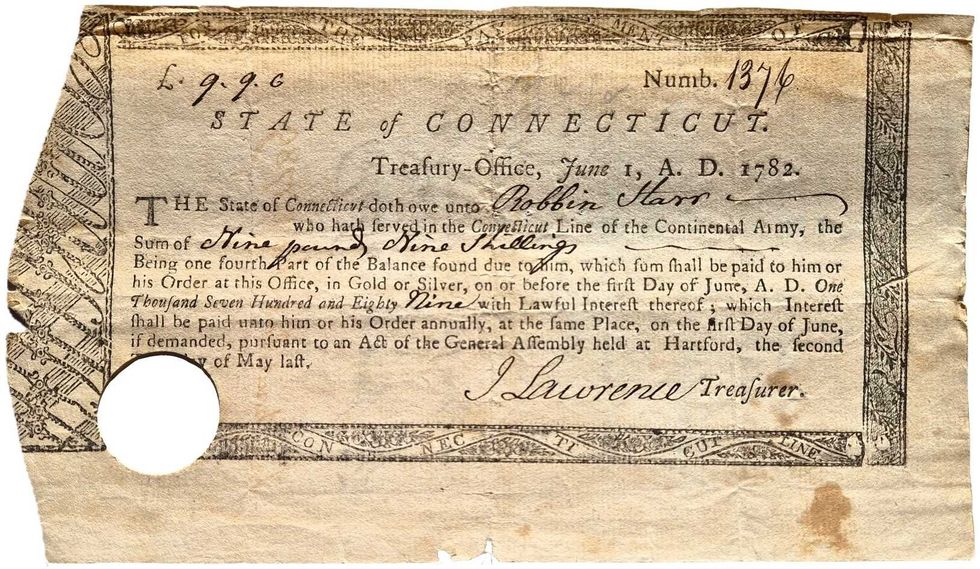 Pay Bill for Robin Starr’s service in the Continental Army.Courtesy the Alex Breanne Corporation
 John Mills speaking at Quinnipiac University.Courtesy the Alex Breanne Corporation
 Stephanie Saetta,with her rescue dog George and Blue (left), a shepherd mix awaiting his forever home.Madi Long
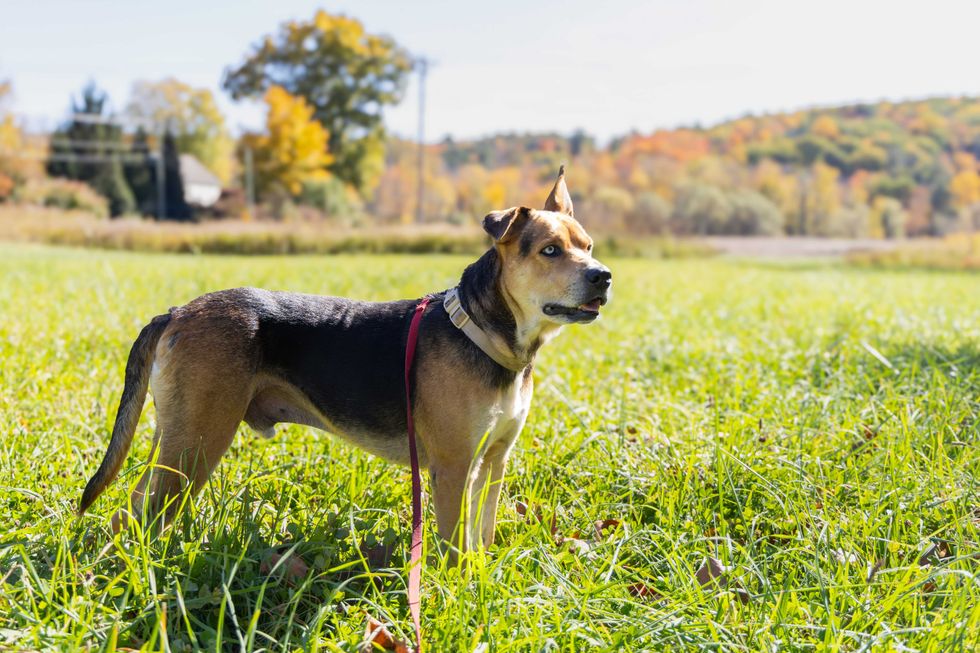 Blue, a 7 year-old Shepard mix, is waiting for his forever home. Madi Long