


Latest News


The all-female cast of Swingtime Canteen prepares to wave goodbye after bringing WWII-era music and stories to the stage. The special July 4 performance is among Sharon's holiday festivities.
PHOTO BY JENNIFER ZMUDA, COURTESY OF SHARON PLAYHOUSE
“What’s so cool about Swingtime Canteen is the way it features women,” said Claire Marie Spencer, who plays Topeka Abotelli, the Rosie the Riveter-inspired character. “I think that the show does an incredible job of featuring the enormous shift in history that happened during WWII when, in a lot of ways, women came to the forefront in a beautiful team effort.”
The show’s fading Hollywood starlet and band leader Marian Ames, played by Margaret Dudasik, brings a group of instrument-playing women to London, providing her with a meaningful second act as a performer for American troops stationed abroad.
“It was a period of time when probably everyone you knew was serving,” Dudasik said. “A husband, a high school sweetheart, a neighbor. It really shows that you never know what someone’s going through or dealing with.”
Michelle Lemon, who returns to Sharon after years of performing and choreographing at the Playhouse, enjoys significant stage time as she jams on the saxophone, guitar, banjo and piano throughout the show. But for her, it’s a moment of collaboration with the audience – one of many – that causes her to choke up during every performance.
“We invite the audience to sing with us, and to see people sing the lyrics back…I kind of have to disassociate because it’s so beautiful.”
Spencer echoed the sentiment, saying it’s a song called “Pack Up Your Troubles” that brings her to tears each night.
“The idea of 18-year-old boys singing such a happy, upbeat song in the midst of such evil and darkness is powerful,” she said, alluding to a parallel between the song’s history and how it was performed by the women during the show amidst a dark moment.
Still, the show is chock-full of lighter moments and familiar tunes. Lauren Seery, who plays Lt. Jeannie Pielmeier and serves as an integral member of the band, enjoys the first moment when the cast breaks the fourth wall with style – and sweets.
“There’s a break in the middle of the song ‘Hollywood Canteen’ where the band gets to jam out over some really fun changes, and Lucy, Michelle and Margaret’s characters go into the audience and serve real donuts and coffee to the audience as if they were the troops,” Seery said.
The show features 30 different songs from the 1930s and 1940s in a fast-paced, upbeat production that brings audience interaction into the spotlight.
Originally hailing from six different states across the country, the cast currently resides in Manhattan or Brooklyn but has found a handful of local favorite spots during the show’s run.
The cast said they’ve gone as a group to Grassland Dessert Cafe in Lakeville for ice cream more than once. Lucy Rhoades – who shines this year as Katie Gammersflugel after her breakout Sharon Playhouse debut as Dyannne in Million Dollar Quartet last summer – said her first job in New York City was working at an Irving Farm so she stops in for coffee in Millerton often. Others have enjoyed antiquing in the area, stopping at On the Run for a breakfast sandwich, and hiking in Kent State Park and enjoying views of the 250-foot waterfall.
Tickets for Swingtime Canteen are still available at sharonplayhouse.org, including a special holiday afternoon performance at 4 p.m. on the Fourth of July.
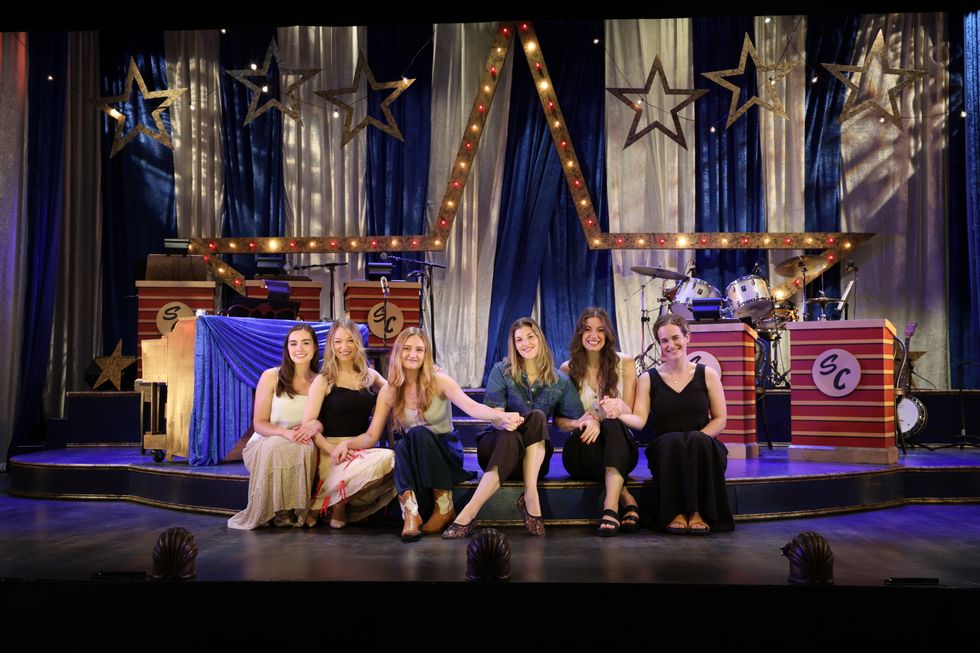 The all-female cast of Swingtime Canteen shares a behind-the-scenes moment before taking the stage.Madi Long

Want more of our stories on Google? Click here to make us a Preferred Source.

An extensive clean-up effort was required after a June 29 tractor-trailer crash sent beer all over Route 44. The driver, reportedly unharmed, was issued a ticket for driving too fast under the conditions.
Photo Courtesy of Troop B
The detour was necessary, police said, so they could clear the large volume of debris and safely remove the “severely damaged truck and trailer,” which was towed to Arnold’s Garage in Canaan.
The driver, Filmon Mahari Zerae, 36, was issued a ticket for driving too fast for the conditions.
This crash remains under investigation, and police are asking witnesses to contact Trooper DaSilva #915 at (860) 626-1820.
 An extensive clean-up effort was required after a June 29 tractor-trailer crash sent beer all over Route 44. The driver, reportedly unharmed, was issued a ticket for driving too fast under the conditions. Photo Courtesy of Troop B
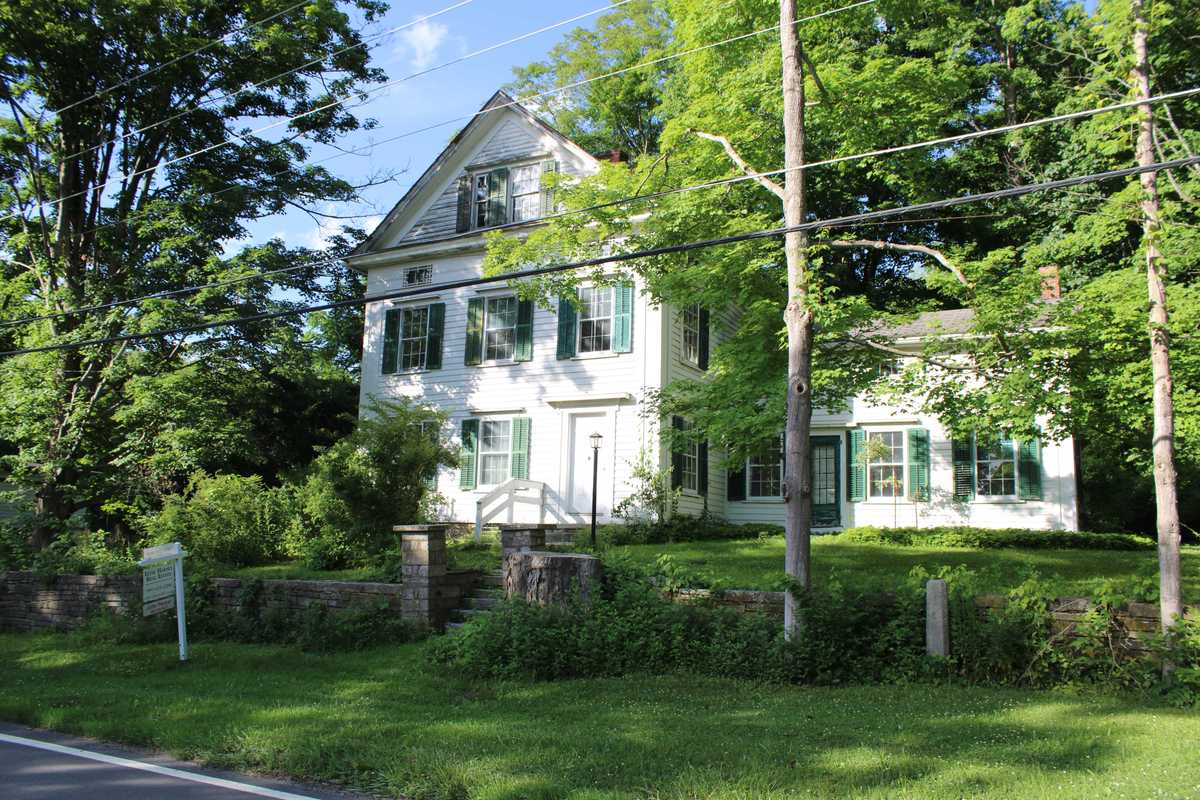
A 22.5-acre property at 60 Millerton Road in Sharon is at the center of a trust dispute over the sale of the land to Jasper Johns-related arts nonprofit Low Road Sharon Inc.
Alec Linden
Before any sale can proceed, however, the Litchfield Hills Probate Court must resolve a dispute among members of the family trust that owns the Millerton Road property. A hearing is scheduled for June 30, when Judge Jordan Richards is expected to decide whether to approve the sale and rule on objections filed by one of the trustees.
According to probate court documents, Peter Bartram has objected to a petition filed by his sisters, Carey Meltzer and Amy Bartram, seeking court approval to sell the property held by the Hillside Farm Trust. In a June 11 filing, Bartram said the proposed transaction is the second attempt to sell the property to the same buyer after an earlier effort was blocked by the court since he did not agree to the sale.
"In September 2025, the Trustees accepted an offer of $615,000 from the same buyer, Low Road Sharon Inc.," Bartram wrote in his objection to his sisters’ second attempted sale. "All beneficiaries except the Movant [Peter] signed the Beneficiary Approval. The Court denied the proposed modification on November 26, 2025.
The new petition seeks approval for essentially the same sale, with the purchase price of $650,000, an increase of $35,000 since the last attempted sale.
Neither the parties to the probate case nor Conley Rollins, who has represented Low Road Sharon in previous town applications and is the COO and CFO of the Brooklyn Museum, provided comment. Rollins also did not respond to questions about whether the proposed purchase would be connected to the artists' retreat.
The property at 60 Millerton Road includes an unoccupied 1840 white clapboard farmhouse near the Silver Lake Shores neighborhood. Together with two much smaller adjoining parcels included in the proposed sale, it has been held by the Hillside Farm Trust since 2013.
The trust was established in 2012 by Maynard and Barbara Bartram, who were both raised in the colonial home, which sits prominently at the corner of Millerton Road and Silver Lake Shore Road.
Following Maynard Bartram's death in 2021 and the death of their daughter, Sarah Noyes, in 2022, Carey Meltzer, Peter Bartram and Amy Bartram have served as the remaining trustees. Peter Bartram, however, was removed as a trustee by court order in 2024 after he removed several trees from the property to protect a barn without his siblings’ approval.
As part of the June 30 proceedings, Judge Richards is also expected to consider Bartram's request to be reinstated as a trustee.
In an April 30 court filing, Meltzer and Amy Bartram argued the property has become a financial burden for the trust and they have a right to put it on the market.
"The farm is a significant and depreciating asset that incurs ongoing carrying costs including property taxes, insurance, maintenance and utilities," they argued.
The three parcels included in the proposed sale are assessed at more than $813,000, with the main 22.5-acre parcel accounting for nearly all of that value. As of June 25, the property was listed for sale through Elyse Harney Real Estate for $795,000.
Property adjacent to planned artists' retreat
The proposed purchase has drawn interest because the Millerton Road property directly borders land already designated for Low Road Sharon's planned artists' retreat.
The retreat, approved by Sharon Planning and Zoning in 2017, encompasses approximately 171 acres spread across six parcels that stretch from Low Road to the shoreline of Mudge Pond. The approval allows up to 24 artists in residence at one time and does not permit public access to the campus. The property would be able to contain up to six housing units. Each housing unit is permitted to accommodate up to three people.
Any proposal to expand or materially alter the footprint approved in 2017 would require additional review by the Planning and Zoning Commission and a public hearing, outgoing Land Use Administrator Jamie Casey said.
Low Road Sharon has not indicated whether the Millerton Road property would become part of the retreat or serve another purpose.
Johns, who has lived in Sharon for more than three decades, is widely regarded as one of America's most influential living artists. According to the 2017 statement of proposed use submitted to the town, the residency program is intended to become "one of the leading artists' residency programs in the United States," comparable to MacDowell in New Hampshire and Yaddo in Saratoga Springs, New York.
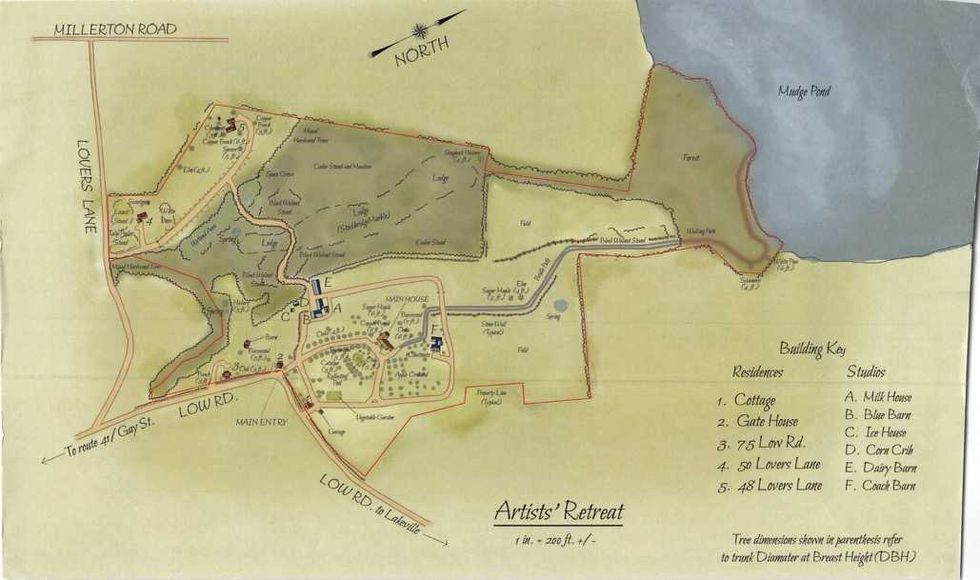 An illustration of the proposed artists' retreat on Jasper Johns' 171 acres in Sharon after his death, included in the original 2017 site plan for the project. Provided
The proposal envisioned a staff of roughly 20 to 25 people, some of whom would work at an administrative functions and event space based at a downtown Sharon office.
Construction is already underway on that downtown property, including a new building which is going up where the former Bargain Barn thrift store was located at 1 Low Road. The two-building complex, approved after months of public hearings last year, will primarily serve as the nonprofit's administrative center and include a venue designed to host occasional public cultural events that would be free to the public.
Low Road Sharon was incorporated in 2022 to establish a short-term residency program for artists across multiple disciplines. According to its 2024 tax filing, the organization reported approximately $32 million in assets. A separate philanthropic organization founded by Johns in 2004, the Low Road Foundation, reported approximately $255.5 million in assets in 2024.
The commercial district project boasts an impressive development team. Lead architecture outfit Johnston Marklee & Associates is a Los Angeles-based firm with an accomplished international portfolio of projects like the Museum of Contemporary Art Chicago, Kunstmuseum Basel, the Institute of Contemporary Arts at the University of Pennsylvania and many others.
New Haven’s Reed-Hilderbrand is the landscape architect for the Low Road development, and has designed for a wide variety of clients, including Yale University, Duke University and the Hudson Valley’s famed outdoor museum, the Storm King Art Center.
The owner’s representative Envoie Projects also manages high-profile arts facilities such as Harlem’s Apollo Theater, The Delacorte Theater in Central Park, and again, the Storm King Art Center.
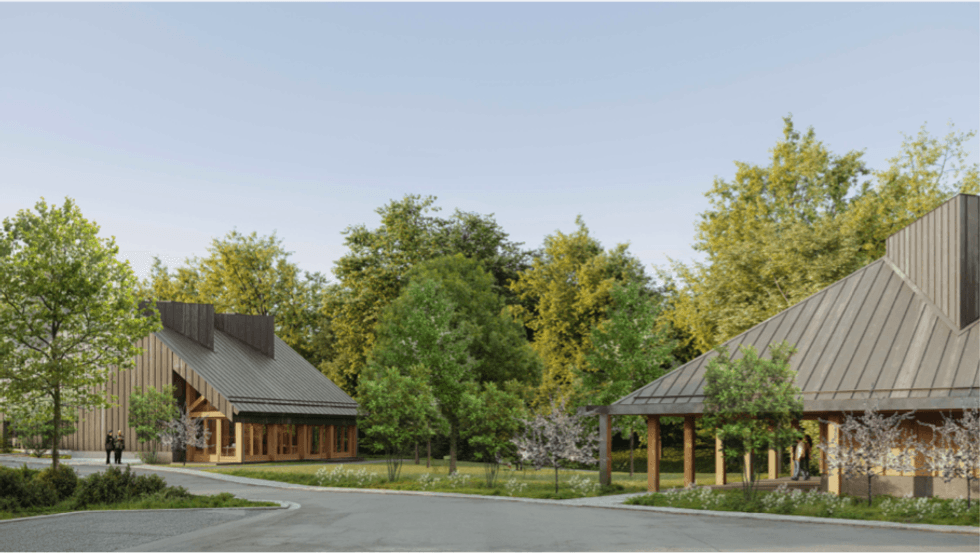 A rendering of the proposed administrative building and events facility on Low Road in Sharon's commercial district, developed by project lead architect Johnston Marklee & Associates. Provided
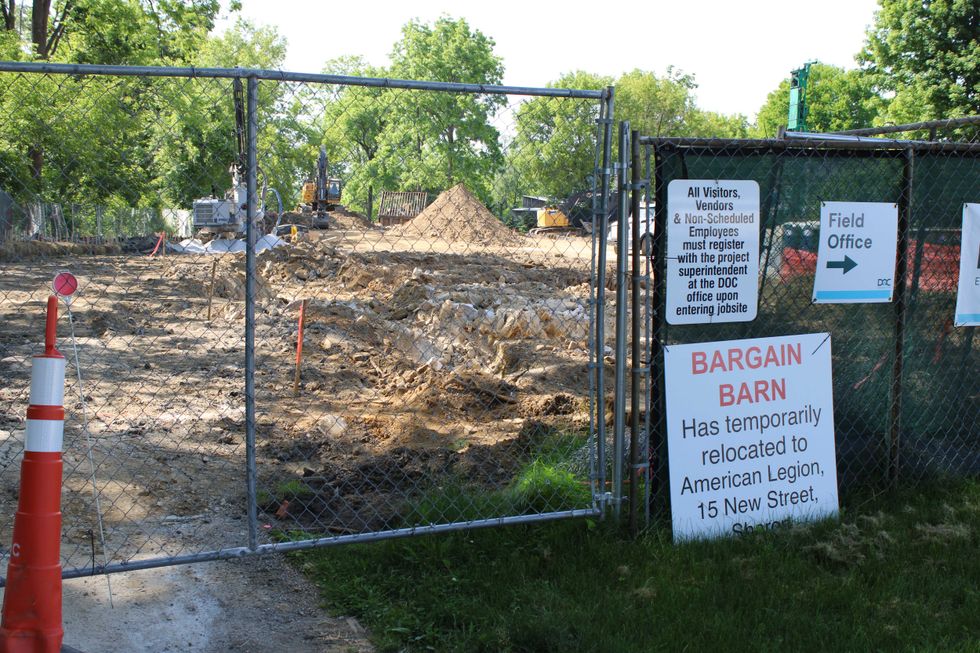 Construction at 1 Low Road began earlier this year for an administrative center and occasional performance center and events space for Jasper Johns-related arts nonprofit Low Road Sharon Inc.Alec Linden

Want more of our stories on Google? Click here to make us a Preferred Source.