Everyone I know seems to be having trouble sleeping lately. It’s hard to say what the cause is; I’ve had friends suggest everything from politics and the stock market to the more global impression that, “I just feel like I’m under a bad planet lately.”
It’s not that uncommon for Northwest Corner residents to have trouble sleeping. As a community, we are on the higher end of the age spectrum; statistically, people over the age of 65 tend to have more trouble falling asleep and staying asleep.
Anyone who has chronic sleep problems might want to check in with a sleep specialist or medical expert.
But those of us who are just experiencing temporary sleep problems can try making some upgrades to what experts call “sleep hygiene.”
When I hear “hygiene” I tend to think of grooming and housekeeping. Those can of course be part of “hygiene,” but experts tend to mean just general “best practices” when they use that word.
So when you talk about sleep hygiene, you’re not just talking about brushing your teeth and cleaning yourself up before settling down on nice clean, crisp sheets. You’re talking about the things you eat and the things you do before bedtime and about how you expend energy during the day.
There’s an organization called the National Sleep Foundation that has a convincing and attractive website at www.sleepfoundation.org.
They have all sorts of helpful tips and information about sleep and circadian rhythms and diet and disease. They have a list of about a half dozen suggestions to help improve your sleep hygiene.
Keep naps short
I would laugh at the first tip except for the fact that my daughter loves to nap and will nap for hours during the day if she can get away with it — and will then of course stay up until 4 a.m. (and yes, I am trying to shoehorn her out of that bad pattern). So the first tip is: Don’t take long naps during the day.
Short naps are OK, however. The Sleep Foundation says that if you’re having trouble sleeping at night, you might want or even need to take a 30-minute nap in the morning and in the afternoon. I don’t know how you’re going to convince your boss and co-workers to let you get away with this; but if you’re a retiree then by all means, nap away — as long as you set an alarm and limit your sleep to 30 minutes.
Don’t over-stimulate
This one also seems obvious but maybe it isn’t: Don’t smoke cigarettes or vape or drink coffee at or near bedtime. Nicotine and caffeine are stimulants.
Exercise is a stimulant too, but you should definitely get some aerobic exercise (at least 10 minutes) every day. In theory, you aren’t supposed to do strenuous exercise at night because it’s too stimulating; but I have a friend who does a two-hour intense workout every night and then goes right to bed and claims to sleep deeply for eight hours so … as the Sleep Foundation says, the exercise thing differs from person to person so see what works for you.
What you drink
I’m always surprised when people who are pretty food-aware don’t understand that carbonated beverages, especially soda, don’t really count as part of your recommended eight glasses of water per day. Even fruit juice is better than soda, because it has some water in it. Soda is soda. Don’t drink it at bedtime. The carbonation and the chemicals and the sugar won’t help you sleep.
I’m not trying to go all Bloomberg on you here; during the day, drink whatever you want. But if you’re having trouble sleeping, don’t drink soda at bedtime and don’t eat a lot of spicy food before you go to sleep (in fact, you’re not supposed to go to sleep right after you eat; it causes reflux and heartburn). Don’t eat a lot of heavy, greasy, fatty food at night. Skip anything with a lot of acidic citrus in it.
The magic of kiwis, cherries
Here are two things you can eat and drink at bedtime (lest you accuse me of being all about the Don’t list and not about the Do list). Studies done in the past few years indicate that eating two kiwi fruit every night before bed will definitely, measurably improve your sleep. It takes about a month for it to kick in, but actual scientific studies have shown that it works.
The same is true of the juice of Montmorency cherries. There have been a lot of studies trying to figure out why this works but the end result is that it just does. Drink a glass of Montmorency cherry juice in the evening and it should improve the quality of your sleep.
Do the feng shui thing
A couple other things: Go outside and get some exposure to sunlight during the day.
And go all Marie Kondo on your bedroom (what we used to refer to as feng shui). You should be sleeping in a bedroom that is tidy and decorated in relatively neutral colors and patterns. I personally like to iron my bed linens after I wash them; they just feel plusher and more orderly than wrinkly sheets. I am scorned by most of my friends because I do this but it really does help me sleep.
The Sleep Foundation also recommends that you create a peaceful and orderly evening routine for yourself, just as you would do for a young child. Take a warm bath. Read a book. Don’t watch television just before you try to sleep. No arguing at bedtime.
I hope that some of these tips work for you and let’s hope we get out from “under this bad planet” soon.

 Models walk the organic runway at HVSFW. Ilan Harel

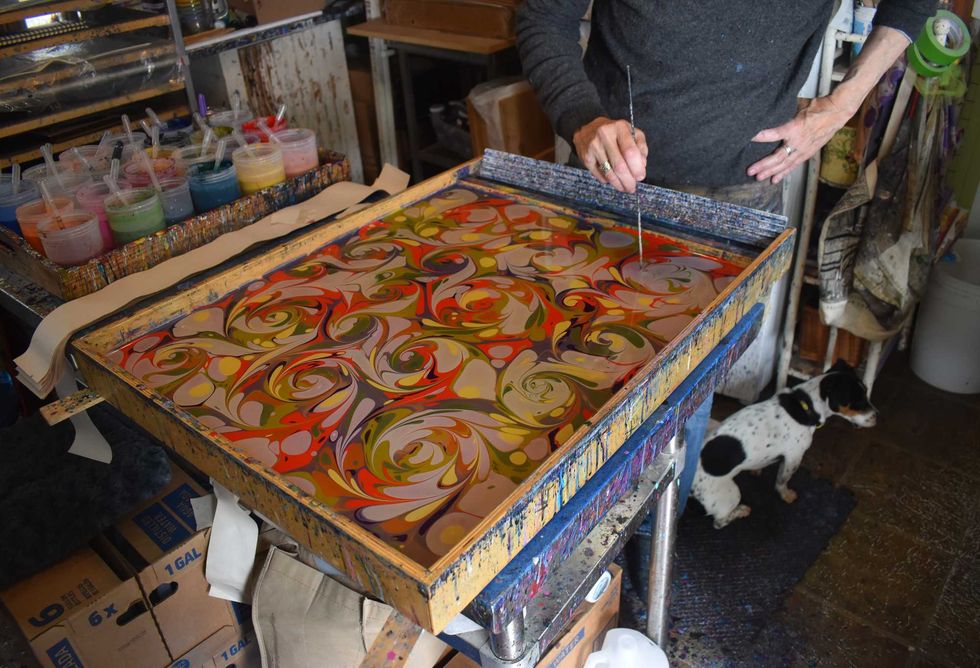 Susan Schneider, owner of Shandell’s, creates a variety of products with marbleized surfaces in her Ashley Falls studio.L. Tomaino


 Roger McKee naming the winners with the first place entry over his left shoulder. Patrick L. Sullivan
 Muriel Stockdale’s “Kevin” took second place in the juried art show at Trinity Episcopal Church.Patrick L. Sullivan