In the eyes of Christopher Koppel, there is no better garden designer than nature itself.
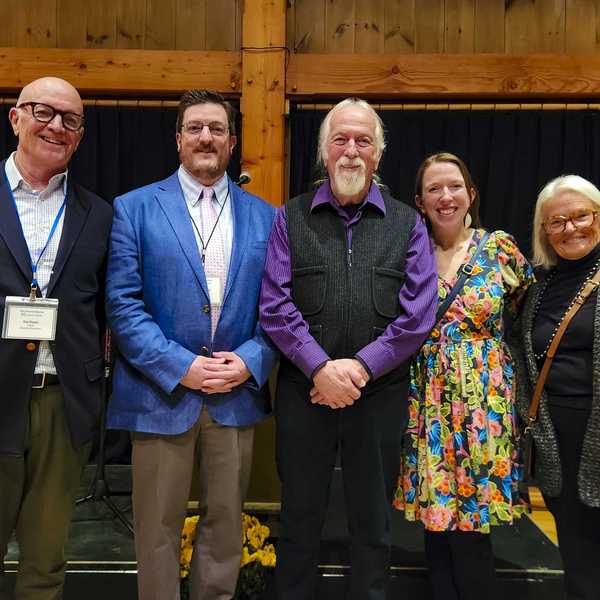
Koppel was the guest speaker Thursday, Jan. 25, at the first of the three-part lecture series Bad Grass 2024, returning to The White Hart Inn after the success of last winter’s inaugural program.
The Bad Grass series is brought to the public by the recently formed Silva et Pratum group — “forest and meadow” in the Latin tongue — led by Salisbury resident Jeb Breece with the effort of informing area gardeners on better practices to support insect and flora cohabitation when it comes to private land care. Last year’s Bad Grass series inspired Salisbury School students Sachem Ramos and Russell Judge to successfully launch the Pollinator Meadow Project, planting 45 species of flowers and grasses on a 6-acre plot of land on the campus of their private boys preparatory school.
Ticket sales from 2024’s Bad Grass series will directly benefit Falls Village’s Native Pollinator Pathway Project, which began on the town’s Main Street, where village gardeners like Page Dickey and Deb Munson planted native perennials to provide a nurturing habitat for bees, birds and butterflies. Now the group hopes to extend the pollinator path up to the steps of David M. Hunt Library, a horticultural endeavor it hopes will be funded by ticket sales and additional charitable donations.
Koppel, a lively speaker to launch the 2024 program, is a self-described nurseryman, gardener and naturalist who has previously overseen the woodlands and trails of Martha Stewart’s historic Seal Harbor estate, Skylands, in Mount Desert, Maine, and now serves as an estate manager in Washington, Conn.
Wild nature, unrestricted and growing in uncommon ground, is Koppel’s source of inspiration: “Everywhere I walk in the woods, the roadside, I see design and plant combinations.” For example, Koppel showed the audience a photo of a rocky cliff he spotted while kayaking off of Long Island. Despite the rough terrain continuously sprayed with saltwater from the sound, there was a veritable bouquet of native plants artfully arranged, disregarding the hostile scenery. Grouped sprouting from the rocks were liatris novae-angilae, an explosive purple bud commonly known as the New England blazing star, paired with andropogon gerardii, a North American grass with a lilac hue widely known as big bluestem, and juniperus virginiana, an evergreen known as Eastern red cedar. These natural formations are the kinds of combinations in size, color, texture and placement that influence Koppel’s designs in private gardens.
“Growth like this teaches you so much about soil, about what the plants truly want, as well as about pruning, about how we don’t have to be as nice to our plants as we intended to be, which saves us time and lets us enjoy the garden more,” Koppel said. “What I’ve discovered is that nature is better at everything than me. Nature is a better nurser than I am at raising plants from seed. Nature is a better gardener than I am and a better designer.”
The Bad Grass speaker series at The White Hart Inn will continue Thursday, Feb. 15, with a lecture by Christoper Roddick on tree care in the age of climate change; and Thursday, Feb. 29, as Leslie Needham, Dee Salomon and Matt Sheehan discuss the role humans play in maintaining natural landscapes in a conversation with Breece. Tax-deductible gifts to the library’s pollinator project can be made by going to www.huntlibrary.org