AMENIA — With four Amenia Town Board members voting in favor and one, Supervisor Wayne Euvrard, voting against, the board approved five change orders to work on the new Town Hall at its Oct. 14 meeting. One particular item in the change order will increase costs, but Councilwoman Darlene Riemer was still confident that the first phase of the project would still come in under the original $100,000 budget.
Riemer reported that the town had received its first invoices from Alternative Designs, the project’s general contracting company, totaling approximately $24,000 for work involving painting, carpeting, materials and various repair work.
Six change orders were originally up for review; one for a raised platform to be used during live television broadcasts of board meetings was unanimously removed from consideration for being unnecessary. Several were agreed upon, at least when it came time to vote, by the entire board: additional electrical work, the removal of several sinks and plumbing work.
The two change orders that Euvrard emphatically disagreed with were the proposed painting and scraping of the hallways and stairwells in the building for approximately $14,000 and the town clerk’s request for a new carpet to be installed in her office for health reasons.
The painting was needed due to peeling and constituted a building code issue, Riemer explained.
“We’d never get a C of O [Certificate of Occupancy] with that peeling paint,� she said. “This is an issue of health, safety and welfare. This is important.�
Euvrard called the cost estimate of $13,970 “absolutely insane� and argued that the work that needed to be done was not that serious and did not need to be completely redone, at least not at this point.
“Scrape it off and touch it up,� he said. “This is taxpayers’ money.�
Riemer countered that the money used was actually from the sale of the Tri-Wall Container Corporation building in Wassaic. She also stressed that the work was not being done for aesthetic reasons and that the amount of peeling paint in those areas was “overwhelming.� Councilwomen Vicki Doyle and Victoria Perotti agreed with Riemer.
“This is not a frivolous thing,� Perotti said. “This is something that has to be done.�
“I’d be prepared to stand behind it,� Doyle added. “There are a lot of professionals who have weighed in on this. It’s expensive to repaint.�
As for a new carpet for the town clerk’s office, Clerk Maureen Bonds said that the total cost to purchase and install carpeting would be roughly $1,250. But, as she said, that cost would be offset by sacrifices she would be willing to make in either her equipment or contractual budget lines that would not require additional monies to be spent by the town overall.
Bonds said that during her two visits to the Town Hall she had become sick from what she said was mold in the carpets, presumably originating from its use and abuse as a kindergarten classroom. The health issues are specific to that one room, she said, and she would produce a doctor’s note if needed.
Euvrard acknowledged that the carpets were “filthy,� but said that they would all be steam-cleaned before Town Hall opened up. He said that he felt the clerk’s health issue would be addressed with the cleaning and that a new carpet was unnecessary. He was also concerned that granting the request could inadvertently set precedent for other departments to ask for new carpeting.
“I’ve said it before, we’re not moving into the Taj Mahal,� he pointed out.
Riemer clarified in an interview after the meeting that any carpeting that was used in a school would have to pass health inspections to begin with.
“This is good carpeting,� she said. “The issue is that [Bonds] has significant allergies.�
There was some discussion about steam-cleaning the carpet for now and revisiting the issue at a later date, but there were concerns that it would only prolong and increase costs.
Euvrard made a motion to reject both the additional painting and carpeting change orders; there was no second and the motion failed. A motion was then approved by the remainder of the board to accept all of the change orders, with the exception of the platform, with Euvrard voting no.
Euvrard also took issue with the first invoice that was submitted. He questioned the high hourly labor costs, citing concern that the town was being overcharged. Both Perotti and Riemer explained to him that the state’s prevailing wage law stipulates that the town is required to pay prevailing hourly wages as well as supplemental benefits including workers’ compensation insurance, Social Security and Medicare costs.
Most of the change orders, Riemer said after the meeting, would not amount to an overall increase in cost for the project but were predominantly for record-keeping purposes in the scope of work. But the painting in the stairwells and hallways, which would have to be added to the scope of work instead of just amended, would increase the overall cost.
But, she pointed out that Alternative Designs had previously submitted a budget estimate for the first phase of the project at $72,000. That estimate did not include the stairwells and hallways or several other items that would still need to be addressed, like security, Riemer said.
“Now that these are back in, I’m still pretty confident that we’ll be under $100,000,� she said.

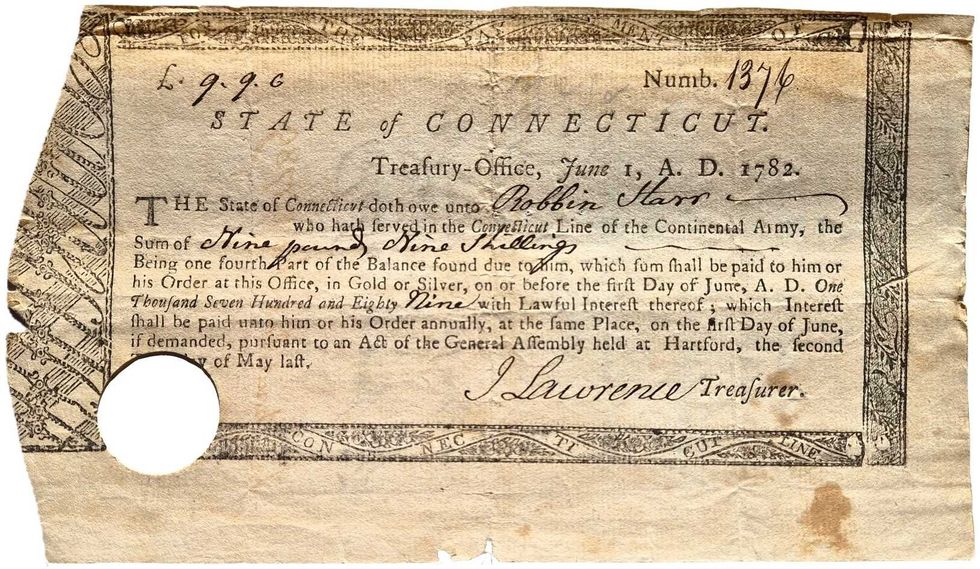 Pay Bill for Robin Starr’s service in the Continental Army.Courtesy the Alex Breanne Corporation
 John Mills speaking at Quinnipiac University.Courtesy the Alex Breanne Corporation
 Stephanie Saetta,with her rescue dog George and Blue (left), a shepherd mix awaiting his forever home.Madi Long
 Blue, a 7 year-old Shepard mix, is waiting for his forever home. Madi Long