Children tour Hotchkiss’ Fairfield Farm, meet chickens

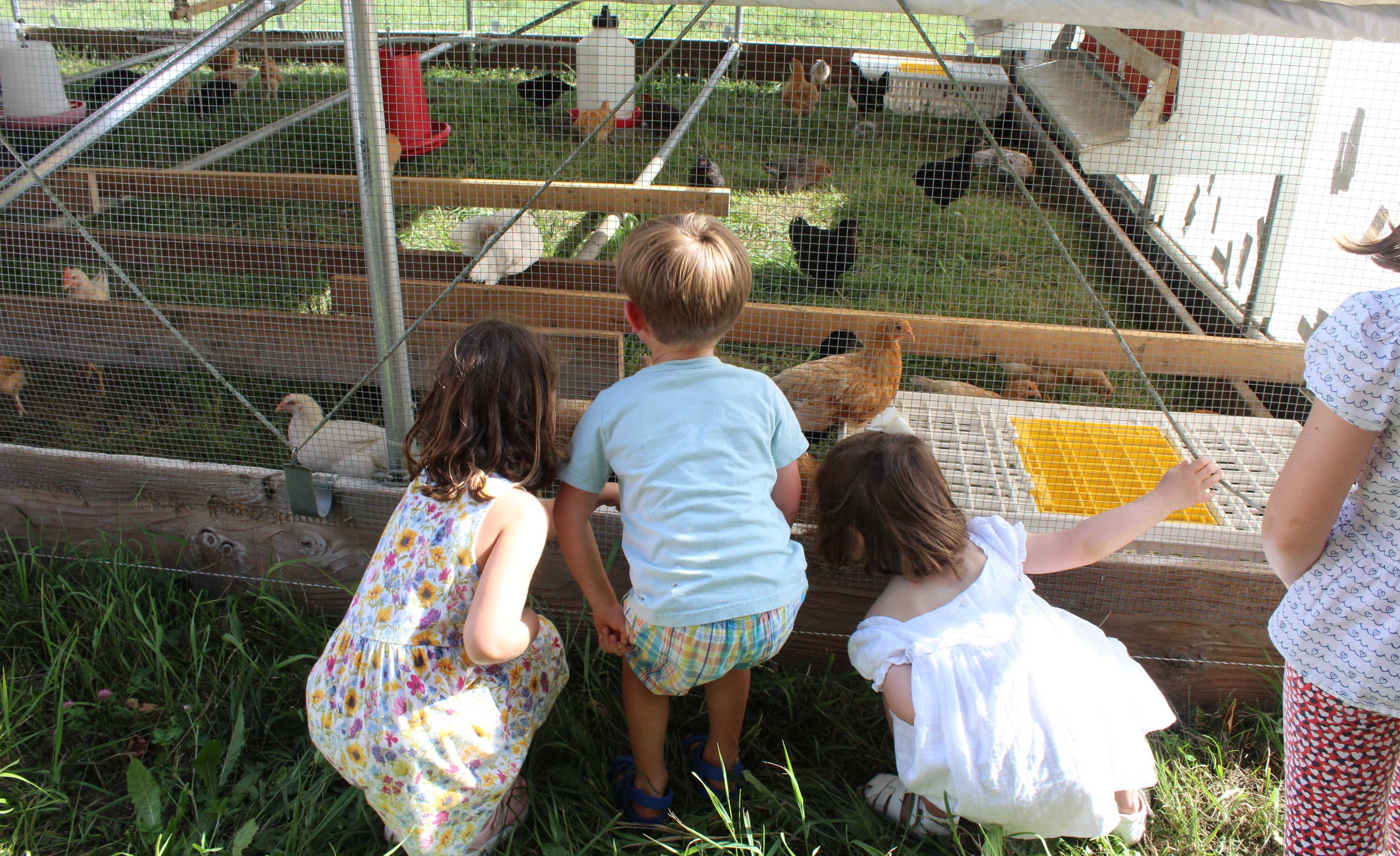
Children gather outside the chicken coop during a tour of The Hotchkiss School’s Fairfield Farm on Friday, July 10.
Patrick L. Sullivan


Children gather outside the chicken coop during a tour of The Hotchkiss School’s Fairfield Farm on Friday, July 10.
LAKEVILLE –A group of parents and curious children took a guided tour of The Hotchkiss School’s Fairfield Farm Friday, July 10 to learn how vegetables are grown using sustainable farming practices and to see the chickens in a program sponsored by the Scoville Memorial Library.
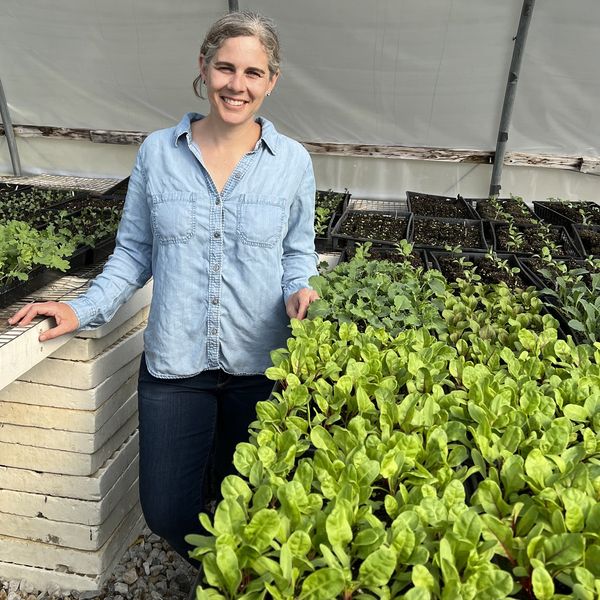
Farm Manager Bridget Lawrence-Meigs, carrying her daughter Alana, and the library’s Kyla DeRisi got the children started creating artwork with construction paper, glue and dried beans.
Cousins Wynter Landau and Jack and Charlotte Swanner took to this activity with enthusiasm, using plenty of glue.
The completed artworks were put on paper plates to dry, and the group of 16 headed off to see the farm.
The children were anxious to see animals. Lawrence-Meigs explained that apart from the occasional cow in a nearby field, the farm does not have a lot of livestock. Except for the chickens.
She explained that this batch of chickens was still young and had just recently been transferred to a large coop.
She cautioned the youngsters to be quiet, as loud noises disturb the chickens, and not to touch the fencing around the coop until she turned off the electrified part.
En route to the coop the group stopped by an unmowed area, dominated by milkweed and meant as a haven for monarch butterflies, bobolinks and kestrels.
Then it was chicken time. The children raced to the coop but heeded the warning about the electric fence.
The children suggested names for the chickens. “Henry” was popular. The chickens didn’t seem to mind.
Back under the shade behind the farm’s Grange building, the children admired their now-dry artworks and ate fresh cucumber slices.
Fairfield Farm was established in 2008 under the direction of Charlie Noyes. The farm grows 35,000 pounds of vegetables on 287 acres each year. Lawrence-Meigs said that 90% of that is consumed at the school’s dining hall, and 10% donated to local food pantries.
Lawrence-Meigs said she has an assistant and summer crew of five students. During the school year a larger contingent of students work on the farm.
The farm is open to the public, and there is a self-guided tour kiosk.
And if the timing is right, “We’ll probably send you home with a couple of cucumbers.”
D.H. Callahan
A full table at House of Books’ Salon at Swyft in Kent.
The act of sitting down with like-minded individuals to share food, and talk with each other is at once calming.
Fiction is a funny thing. There are so many ways to interpret how an author built a story, or what the meanings are behind characters, events and specific word choices. Even a novel’s title and dust jacket can garner pages of comments in online forums and book clubs.
If you’re lucky, every once in a while, you might get the opportunity to sit in on a discussion between an author and a scholar about a specific book, or even a body of work. The House of Books in Kent hosts author events on a regular basis, but the store manager Benjamin Rybeck finds value in more intimate conversations so in 2022, he started the Salon Series at Swyft.
The series is based on the 19th-century tradition of the artistic and academic salons, which were seen as cultural hubs for the upper echelons of society. There, writers, artists, dancers, musicians and actors would gather in intimate settings, often the parlors of the wealthy and aristocratic patrons. While House of Books isn’t exactly equipped for such an event, the restaurant it is affiliated with, Swyft, certainly is. Known throughout the region as being one of the most consistently delicious and innovative restaurants, Swyft shares a common owner with House of Books, making for some seamless collaborations.

After pausing for a few years, Rybeck believed the time was right to revive the series, so he invited Hannah Lillith Assadi, author of the new novel “Paradiso 17,” for the first Salon of the season. The novel is based on the story of her late father’s life, beginning with his family’s expulsion after the Nakba of 1948.
Israeli-Palestinian relations are a particularly sensitive subject these days, often leading to passionate arguments between opposing sides. But the well-read literature enthusiasts at the salon weren’t interested in the politics of the book so much as they were the art of it. Over a family-style dinner of fresh salads, pizza and specialty cocktails, the conversation was surprisingly civil and curious. The group discussed structure and narrative, sense of place and the feeling of transience.
The whole evening was a wonderfully refreshing departure from the vitriolic divisiveness of today’s online discourse. While the anonymity of the internet can frequently lead to heated rhetoric, the act of sitting down with like-minded individuals to share food, and talk with each other seems to do the exact opposite. It’s at once calming, intellectually satisfying and culinarily enriching.
The next Salon on Aug. 27 will feature Natasha Stagg, author of the new novel “Grand Rapids,” and painter Sam McKinniss, whose art is featured on the book’s cover.
Kerri-Lee Mayland
Kitchen islands remain popular gathering spots, but they’re just one of many ways to create a functional, welcoming kitchen.
Here in the Northwest Corner, many homes were built long before oversized islands became fashionable. Trying to squeeze one into a modest kitchen can leave the room feeling cramped instead of comfortable.
If you’ve ever hosted a party, you’ve probably noticed the same thing.
You can spend hours setting a beautiful dining table, fluffing pillows in the living room and arranging fresh flowers in the entry. Guests arrive, compliment your home, and then, almost without fail, everyone ends up standing in the kitchen.
If there’s an island, that’s where they’ll gather.
Kitchen islands have become the social center of many homes, but while they feel timeless, they’re actually a relatively modern invention. In colonial, Georgian and Victorian homes, you were much more likely to find a freestanding harvest table, butcher’s block or sturdy worktable in the middle of the room than a built-in island.
Don’t get me wrong. Islands are wonderful in the right space. They provide extra storage, generous prep space and casual seating. In many newer homes, they’re built right into the floor plan, and if there’s room, homeowners often dream of making them even larger — or adding a second one.
But here in the Northwest Corner, many homes were built long before oversized islands became fashionable. Trying to squeeze one into a modest kitchen can leave the room feeling cramped instead of comfortable.
Sometimes the better answer isn’t another cabinet. It’s borrowing an idea from the past.
When I recently gave my own kitchen what I affectionately call a “Band-Aid renovation,” I changed everything except the cabinets. I installed new countertops, a backsplash and lighting, but the biggest transformation came from what I removed.
Out went the island.
In its place, I brought in a rustic wooden worktable with deep drawers for onions, garlic and potatoes, plus an open shelf below for pots and pans. The tabletop has become my everyday prep station, while a small overhang allows friends to pull up a stool and chat while I cook. The warm wood also breaks up long stretches of identical cabinetry and stone, making the room feel instantly warmer and more collected than constructed.
If space is tight, think vertically, too. A ceiling-mounted pot rack above a farmhouse table frees valuable cabinet space while adding character. Woven baskets suspended overhead can hold herbs, linens or dried flowers, creating texture where there might otherwise be another expanse of countertop.
The beauty of a freestanding piece is its flexibility.
A butcher’s block on locking casters moves wherever you need it. A vintage library table becomes a holiday baking station. A worktable found on Facebook Marketplace can roll into the dining room during a party and double as a buffet.
I’ve helped clients do exactly that. Rather than spending thousands on a custom-built island, we’ve found beautiful antique or secondhand pieces, added wheels and created kitchens that feel personal instead of predictable.
We’re fortunate to have wonderful antique shops throughout our region, and they’re worth visiting often because inventory is always changing. Estate sales, Facebook Marketplace and even a grandparent’s barn can uncover pieces with far more character than anything ordered from a catalog. Their worn edges, scratches and patina tell stories no brand-new cabinet ever could.
Another option is something we don’t see nearly enough anymore: a kitchen table in the middle of the room. Not one tucked into an eat-in nook, but a true worktable where meals are prepared, homework is spread out, cookies are decorated and conversations naturally unfold.
The kitchen island isn’t going anywhere, nor should it. In the right home, it’s a terrific solution. It’s simply not the only one.
Whether the centerpiece of your kitchen is a marble island, a weathered farmhouse table or a rustic workbench on wheels, the goal has always been the same: create a place where people naturally gather. Because the true heart of a kitchen has never been the island. It’s the life that happens around it.
D.H. Callahan
Oskar Espina Ruiz and the Erinys Quartet
High atop a mountain in the foothills of the Berkshires lies a bucolic oasis of tranquility, community and a whole lot of music. For more than 95 years, Music Mountain has hosted a litany of fine classical and jazz concerts. But you’ll find more than just music alive in these hills.
Beneath the towering willows on the Music Mountain campus sits Gordon Hall, the main performance space. Gordon Hall was named after Jacques Gordon, Chicago Symphony concertmaster from 1921 to 1930 and the founding first violinist of the Gordon String Quartet. In 1930, he came to Falls Village and created Music Mountain. To build his campus, he enlisted Sears, Roebuck & Co., whose prefabricated housing division installed all of the buildings. Because many of the houses by Sears, Roebuck have been lost to time, Music Mountain’s well-documented collaboration with the company earned it a spot on the National Register of Historic Places.
But Music Mountain doesn’t rest on its historical laurels. While it honors its past, carefully noting in its programs when prominent classical pieces have been previously performed, it also takes pride in its premieres. Most recently, Artistic Director Oskar Espina Ruiz was involved in such a premiere.

On Sunday, Aug. 2, Alfonso Fuentes, a Puerto Rican composer, improvisation pianist, poet and educator, joined Ruiz and the Erinys Quartet, which won first prize at the 2025 Trondheim International Chamber Music Competition in Norway, for the premiere of his Clarinet Quintet. The performance was one of three clarinet premieres happening throughout August; the other two were composed by Seth Grosshandler on Aug. 16, with the Ulysses Quartet, and by Javier Montiel on Aug. 30, with Cassatt Quartet.
Of course, it wouldn’t be Music Mountain without some classics, so Ruiz will join the quartets for additional pieces by Mozart, Weber and other legendary composers.
But classics aren’t always classical. Jacques Gordon’s son, Nicholas Gordon took over as artistic director in 1974, and during his tenure introduced the Twilight Jazz Concerts on Saturday nights. These performances allow the audience to let their hair down, and revel in the unpredictability of the genre.

Jazz has developed in remarkable ways since Music Mountain’s founding, and many of its subgenres take their place on the stage of Gordon Hall. This year has seen straight-ahead jazz pianist Helen Sung, vocalist Nicole Zuraitis, swinging big bands like Bob Parker’s Jive by Five and Music Mountain’s 20-piece house band. Still to come are Grammy Award winners Bill Charlap with his trio, andZaccai Curtis and his Afro-Cuban quartet.
This season also features a couple wild cards that fall outside of the jazz and classical circles. The New York Gilbert & Sullivan Players brought the silliest operas of the 19th century to Gordon Hall on Aug. 8, and on Aug. 22, pianist Donald Sosin and singer/percussionist Joanna Seaton will accompany Buster Keaton’s silent film “The General” with a live score, breathing new life into an old cinematic classic.
With all this, and many more Sunday afternoon classical performances running through Sept. 13, there’s still time to catch some incredible magic on the Mountain.
For a full listing of performances and tickets, visit musicmountain.org

Want more of our stories on Google? Click here to make us a Preferred Source.
Patrick L. Sullivan
Local readers close out the summer reading program at Scoville Memorial Library with prizes.
SALISBURY — The children’s summer reading program at the Scoville Memorial Library wrapped up Sunday, Aug. 9, with prizes, games, music from the Berkshire Resilience Brass Band and, of course, more books.
Children’s Services Coordinator Kyla DeRisi said 24 children in Kindergarten through sixth grade signed up for the program this summer.
Participants could win prizes, including gift certificates from Sweet Williams, Candy-O’s, Lakeville Books and Stationery, Grassland Dessert Cafe, Oblong Books and the Moviehouse.
As the children considered their options, the band, situated prudently beneath a shade tree as the morning grew sunnier and hotter, got started with their unique brand of jazz.
Bandleader Shamu Sadeh encouraged the listeners to grab a percussion instrument and/or dance.
Patrick L. Sullivan
Children stepped inside an iconic board game in Falls Village Thursday, Aug. 6.
FALLS VILLAGE — More than 30 children immersed themselves in the world of Candy Land at The Center on Main Thursday, Aug. 6, to become moving pawns in a life-sized version of the classic board game.
A collaboration between The Center on Main and David M. Hunt Library, the life-sized Candy Land took place in the main room of the Center, which was decked out with balloons and colorful props, some repurposed from previous Falls Village Children’s Theater productions.
Dozens of large, colored rectangles affixed to the floor formed a winding path through the room. Players stood on their assigned colors and followed directions, with the first one to reach the end declared the winner.
Five children played at a time, with Anna Pattison from the library, Britta Sallick from the Center and volunteer Madison Oflynn facilitating. Each round lasted around ten minutes, keeping a steady stream of activity throughout the game.
Alec Linden
Local photographer Cedric Gairard’s earthy images now adorn the chain link fence outside the Kent Memorial Library construction site, where a major renovation is underway.
KENT — A chain link construction fence outside the Kent Memorial Library has been transformed into an open-air gallery of local agrarian scenes, thanks to a collaboration between the library and Kent-based professional photographer Cedric Gairard.
Since work began on the $7 million renovation of the historic Main Street building in April this past spring, the site has been closed off and vacant. Library operations, including the popular weekend book sale on Fridays, Saturdays and Sundays, have moved into a temporary satellite location on Kent Green at 10-12 Landmark Lane.
Library Director Sarah Marshall said that Gairard approached the library himself with the idea, positing that he open up his photo archives for the library to spruce up the sidewalk next to the construction site.
“It was kind of like choosing between your children, they were all so lovely and wonderful,” Marshall said of the photographs, which depict working landscapes and earthy snapshots of life in Litchfield and Dutchess Counties.
Marshall said that library staff also chose about eight additional images that they plan on cycling into the fence display.
Marshall said that Gairard donated the photos, and the vinyl printing was covered by local donors. She also said it enabled the library to print signs directing people to the temporary Kent Green location alongside regular hours and the weekend book sale times.
“It was just sort of a win-win for everybody,” she said.
Gairard is the founder of FieldWork Press, which publishes a print newspaper that highlights the interaction of work and landscape in the region. He also consults for clients as a digital designer and brand storyteller. The library has scheduled an artist’s reception for the photographer on Friday, Aug. 28 from 5:30 to 7 p.m. that is open to the public.
In terms of the library renovation, Marshall reported that progress has been smooth, and that she has been impressed with the project’s architecture firm—Chester, Connecticut’s Wyeth Architects—as well as the construction team, which is Torrington’s Millennium Builders.
She said the projection is for “substantial completion” by May 2027, meaning the library could begin moving back into the building then, but she noted that the move-in process could take some time given the scale of the renovation.

Want more of our stories on Google? Click here to make us a Preferred Source.

Want more of our stories on Google? Click here to make us a Preferred Source.