

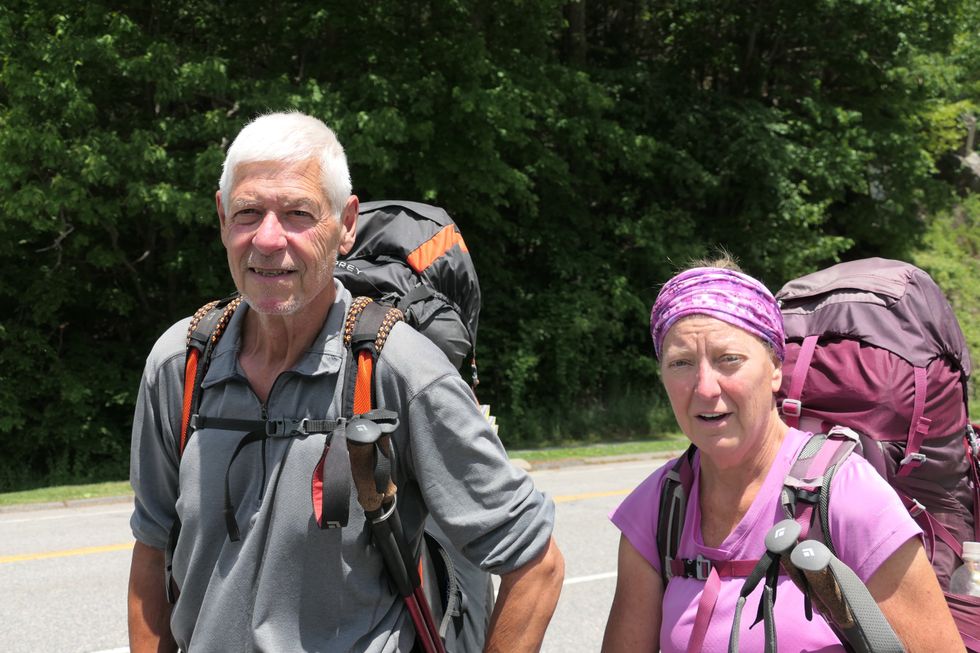
I haven’t done the math on this, to be honest, but I’d be willing to wager that there are more miles of hiking trails in the Tristate region than there are paved roads.
There are trails everywhere, running through woods and fields and alongside rivers and creeks. They go uphill and downhill. Some are easy, some are hard. Some have views that extend for miles, others don’t.
This is mecca for hikers, but a great many of the recreational pedestrians who come through this region (and again, I haven’t done the math) are just passing through on one of America’s greatest interstates: the Appalachian Trail, which has its terminuses in Georgia and Maine and which passes right through many of our local towns.
Perhaps you’ve seen the hikers as they trudge along roadways or stop at post offices and libraries to catch up with family and friends back home. You might have sat near them at a café while they wolf down entire pints of ice cream. If the café was indoors, perhaps you moved away to a distant table, your senses assaulted by the scent of many days on the trail without any bathroom facilities of any kind. One of our Lakeville Journal summer interns once wrote that Appalachian Trail hikers smell like the 18th century.
It’s an annual tradition at The Lakeville Journal that we send our summer interns out in search of hikers, preferably those who are trekking the full expanse of the trail. Every hiker has an interesting story to tell, and provides a great interview opportunity for a young writer. All our interns enjoy this assignment; one went on to do a documentary about AT hikers for a high school project and more than one has decided to hike the trail him or herself. You can read in this issue the story of our 2021 intern Sadie Leite, who writes about hiking the trail last month with her sister, Petra (see story on the next page).
We generally shorthand the length of the trail and say it’s 2,100 miles but its actual length changes every year or two, as repairs are made and sections are rerouted.
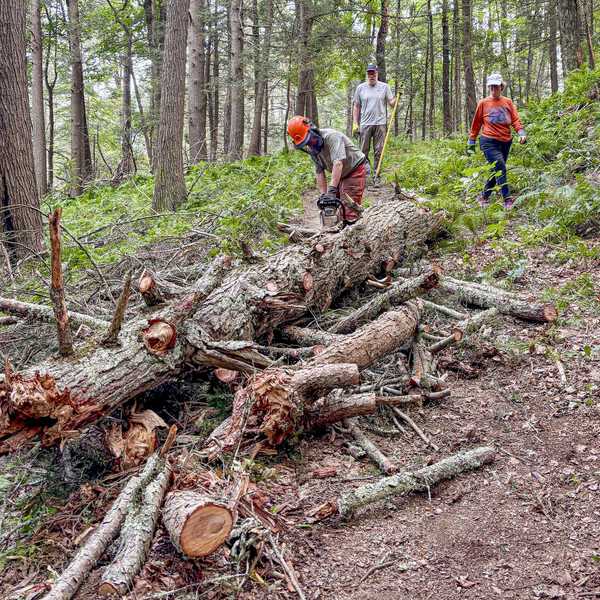
For 2022, the trail is officially 2,194.3 miles long, thanks in part to trail work done by the Appalachian Mountain Club (AMC) on sections in New York and Connecticut. Much of the AT runs through privately owned land; this new work by AMC members shifted the trail over onto National Park Service lands.
You can get details about the AMC (which maintains sections of the trail between Maine and Washington, D.C.) and find out how to volunteer for future work details at www.outdoors.org. The website also has useful information on, for example, where there are overnight shelters along the trail. You can learn about the Appalachian Trail parent organization (the Appalachian Trail Conservancy) at www.appalachiantrail.org.
But if you’re looking for serious up-to-the-minute data (and if you want to register as an AT hiker), then you should go to the Appalachian Trail Conservancy’s registration pages at www.atcamp.org. There you can find explanations of why you should bother to register, and tips on when and where to begin your journey.
As a journalist, I particularly like the page that shows how many hikers have registered and started walking. If you’ve lived in the Tristate region for long enough, you start to see the hikers as an indicator of the seasons. Sometimes the lilacs bloom late or early; sometimes the first hikers appear earlier or later.
In 2020, shortly after the start of the COVID-19 pandemic, there were only 42 hikers who started out on April 1, and the numbers dwindled from there. In 2021, the majority of hikers doing the traditional south-to-north journey started out on April 1. There were 56 hikers on that date.
In 2022, there were 65 hikers who registered to start on April 1, but the following day (April 2) there were 66 hikers. On April 3, an additional 63 hikers headed north and the numbers have remained steadily high since then.
The first hikers began to appear in our towns in mid May. If you see a hiker on the road, give him or her a wave but don’t be surprised not to get a response. Often, to help them survive the many hours and days of walk, walk, walk the hikers go into a sort of fugue state. They’re most likely to be most friendly if you see them seated and relaxing with a lot of high-calorie food outside a grocery store.
If you want to help a hiker along the way, think about leaving some food or cold drinks in a cooler with a sign that says Trail Magic. Or if you see a hiker or two who are depleted and hoping for a ride, pull your car to the side of the road and let them clamber in if you have space for all their gear. But keep in mind that you might want to roll down all the windows first.

 Pay Bill for Robin Starr’s service in the Continental Army.Courtesy the Alex Breanne Corporation
 John Mills speaking at Quinnipiac University.Courtesy the Alex Breanne Corporation
 Stephanie Saetta,with her rescue dog George and Blue (left), a shepherd mix awaiting his forever home.Madi Long
 Blue, a 7 year-old Shepard mix, is waiting for his forever home. Madi Long









