I was checking out at a supermarket not long ago—basically an out-of-body experience these inflationary days—and while I was focusing on keeping my head attached and putting my credit card back where it belonged, my checker took my bags and started packing them.
When consciousness bubbled up, I realized she had taken the largest bag and loaded it with six big cans of plum tomatoes, four cans of soup, eight bars of Cabot cheese (it was on sale), and more besides. I gave it a trial heave, just to show I was a sport, but there was no way.
“I can’t lift this bag,” I said. “You have so many cans,” she said, proving that watching politicians on the evening news had in fact been instructive re: offering evasive non sequiturs as being responsive.
Feeding a big group
This recipe feeds a lot of people, 12 at least, or a smaller number can eat it for several days, as it keeps well. You can make it ahead of time and it doesn’t suffer, and neither will you—is there anything better than having people over and not having to do a lot at the last minute?
This is very easy to serve up without a lot of fuss. The first time, I put it together from what was in the refrigerator—sometimes that works out. Don’t be discouraged by the list of ingredients, or by the initial prep work. A lot of chopping, but then it’s done.
If you are a vegetarian, you can probably substitute drained and rinsed canned beans—Roman, navy beans, etc., and I use Goya, they’re the best ones—for the meat, although I haven’t done this.
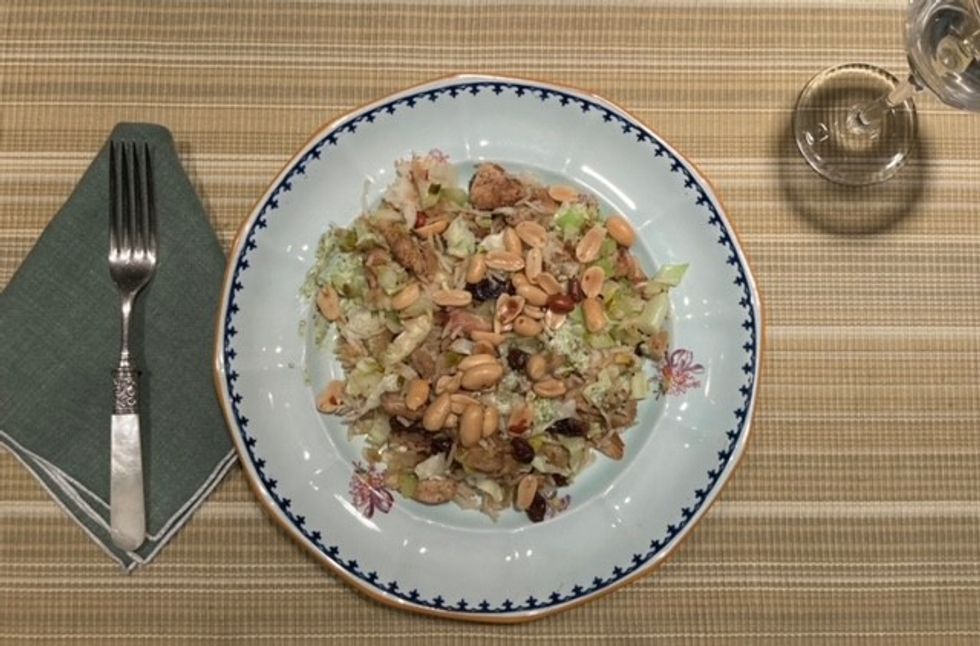
Really Good Chicken And Rice
4 to 5 cups cooked chicken. I first made this with duck, but chicken is easier to come by. Cut or shred into bite-size pieces.
4 bunches scallions—about 20, trimmed, coarse stalks cut off, thinly sliced
One 1-pound package frozen cauliflower. Cook in the microwave, drain, squeeze out excess liquid moderately with paper towels, chop into bite-size pieces
Hot pepper flakes to taste, at least a teaspoon. I use very hot peppers chopped and put into a jar with a neutral olive oil (Berio). This will keep for a few days in the refrigerator and it’s guaranteed to set your mouth on fire. But the pepper flakes are okay. A hottish afterburn is what you want.
10 Mission figs. Remove the tough stems, then slice.
3/4 cup sultanas or raisins. Soak in hot water to cover for about half an hour to soften. Drain.
2 teaspoons ras el hanout, a North African spice, which can be found in the supermarket spice section. This has a very unique flavor, and its contribution to the finished dish is out of proportion to the amount used. It’s important.
5 cups cooked basmati rice
Using a big, deep skillet (mine is non-stick) or a cast-iron casserole, sauté the scallions over low to medium heat in some butter and neutral olive oil—a few tablespoons of each will do.
When they are softened, make a well in the center, put in a little more oil, and add the garlic. Cook for a minute or two, using a silicone stirrer to keep it from sticking to the pan. Don’t burn.
Stir in everything else, rice last. This is the base mixture you will keep in the refrigerator for up to a day or two until you are ready to serve.
At some point, chop:
1/2 head green cabbage and thinly slice, on the diagonal, 6 or so stalks of celery, and some of the good leaves in the center of the head.
Both of these can be kept, chopped and ready, in bowls in the refrigerator. Squeeze out a couple of paper towels with cold water and place them over the bowls. This will keep things fresh and crisp, but do check that the towels don’t dry out.
Make a cup of chicken stock using a bouillon cube. Vegetarians can use vegetable stock or water.
When you are ready to serve, mix together a couple of handfuls of celery, three or four handfuls of cabbage, and some big scoops of the base mixture. The base should be about 40% of the mix. Add about 1/4 cup (or more, depending on how much you’re serving; it should be moistened, not wet) of stock or water. Microwave, covered, for about 4 and a half minutes at full power,until hot. Serve in heated bowls, with:
Chutney—I buy Stonewall Kitchen Mango, and Patak’s Major Gray
Plain whole-milk yogurt—by itself, or mixed with your chopped herb of choice (parsley, basil, sorrel), a little olive oil, and a pressed garlic clove. This can be made ahead.
Salted peanuts, sprinkled on top
Well, I’m exhausted, and all I did was tell you how to do this. Anyway, I was thinking about the grocery bagging. What you want to do is put the heavy stuff into small bags and put those onto the floor of the back seat. Then take your big bag, which you’ve filled with good bread, soft cheese, berries, tomatoes, potato chips—all the fragile things that make life worth living—and sit that on top.
Pam Osborn keeps her kitchen in Sharon.



 Tiffany Lemelin, shelter manager, brushing Marsala upon arrival.Provided
 Michael DeBarba, certified dog trainer working with Marsala.Jennifer Almquist
 Marsala wins a heart.Jennifer Almquist

 Sadie, center, a Carolina dog, plays with her friend Negra, a terrier mix. Bella Linda, the small poodle, has since been adopted.L. Tomaino
 Wesley, a young, exuberant mix, is looking for an active home.L. Tomaino
 Bonnie and Clyde, an affectionate terrier pair.L. Tomaino

 Provided