Hotchkiss girls on 15-game win streak

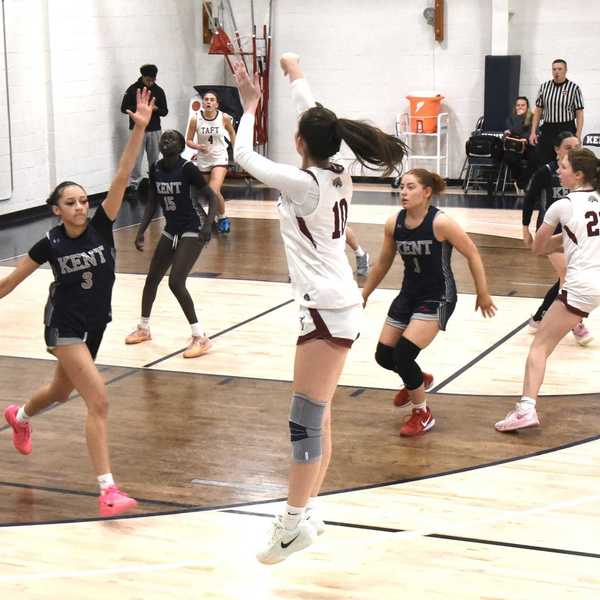
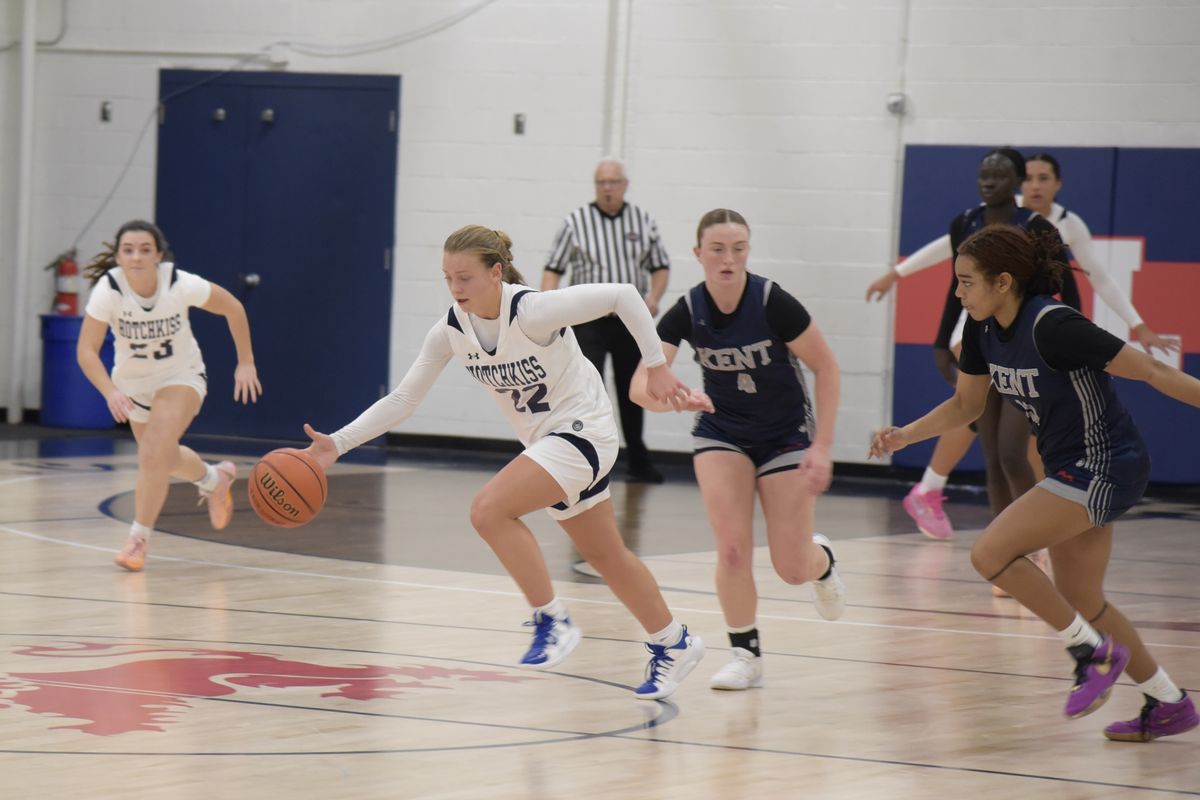
Eleanor Helm leads a fast break for Hotchkiss Feb. 12.
Lans Christensen

Eleanor Helm leads a fast break for Hotchkiss Feb. 12.
KENT — Since losing the first game of the season, The Hotchkiss School’s girls basketball team has been perfect.
The win streak extended to 14 following a visit to Kent School Feb. 12.
After winning the opening tip-off, Hotchkiss scored three quick baskets by Morgan Jenkins.
Kent managed to keep the game close and under control for the first half thanks in large part to Kaya Nuttall and Celeste Harper. Both made three pointers and were near-perfect from the free-throw line.
The first half ended with a Hotchkiss lead 30-24. The Bearcats pulled ahead in the second half with superior rebounding, shooting and play execution.
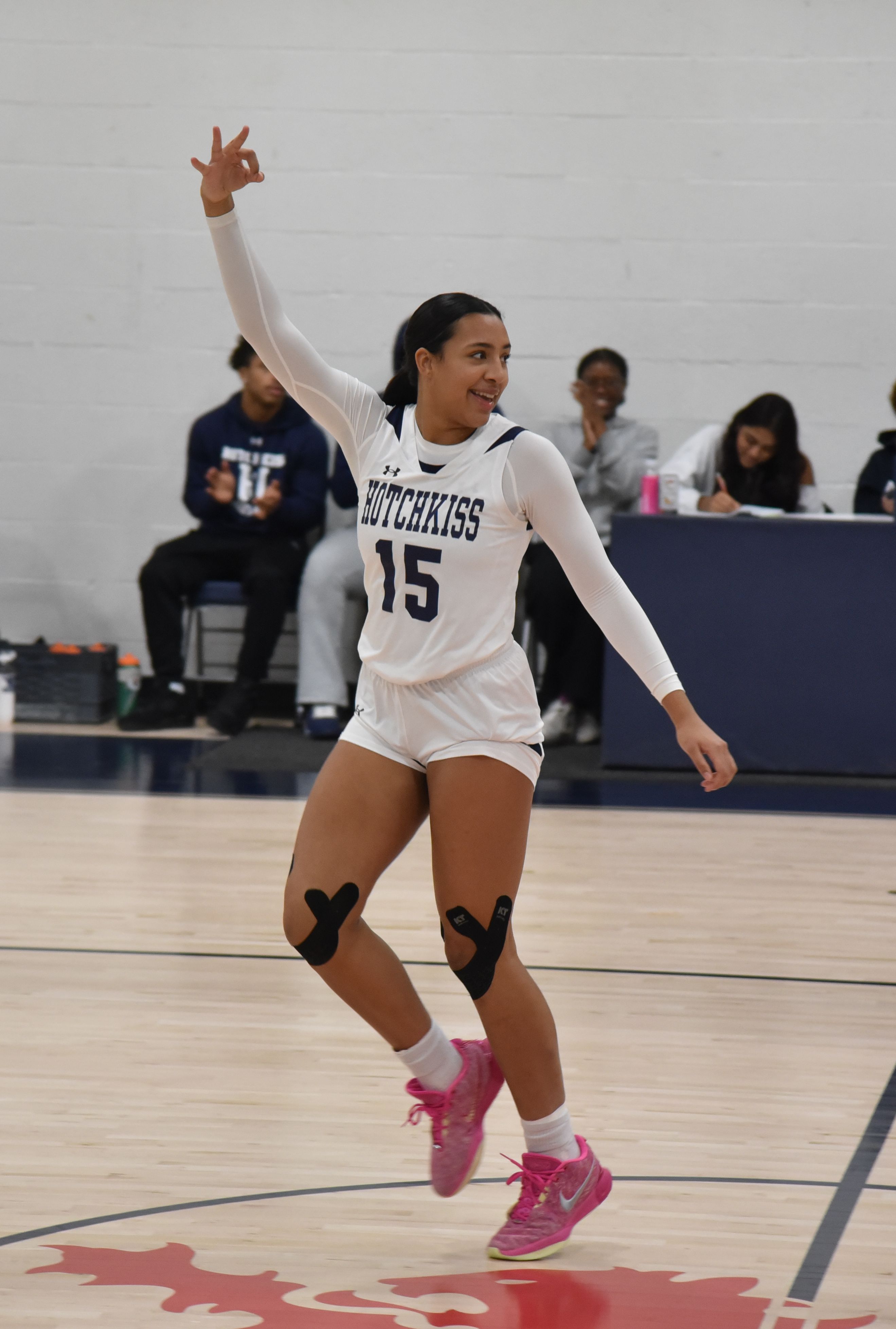
Hotchkiss’ star seniors Morgan Jenkins and Kaila Richards were leaders on the court. Both surpassed 1,000 varsity points earlier this season.
Eleanor Helm of Hotchkiss added to the winning effort by sinking three-pointers with frequency and leading a coordinated plan of attack.
In the end, Hotchkiss defeated Kent 69-49.
Hotchkiss then defeated Taft School 66-55 on Feb. 15 and the Bearcats’ season record improved to 15-1.
New England Prep School Athletic Council postseason tournaments begin in March.
Municipal elections across Northwest Connecticut in 2025 largely left the status quo intact, returning longtime local leaders to office and producing few changes at the top of town government.
With the exception of North Canaan, where a two-vote margin decided the first selectman race, incumbents and established officials dominated across the region.
In North Canaan, Democrat Jesse Bunce narrowly defeated Republican Brian Ohler by just two votes. The result, which required a recount, marked the only contested change in first selectman among the Northwest Corner towns. North Canaan also recorded the region’s highest voter turnout, with 53.5% of registered voters casting ballots, ranking 10th statewide.
In Cornwall, voters re-elected Democrat Gordon Ridgway, who ran unopposed for his 18th term as first selectman and has served in office for 34 years. In Salisbury, voters again returned Democratic First Selectman Curtis Rand, also unopposed, electing him to an 11th term and extending a long period of continuity in town leadership.
Falls Village voters re-elected all three members of the Board of Selectmen, keeping cross-endorsed First Selectman Dave Barger (D/R) in office alongside Selectman Chris Kinsella (D) and Selectman Judy Jacobs (R).
In Sharon, voters returned First Selectman Casey Flanagan (D) and re-elected selectmen Lynn Kearcher (D) and John Brett (U), maintaining the town’s existing governing board.
Kent was the only other town to see a change in first selectman, though not through a competitive race. Democrat Eric Epstein was elected first selectman in an uncontested race, succeeding Marty Lindenmayer, who did not seek reelection after being in office for just one term. Kent voters, however, approved a local referendum banning recreational cannabis dispensaries.
Turnout across the Northwest Corner remained high despite the limited number of contested races. Kent recorded 47.7% voter participation, followed by Falls Village at 44.2%. Sharon, Cornwall and Salisbury each posted turnout slightly above the statewide average of about 40%.
Election officials described Election Day as orderly, aided by early voting and new state-issued voting tabulators.
In post-election discussions, however, local registrars raised concerns about the administrative burden of expanded early voting, saying the state’s 14-day mandate was too long and strained small towns’ finances and staffing.
The Boards of Selectmen across the six towns in Region One now consist of 11 Democrats, five Republicans, and two unaffiliated members. Compared with the previous term, Republicans increased their numbers by two, while unaffiliated members declined by two.
A boater prepares to launch from O’Hara’s Landing at East Twin Lake this past summer, near the area where hydrilla was first discovered in 2023.
SALISBURY — After three years of mounting frustration, costly emergency responses and relentless community effort, 2025 closed with the first sustained signs that hydrilla — the aggressive, non-native aquatic plant that was discovered in East Twin Lake in the summer of 2023 — has been pushed back through a coordinated treatment program.
The Twin Lakes Association (TLA) and its coalition of local, state and federal scientific partners say a shift in strategy — including earlier, whole-bay treatments in 2025 paired with carefully calibrated, sustained herbicide applications — yielded results not seen since hydrilla was first identified in the lake.
The arc of the problem
The Connecticut River strain of hydrilla at East Twin Lake, first detected near O’Hara’s Landing Marina, is an unusually robust variant that quickly triggered emergency removals, diver searches and spot treatments, as TLA officials scrambled to contain fragments capable of rapidly sprouting into new beds.
By 2024, the cost of fighting the invader had grown significantly, straining both community and association budgets as managers moved from isolated spot treatments to serial applications and broader planning efforts. Monitoring and repeated partial treatments that year helped prevent larger outbreaks but failed to eliminate the plant.
“It became pretty clear that the Whack-a-Mole strategy wasn’t going to work,” said George Knoecklein of Northeast Aquatic Research, the TLA’s limnologist.
A strategic pivot in 2025
Drawing on lessons from earlier seasons, TLA leaders and limnologists adjusted their approach in 2025. Instead of reactive, site-by-site responses, the association began the season with a planned, sustained dosing of the northeast cove of East Twin Lake and the lake’s full littoral zone beginning in late May, maintaining low, permitted concentrations of the systemic herbicide fluoridone throughout the growing season.
Operationally the work involved close tracking of application tracks, repeated water sampling to confirm target concentrations, and diver-assisted surveys in deeper water to find any remaining pockets.
The payoff: hydrilla retreated in 2025
By mid-summer and into early August, field surveys and association updates reported a dramatic decline in visible hydrilla within the lake.
At the TLA’s annual August meeting, association leaders described the season as “the first good news we’ve had in three years,” while cautioning that the victory is fragile and requires continued monitoring and rapid response to any new fragments or regrowth.
At the annual meeting, it was announced that the final two planned applications of the herbicide Sonar would not be needed. The slow-release pellets currently in the water are expected to remain effective, reaching the target duration of 120 days.
TLA officials reported that East Twin Lake is closer than ever to achieving a functional eradication of the invasive plant infestations.
They emphasized, however, that this progress has been made possible through continued funding, permitting, and close coordination with state partners. The success of this effort could also provide valuable insights for addressing similar challenges in other lakes affected by the Connecticut River strain.
Why this year’s approach mattered
Several elements distinguished the 2025 season: an earlier start to herbicide applications, sustained low-level dosing, frequent monitoring, and data-driven coordination among the TLA, its limnologist, state and federal agencies, and contractors.
The payoff came at a price: three years of repeated interventions had driven lake management expenses sharply higher, and the 2025 season required continued fundraising and justification to town and state stakeholders.
The wider use of herbicides in waterways remains controversial in some quarters, and TLA officials stressed that the treatments used in East Twin were done under state permits with scientific oversight — and that results would be shared cautiously as case studies for other affected lakes.
What comes next
TLA and partners made clear the 2025 results are cause for cautious optimism, not celebration.
The next steps include diver-assisted surveys of deepwater areas to check for any surviving turions or isolated plants; continued low-level surveillance and rapid spot treatment to snuff out any reappearance and sharing methodologies, and monitoring data with neighboring lake groups and state programs to refine best practices for tackling the Connecticut River strain.
The lake association’s Fall newsletter reported that while treatment costs are expected to be moderate in 2026, “the heightened level of surveillance will continue.” The TLA predicted $400,000 will be spent on lake management next year.
By the end of 2025, what began as an emergency discovery in East Twin in 2023 had evolved into a test case for a new, more intentional treatment model. The TLA and its partners achieved the first season in which hydrilla substantially receded in the lake — a breakthrough that shows the combination of early action, sustained dosing and disciplined monitoring can work against this particularly aggressive strain.
That success, however, comes with an explicit rider: vigilance, funding and science-backed management must continue if the Twin Lakes are to remain hydrilla-free.
Salisbury’s Joel Blumert, center, is flanked by Linda Huebner, of Halifax, Vermont, left, and Trish Walter, of Collinsville, atop the summit of Bear Mountain on New Year’s Day. It was Blumert’s 1,000th climb of the state’s tallest peak. The Twin Lakes can be seen in the background.
SALISBURY — The celebration was brief, just long enough for a congratulatory hug and a handful of photos before the winter wind could blow them off the mountaintop.
Instead of champagne, Joel Blumert and his hiking companions feted Jan. 1 with Entenmann’s doughnuts. And it wasn’t the new year they were toasting, but Blumert’s 1,000th ascent of the state’s tallest peak.
The 76-year-old Salisbury resident has been hiking Bear Mountain twice a week, with only sporadic lapses, for nearly a dozen years. On New Year’s Day, Blumert reached the goal he set a few years ago of 1,000 climbs.
He has hiked it in the wintry cold and the summer heat, amid the splendor of the autumn foliage and even in the middle of a daunting tornado.

“It’s just been one step at a time and one climb at a time,” said Blumert, a musician who performs mostly at area nursing homes.
Blumert and his wife, Theresa Carroll, moved to Sharon in 1985 and to Salisbury in 1987, in part for the outdoor recreation the Tri-State region offers. But after their two daughters, Shayna and Denali, were born in the 1990s, Blumert’s exercise regimen started to lag.
In 2000, his doctor reported he had “ridiculously high blood pressure.”
“I decided if I was going to die of a stroke, it was better to die in the woods than sitting around the house,” Blumert said.
He began hiking again and rebuilt his endurance. In March 2014, he summited Bear Mountain, which at 2,316 feet is the highest peak in Connecticut. (The state’s highest point at 2,380 feet lies on the south slope of Mount Frissell at the border with Massachusetts.)
It was Blumert’s first hike up Bear in several years. As he gazed at the Twin Lakes shimmering below, he said to himself, “I love this mountain. I’m going to do this once a week.”
He grew to love the hike so much that after a year he doubled it to twice a week. Since then, Blumert has stuck to his weekly ritual with only occasional pauses for out-of-state trips or illness, along with one 13-week stretch when a pulled ligament in his pelvis planted him on the couch.
He knows the 2.9-mile route intimately, from the Undermountain trailhead off Route 41 to the intersection with the Appalachian Trail and on to the summit. In his sojourns, he has seen porcupines, deer, a timber rattler, a pair of copulating copperheads (“Or maybe they were milk snakes; I didn’t interrupt them to find out”), owls and redtail hawks — yet not a single bear.
Soon after he began hiking Bear regularly, Blumert made another vow: He would be cheerful and friendly to every hiker he met on the mountain. “I’ve developed trail friendships with 20 to 30 people,” he said.
One of them is Collinsville resident Trish Walter, who became a regular hiking buddy and has now climbed the mountain with Blumert about 70 times over the past five years.
Walter and her friend, Linda Huebner, of Halifax, Vermont, joined Blumert for his milestone hike on New Year’s Day. With 4 inches of snow having fallen the night before, they set foot shortly after noon and reached the top just before 3 p.m. The trek back down took half that time.
Aside from the blustery wind approaching the summit, they enjoyed a spectacular day of bright sunshine and blue skies.
The weather hasn’t always been so cooperative. Blumert was once nearly struck by lightning on the upper ridge. And this September, he hiked down in what he described as a tornado.
“It came right down Undermountain Trail,” he noted. “Trees were swishing back and forth. Branches were flying everywhere. There was grape-sized hail. It was scary.”
Now that he has reached his goal, Blumert plans to cut back to one hike of Bear each week. That will free time for other climbs in the area, a recumbent bicycle he has bought, and yet another mountaineering goal.
“I want to complete the 4,000-footers in New Hampshire,” Blumert said. “There are 48 of them, and I’ve done 23.”
Tessa Dekker, four-year basketball player at Housatonic Valley Regional High School, was named female Athlete of the Year at the school's athletic award ceremony in May 2025.
FALLS VILLAGE — From breakthrough victories to record-shattering feats, the past year brimmed with moments that Housatonic Valley Regional High School athletes will never forget.
From the onset of 2025, school sports were off to a good start. The boys basketball team entered the year riding high after winning the Berkshire League/Connecticut Technical Conference Holiday Tournament championship on Dec. 30, 2024.
Basketball games were well attended last winter thanks in part to the return of the Mountaineer cheerleaders. The squad performed halftime shows and coordinated themes for the audience, such as Hawaiian night.
“We made the themes really pop off,” said cheer captain Taylor Terwilliger.

The birth of a new Berkshire League rivalry emerged between HVRHS and the newly created Lakeview High School. The bleachers were packed when the girls and boys teams faced off back-to-back in Falls Village Feb. 5. HVRHS won the girls game 59-43, but Lakeview won the boys game 71-60.
At the end of the basketball season, Daniela Brennan was chosen to receive the Berkshire League’s Edward B. Kolakoski Sportsmanship Award.
The Housatonic co-op hockey team played its final game last winter. After the season, the co-op disbanded and this year HVRHS players are in a new co-op hosted by New Milford High School.

Players took to the diamonds come springtime for baseball and softball. In addition to high school teams, the Region One Middle School Mountaineers fielded teams for both sports.
Varsity baseball went on to earn a state tournament bid as the 21 seed. The boys played 12 seed Haddam-Killingworth High School in the first round and remained tied until a final inning walk-off win for HK.
Varsity girls lacrosse had a stellar season on the field and made it to the Western Connecticut Lacrosse Conference championship game. They ran into top-ranked Watertown High School and after a back-and-forth battle, Watertown won 6-4.

Track and field athletes made waves last season, breaking several school records and taking home 10 gold medals at the Berkshire League finals and festival. Sixteen Mountaineers represented HVRHS at the Class S state meet in New Britain and five went on to qualify for the State Open meet: Anthony Labbadia, Mia Dodge, Kyle McCarron, Gabi Titone and Ryan Segalla.
Labbadia’s performance in the triple jump earned him a spot at the New England track and field championships. His best distance of 44 feet and one inch stood for ninth place in New England and set the new HVRHS record. The previous school record of 43 feet eight inches was set by Don Hurlbutt in 1967.

Athletics continued into the summer with the Housy Hoops teams at the Torrington Summer Basketball League and the Housy Juniors in the Babe Ruth League summer baseball program. The girls basketball team became TSBL runners up after making it to the championship game against Lewis Mills.
When school started up in late August, fall sports swung into action beginning with varsity golf. Jonas Johnson went on to win the longest drive award at the Berkshire League golf all-star tournament Tuesday, Oct. 14.

Girls and boys soccer teams had historic seasons on the field and both qualified for the postseason tournaments.
The boys soccer team defeated Shepaug Valley High School for the first time in five years. The 1-0 win came in the Berkshire League tournament semifinals.
On the girls team, Ava Segalla set the new school scoring record with a total of 134 varsity goals. She surpassed the previous record of 120, which was set by her sister Sydney Segalla in 2021.
“Having scouts for the first time was definitely a very rewarding experience,” Segalla said. “It was exciting to see my hard work paying off.” Segalla committed to play Division I soccer at Sacred Heart University.
Girls soccer made a deep run in the Class S tournament, concluding with a showdown against Morgan High School in the semifinals. Morgan went on to become Class S champions.

HVRHS had three cross country runners medal at the BL championship Oct. 16. Olivia Brooks placed 11th, Hannah Johnson placed 17th and Finn Malone placed 18th.
Gilbert/Northwestern/Housatonic’s co-op football team was led in large part by the Mountaineers with eight seniors on the team. The team faced a top-heavy schedule and started the season 1-4. But they stayed disciplined and battled back to a 5-5 finish, concluding with a 34-0 shutout win in the Turkey Bowl.

“Out of the four years I’ve been playing, undefeated on Thanksgiving. No one will ever take that away from me,” said GNH captain Wes Allyn after the win.
Winter sports returned in December beginning with basketball. The girls team has a lot of young talent in new freshmen, and the boys team features a senior-heavy roster.
“I’m feeling very optimistic,” said senior captain Victoria Brooks. “Our strength is definitely going to be our dedication this year.”