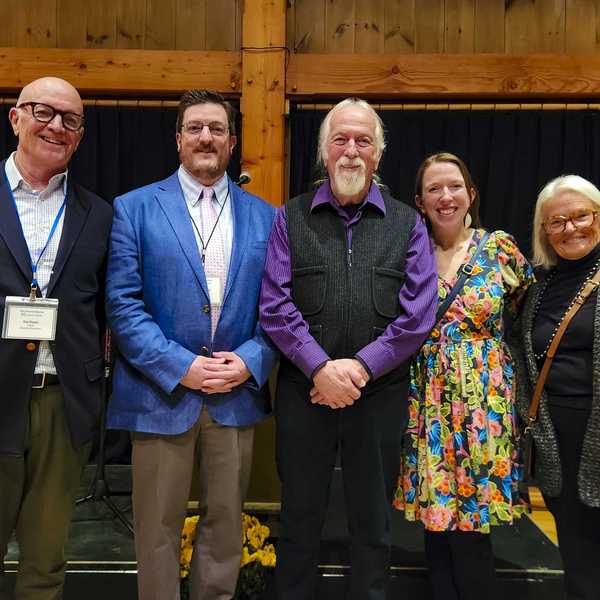
KENT – Politics and ice cream shared the spotlight Saturday as Gov. Ned Lamont, a Democrat who is seeking reelection this fall, stopped at 45 on Main after a visit to Lime Rock Park.
The governor chatted with supporters who gathered at the popular Kent ice cream shop and treated them to ice cream or cold drinks, a gesture that was especially welcome in the hot, humid weather.
Accompanied by state Rep. Maria Horn, D-64, of Salisbury, Lamont fielded questions on a wide range of topics, including immigration, energy costs, housing and healthcare.
Referring to Republican gubernatorial candidate Ryan Fazio’s pledge to repeal the Trust Act — a state law that limits when local and state law enforcement may cooperate with federal immigration authorities — Lamont said the measure originally received bipartisan support before Republicans later backed away from it. He added that the law keeps ICE agents away from courthouses and schools.
“It’s called a Trust Act for a reason,” interjected Horn.
Energy costs also drew questions from the attendees. Lamont said Eversource’s operations were “a disaster” a year ago and believes the utility has become more responsive to public concerns, though he acknowledged the need to bring electric rates under control.
“The big problem is that there is not enough generation, but we’re making slow progress.”
Asked about nuclear power, Lamont said the Millstone nuclear power plant, owned by Dominion Energy, would like to increase the price of its power. “It’s clear you have to pay for overruns.”
He also discussed the growing number of large data centers around the country.
“They would use more power than Litchfield County times two,” Lamont said.
Mary Weber of Washington, a local activist and chair of the Board of Education, said Lamont’s Democratic primary opponent, state Rep. Josh Elliott of Hamden, wants to eliminate local property taxes and replace them with a single state income tax. She said that would mean owners of multimillion-dollar weekend homes would pay nothing, shifting the burden to local residents. “That’s insane,” she said.
Lamont responded, “You can make up stuff when you’re running for office.”
Turning to another proposal aimed at helping homeowners, Lamont said towns have the ability to adopt a homestead exemption, which protects up to $250,000 in equity in a homeowner’s primary residence, or $500,000 for married couples, from forced liquidation by judgment creditors. The protection applies to real estate, cooperatives and mobile homes.
“I want to really drill down on that to help all-year residents and others,” said Horn.
Asked about outward migration from Connecticut, Lamont said he would not pay large corporations to relocate to or remain in the state, as some of his predecessors had done.
“My focus is to grow small businesses. They create most employment,” Lamont said, adding that they are continuing to grow. He also said Connecticut ranks No. 12 in the nation for economic growth.
Housing also came up during the discussion. Horn said workforce housing is needed to help young people find affordable places to live, raise families and help stabilize school enrollment.
“We’ll do everything we can to make housing happen,” Lamont said, while noting that 80% of state housing funding goes to Connecticut’s 10 largest cities.
Looking ahead, Lamont said he is most concerned about healthcare when President Trump’s “Big Beautiful Bill” takes effect, estimating it could cost Connecticut $400 million. While some hospitals — including Sharon Hospital, he said — do a good job controlling costs, many residents could face large medical bills.
Lamont ended his visit by crossing Route 7 to greet the “No Kings” protesters who are on Main Street every Saturday afternoon. While sipping on a coffee milkshake, he praised them for their efforts, informing them that 18 of the Declaration of Independence signers were immigrants.






 Pay Bill for Robin Starr’s service in the Continental Army.Courtesy the Alex Breanne Corporation
 John Mills speaking at Quinnipiac University.Courtesy the Alex Breanne Corporation
 Stephanie Saetta,with her rescue dog George and Blue (left), a shepherd mix awaiting his forever home.Madi Long
 Blue, a 7 year-old Shepard mix, is waiting for his forever home. Madi Long