Thank you!
Your support is sustaining the future of local news in our communities.

Republicans gather to hear candidate Ryan Fazio speak in Kent

Governor’s Race

Republicans gather to hear candidate Ryan Fazio speak in Kent

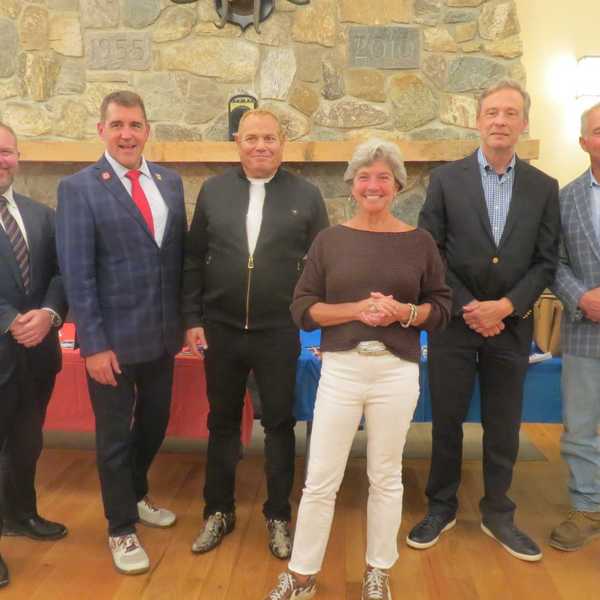
Ryan Fazio, the Republican candidate for governor, addresses supporters Thursday in Kent. The event was moderated by Tom Morrison, chairman of the Salisbury Republican Town Committee.

Ruth Epstein

KENT — Republican gubernatorial candidate Ryan Fazio pledged to cut taxes, lower electric bills and return more authority to local communities during a campaign stop Thursday, telling more than 50 supporters that Connecticut’s problems stem from what he called failed state leadership.

Speaking at the Kent Community House, Fazio outlined a platform centered on a proposed $2 billion middle-class tax cut, reducing government spending, lowering energy costs and rolling back state policies he said have eroded local control over issues such as zoning.

Fazio, 36, represents Connecticut’s 36th House District and is challenging Democratic Gov. Ned Lamont in November. The event was hosted by the Republican town committees of Kent, Salisbury and Sharon and moderated by Salisbury Republican Town Committee Chairman Tom Morrison.

He said the first step, if elected governor, would be limiting the growth of state spending, arguing that Lamont’s budgets have grown by about 8% annually while Connecticut continues to take on more debt.

“I’m proposing a $2 billion middle-class tax cut,” he said.

Second, Fazio said he would work to reduce electric bills.

“We have the second highest bills in the country ahead of Hawaii and California,” he said. “The fault is in our state policies and the governor.” He criticized the public benefits charge on electric bills, saying while some of the programs it funds have merit, the costs have grown beyond what taxpayers should bear.

Fazio also argued that Connecticut’s tradition of home rule has been undermined by the governor, pointing to zoning policies as an example.

“I believe we need more housing, but developers and the governor shouldn’t override decisions by those who know their towns best,” Fazio said, drawing applause from the audience.

“This state could flourish like nothing else,” Fazio said. “Yet Connecticut is struggling. Why? Because of the failure of state leaders and their policies.”

He talked about citizens hurting due to what he deemed high taxation, making it difficult for them to put down roots, purchase homes or retire. “This election represents a turning point; gives us a chance to change the trajectory.”

Morrison, the moderator, asked Fazio a series of questions, including why he thought he could achieve his goals if the General Assembly is under Democratic control.

Fazio, who touted his ability to work with elected officials from across the aisle, replied, “We can always find common ground. For example, everyone can agree taxes and electric bills are too high.”

He also noted the governor has veto power for leverage, “but I will not promise anything that is not realistic.”

Asked to talk about education, Fazio said current reading scores among certain grade levels are unacceptable. He called for higher expectations, getting back to basics and more instructional time in the classroom.

Fazio touched on the Trust Act, a state law that limits local and state law enforcement from cooperating with federal immigration authorities (ICE), which Lamont supports. “Legal immigration is good and necessary, but we need laws to protect our safety,” Fazio said, stating if he became governor he would repeal it.

Morrison mentioned a recent poll showing Fazio trailing Lamont by 13 points and asked for his reaction. Fazio dismissed the survey, saying it did not accurately reflect the state of the race.

On a lighter subject, Morrison asked Fazio if Connecticut should have participated in the recent National Fair on the National Mall in Washington, D.C. “I regret he didn’t participate,” he replied.

The event concluded with questions from the audience.

Latest News

Oresta O. Szeparowycz

Oresta O. Szeparowycz

PINE PLAINS — Oresta O. Szeparowycz was born Nov. 17, 1938, in Lviv, Ukraine, and died on Aug. 26, 2026, in Dover Plains, New York, after a long, remarkable life. A talented artist, she passed away in her sleep, from cancer, just days before the opening of her inaugural sculpture exhibit in Millerton. She was 87.

The daughter of the late Daria and Omelian Szeparowycz, her birth name was Orysia but she changed it to Oresta in the early 1950s, soon after arriving in New York City from a displaced persons camp in Germany. Both names stem from the ancient Greek for “of the mountains.”

Keep ReadingShow less

Gretchen Rath Doolittle

Gretchen Rath Doolittle

WEST CORNWALL — Gretchen Rath Doolittle, former longtime faculty member and Director of Studies at both the Indian Mountain School in Lakeville, Connecticut, and South Kent School in South Kent, Connecticut, died quietly at home on Sunday, Sept. 20, after spending the day surrounded by family and neighbors. She had kidney cancer.

Gretchen Rath, who as a young adult took her mother’s name (Dewitt) as a middle name, was born on Oct. 26, 1933, in Washington, DC to Gordon Brandon Rath, a veteran of the Great War, and Dewitt (Gertrude) Norris Rath.

Keep ReadingShow less
Doug Tallamy’s work in progress: saving the planet one backyard at a time

Windacre, a 25-acre property in Millerton will be the site of “Work in Progress,” an afternoon with acclaimed entomologist, New York Times bestselling author and Homegrown National Park co-founder Doug Tallamy.

Provided

For nearly three decades, Doug Tallamy, a professor at the University of Delaware and co-founder of Homegrown National Park, has studied the intricate relationships between native plants, insects, birds and the ecosystems that sustain them. His books, including “Bringing Nature Home” and “Nature’s Best Hope,” have helped shift the conversation about conservation from something that happens primarily in parks and preserves to something ordinary people can practice on the land around them.

On Sunday, Oct. 4, Tallamy will bring that conversation to Windacre in Millerton for “Work in Progress: Toward Native Fields,” an outdoor gathering exploring both the possibilities and the complications of restoring private land for biodiversity.

Keep ReadingShow less
google preferred source

Want more of our stories on Google? Click here to make us a Preferred Source.

Celebrating Dick Hermans’ life built around community

Dick Hermans in the Oblong Bookstore on Millerton\u2019s Main Street in 1985.

Provided
No matter what I’ve done, I’m trying to be useful to the communities I’m associated with.
— Dick Hermans

When Dick Hermans receives the Estabrook Community Leadership Award on Oct. 11, he will accept it for a lifetime of work that has taken many forms: bookseller, radio host, school board member, advocate for the Harlem Valley Rail Trail, business owner, volunteer and, perhaps most importantly, a person who has consistently looked for ways to be useful to the communities around him.

The Lakeville Journal and The Millerton News will present Hermans with the 2026 award at the annual Jubilee celebration at the Sharon Playhouse. The award honors outstanding leadership in community service and was inspired by Mary Lou and Robert Estabrook, former owners of the newspapers who believed that strengthening a community extended well beyond the work of publishing a newspaper.

Keep ReadingShow less
Tending the Fire: Homelands PowWow brings Mohican culture home to the Berkshires

Members of the Stockbridge-Munsee tribe at Homelands PowWow in 2025.

Joeseph Plante New Media Storytellers
Our goal is to continue building an annual gathering that honors the history, culture and traditions of the Stockbridge-Munsee Band of Mohicans in their original Homelands.


For the Stockbridge-Munsee Mohican people, the Berkshires are not simply a place to visit. They are ancestral homelands.

Keep ReadingShow less
Ancram Center’s “A Number” doubles questions of identity
Ledbetter (left) and Wojda (right) on the set of “A Number” at Ancram Center for the Arts.
Jeff Mousseau

How would you feel if you found out you weren’t the only you — if there was an exact replica of you? What if you found out that you’d been cloned? Would you believe that you’re the real you? Would you suspect you might be a copy of the original? How could you be sure anything about your life was real? These are some of the questions posed in Caryl Churchill’s play “A Number,” opening at the Ancram Center for the Artson Oct. 1.

Churchill was born in London in 1938 and has been hailed by the theaterl world as one of the strongest voices of her time to take on sexual politics and feminist themes. Her works garner pointedly considered analysis from the highest levels of theatrical intellectualism. Basically, it’s about as far from “The Lion King” as you can get. While she’s experimented with dance theater in the past, “A Number” is much more stripped down, highlighting Churchill’s chosen themes and the skills of both actors on stage.

Keep ReadingShow less
google preferred source

Want more of our stories on Google? Click here to make us a Preferred Source.

google preferred source

Want more of our stories on Google? Click here to make us a Preferred Source.