Liking the look of it

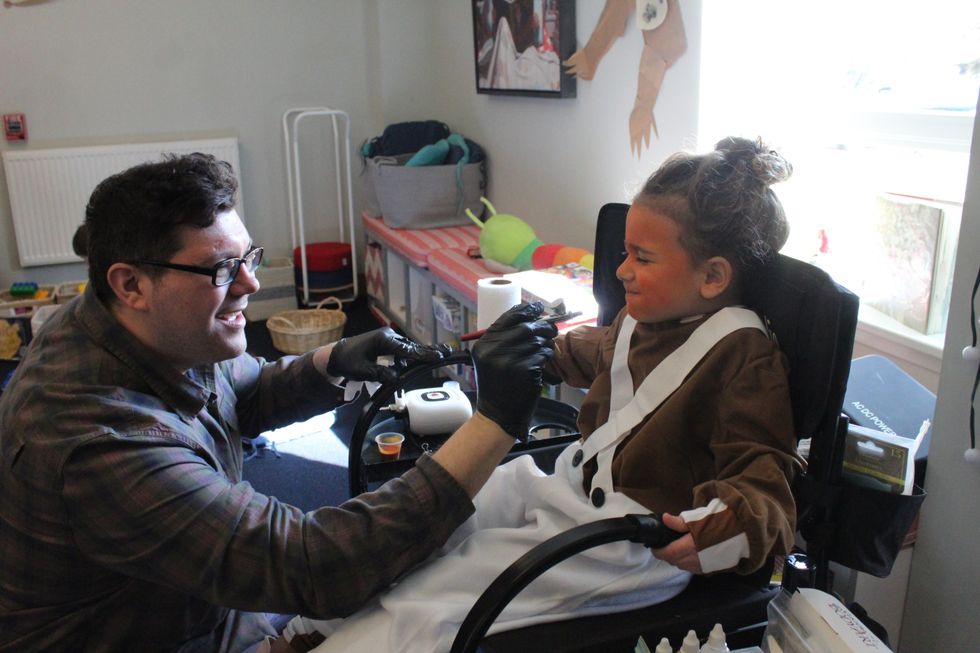
Charlotte “Charlie” Garippo won the golden ticket at Scoville Memorial Library’s Oompa Loompa makeover party.
Patrick L. Sullivan


Charlotte “Charlie” Garippo won the golden ticket at Scoville Memorial Library’s Oompa Loompa makeover party.
SALISBURY — Excited children waited for makeup artist Tyler Green and the Scoville Memorial Library’s Kendra Percy to pull the winning name Saturday morning, Feb. 24.
The prize was a professional makeover, from small child to Oompa Loompa.
The Feb. 24 event was the culmination of a “Willy Wonka” contest, with Charlotte “Charlie” Garippo, 4, of North Canaan as the big winner.
All the children received an Oompa Loompa makeup kit to take home, so if you spot an unusually orange child in the next week or so, now you know why.
Young Charlie was very focused and disciplined in Green’s makeup chair.
Apart from a tickling sensation caused by the air brush causing a momentary scrinching up of the face, she sat stock still as Green worked his magic.
After about 15 minutes, and the deployment of a wig of a particularly virulent shade of green, the transformation was complete.
Green, who lives in Litchfield, runs the Tyler Green FX studio and school in Winsted. Devotees of the SyFy channel will remember him from the network’s “Face Off” program.
He kept up a steady stream of light banter and jokes to keep Charlie at ease.
“This is ‘Oompa Loompa Orange,’” he announced grandly as he started.
“Actually, there’s no such thing. I made it up. Mixed it this morning.”
Christian Murray
NORTH CANAAN — North Canaan Selectman Brian Ohler resigned last week after a five-month medical leave, saying he could no longer justify remaining absent while the town’s three-member Board of Selectmen continued operating with only two active members.
Ohler’s resignation, effective July 31, follows a medical emergency in February that initially appeared to be a stroke. Although he has undergone extensive testing, doctors have not determined the cause, he said, and the search for answers continues.
“I have come to a very hard decision,” Ohler wrote in a Facebook post after filing his resignation. “It would be selfish of me to remain on such a prolonged medical leave when the residents and businesses of the Town of North Canaan deserve a full and active Board of Selectmen.”
He thanked residents for their support throughout his recovery and said he hopes improved health will allow him to return to public service.
“My love for the Town of North Canaan and the good people who also call it home is eternal,” he wrote. “The prospect of returning once again to elected municipal service in the future will remain the fuel and strength that lives within me.”
Ohler first announced his leave in March after describing symptoms that included double vision, slurred speech and paralysis on the right side of his body. While neurologists have not identified a definitive diagnosis, he has said physicians are also examining whether traumatic brain injuries sustained during his military service in Iraq and Afghanistan may have contributed to his condition.
Ohler notified First Selectman Jesse Bunce on Thursday, July 30, that he was stepping down.
“I wish him the best in his health, and I hope he can find out the cause of his issues,” Bunce said.
His absence had left the three-member Board of Selectmen operating with only Bunce and Selectman Melissa Pinardi. Although the two-member board could continue conducting business since it still met quorum requirements, the arrangement left little flexibility and created the potential for deadlocked votes.
“It’s a tough thing to run the town with two people,” Bunce said. “I do appreciate Brian giving us his resignation so we can move forward.”
Pinardi said it must have been difficult for Ohler to step down.
“Brian put his whole heart and soul into the town,” she said. “I know it was very hard for him to come to that decision. But he didn’t feel like he could give 100% right now.”
Ohler could not be reached for comment.
Replacement process begins
With Ohler’s resignation now official, town officials have begun the process of filling the vacancy for the remainder of his term, which was to end in November 2027.
Under Connecticut law, the town has 30 days from the date of the vacancy to appoint a replacement, according to Town Attorney D. Randall DiBella, a partner at Cramer & Anderson, who represents several towns. The appointment will be made by a vote of Bunce and Pinardi.
Since Ohler was elected as a Republican, DiBella said his replacement must be either a Republican or an unaffiliated voter. In this case, the Republican Town Committee is likely to recommend a candidate for the board’s consideration.
However, if Bunce and Pinardi cannot agree on an appointment, DiBella said the town’s elected Republican officeholders would choose the replacement.
Bunce said he plans to ask the Republican Town Committee to recommend a candidate and noted that Ohler did not suggest any potential successors before resigning.
Residents who disagree with the appointment may circulate a petition to force a special election. However, DiBella said that in his 40 years of representing municipalities, he has never seen a vacancy filled that way.
Long record of public service
Ohler has spent much of the past decade in public service. He represented Connecticut’s 64th House District from 2017 to 2019, before being defeated by Democrat Maria Horn by a thin margin in November 2018, losing by 61 votes. In November 2023, he was elected first selectman in North Canaan, succeeding Charles Perotti, who did not seek re-election.
He served one term before narrowly losing his bid for re-election to Bunce in November. Bunce prevailed by just two votes, 572-570, following a recount. However, Ohler was re-elected to the board of selectmen, just not as first selectman.
Beyond elected office, Ohler served 12 years in the U.S. Army as a military police officer, volunteering for three combat deployments — two in Iraq and one in Afghanistan — before receiving an honorable discharge in 2013.
A lifelong fifth-generation North Canaan resident, Ohler comes from a family with a long history of service to the town.
Lakeville Journal
The following information was provided by the Connecticut State Police at Troop B. All suspects are considered innocent until proven guilty in a court of law.
Stop and Shop larceny
Early in the afternoon on July 29, troopers arrested David Whitman, 80, of Colebrook for the theft of groceries from Stop and Shop in North Canaan. After receiving the call from the store, troopers followed Whitman’s vehicle as he drove away on Route 44 and arrested him for 6th degree larceny. He was released on a $500 non-surety bond and is scheduled to appear at Torrington Superior Court on Aug. 13.
Parked car rear-end
On July 29, a Rivian R1S belonging to Amanda Wilson, 50, of New York City was parked on Route 44 near Town Hall in Salisbury. At approximately 3 p.m., a Ford van belonging to Kenneth Ball, 72, of Creswell, Oregon parked directly behind accidentally rolled into the rear of her vehicle, which was unoccupied. Both vehicles suffered minor cosmetic damage.
Single vehicle boulder accident
On the evening of July 29, Michel Desousa, 22, of Naugatuck was driving south on Route 63 in Falls Village when his Honda Civic drifted off the roadway, striking a boulder. After the impact, the vehicle flipped onto the driver side and slid across the roadway, where it ultimately impacted the embankment on the other side of the road and flipped back onto its wheels. Desousa evaded the scene, and at the time of report it was unknown if he sustained any injuries.
Evading accident scene summons
Troopers were dispatched at approximately 6:45 p.m. on July 29 to the report of a motor vehicle accident on Route 63 near the intersection with Cobble Road in Falls Village. Upon arriving, troopers found that the driver had evaded the scene, but ultimately made contact with Mauricio Souza, 45, of Naugatuck, who admitted to being the operator of the vehicle. Souza was issued a misdemeanor summons for evading responsibility, failure to maintain lane and operating a motor vehicle without a license. Souza was released with a promise to appear at Torrington Superior Court on Aug. 12.
Failure to yield crash
At approximately 7:45 p.m. on July 29, two vehicles collided at the intersection of Route 44 and North Elm Street in North Canaan. Sherrie Heath, 61, of North Canaan was attempting to make a right turn onto North Elm Street from Route 44 in a Toyota Camry but did not yield to a Ford F350 already in the intersection, driven by Walter Hewins, 70, of Ashley Falls, Massachusetts. The two vehicles collided, and both sustained functional damage. No injuries were reported from the incident.
The Lakeville Journal will publish the outcome of police charges. Send mail to P.O. Box 1688, Lakeville, CT 06039, Attn: Police Blotter, or send to editor@lakevillejournal.com.
Patrick L. Sullivan
Cristin Rich, left, and Brenda Fife discuss end-of-life care at the Scoville Memorial Library on July 28.
SALISBURY — Every adult should have an advance directive — a legal document that outlines future healthcare wishes — regardless of age or health, according to two end-of-life care professionals who spoke at the Scoville Memorial Library on Tuesday, July 28.
Cristin Rich, executive director of East Mountain House in Lakeville, a residential hospice that provides end-of-life care, joined Brenda Fife, a certified dementia practitioner and admissions coordinator at Geer Village in North Canaan, to discuss the benefits of the “Five Wishes” advance directive. Together, they encouraged attendees to begin conversations about their healthcare wishes before a crisis occurs.
An advance directive is a legal document that specifies what medical treatments a person wants if they become incapacitated and unable to make those decisions. It also typically designates someone to make healthcare decisions if needed on the person’s behalf.
Fife said advance directives are not just for the elderly or the sick.
“Every adult over the age of 18 should have one.”
Meanwhile, Rich added: “If you don’t make choices, the choices are made for you.”
The pair explained that there are five common types of advance directives: healthcare proxy, living will, POLST/MOLST (physician orders for life-sustaining treatment and medical orders for life-sustaining treatment), a dementia directive, and the Five Wishes.
The Five Wishes combines elements of those directives into a single document written in plain language that also addresses emotional, personal and spiritual preferences.
Rich and Fife walked the audience through each of the document’s five sections.
The first wish focuses on choosing a healthcare proxy — the person who will make medical decisions if the patient is unable to do so.
Fife said the ideal person is someone who will remain calm under pressure. “You should also name an alternate as well,” in case something happens to the first person.
The proxy “does not speak for you unless you are unable to speak for yourself.”
Fife said when picking the person to be the healthcare proxy, the question to keep in mind is “who is the best person to follow your wishes?”
The second wish addresses the kind of medical treatment a person wants or does not want if they are unable to communicate, such as whether they would want life-sustaining treatment or other medical interventions.
Fife added that this is not the same thing as a Do Not Resuscitate (DNR) order, which is issued by a physician. She said in general a healthy person cannot get a DNR order, and Rich added that a DNR “should not be in contravention of your wishes.”
The third wish focuses on comfort care.
Fife said this comes down to whether a person would prefer to have pain relief treatment that leaves them sleepy or if a person would rather be alert but experience more pain.
Rich noted that situations can change. “We had a patient who wanted to be awake and alert until the family members had been there. After that, pain medication was ok.”
She added that there are options other than opioid pain medications. “Distraction can be effective,” Rich said.
The fourth wish addresses how a person wants to be treated during their final days.
Fife said some patients prefer to have music playing, or enjoy flowers, or appreciate people coming to pray. It all depends on the individual.
“Me? If I’m not feeling well, I don't want people around me,” she said.
During the discussion, an audience member asked whether East Mountain House allowed pets.
Rich said pets are welcome as long as certain conditions are met. If the pet gets along with the resident therapy dog and can’t escape, then it’s usually okay.
“It’s not a hard yes or no.”
The fifth wish allows people to communicate what they want their loved ones to know.
“This is the most emotional wish,” Fife said. Some people write letters of gratitude or forgiveness.
Rich said that personal messages like those are what distinguish the Five Wishes document from more traditional legal forms.
“Sometimes these are words that family members will remember forever,” Rich said.
People interested in completing a Five Wishes document should first determine whether it is legally recognized in their state.
Rich said in 46 states the Five Wishes are legal, and in four more states (including Connecticut and New York), the Five Wishes require some additional legal provisions.
The pair also said it is important to keep the document up to date. One audience member said she prepared a Five Wishes document only to pull it out some years later and realize the proxy she had designated had died.
Fife encouraged people to revisit the document as life circumstances change.
“So don’t just put it in a drawer.”

Want more of our stories on Google? Click here to make us a Preferred Source.
Patrick L. Sullivan
Crowds gather for a laser light show on Satre Hill in Salisbury Aug. 2, after the Fourth of July event was postponed by the powerful storm. Giant beach balls and a food truck round out the celebration.
SALISBURY — Around 300 people came to Satre Hill in Salisbury on Sunday evening, Aug. 2, for a laser light show sponsored by the Salisbury Association. The event was originally scheduled for the evening of July 4 to cap off the town’s Independence Day celebrations, but was canceled by the unexpected storm that took down trees and knocked out power in the area.
As people filed in to the SWSA Ski Jumps around 8 p.m., Salisbury Association Executive Director Chris Abeel said the laser show was a new type of event for the organization, which usually sponsors educational talks.
A silver lining of the delayed light show was the availability of food trucks, which were fully booked on the Fourth of July. The Taco Shack food truck attended the Aug. 2 event, providing crowds with a mix of street tacos, burritos and Mexican favorites.
To add to the excitement, three giant beach balls were inflated and tossed into the crowd a little before 8 p.m. The idea came from Salisbury Association Board Member Gloria Miller, and was proven successful. Children of all ages immediately rolled, jumped on, tossed, and kicked the beach balls. It was still going on during the laser show, which started at about 9 p.m. and ran for 30 minutes.
Accompanied by music, the light show displayed geometric patterns that weaved around artificial fog. Occasionally, a representation of a human was projected onto the ski jump hill.

Alec Linden
The Sharon Land Trust manages about 500-acres of protected farmland, including the Mary Moore Preserve, where cows graze. Policymakers are exploring ways to connect farmers with available farmland.
SHARON — Farming in Sharon is increasingly at risk due to soaring land prices, a shortage of affordable housing and continued development pressure, residents and planning officials said during a public planning meeting on July 22.
Farmers, landowners and conservation advocates gathered at Town Hall to discuss how the town can better preserve agricultural land as part of its upcoming update to the Plan of Conservation and Development (POCD).
The meeting was the final of four sessions with the Planning and Zoning Commission that invited public input on four key land use issues identified by residents in responses to a survey conducted in the spring. The other three, which were discussed in the three previous meetings, were economic development, conservation and housing.
The public input will help shape the rewrite of the POCD, which state law requires municipalities to review and update every 10 years. Sharon’s current plan is due for revision by the end of the year. Janell Mullen, a land use consultant hired by P&Z to prepare the revision, referred to the document as “a road map for the next 10 years of planning and development.”
Several participants at the July 22 meeting voiced their desire to see firmer safeguards for the town’s agricultural land, which totals some 4,000 acres, or approximately 11% of Sharon’s total area, become a priority in future changes to town codes.
“There’s no governance by the town that protects it,” said resident Carol Flaton, who serves on the town’s Board of Finance.
Some argued that Connecticut as a whole is not hospitable to farmers, making the town’s role in protecting agriculture especially important.
According to statistics published by the U.S. Department of Agriculture in 2025, Connecticut had the fourth most expensive farmland in the country at $14,400 per acre, following Rhode Island, New Jersey and Massachusetts, in order.
“Connecticut and farming are separating slowly, unfortunately,” said James Shepherd, a Sharon farmer and a board member for the Connecticut Farmland Trust.
Mullen, originally from Sharon herself, said “we’re only going more in the direction of losing our farms.”
Participants suggested several ways in which the town could support especially small farmers given the relatively compact plot sizes in Sharon. Flaton brought up the possibility of a town-operated platform that could connect farmers to landowners wishing to have their land farmed. “Something that says, ‘Hey we’re getting serious about this,’” she said.
Shepherd pointed to a state-run initiative called Connecticut FarmLink that seeks to connect working farmers to available land across the state, saying that “the infrastructure exists for the town of Sharon,” but needs some nudging to be utilized.
Flaton and others noted that there are other obstacles keeping working farmers out of Sharon, namely affordable housing.
Resident Jill Drew said that diversified housing options are essential “if we’re going to get away from just having gentleman farms,” farms that exist for recreation rather than profit or widespread food supply.
Several suggestions were made about how to create housing opportunities for farmers, such as changing zoning laws to make it easier for farmers to live as tenants on the land they farm. Carolyn Klocker, executive director of the Sharon Land Trust, said that her organization is actively working with the Sharon Housing Trust to find housing solutions that protect natural landscapes, agriculture and workers together.
Many during the discussion agreed that above all, protecting the lands themselves should be a foremost goal for the town as it looks into the future.
Flaton argued that stricter oversight for farmland protection needs to be in place. Within the last several years, two properties under state Department of Agriculture easement were purchased by private landowners and turned into residences.
Klocker said that Sharon’s self-sufficiency is reliant on its farms, making their protection a primary goal for the POCD. “If all the land is gobbled up,” she said, “there will be no land left for our kids to grow the food they need.”
Christian Murray
NORTH CANAAN — The Town of North Canaan has agreed to pay former longtime Town Clerk Jean Jacquier $48,000 to settle a lawsuit stemming from a nearly two-year dispute that divided Town Hall and culminated in multiple court battles.
First Selectman Jesse Bunce confirmed the settlement, which was finalized about two weeks ago, following mediation. Of the $48,000 settlement, the town will pay $12,500, while the town’s insurance carrier will cover the remaining $35,500.
The settlement compensates Jacquier for back wages and legal fees, Bunce said.
“We sat down in mediation and went back and forth until we discussed the number that both sides were comfortable with,” Bunce said. “Our insurance company was in on it as well because they picked up a good portion of the cost.”
Bunce said resolving the dispute allows the town to put a difficult chapter behind it.
“That’s behind us, and I think that’s really good for North Canaan, so we can move forward,” he said.
Jacquier, who worked in the Town Clerk’s Office for more than three decades and served as the elected town clerk from 2017 until January 2026, could not be reached for comment.
The settlement resolves a lawsuit Jacquier filed in August 2024 seeking reimbursement for legal expenses she incurred defending herself during a state investigation into her conduct as town clerk.
Years of conflict
The conflict began shortly after Brian Ohler was elected as First Selectman at the end of 2023.
Ohler filed a complaint with the Connecticut Attorney General in January 2024 alleging misconduct by Jacquier, arguing that she had failed to secure the town vault properly, posted election campaign materials in Town Hall, and failed to promptly stamp official documents.
The Attorney General’s investigation concluded in October 2024, finding evidence of wrongdoing in those three areas but imposed no disciplinary action. Instead, the attorney general recommended procedural changes regarding vault security, political activity in Town Hall and document handling. Jacquier was not fired.
Relations between Jacquier and town officials deteriorated further in early 2025.
In February 2025, Jacquier stopped coming to work, saying ongoing conflicts with Ohler and another town employee had created a difficult work environment. She later claimed that she had been subjected to harassment and verbal abuse and that the situation had taken a toll on her health. Ohler could not be reached to refute those claims.
The Board of Selectmen voted in March 2025 to suspend her salary after she remained absent from work. Ohler and then Selectman Craig Whiting voted to suspend her pay, while Bunce abstained.
The dispute escalated again in September 2025 after Jacquier attempted to return to Town Hall to work. She said she found the locks had been changed and was ultimately ordered to leave the building by Connecticut State Police after Ohler requested her removal. Town officials maintained she had abandoned her position, while Jacquier insisted she had never resigned.
Jacquier also became embroiled in a separate legal battle over her 2025 reelection bid after errors in Democratic Party endorsement paperwork rendered her filing invalid. A judge ruled she could not appear on the November ballot.
Returned before leaving office.
Despite the ongoing conflict, Jacquier returned to complete the final weeks of her term as town clerk after Bunce defeated Ohler in the first selectmen’s race in November.
Jacquier said her return was made possible after Bunce and the Board of Finance asked whether she would like to finish her term and that they would reinstate her pay.
“They reached out to me,” Jacquier said in December. “They asked me if I would like to finish my term. And I said, absolutely.”

Want more of our stories on Google? Click here to make us a Preferred Source.

Want more of our stories on Google? Click here to make us a Preferred Source.