Local artist offers plein-air painting class in Coltsfoot Valley

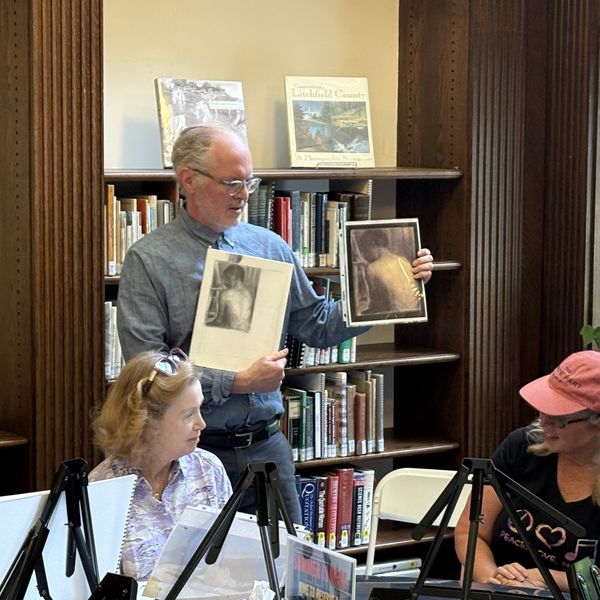
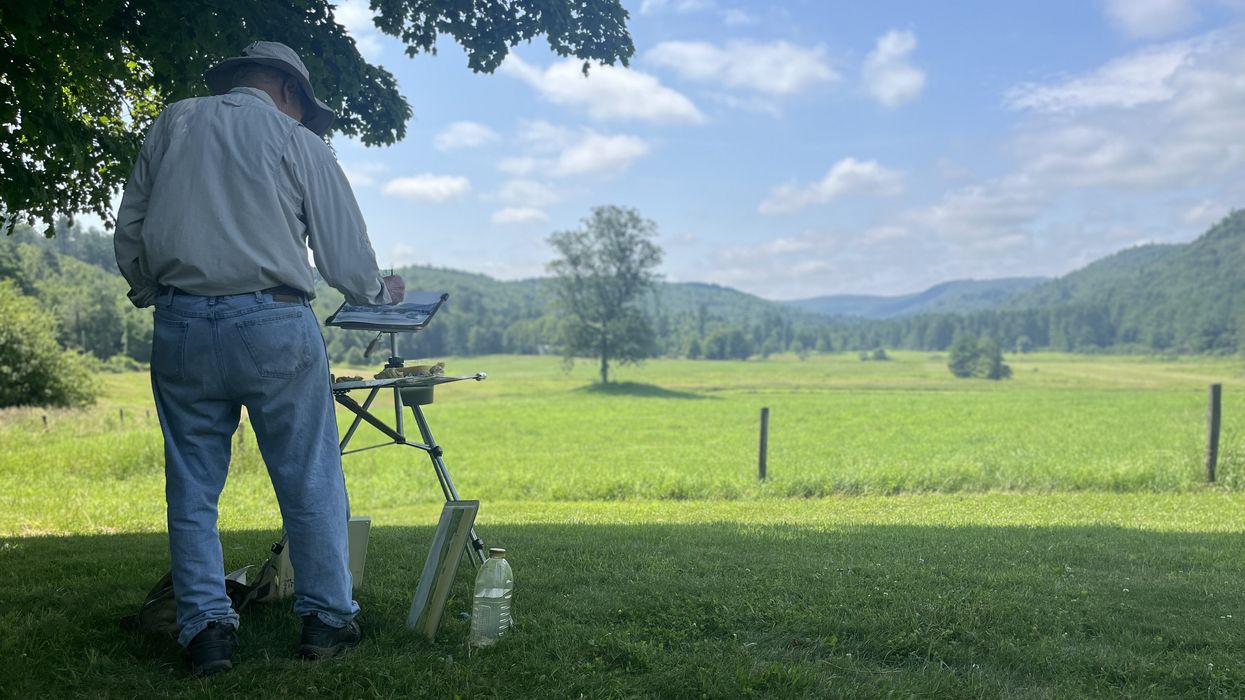
Area painters gathered at Coltsfoot Valley in Cornwall Village Saturday, July 12, for a painting lesson led by Cornwall artist Robert Adzema.
Jules Williams

Area painters gathered at Coltsfoot Valley in Cornwall Village Saturday, July 12, for a painting lesson led by Cornwall artist Robert Adzema.
CORNWALL — Last Saturday morning, July 12, from 10 to 12 a.m., a small group of artists gathered on the edge of Pine Street in Cornwall Village to paint watercolor studies of Coltsfoot Valley.
Local artist Robert Adzema, who specializes both in sculpting sundials and plein-air watercolors, led the class. Plein-air painting is the practice of painting outside, directly from nature.
On his website, Adzema explains how plein-air “encourages one to deal with the subject directly and spontaneously, and to welcome chance and accident”.
It is different from sculpture, which requires more precision.
To start off, Adzema did a small demonstration with his paints, explaining his thought process and answering questions. He painted both in both grayscale and color, focusing on laying out basic shapes before slowly going in with more details.
Afterwards the group split off to work on their own pieces, implementing newly learned techniques and accepting feedback. Many stayed beyond the scheduled time to continue their work.
Throughout the class, Adzema offered tips to help familiarize people with the basics of watercolors. He suggested that a value painting in black and white first is helpful with getting a feel for the subject and the sections of the landscape.
“The big secret of painting watercolor is being aware of how wet the paper is,” he told participants.
The wetness of the paper affects the way the paints interact with it; more moistness means more paint is absorbed and the colors will spread to a larger area, creating a softer look, while dry paper is better for achieving sharper details.
He demonstrated how to mix colors directly on the canvas to add depth. In particular, he suggested adding oranges and golds to the grass and sky to add warmth into the picture.
As the group split, Adzema continued to encourage participants to paint what interested them and to use the techniques that spoke to them most. It was clear in his passion that he hoped to encourage others to delve into art as deeply as he had.
Patrick L. Sullivan
The Falls Village Board of Selectmen approve a new yoga studio Feb. 27.
FALLS VILLAGE — Monica Zinke will be opening a yoga studio this month at the town-owned 107 Main St. in the space that was previously occupied by Furnace: Art on Paper.
The Planning and Zoning Commission approved a change of use application Thursday, Feb 26, and the Board of Selectmen voted to approve the lease the next night.
The lease is for two years, $650 per month plus 15% of the heat and electric bill.
Selectman Judy Jacobs said when proposals for use of the space were evaluated, it was clear that Zinke’s was the best fit for the space, which does not have water and occupies a walled-off corner of the ground floor along with the Off the Trail Cafe.
Jacobs said an added bonus is that the cafe owners, Liz and Howie Ives, know Zinke.
Zinke will be offering therapeutic yoga, in private sessions and small groups.
First Selectman Dave Barger said, “I think this is something well worth coming to our town.”
Patrick L. Sullivan
From left: Connor Wambach, Rocco Famularo, Ben Van Wormer, Liam Gregory, Luke Feller, Charlie Merk, Oliver Ayer, teacher Rhonan Mokriski and Karen Vrotsos from the Scoville Memorial Library.
SALISBURY — A group of Salisbury School students provided a preview of their history projects at the Scoville Memorial Library Thursday, Feb. 26.
The students will present the final versions April 22–24 at the Troutbeck Symposium, a student-led historical education forum held each spring at Troutbeck in Amenia, New York.
Teacher Rhonan Mokriski reminded the audience of about 20 people that the projects are still works in progress and emphasized that the students are seeking feedback ahead of the symposium.
The students and topics covered were:
Connor Wambach and Liam Gregory on the Salisbury iron industry and the environment.
Rocco Famularo on Alexander Hamilton in Salisbury.
Ben Van Wormer and Luke Feller on Sherm Chase’s horizontal windmill at the South Kent School.
Charlie Merk on indigenous whaling.
Oliver Ayer on midwifery.
Wambach and Gregory showed a clip from a video interview with Star Childs of Great Mountain Forest. Audience members noted that the audio was very faint, offering that as feedback.
Van Wormer and Feller had a video interview with historian Marge Smith, who has childhood memories of the horizontal windmill, placed on the hillside overlooking Hatch Pond.
Famularo recounted how, with help from Salisbury historian Jean McMillen, he has been able to place Alexander Hamilton in Salisbury in 1797, possibly working as a surveyor or on a real estate transaction.
The audience offered constructive criticism, everyone posed for a group photo, and then turned their attention to the pizza that had materialized during the presentation.
Lakeville Journal
The following information was provided by the Connecticut State Police at Troop B. All suspects are considered innocent until proven guilty in a court of law.
Collision at intersection
On Tuesday, Feb. 24, at approximately 9:15 a.m. James Dorizzi, 70, of Falls Village was traveling westbound on Route 44 in North Canaan in a 2009 Jeep Liberty Sport and proceeding through the intersection with Route 7 when his vehicle was struck by a 1993 Chevrolet Suburban. The driver of the Suburban, Trinity Fields, 21, of Torrington, was negotiating a left-hand turn northbound onto Route 7. The Suburban was found to be unregistered and uninsured. Fields received a citation for violating traffic signals, operating an unregistered vehicle and failure to have minimum insurance. There were no injuries reported.
Hits DOT barrels
Kyle Hurlburt, 32, of West Cornwall, was westbound on Route 44 near Ashpohtag Road in Norfolk on Thursday, Feb. 26 at approximately 7:30 a.m. in a 2005 Chevrolet Silverado. The vehicle exited the roadway on the right and struck a rock wall, rolling over into Department of Transportation barrels. Hurlburt reported no injuries but was transported to the hospital as a precaution. He was issued a citation for failure to maintain lane.
The Lakeville Journal will publish the outcome of police charges. Send mail to P.O. Box 1688, Lakeville, CT 06039, Attn: Police Blotter, or send to editor@lakevillejournal.com

Want more of our stories on Google? Click here to make us a Preferred Source.
Lakeville Journal
The radiology team at Sharon Hospital added a new Aquilion Serve SP CT scanner in February. The redesigned CT scanner offers a large, flared gantry bore of 80 cm that improves comfort, accessibility and may help reduce claustrophobia for patients. Pictured above is Ken DiVestea, Director Imaging Services at the hospital, with the new scanner.
Katy Golvala, Ct Mirror
Gov. Ned Lamont delivers an opening address on the first day of the legislative session on Feb. 4, 2026.
Gov. Ned Lamont has made health care affordability a cornerstone of his policy agenda. In his reelection campaign launch and during his State of the State address, he touted a long-term goal to develop what he’s calling the “Connecticut option” — a health plan that would bring universal, affordable health care to the state.
What would the Connecticut option offer and when could residents enroll? Here’s everything you need to know about what’s been proposed so far.
How would it work?
This session, Lamont proposed legislation that would direct the state Office of Policy and Management to study the feasibility of a “Connecticut option.” The bill states that the plan would be designed by the state, but run by private insurers.
Small businesses, nonprofits and individuals would be able to purchase the coverage. Lamont said the state will aim to make insurance more affordable by creating a “preferred network” of providers that offer high-quality, low-cost care, and then incentivizing plan participants to go see them for care.
That network would probably start with the state’s own University of Connecticut Health Center, as well as Waterbury Hospital — its newest acquisition, Lamont said. But, eventually, the state would negotiate a cap on the cost of care with any hospitals willing to come to the table, he added.
“A big piece of what the Connecticut option is about is paying for high-quality, low-cost care, and drawing people towards those networks,” Sean Scanlon said. As state comptroller, Scanlon runs the state employee health plan. He’s also playing a leading role in the development of the Connecticut option.
Scanlon said the broad structure currently conceived for the Connecticut option is a “cousin” of the Colorado option program, which launched in 2023. A study published in January 2026 found that the program has, in many cases, offered residents lower premiums for similar coverage when compared with non-Colorado option plans and 15% lower out-of-pocket costs on average.
Is Connecticut’s plan to create a public option?
Even though the state is still figuring out what the Connecticut option will be, Lamont is clear on one thing: It will not be a traditional “public option,” where the government administers the plan and bears the financial risk.
In 2019 and 2021, Scanlon, who served as co-chair of the Insurance Committee at the time, was part of an effort to propose legislation to launch a more traditional “public option” that would allow small businesses and nonprofits to buy into the state employee health plan. (Similar legislation was proposed in 2020, but COVID cut the legislative session short). In 2021, Lamont effectively killed the effort when he threatened to veto the bill if it passed the General Assembly.
In the case of the Connecticut option, the state would design the plan, but a private company — or companies — would run it, meaning the state wouldn’t bear the risk if people end up getting more frequent or higher-cost care.
“This is privately managed. They take the risk, not the taxpayers,” Lamont said.
When would this new option take effect?
Not for a few years, at least.
If Lamont’s bill to look into a Connecticut option passes this session, Scanlon said the state would spend the rest of the year studying the details of what the Connecticut option should look like, including researching what other states have done.
The aim would be to propose legislation in 2027 with a “fully baked and studied plan” for the Connecticut option.
Patrick L. Sullivan
State Sen. Stephen Harding (R-30) and State Rep. Maria Horn (D-64) attend the annual breakfast of the League of Women Voters held in Goshen Saturday, Feb. 28.
As the 2026 legislative session moves forward, State Rep. Maria Horn (D-64) and State Sen. Stephen Harding (R-30) are advancing distinct priorities they say will shape the direction of the state.
The regular session, which convened in Hartford on Feb. 4 and is set to adjourn May 6, comes amid uncertainty over federal funding, debate over housing policy and continued scrutiny of state spending.
Horn said one of her top priorities this session is to maintain “fiscal and program stability” in Connecticut in the face of rapidly changing federal policies.
“We are in a position to mitigate the chaos,” she said in a phone interview Friday, Feb. 27.
Horn is the chair of the legislature’s Finance Committee.
One item she is keeping an eye on is elections. Horn said that small-town first selectmen and registrars have complained that the 14 days of early voting requires too much effort and money for what amounts to a handful of voters taking advantage of the policy.
There is also a move in Connecticut to create “no-excuse” absentee voting, which would allow any registered voter to request a mail-in ballot without providing a specific reason — aligning the state with most others and potentially achieving the same access as extended early voting at a fraction of the cost.
Horn is also working on changes to Connecticut’s “bottle bill,” which raised the deposit on bottles and cans from five cents to 10 cents in 2024. However, because neighboring states such as New York, Massachusetts and Rhode Island did not follow through on similar increases, some people have been bringing containers purchased out of state into Connecticut to redeem them at the higher rate. That practice has prompted lawmakers to pursue stricter enforcement and penalties to curb cross-border fraud, which has left beverage distributors absorbing the costs.
Horn said the state needs more redemption centers and better enforcement and accountability.
In a phone interview Feb. 27, Harding, who is the state Senate Minority Leader, said his top priority is to take advantage of a General Fund balance of some $4 billion to provide tax relief for residents.
Tax relief could come in the form of eliminating the car tax and reducing state income taxes for some taxpayers.
Harding said he and fellow members of his caucus are pushing back against what they describe as “statewide zoning” proposals. He argued that efforts to expand affordable housing — including measures that allow developers in certain cases to override local zoning — pose a threat to the open space that residents of the Northwest Corner value.
“Open spaces get eaten up by developers under the current rules,” he said.
While acknowledging the state faces an affordable housing shortage, Harding said solutions should not come at the expense of local control.
“I understand there’s a problem with affordable housing in the state, but we shouldn’t bypass local zoning,” he said, adding that housing policy is best addressed at the local rather than state level.
Harding said there is a problem with easements granted by the state Department of Agriculture in the past. The easements were written years — and sometimes decades — ago, and developers have learned how to exploit ambiguities in the legal language.
“Some of these easements are 30 or 40 years old, and they are not worded properly.”

Want more of our stories on Google? Click here to make us a Preferred Source.

Want more of our stories on Google? Click here to make us a Preferred Source.