Kellogg kindergartners explore artistic passions

The template that guided kindergarten artwork at Kellogg School Feb. 28.
Patrick L. Sullivan


The template that guided kindergarten artwork at Kellogg School Feb. 28.
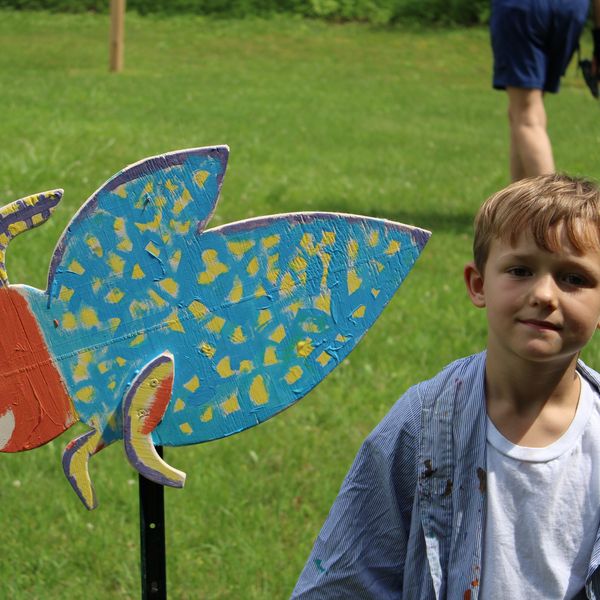
FALLS VILLAGE — Anna Pattison waited patiently as children filtered in the all-purpose room at the Lee H. Kellogg School Friday afternoon, Feb. 28.
There were three long cafeteria tables set up with acrylic paints laid out on paper plates, sets of three brushes — thin, medium and thick — and a smallish blank canvas at each place.
Eventually 13 children and five adults got their marching orders from Pattison.
The goal was to do a version of a fox in a wintry landscape.
Pattison said the template is ideal for a group activity because it can be done in just a few basic steps.
Step one was to use the teal paint to make the sky background. Depending on the artist, this took up about two-thirds of the canvas.
Background accomplished, the artists took a break for popcorn while the paint dried.
Pattison suggested waving the canvases back and forth to facilitate drying, while cautioning against getting stray bits of popcorn in the mix.
A couple of enterprising students decided that running in circles around the room, holding their canvases, would be even better.
And soon the room was filled with small children charging back and forth brandishing teal-colored canvases.
Natalia Zukerman
Curator Deborah Goodman Davis reads the Emily Dickinson poem “The Grass So Little Has to Do.” Spencer Finch’s “Following Three Bees (Zinnias)” buzzes in the background.
“The Grass Has So Little to Do,” on view at James Barron Art in Kent, takes its title from Emily Dickinson’s poem “The Grass So Little Has to Do,” written in 1862:
“The Grass so little has to do—
A Sphere of simple Green—
With only Butterflies to brood
And Bees to entertain—”
Curated by Deborah Goodman Davis, the exhibition borrows Dickinson’s meditation on the natural world as both its title — with a subtle shift — and guiding principle. The exhibition gathers more than 30 contemporary artists whose work examines flowers, leaves, insects, landscapes and changing light — not through scientific observation, but through memory, imagination and deep attention.
“I started spending so much time in the country that I began seeing things differently,” said Davis, a Montreal native. “I became drawn to artists who were also looking at nature.”
Davis has spent decades working in museums, galleries and as an art advisor, including positions at the Art Institute of Chicago, Yale University Art Gallery and with influential dealer Jeffrey Deitch, before returning to curatorial work in recent years. This is her third exhibition with James Barron Art, following last year’s “Boundless Color.”
The exhibition’s emotional anchor is Dickinson’s poem, which marvels at grass, butterflies, bees and sunlight while imagining a life devoted simply to existing in the natural world. The poem, and its simple and reverent message, echoes throughout the exhibition.
Spencer Finch’s drawing titled “Following Three Bees (Zinnias)” tracks the movement of three bees as they moved from flower to flower in the artist’s garden. Standing on a ladder, Finch patiently followed their movements, recording each insect’s path with a different line.
Montreal-based painter Veronika Pausova’s luminous moth paintings next to Finch’s work carry a thread — literally. Whether Pausova was familiar with Finch’s drawings before creating her painting “Cabin’s Moon,” commissioned by Davis for this show, is unknown, but the placement is certainly intentional. Davis’ thoughtful curatorial approach creates conversations, quiet whispers and surprisingly funny moments throughout the space.
Toba Khedoori, an Australian-born artist of Iraqi-Jewish heritage, contributes exquisitely detailed mezzotints that transform ordinary grasses into monumental landscapes. “Imagine rolling in the grass before ticks,” Davis said with a laugh. One is left longing for such a simple pleasure, the work inviting viewers to imagine a connection to the natural world that feels both familiar and increasingly distant.
One of Wassaic Project co-founder Eve Biddle’s ceramic snakes slithers up a nearby side wall, while internationally recognized artists including Ellsworth Kelly, Alex Katz, Lois Dodd, Kiki Smith and Charles Gaines offer their own interpretations of leaves, flowers, trees and changing seasons.
The exhibition also highlights several artists with local ties. Yale Norfolk School of Art co-director Byron Kim contributes one of his contemplative “Sunday Paintings,” documenting the sky over Norfolk alongside personal diary-like observations.
One of the show’s most unexpected works isn’t visual at all.
Inspired by Dickinson’s line, “And even when it dies to pass / In odors so divine,” Davis commissioned Brian Goeltzenleuchter, an interdisciplinary artist working at the intersection of olfactory art, social engagement, and image making to create a scent for the exhibition. “The grass so little has to do, I wish I were the hay!” wrote Dickinson, so Goeltzenleuchter created the scent of fresh hay specifically for the exhibition. Fragile glass vials sit in a bed of marble, waiting to be broken to release the scent, which also lives under a glass enclosure dewy with its fragrance. The faint odor permeates the gallery, adding an immersive sensory layer that extends the show’s meditation beyond sight alone.
There are quieter surprises throughout: concrete casts preserving cherry blossoms that will slowly fade over time by Japanese artist Motohiro Takeda; carvings of owls in Arctic marble by Sam Akesuk, an Indigenous artist from Kinngait (Cape Dorset); paintings of moonlight; the intricacy of spider webs placed next to a graph-like drawing of a tree; and Kiki Smith’s shadow of birds by the windows overlooking the majestic scenery of Barron’s property.
For Davis, the idea for this show has been growing since she began spending more time in the Northwest Corner.
“It’s been percolating for six years,” she said.
The resulting exhibition rewards viewers willing to do the same.
“The Grass Has So Little to Do” is on view at James Barron Art in Kent through Sept.12. By appointment only. Email maria@jamesbarronart.com or call (917) 514-3762. For a catalog of the exhibition, visit jamesbarronart.com.
D.H. Callahan
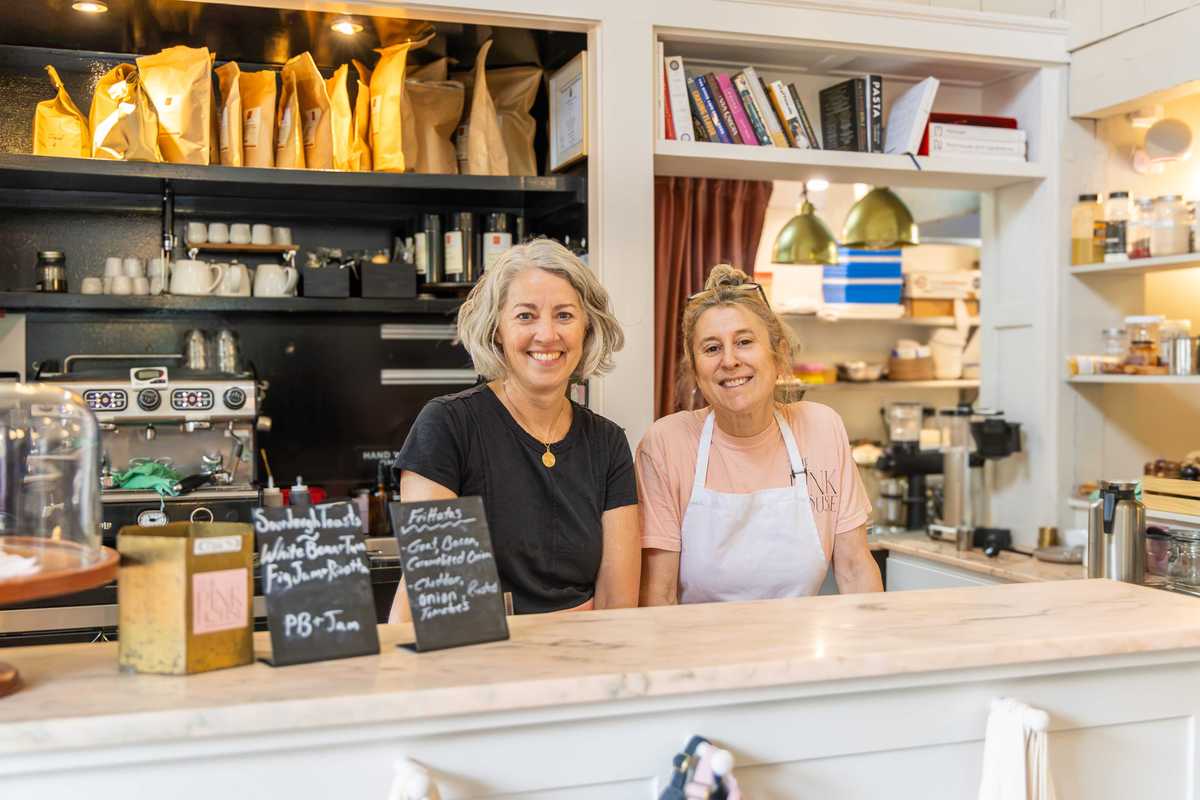
Marina Kotchoubey at the Ian Ingersoll Cabinetmakers showroom in West Cornwall.
After 40-something years navigating the world of custom fine furniture, Ian Ingersoll was getting ready to retire. Starting off with a little dovetail stool that he sold at a shop in West Cornwall in the 1970s, he’d grown his skill and his business into something he — and the whole town — could be proud of. Shutting down that business was not an option.
Ingersoll built Ian Ingersoll Cabinetmakers, which produced mainly classical Shaker furniture, on passion: the passion he had to make a living through creative challenges and the passion of his employees, who all seem deeply in love with their craft.
Sometime in the mid-2010s, with grandkids accumulating, he started to picture a future away from the shop. It was getting time to step away and enjoy what he insists is one of the most beautiful parts of the world: the Northwest Corner of Connecticut. But just because he was aging out of the job didn’t mean his employees needed to as well.
Ingersoll recognized the home he’d built for these creative experts — a place where they, too, could make their livings building masterworks of fine furniture. So, for his next big challenge, he began the search for someone he could trust to take what he’d made and build it even better. After searching for quite some time, he decided to look next door.
Technically, Marina Kotchoubey grew up in Manhattan but she spent weekends and summers in Cornwall, Connecticut, feeling more at home amongst the woods and rivers of Litchfield County than in the subways of the city. But business opportunities kept her away from making her permanent home in the region.
After college, Kotchoubey moved to Paris to run the U.S. branch of children’s fashion brand Petit Bateau. At the young age of 23, it was a job she wasn’t ready for. But that’s where Kotchoubey finds her creative challenges.
By pairing the experience of her peers and coworkers with her razor-sharp intuition, Kotchoubey ran the brand with seamless expertise despite her lack of experience. She jumped into the deep end of the pool and challenged herself to swim. For seven years, she swam like an Olympian.
After her time in France, she felt ready to finally make a home in Cornwall. With no career or even job lined up, she approached several local businesses around the Northwest Corner and offered to help out in a consulting capacity. After years of challenging conditions in the deep end, this seemed like calm, shallow waters. And that’s when her neighbor, Ian Ingersoll, approached her.
At first, he was looking for a little help with business issues. Ian Ingersoll Cabinetmakers was doing well, but a younger customer base of homeowners and interior designers weren’t as keen on classic Shaker furniture. Though the studio had already started to diversify their offerings, Kotchoubey was instrumental in implementing a smooth transition to other styles of furniture. Ingersoll saw that, thanks to her breadth of experience and enterprising vision, she could take the baton and run with it.
In 2025, he handed her the keys.
Kotchoubey is not a master woodworker. In fact, she knows very little about the craft. But what she lacks in practical knowledge, she makes up for in the confidence she has in her craftsmen. Much like her time running a brand in France, she knows how to help support and get the most out of the experts who have the experience she lacks. It helps that all those experts love what they do.
When she took the reins, Kotchoubey saw two new ways forward. She could shake things up and pivot the shop toward installations and on-site custom builds. This would require new equipment, new clients and possibly new craftsmen. The other path leaned into what she had already helped the company do: expand its offerings and cater to a new, less traditionally minded clientele.
With confidence in her craftsmen and the reputation their work has garnered, she resisted the urge to pivot and instead relied on what makes Ian Ingersoll Cabinetmakers great — high-quality furniture made by expert craftsmen.
The journey isn’t quite as easy as it sounds. There are great challenges that come with being a young woman in an older man’s world. Firstly, she had to win the respect of her employees, despite not sharing in their skills and know-how. She accomplished that, once again, by listening to the experts and not forcing her vision on a remarkably capable group. The woodworking side of things might be new, but her ability to swim in unknown waters has proven unflappable throughout her career.
Now in its sixth decade of operations, Ian Ingersoll Cabinetmakers shows no sign of slowing down. Kotchoubey’s leadership is finding new customers by expanding on the reputation of the work. With increasing demand and a steadfast commitment to slow, quality jobs, don’t expect to pop into their West Cornwall showroom and leave with a piece anytime soon. Lead times on custom creations range from 12 to 16 weeks, but if things keep going the way they are, that wait could get even longer.
To see some of the company’s offerings, visit ianingersoll.com.
Marina Kotchoubey at the Ian Ingersoll Cabinetmakers.Photo by D.H. CallahanD.H. Callahan
One hundred and twenty years ago, Carl and Ellen Stoeckel commissioned New York architect E.K. Rossiter to design The Music Shed in Norfolk, Connecticut. After nearly a decade of entertaining their friends and neighbors with the finest music of the day, they built a permanent home for their beloved Litchfield County Choral Union.
The commission and full funding of the construction was not unheard of in an era when great fortunes led to public enrichment. Railroad tycoon John D. Rockefeller was instrumental in funding institutes of higher education. Steel baron Andrew Carnegie was building libraries all over the country, and famously said that a man who dies rich is a disgrace, challenging his peers to give their fortunes back to the people.
But the Stoeckels went even further. They took it upon themselves to pay for everything from trains and coaches for American musicians to trans-Atlantic crossings for European composers, and even rented instruments when needed. They never told anyone what it all cost and worked hard to keep their names off the buildings and mastheads, instead directing all credit to the Litchfield County Choral Union.
Upon her death in 1939, widowed Ellen Battell Stoeckel bequeathed the entire operation to the Yale School of Music. Since then, Yale has operated the Norfolk Chamber Music Festival at the iconic property, with only modest renovations made in 2024.
This year, the Festival is looking to the past for inspiration as it presents its “Anniversaries” program, featuring performances dedicated to celebrating history. On Saturday, Aug. 1, the Festival looked back 200 years with pieces written in 1826 by Schubert, Beethoven and a 17-year-old Felix Mendelssohn. The previous evening focused on the Music Shed itself, with repeat performances of works by Sibelius, Coleridge-Taylor and even Rachmaninoff, all of whom graced the shed with their presence.
On Aug. 8, the festival will celebrate its final anniversary of the season: America’s 250th. The program will feature a world premier by Juilliard-trained composer and pianist Nahre Sol. The piece is part of the Festival’s Musical Bridges project, which commissions music inspired by the American West.
Apart from the anniversaries, there’s still more music to come. Friday, Aug. 7 will feature pieces by Haydn, Holcomb, Schoenberg and Shostakovich. On Aug. 14, works by Beach, Childs and a little more Haydn will be performed with Melvin Chen on piano. Oboeist Stephen Taylor will join William Purvis and the Norfolk Fellows for an evening of Johann Sebastian Bach’s Brandenburg Concertos on Saturday, Aug. 15. The culmination of the season happens on Saturday, Aug. 22 with a musical tour of choral masterworks from the Renaissance through today, featuring the Norfolk Festival Chamber Choir and Orchestra.
Of note is the Festival’s new collaboration with locally based fashion brand BODE. While no robber barons — or even modern-day rocketship billionaires — it’s nice to know the spirit of musical altruism lives on in Norfolk.
To learn more, head to norfolkmusic.org.

Want more of our stories on Google? Click here to make us a Preferred Source.
D.H. Callahan
Henry Klimowicz with his sculpture, “Partial Pillar 1”
On Saturday, Aug. 1, Geary Gallery opened its doors in Salisbury for two unique shows in its first- and second-floor gallery spaces. Art lovers flooded both floors over the course of the afternoon, giving the events a vibrant feeling that enhanced the importance of the art.
On the first floor is a show by Chicago-born, Colorado-based photographer Summers Moore, titled “Lobitos: Pueblo Fantasma,” or “Lobitos: Ghost Town.” The work centers around her daughter’s current hometown in Peru. Moore herself found a home away from home in Colorado in the mid-1980s and encouraged her children to seek out new places outside of their comfort zones.
Her daughter found Lobitos, a small surfing village on Peru’s coast that has taken on multiple identities throughout its history, including a booming era as an oil town in the 1800s and later as a military outpost before becoming the small fishing and surfing community it is today.
While visiting her daughter, Moore befriended a local artist named Inti. The bulk of the photos on display are of murals Inti painted on Lobitos’ crumbling infrastructure, as well as the horses who live at the equine therapy retreat where Moore’s daughter works and lives.
Directly above Moore’s photography exhibition is “Methods of Proceeding,” a show by local multi-disciplinary artist and curator, Henry Klimowicz. Coming from a room full of photographs of easily decipherable places, people and animals, Klimowicz’s work is anything but obvious.
The room is carefully populated with amorphous structures made from shreds of cardboard and hot glue. The cardboard was sourced from a furniture shop in Millerton, just down the road from Klimowicz’s own art space, the Re Institute.
The Re Institute is known for making the inaccessible accessible. Its “gift shop” features a wide variety of artworks, all priced under $750. “Methods of Proceeding” seems to do the opposite — taking one of the most common materials available in our modern era of online shopping, and the shipping waste that comes with it, and making it less accessible by forming it into curious structures that can resemble a panoply of ideas depending on the viewing angle.
Larger structures are mostly called “Partial Pillars,” with smaller “Truffles” and “Pebbles” scattered around the ledges and corners of the room. Alongside the cardboard and glue sculptures is a series of colorful monoprints that mirror the wild patterns of the sculptures.
Both shows will remain on view at the gallery until Sept. 27, when Moore will return for a discussion about her work. For more information about the artists and the gallery, visit geary.nyc.
Jennifer Almquist
Participants in a 2024 Great Mountain Forest Woodland Academy workshop at Yale Camp.
Great Mountain Forest (GMF) will host its first Nature Writing Retreat at the historic Yale Camp in Falls Village from Aug. 7-9, 2026. Writers of all levels are invited to draw inspiration from one of New England’s most notable forest landscapes. GMF envisions the retreat becoming an annual event celebrating writing, conservation and the relationship between people and forests.
This immersive three-day retreat reflects on the legacy of Hal Borland, the American writer and New York Times nature columnist whose work was deeply connected to this landscape. The retreat explores how wilderness shapes language, strengthens close observation and fosters environmental consciousness.
Six workshops, led by nationally recognized authors, poets and environmental experts, will take place throughout GMF’s 6,400-acre forest. Participants will engage in field observation, writing and discussion focused on description, ecological literacy, eco-poetry and nature-based storytelling.
According to Michael Zafros, GMF executive director, “There are few uses of a forest more sustainable than serving as inspiration. Hosting writers and artists is a great way to explore and provide this use of our forests. This new program demonstrates how Great Mountain Forest can be an antidote to the challenges facing our world. The retreat brings people together, builds community in the forest, gets participants outside and off their screens, and uses nature sustainably to heal and inspire minds and souls.”
The weekend includes journaling and campfire conversation on Friday, a guided nature walk and workshops on Saturday, and a closing reflection on Sunday.
Borland wrote, “I challenge anyone to stand on a hilltop and fail to see a new expanse not only around him, but in him, too.” Organizers hope participants in the inaugural retreat will experience just such an epiphany.
The 2026 Great Mountain Forest Nature Writing Retreat is made possible in part through support from H. Bruce McEver, Roshy and Dalton Dwyer, and Housatonic Heritage. The retreat is curated by Tom Shachtman.
Enrollment is limited. An optional post-retreat online anthology of participant work will also be offered. For more information and to enroll, visit greatmountainforest.org/writing-retreat-2026.
Natalia Zukerman
Artist Adam Van Doren and curator Donna Hassler talk to a group of visitors at the Berkshire Botanical Garden. A Stephen Proctor vessel sits to their left.
This summer, the Berkshire Botanical Garden in Stockbridge has hosted “Grounded in Nature: Paintings by Adam Van Doren,” an exhibition exploring the intimate relationship between architecture and the natural world.
On view for only a few more weeks in the Leonhardt Galleries, the exhibition features more than 35 watercolor and oil paintings by the New York-based artist, architect, author and Yale professor, curated by art historian Donna Hassler, director emerita of Chesterwood. The works span three distinct places that have shaped Van Doren’s artistic practice: New York City, Cornwall, Connecticut, and his travels throughout Europe.
Hassler first encountered Van Doren’s work years ago, when they crossed paths through their shared connection to the American Academy in Rome. Years later, when she was considering artists whose work would complement Berkshire Botanical Garden’s focus on art and nature, his paintings immediately came to mind.
“When I heard about Steve Proctor’s show, I immediately thought about Adam’s work,” Hassler said, referring to the ceramic artist whose monumental vessels and sculptures are also on view at the Garden. “Everything that is on exhibit here has some aspect of nature in it. And thinking about the built environment — buildings are not built in a vacuum. The landscape is important to the overall impression of the building in a particular setting.”
After visiting Van Doren’s New York studio and reviewing hundreds of works, Hassler decided to organize the show geographically, allowing viewers to trace how different landscapes have influenced the artist.
The first gallery focuses on Van Doren’s life in New York City, where he has maintained a studio on West 57th Street, near Central Park. His watercolors capture architectural details and urban landscapes, from Central Park bridges and fountains to Greenwich Village townhouses and the former Carnegie Mansion, now home to the Cooper Hewitt, Smithsonian Design Museum.
“He has a studio on West 57th Street, right down the block from Carnegie Hall,” Hassler said. “Within a couple of blocks of Central Park, you see a number of watercolors — a fountain, details of the balustrade, bridges in Central Park, cityscapes.”
The exhibition then moves to Cornwall, where Van Doren has spent summers throughout his life on a family farm originally purchased by his grandparents, writers Mark and Dorothy Van Doren. Surrounded by fields, streams and historic buildings, this landscape, which will be familiar to many, has become one of his most enduring subjects.
The Cornwall gallery is housed in Berkshire Botanical Garden’s historic Center House, an 18th-century building whose preserved character echoes the themes of Van Doren’s work.
“I like that they’re in here,” Hassler said. “It’s not a white gallery space. The raw material of this older building is still here.”
Many of Van Doren’s Cornwall paintings explore the interplay of architecture, land and light, including views of the Bradford homestead, an 18th-century farmhouse surrounded by weathered barns and stone walls.
The final section of the exhibition follows Van Doren’s travels abroad, particularly in Italy, France and England. Influenced by his architectural training at Columbia University and the classical watercolor techniques of the École des Beaux-Arts, Van Doren has long used watercolor to capture historic buildings within their landscapes.
“He paints mainly outdoors,” Hassler said. Working en plein air, the artist often paints with a portable stool, watercolor paper and palette, capturing changing light and atmosphere in real time.
Hassler noted the difference between Van Doren’s watercolor and oil paintings, a few of which are displayed side by side in the exhibition.
“He uses pure color,” she said of his watercolor technique. “It’s your eye that then fills in the form that he’s creating.”
The exhibition also includes works from Van Doren’s time as a visiting artist at the American Academy in Rome, where he painted ancient ruins, gardens and architectural views. His Rome paintings later inspired the poet John Tagliabue’s collection “An Artist in Rome.”
“Grounded in Nature: Paintings by Adam Van Doren” is on view through Aug. 23 at Berkshire Botanical Garden. For more information, visit berkshirebotanical.org

Want more of our stories on Google? Click here to make us a Preferred Source.

Want more of our stories on Google? Click here to make us a Preferred Source.