North Canaan reclaims 27-acre Camp Brook Greenway after 35-year effort

The overgrown Camp Brook Greenway will return to its roots, offering residents outdoor recreation opportunities.
Madi Long


The overgrown Camp Brook Greenway will return to its roots, offering residents outdoor recreation opportunities.
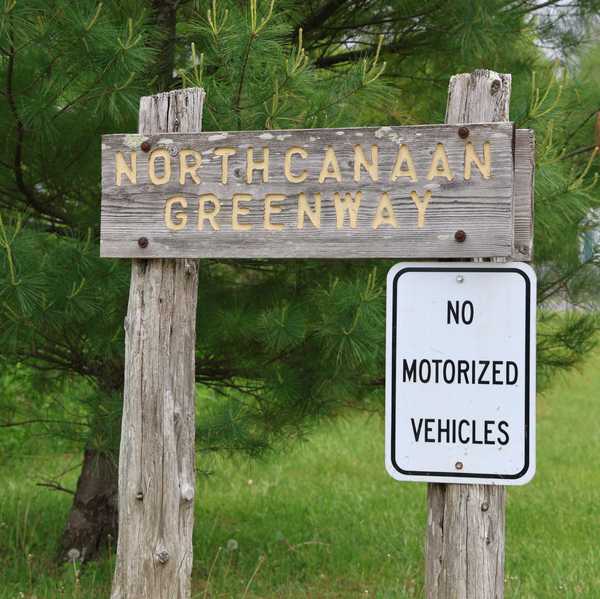
NORTH CANAAN – The Town of North Canaan has acquired the now overgrown Camp Brook Greenway parcel, a 27.45-acre property located behind Caddy Shack and State Line Pizza, with plans to revive it as a destination for recreation and walking trails.
The parcel includes wooded trails and looping paths that many longtime residents remember using decades ago. First Selectman Jesse Bunce said the property once served as a place for short hikes and outdoor recreation.
“So a lot of young people in town don’t have a lot of things to do,” Bunce said. “And this is a very nice stretch of land.”
North Canaan voters approved the purchase at a May 18 town hall meeting, authorizing the town to pay $1,000 to acquire the property from the Connecticut Department of Transportation.
In documents submitted to the Connecticut General Assembly in 2025, the town noted the state previously attempted to auction the parcel in 2022-23 for $200,000, after appraising it at $190,000, but received no bids. Town officials argued the wetland-heavy property has limited development potential and is best suited for passive recreation and open space.
The transfer required approval from the Connecticut General Assembly through conveyance legislation sponsored by state Sen. Stephen Harding (R-30) and state Rep. Maria Horn (D-64)
The land had long been tied to the controversial “Super 7” Route 7 expansion project, a 1960s proposal to convert the winding, scenic road to a four-lane highway, which was ultimately abandoned decades ago. Much of the land for the failed project has been owned by the CTDOT for decades without being maintained.
Bunce said he signed the deed Tuesday, May 19, formally transferring ownership to the town after what he described as a process more than 35 years in the making.
According to Bunce, the town had leased the land from the state for years, but once the lease expired the area gradually fell out of use. It is unclear when the lease ended.
The trails, however, are now overgrown, and the parcel unkempt.
“People have talked about, ‘Hey, I really enjoyed playing disc golf down there,’ or ‘I loved going on walks,’” Bunce said. “It’s a nice walk through the woods.”
The town now plans to revive those recreational uses. Bunce said officials will meet this week to discuss reopening and maintaining the trails.
“There is a Greenway Committee in town, so we’re going to try to get the committee active again a little bit and see what their bandwidth is on doing that,” he said.
Bunce credited longtime local advocate Geoffrey Drury with helping push the acquisition forward over several decades, along with former First Selectmen Doug Humes, Charlie Perotti and Brian Ohler.
“A lot of the legwork had been done on this,” Bunce said. “I was just lucky enough to be sitting in the seat when the deed finally came through.”
Alec Linden
KENT – During a town vote that passed five of six proposed ordinances on Friday, July 24, a controversial ban on food trucks was tabled as members of the public voiced concerns over its purpose and implementation.
After lengthy discussion over the proposed ban, a motion was made from the floor to table the discussion. The proposal will now head back to the Board of Selectmen for revisions. The other five ordinances passed with little or no opposition.
“The debate comes after years of criticism from local business owners who argue that food trucks hurt local restaurants. Donna Hayes, a member of the Planning and Zoning Commission and former Land Use Administrator for Kent,has repeatedly said the ordinance is intended to address concerns from restaurant owners who argue food trucks have an unfair advantage because they do not pay the same property taxes and other overhead costs as brick-and-mortar establishments.
Much of Friday’s debate centered on how the ordinance would apply to special events. The proposed ordinance would prohibit food truck operations on both public and private property, with exceptions for one-time special events.
During the meeting, Hayes moved to amend the ordinance so food trucks catering private events could provide food only as part of the event and would not be permitted to sell directly to individual customers. Food trucks operating at town-sponsored events, however, would still be allowed to make individual sales.
However, several residents questioned why town and private events should be regulated separately. “Why is it good for here, but not good for there?” said Mike Gawel, summarizing his testimony.
On the other hand, residents like Matt Starr have previously advocated for the allowance of food trucks and described the ordinance as unfair to small businesses. “I think you’re overstepping,” he said. “You’re taking away a small business opportunity.”
The issue resurfaced earlier this year when French-born, eight-year Kent resident Grégoire Pye came before the BOS seeking a semi-permanent location for his food truck business, Crepe Royal. Pye said he has been disappointed with the town’s response to his proposal, stating that the lack of support for his business has made him reconsider living in Kent.
Aside from food trucks, five ordinances did get voted into town law on Friday night. Town employees will now be allowed to volunteer on the Inland Wetlands and Watercourses Commission, which state statute prevents unless overturned by local ordinance.
Another prevents commercial buses from traveling on South Kent Road, a response to neighbors’ complaints that the narrow roadway had become dangerous due to buses heading towards adult retreat center Club Getaway.
An existing ordinance that prohibited residents from pushing snow into the roadway will now include other materials, such as grass clippings, leaves and brush, while another existing ordinance that regulates the purview of the Cemetery Committee was also modified to include two small cemeteries on private land.
The final ordinance that passed Friday night aligns the town’s veterans property tax exemption with state law by extending benefits to veterans with service-connected disabilities.
Debra A. Aleksinas
BD’s disposable syringe has been selected as one of 16 products competing in the CBIA’s 2026 “Coolest Things Made in Connecticut” contest.
Our team knows every syringe they make may help a neighbor or a loved one.
— Ahmad Warraich, Plant Manager, BD Canaan
NORTH CANAAN — Every year, approximately 2.5 billion disposable plastic syringes manufactured in North Canaan help deliver vaccines, medications and lifesaving care to patients around the world. Now, the company behind that output is receiving recognition much closer to home.
BD, a New Jersey-headquartered medical technology company, employs 500 people at its North Canaan plant on Grace Way, where it manufactures syringes. Its BD Syringe has been selected as one of 16 products competing in the Connecticut Business & Industry Association’s 2026 “Coolest Things Made in Connecticut” contest. The selection makes BD the first manufacturer in the Northwest Corner to earn a place in the contest since it launched three years ago.
“The BD Syringe, like all 16 products in this year’s competition, was nominated because it represents the ingenuity and innovation of Connecticut’s manufacturing industry,” said Chris DiPentima, president and CEO of the Connecticut Business & Industry Association (CBIA). “Since they started producing it in Canaan more than six decades ago, the BD Syringe has helped millions of patients worldwide and transformed the healthcare industry.”
The nomination also spotlights the Northwest Corner’s largest employer and its 385,000-square-foot North Canaan manufacturing facility, where syringes that have shaped healthcare for generations are produced.
“This nomination is an honor and a chance to shine a light on the role our team plays in the Canaan community and around the globe,” said Ahmad Warraich, plant manager at BD’s North Canaan operation.
“BD Syringes made in Canaan have supported billions of patients worldwide,” Warraich said. “Our team knows every syringe they make may help a neighbor or a loved one. We’re proud to keep this spirit of innovation going in Connecticut.”
BD spokesperson Alyssa Kretlow said the company is “thrilled” aboutits North Canaan plant’s recognition in the CBIA’s “Coolest Things” competition. “Nominations came from the public and business leaders across the state, so it’s especially meaningful to know our Canaan team’s work was recognized in that way.”
The syringes produced at BD’s Connecticut plant support patient care in more than 70 countries, she said. They have also played a role in some of the world’s most significant public health initiatives, including smallpox eradication efforts, H1N1 vaccination campaigns, and supplying approximately half of the global demand for syringes during the COVID-19 pandemic.
The disposable BD Syringe transformed modern healthcare by replacing reusable glass syringes with sterile, single-use devices that dramatically reduced the risk of cross-contamination while improving patient safety, according to company officials. Today, it remains one of the world’s most widely used medical devices.

A manufacturing legacy
Previous editions of the contest have featured products from manufacturers across Connecticut, from major aerospace and industrial firms to small food and consumer goods producers.
In the inaugural competition in 2024, Electric Boat’s Virginia-class submarine captured the title of Connecticut’s Coolest Thing Made. Last year’s winner was Ensign-Bickford Aerospace & Defense of Simsbury for its Frangible Joint.
Public voting opens Aug. 20 at cbia.com/coolest-thing.
The recognition comes during another milestone year for BD. On July 9, TIME named the company to its annual list of America’s Best Companies.
CBIA spokesman Scott Beaulieu acknowledged the region’s recognition.
“BD is the first manufacturer from the Northwest Corner to be nominated for the competition, but we’re sure not the last,” he said.
Aly Morrissey
There’s no place like home...for a landing. The hot air balloon was originally scheduled to land on Salmon Kill Road, but the winds had other plans.
SALISBURY — Residents at Lion’s Head Condominiums in Salisbury received an unexpected visit Saturday, July 25, when a hot air balloon made a surprise landing on the lawn of the apartment complex. At dusk, the unplanned touchdown drew curious onlookers as the balloon — which was supposed to have landed on Salmon Kill Road near Housatonic Childcare Center — settled safely.
Resident Anne Richardson said she and her partner were gardening when they saw the balloon in the air. Wondering where it intended to land, Richardson said she was surprised when it kept hovering and coming closer.
“It came out of the blue and was like something from the Wizard of Oz,” Richardson joked. Her partner, H.L. Aller snapped photos while others enjoyed the spectacle.
Lion’s Head Condominiums is a private 28-acre residential community located on Canaan Road in Salisbury.


Want more of our stories on Google? Click here to make us a Preferred Source.
Allison Gollenberg
CORNWALL — Cornwall will end the fiscal year with a roughly $70,000 surplus after approving a series of year-end budget transfers to cover unexpected expenses, including higher student transportation and legal costs for the Board of Education.
The Board of Selectmen approved the transfers at its July 21 meeting. First Selectman Gordon Ridgway said the town remains on solid financial footing despite budget pressures across several departments.
“We are in good shape ending this year, I believe there’s still about $70,000 in surplus after this to go back to the general fund,” Ridgway said. “So we ended up in the black, as we have to. But as you can see, there are cost pressures across the town budget.”
Ridgway said a long, harsh winter placed additional strain on highway equipment, contributing to higher maintenance costs. At the same time, he said, the town saved roughly $80,000 because the highway department was not fully staffed.
“Next year is going to be a challenge,” Ridgway said. “We can increase the budget somewhat, but we will not have that until we have completed the complement of highway workers. So we will not have that cushion of having a reserve at the highway department. But anyway, one year at a time.”
The transfers were approved by the Board of Finance on July 16, Ridgway said.
“Our goal is to try to hit this sweet spot where we don’t have extra money in the budget-- so that we don’t overtax-- but we have enough to do everything,” Ridgway said. “Especially dealing with some of the unforeseen things that can pop up, like utility rate increases or legal fees or transportation costs or bad weather. So, I think we’re in a very good spot.”
In other business, the board awarded a $114,265 paving contract to LB Corporation, the lowest of four bids submitted for the work by about $14,000. The bid covers paving two new pickleball courts on Foote Field and repaving of Hall Road, Great Hollow Road and Town Street South.
Before closing the meeting, Ridgway also highlighted several August community events, including a book talk and signing by author, artist, and Yale professor Adam Van Doren, the Cornwall Historical Society auction, and the Rose Algrant Art Show.
Patrick L. Sullivan
The Hunt Library could receive automatic doors thanks to a $10,000 grant from the American Library Association.
FALLS VILLAGE — Patrons of the David M. Hunt Library gathered Saturday, July 25, to help decide how a $10,000 grant from the American Library Association should be spent, with automatic entrance doors emerging as a leading proposal.
The grant is part of an ALA program, “Libraries Transforming Communities: Accessible Small and Rural Communities,” that offers grants to small and rural libraries to increase the accessibility of facilities, services, and programs to better serve people with disabilities.
The grant requires recipients to hold at least one community conversation before the funds are used. During the discussion, Library Director Meg Sher proposed installing automatic door-opening buttons at the library’s main entrance. She said the entrance’s two separate doors, with a small vestibule between them, can be difficult for patrons using wheelchairs, walkers or canes to navigate.
“I’ve watched people struggle with the doors for 13 years,” Sher said.
Her proposal would add one automatic door-opening button outside the entrance and another inside the vestibule, allowing patrons to open each door without assistance.
Sher said the improvements would benefit not only people with mobility challenges, but also parents pushing strollers and delivery drivers bringing boxes of books into the library.
Ellery “Woods” Sinclair, a library patron who uses a wheelchair, asked whether there was enough demand to justify the project.
“I think so,” Sher replied. “The median age in town is getting older, and I see more patrons who need assistance.”
Other ideas discussed during the meeting included purchasing shopping baskets to make it easier for patrons to carry books while browsing, and adding display shelving to better showcase library materials.
Sher emphasized that installing an elevator is not under consideration.
“We’re not talking about an elevator,” she said, noting that such a project would cost far more than the grant and would require a substantial fundraising campaign.
No decisions were made during the meeting. Sher said her next step is to seek cost estimates for the proposed automatic doors by consulting Salisbury Comptroller Joe Cleaveland about a similar project completed at the Grove building in Lakeville.
Allison Gollenberg
Residents perform to the commands of Rachel Gall, who helped organize a Colonial-era dance party in Cornwall July 25. A contra group met in Cornwall for about 15 years up until the start of the COVID-19 pandemic.
CORNWALL — Foote Field was transformed into a Colonial-era dance hall on July 25, as residents gathered for a picnic and an afternoon of dancing as part of the town’s America 250 celebration.
Rachel Gall, known as the Falls Village Fiddler, led the group through several dances set to period music. People of all ages joined in on the fun, with some members of the band even donning Revolutionary-era garb.
Gall said First Selectman Gordon Ridgway suggested the idea for the dance. She drew on her experience as a fiddler, caller and contra dancer to bring the event to life.
Contra dancing is a type of traditional American folk dance in which a caller, in this case Gall, leads participants through a series of moves known as figures. These sorts of dances have a long history, Gall said, but experienced a strong revival in the 1960s. That’s when her collaborator, Tom Scott, became involved with a dancing group in nearby Sheffield, Massachusetts, which he said has been dancing “right on through from colonial times.”

Scott said there was a contra group that met in Cornwall for about 15 years up until the start of the COVID-19 pandemic. Gall and Scott said they’d love to bring the activity back to the area.
“We’re having a problem getting new dancers,” Scott said. “The older ones are getting older, dropping out. And the new generation coming up doesn’t seem to be as excited about going out and dancing. Which is too bad. It’s a lot of fun.”
Scott added that he met his wife at a contra dancing event. Gall said connection is the whole point of the activity.
“It’s a very social dance,” she said. “I always say that all of you grandparents and ancestors did this and that’s why you’re here – because somebody went up to dance with somebody else.”

Want more of our stories on Google? Click here to make us a Preferred Source.

Want more of our stories on Google? Click here to make us a Preferred Source.