Thank you!
Your support is sustaining the future of local news in our communities.

North Cornwall Meeting House marks 200 years

North Cornwall Meeting House marks 200 years

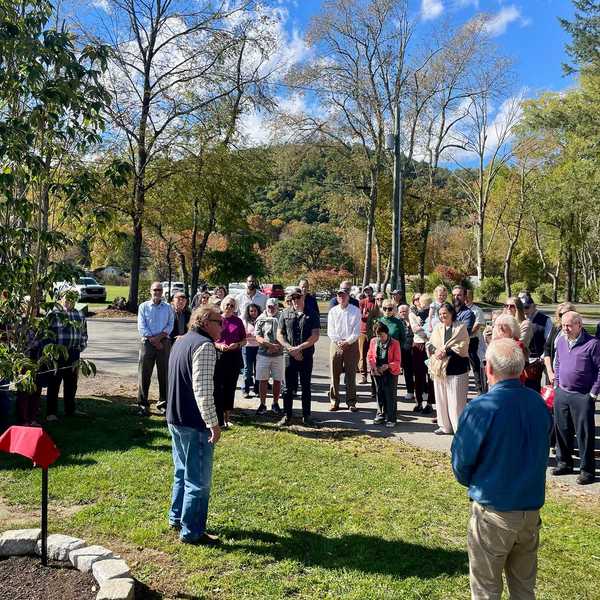
Attendees enter the North Cornwall Meeting House on Friday to mark the building’s 200th anniversary.

Ruth Epstein

CORNWALL – The 200th anniversary of the North Cornwall Meeting House commemorated a tale of separation and reconciliation.

The landmark at Town Street and Cogswell Road was built in 1826 as the home of the Second Congregational Church of Cornwall, which had split from the First Congregational Church four decades earlier. The two congregations reunited in 1988 to form the United Church of Christ in Cornwall, which now owns the meeting house.

The anniversary was celebrated this past weekend with meals, music, lectures and prayer. Such a commemoration has been held every 50 years since the building’s construction.

On Friday evening, a program followed a picnic dinner at which Virginia Gold, Tracy Gray and Rebecca Hurlburt discussed how the building came to be.

Following tradition, Gold was among the young people named 50 years ago to help lead the 200th anniversary celebration.

“Buildings have stories, as people do,” she told those seated in the pews, “and this building has plenty of stories.” She noted three important elements of its history: finances, personal power and religious freedom.

Back in the late 1700s, her fifth-great-grandfather, the Rev. Hezekiah Gold, refused to accept paper money for his salary as pastor of the First Congregational Church.

When the Revolutionary War broke out, he wanted to be paid with English currency. “It didn’t go well,” Gold said.

The minister faced dissension, splitting the congregation between those who supported Gold and those who left to form the Second Congregational Church of Cornwall in 1786.

Those who left the congregation worshiped for 40 years in a shell of a poorly-constructed building until a decision was made to build a new church. Dissent continued over where to locate it, so a county judge was called upon to settle the controversy.

Noah Rogers conveyed the land on which the current building sits for $50. Members got to work and many of the materials were donated by local citizens. The building was constructed in 1826.

Gray focused on the building’s Federal-style architecture, which featured eight solid chestnut pillars given for the sanctuary. Many parishioners provided trees. The pulpit was reached by a high staircase on each side. A bell tower featuring a spire transitioned the building from a civic center to a church.

Over the years, the building has gone through several restorations. A bell was added after 18 years and an organ was installed in 1906. The 1926 celebration featured the addition of a Palladian window.

Hurlburt brought the audience back to 1926, when Samuel Scoville, Jr., Esq. was charged with how to prepare for the centennial. He talked about the extensive renovations that would be needed, including a spire, organ, new carpets and candle sconces, among other improvements. The estimated cost was $10,000 and Scoville had to raise it all, which he did. “It would be another hundred years before there was another renovation,” Hurlburt said.

Now, upgrades are made under the auspices of the non-profit Friends of the North Cornwall Meeting House, which raises the funds. Its current chairman, David Hubbard, said, “Our mission is to support the preservation of this building. It’s a landmark for all the people of Cornwall.”

While summer services for the UCC are held there, so are many community events, such as lectures and concerts.

In her conclusion, Gold told of the continuance of the two churches. Although members often participated in common events, even worshipping together, they were still separate. Attempts to join together failed until a series of committee studies and meetings met with success in 1988.

“They had to overcome stubbornness, pride and greed,” she said. “But the truth is, there was grace on all sides of the debate. I learned about the independent thinking of our ancestors. This building represents what it takes to set down grievances.”

The weekend also featured an organ concert on Saturday by Hector Migliacci, who was raised in Cornwall, and Old Home Sunday Worship with guest minister, the Rev. Kent Siladi.

The committee for the 250th celebration in 2076 has been named: Grayson Dinneen, Lily Danforth Gold, Emma Hart LeBeau, Spencer Markow, Abbe Scoville and Theo Wescott.
Latest News

“The Divine Sister” comes to Sharon Playhouse for one-night benefit
Playwright and performer Charles Busch is “The Divine Sister.”
Provided

Continuing a popular tradition, the Sharon Playhouse will present a one-performance-only staged reading of “The Divine Sister,” another riotous comic romp by the acclaimed playwright and performer Charles Busch, on Friday, Aug. 28 at 7 p.m.

The play is a wild and witty homage to Hollywood films that feature nuns — from “The Song of Bernadette” and “The Bells of St. Mary’s” to “The Singing Nun” and “The Sound of Music.” It is classic Charles Busch: wickedly funny, gloriously over-the-top and overflowing with theatrical joy.

Keep ReadingShow less

KK Kozik sees things differently

KK Kozik sees things differently

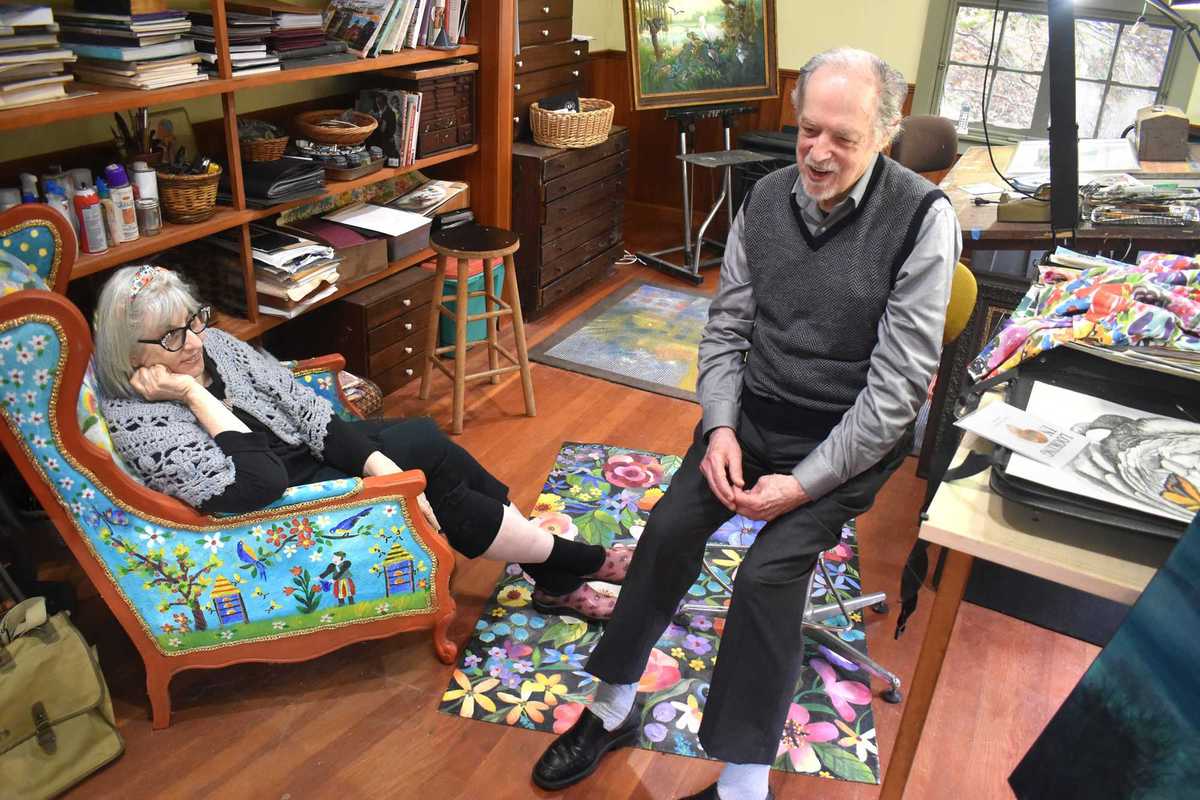
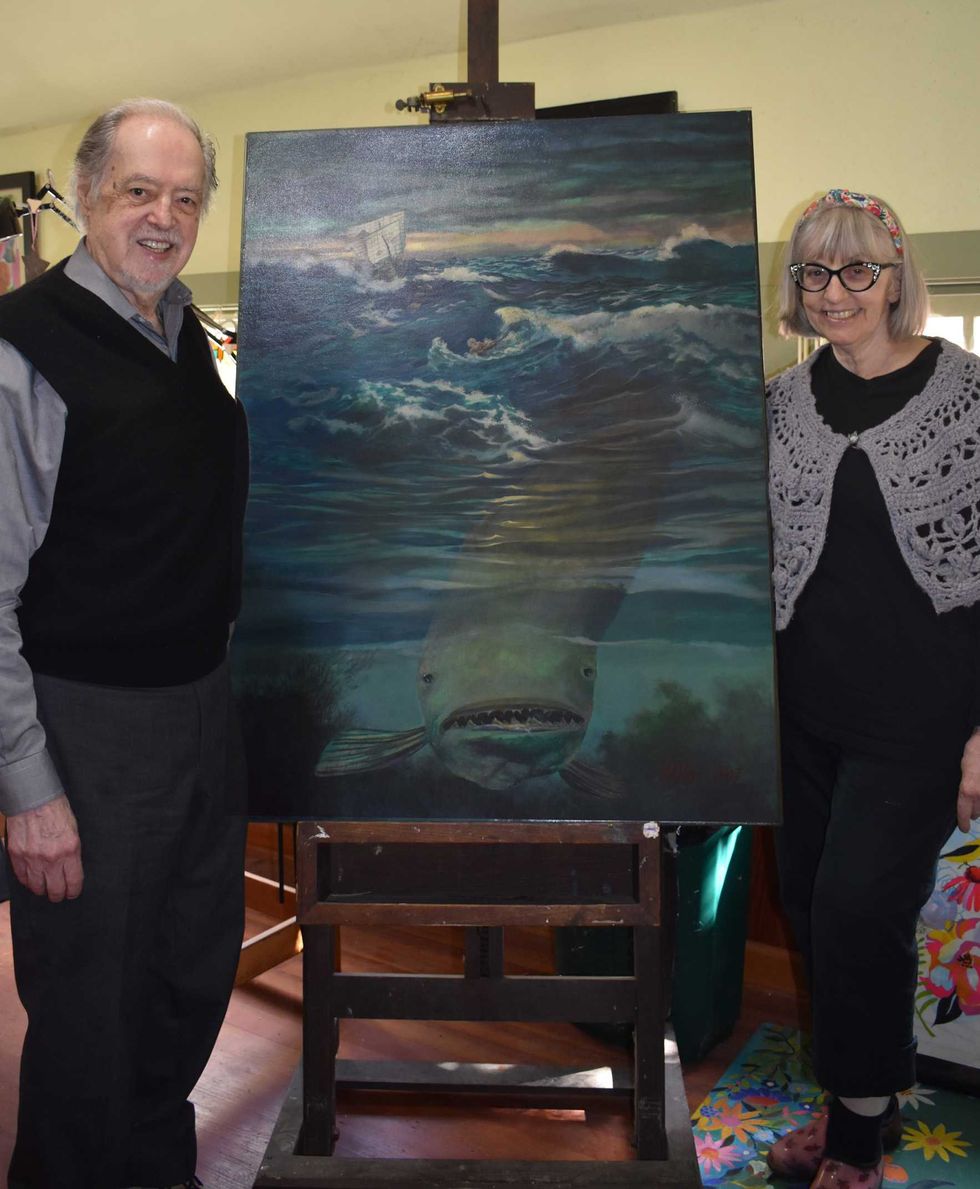
KK Kozik in her studio

Natalia Zukerman
Maybe it takes the ability to interpret what you’re looking at to really see.
— KK Kozik

KK Kozik has a theory about getting older.

“I don’t think you have eyes to see until you have eyes to see,” said the painter. “And maybe it takes the ability to interpret what you’re looking at to really see, and maybe that’s what comes with wisdom.”

Keep ReadingShow less
A Vietnamese water puppet musical returns to the quarry where it began

“The Magnificent Ms. Pham” combines Vietnamese water puppetry, shadow theater, music and storytelling.

Provided

“The Magnificent Ms. Pham,” the first Vietnamese American water puppet show, is returning to the water where it was born. The perpetual motion puppet show will be at TurnPark Art Space in West Stockbridge, Mass., Aug. 28 and 29, following a sold-out New York City premiere earlier this year. The production was originally developed at TurnPark, where its puppets first danced across the surface of the quarry lake.

Created by Vietnamese American artist Tommy Nguyen and director and designer Doug Fitch, the production tells the story of Nguyen’s mother, Kim Pham, and her journey from Vietnam to the United States. The story moves between memory, Vietnamese history and mythology, and the realities of immigration, following Kim from her childhood in Vietnam through her escape as a “boat person” and eventual life in Houston, Texas.

Keep ReadingShow less
google preferred source

Want more of our stories on Google? Click here to make us a Preferred Source.

Barry Blitt draws for the Northwest Connecticut Arts Council

Cartoonist Barry Blitt created a design for a limited edition T-shirt for Northwest Connecticut Arts Council fundraiser.

Jennifer Almquist

A drawing by Barry Blitt is recognizable from a distance simply for his line quality and hint of watercolor. Known for his scathing political cartoons, this longtime cover illustrator for the New Yorker has leaned his shoulder in to support the NWCT Arts Council and its Aug. 29 fundraiser at Buck’s Rock Camp in New Milford. Blitt created a design for limited-edition T-shirts that will be available for sale at the event and online at artsnwct.org.

David Remnick, editor of the New Yorker since 1998, called Blitt “One of the greatest political cartoonists of our time.” A native of Canada, Blitt won a Pulitzer Prize for editorial cartooning and has created more than 100 covers for the New Yorker since 1992. Perhaps most memorable is his 2008 iconic fist bump between Barack Obama and Michelle Obama, “The Politics of Fear.” A quarter century of his sketches and drawings are collected in “Blitt: In One Eye and Out the Other,” published by Penguin Putnam. He has created books for children, including “George Washington’s Birthday” and “Once Upon a Time, the End, (Asleep in 60 Seconds).”

Keep ReadingShow less
Stissing Center brings Frankenstein back to life with live music
Provided

When the 1931 horror classic “Frankenstein” plays with live musical accompaniment at the Stissing Center on Saturday, Aug. 29, it will open with a warning. A handsomely dressed man will step into the spotlight to warn the audience about the thrilling and horrifying tale to come. Then, it’s off to the graveyard.

“Frankenstein; or, The Modern Prometheus” was written in 1818 by English author Mary Shelley. A summary is comically unnecessary, as the story itself has become one of the most important pieces, not just of horror writing, but of the history of literature. A scientist playing with the finite constraints of life and death, alongside the themes of prejudice, acceptance, and the dangers of mob rule continue to capture generation after generation in ways that seem consistently fresh and relevant.

Keep ReadingShow less
Robert Rauschenberg: memories of an art world giant

Rauschenberg in his Captiva studio.

Provided

In 1953, Dutch-American abstract expressionist painter Willem de Kooning was at the height of a career rarely reached by artists during their lifetimes.

That was the year a young Robert Rauschenberg brought him a bottle of Jack Daniel’s and proposed something audacious. He wanted to erase one of the famous artist’s drawings. De Kooning got it. He didn’t like the idea, but he understood the assignment, and started rifling through archived works for a drawing that he would “miss,” and one that would be difficult to erase. Rauschenberg spent the next month making it disappear.

Keep ReadingShow less
google preferred source

Want more of our stories on Google? Click here to make us a Preferred Source.

google preferred source

Want more of our stories on Google? Click here to make us a Preferred Source.