Latest News
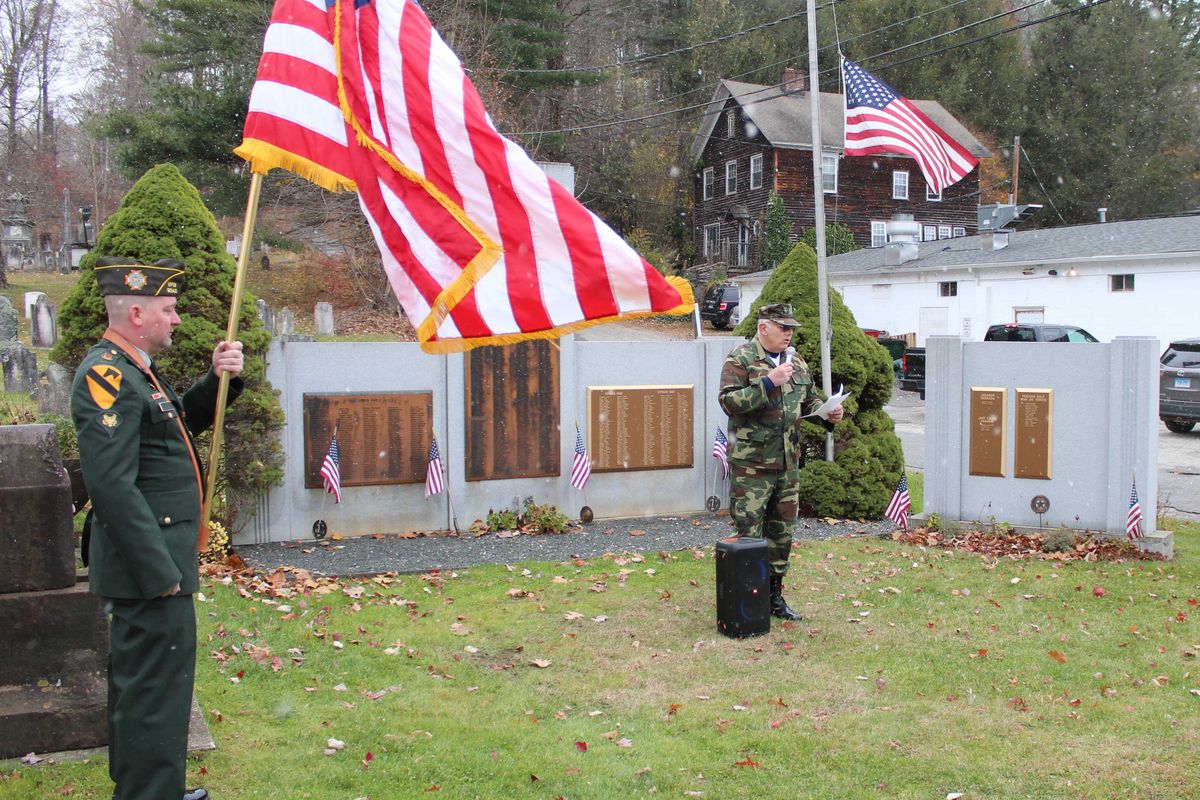
Chris Ohmen (left) held the flag while Chris Williams welcomed Salisbury residents to a Veterans Day ceremony at Town Hall Tuesday, Nov. 11.
Photo by Patrick L. Sullivan
Rev. John Nelson from Salisbury Congregational Church gave both an invocation and a benediction. The latter included this:
“We pray that those who have served and those who have died will never have done so in vain/We pray that the commitment of veterans will be an abiding call to resolve our conflicts without resorting to arms/ That one day soon we may mark the war that indeed ends all wars.”
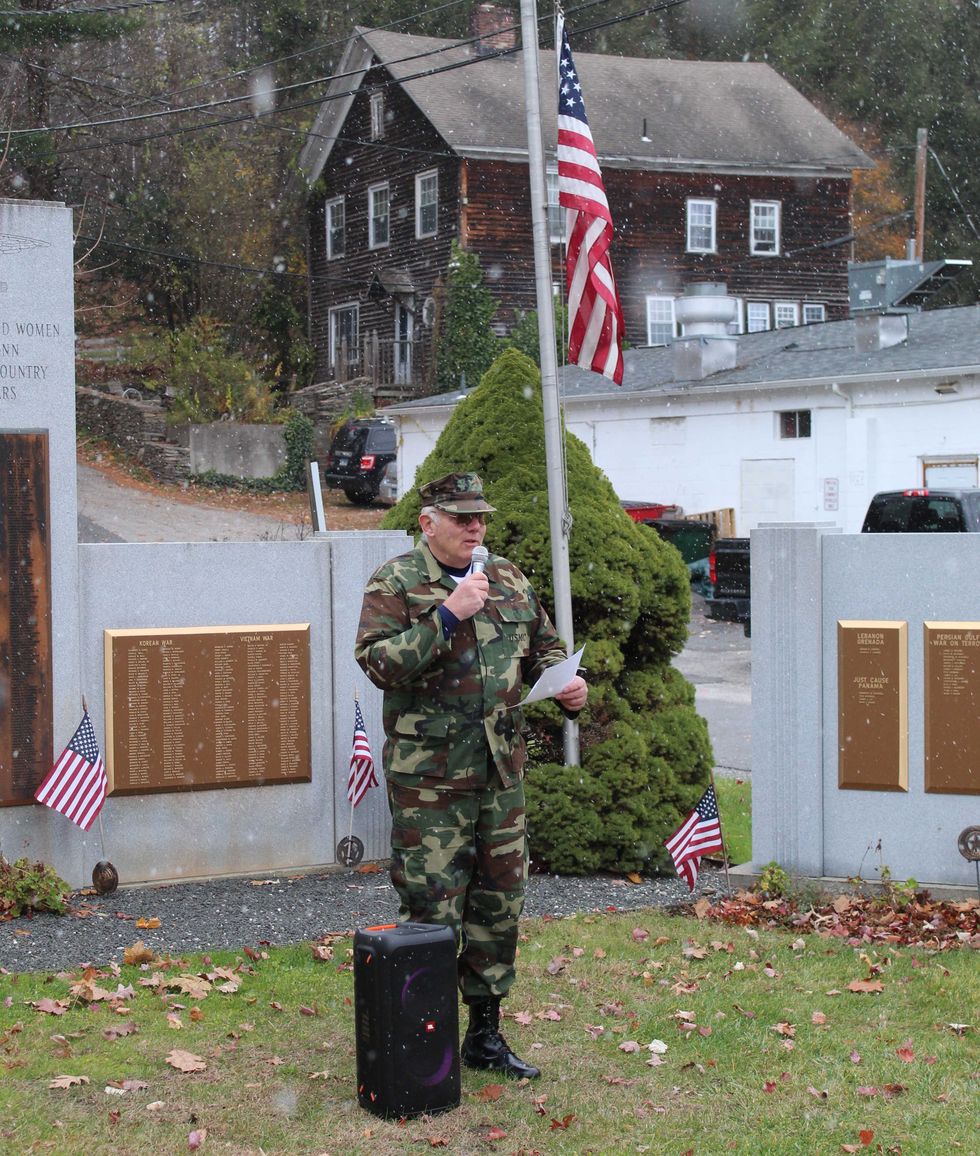 Chris Williams led the traditional Veterans Day ceremony at Salisbury Town Hall on a cold and snowy Tuesday morning, Nov. 11Photo by Patrick L. Sullivan
Williams began his remarks by noting that the Veterans Day speech was usually given by the late David Bayersdorfer, who died earlier this year.
“As we honor our veterans today, let’s keep in mind that service comes in many forms. Each role, each job, each post is a vital part of what makes our military the finest in the world.”
Lloyd Wallingford sang “God Bless America” a cappella, with the crowd joining in.
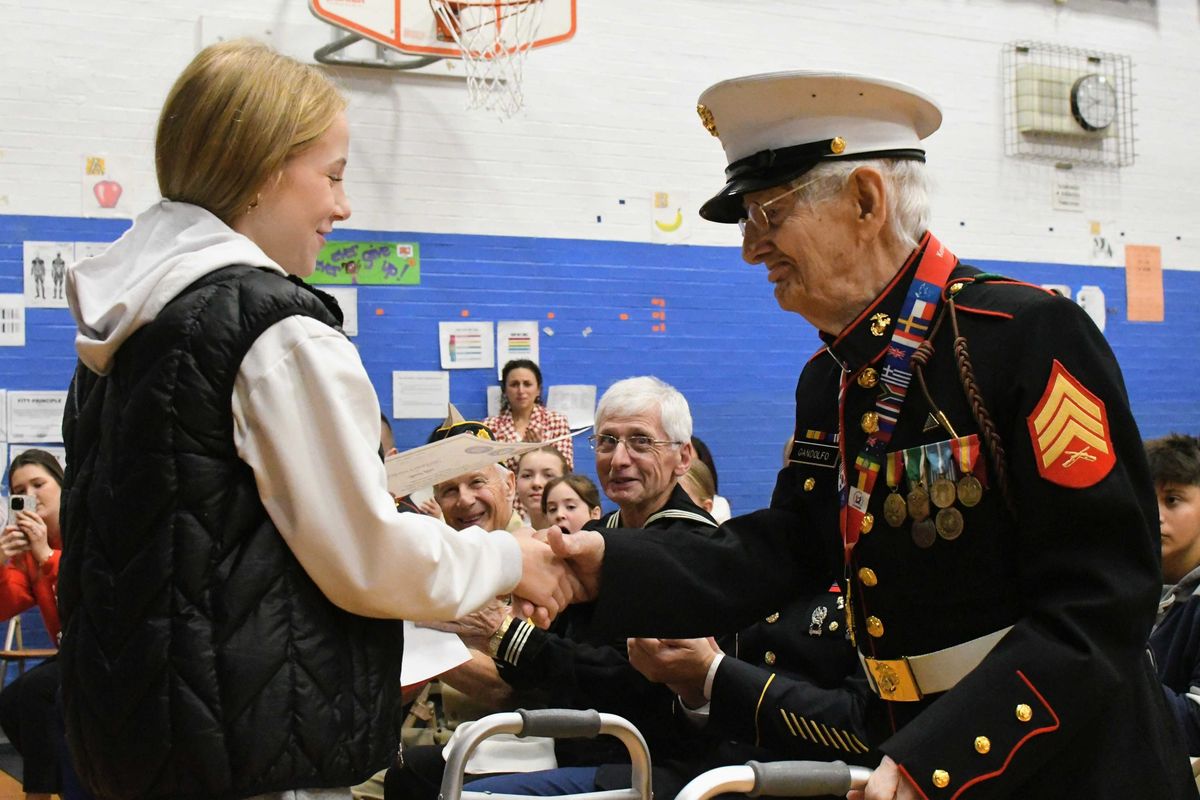
Eden Rost, left, shakes hands with Sergeant Nicholas Gandolfo, veteran of the Korean War.
Photo by Riley Klein
The 2nd graders sang the official song for each branch of service represented that day: Army, Navy, Coast Guard, Marines and Air Force. Special recognition was given to the Marine Corps, which was founded 250 years ago in November 1775.
Eighth graders offered speeches of appreciation. Taylor Gulotta said, "My older sister, Madison, has worked so hard to get to where she is today. She has dreamt of being in the Coast Guard since she was a little girl." She continued, "Her selflessness and bravery... is truly inspiring."
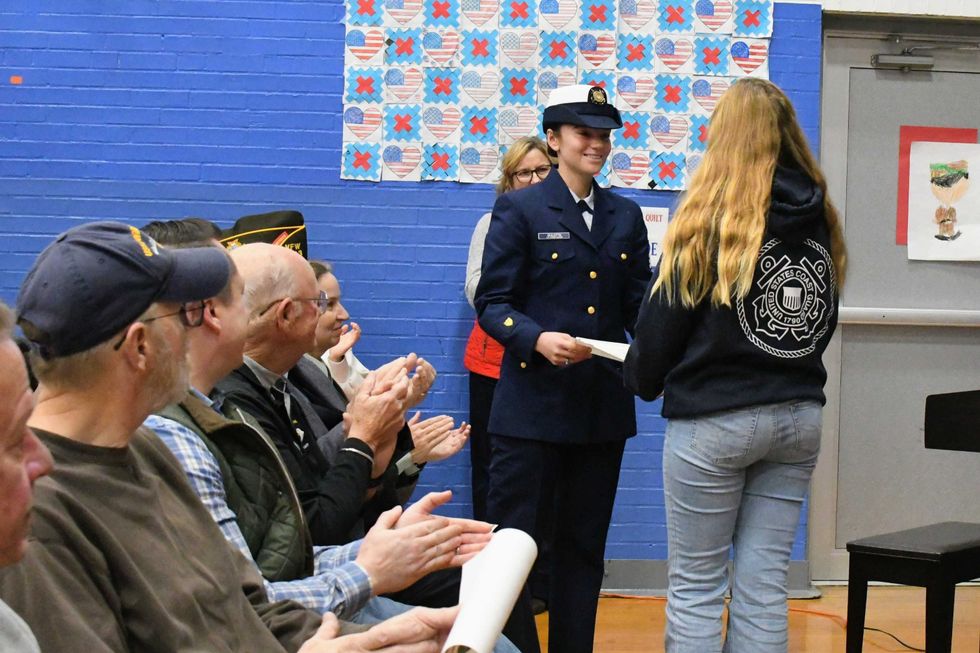 E3 Seaman Madison Gulotta receives a certificate from her sister Taylor, who is an 8th grader at North Canaan Elementary School.Photo by Riley Klein
Brayden Foley spoke of his grandfather Todd Baldwin's time in the Navy. "My grandpa taught me that helping others in a fundamental way can build strong, meaningful relationship and a supportive community. I appreciate all members of the Armed Forces past and present for their bravery and their commitment to protect the freedom that we have today."
Veterans were recognized individually by Principal Beth Johnson and students presented them with certificates.
The 2nd graders closed the ceremony with a choreographed rendition of "Grand Old Flag."
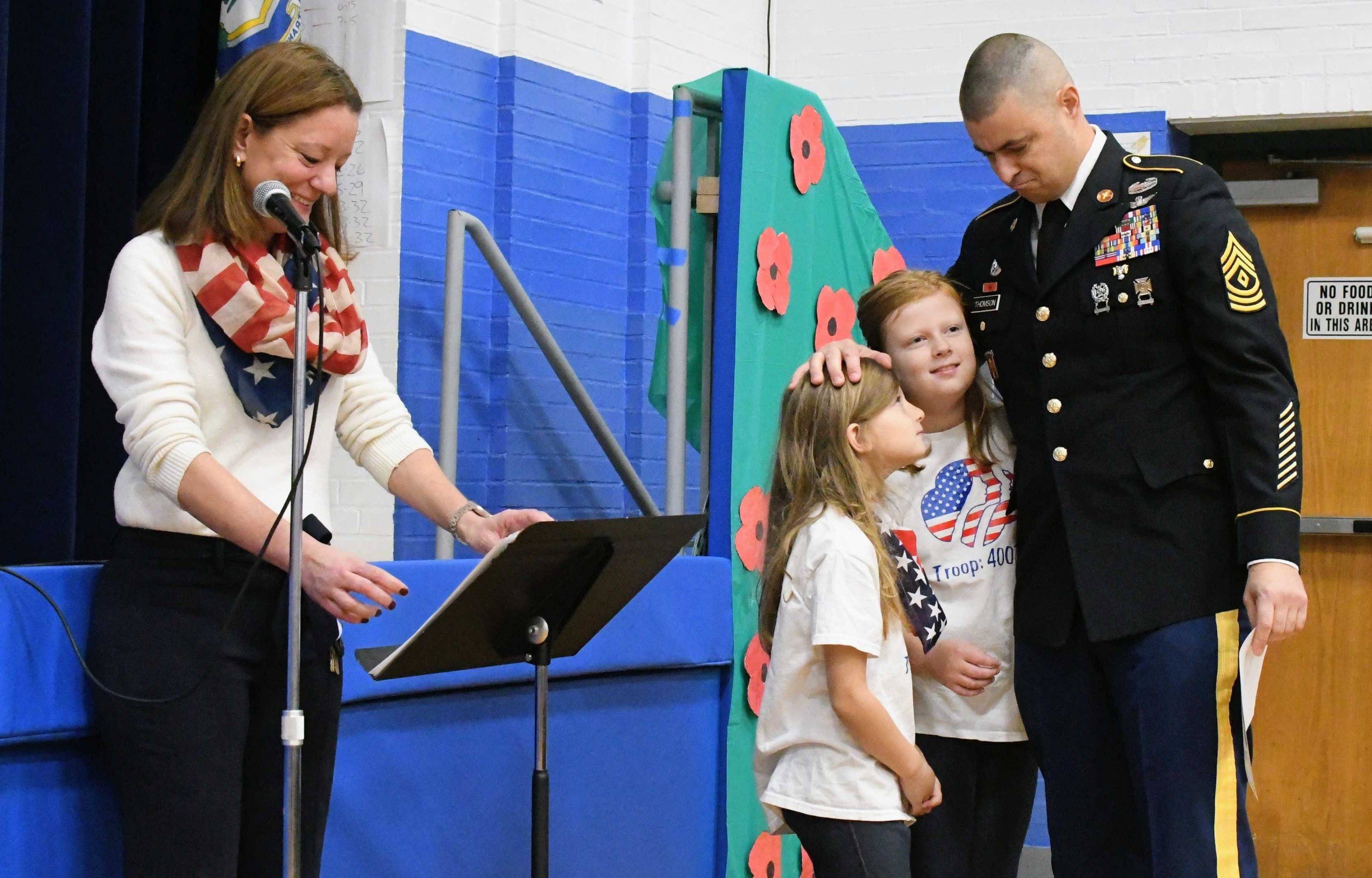 First Sergeant Andros Thomson receives a certificate from his daughters, Lydia and Roslyn, who attend NCES. At left is Principal Beth Johnson.Photo by Riley Klein
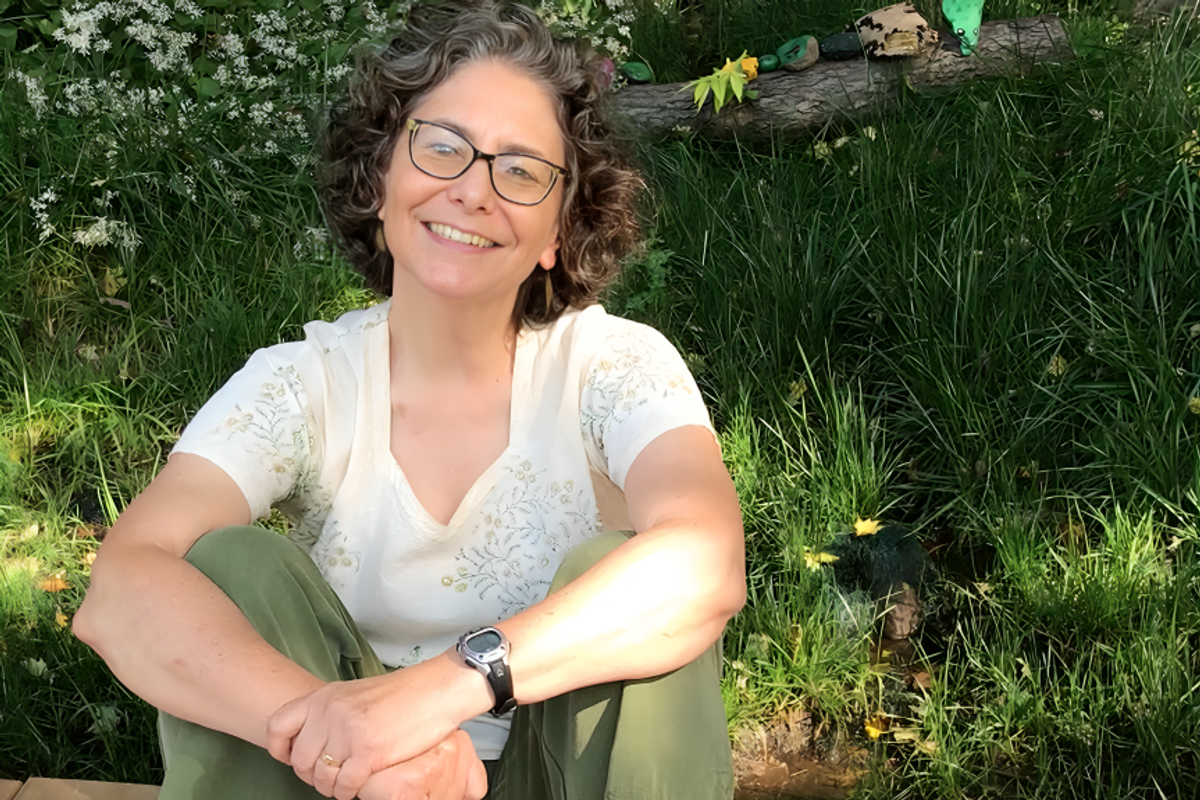
Amy Wynn, who has served as executive director of the American Mural Project in Winsted, has stepped down from her position after seven years with the nonprofit organization.
AMP
“We had such a fun party for her,” said AMP founder and artistic director Ellen Griesedieck. “I am excited for what is next for Amy and grateful for every moment she has invested in her work at AMP.”
Wynn, who previously led the Northwest Connecticut Arts Council, said her decision to step down came after careful reflection.
“It’s time for me to shift into the next phase of my career, which will call upon my 40-plus years of nonprofit experience to do project work,” she said. “I’ve absolutely loved my time at AMP.”
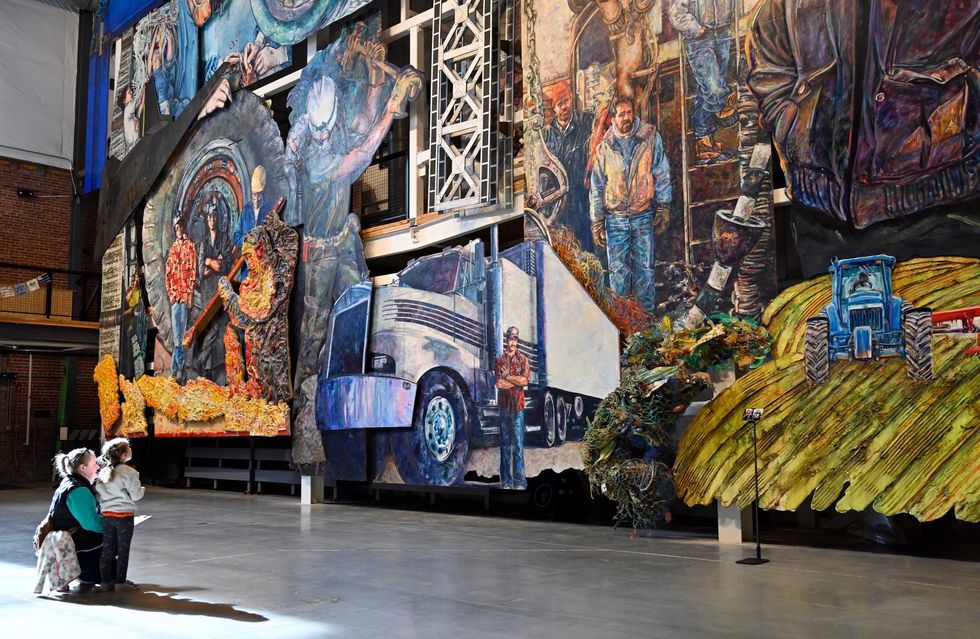 Visitors to the American Mural Project.Sky Johnson
Under Wynn’s leadership, AMP expanded education programs, deepened community partnerships and oversaw key milestones in the creation of its monumental centerpiece — a three-dimensional mural stretching 120 feet long and five stories high — celebrating American ingenuity, industry and collaboration.
“Through all these years, Amy has worked with tireless enthusiasm for AMP, running day-to-day operations and guiding the overall direction of our mission,” Griesedieck said.
During Wynn’s tenure, AMP evolved from a concept into a dynamic cultural campus. She helped professionalize its structure, solidify its funding base and develop programs that drew visitors from across the state and beyond.
“The work she has accomplished, the hours of overtime she has logged, the mountains we have climbed together since that moment are many and miraculous,” Griesedieck said.
AMP also weathered challenging times, including the pandemic, which forced arts organizations to rethink audience engagement. Wynn guided the team during that uncertain period with a steady hand.
To ensure a smooth transition, AMP has brought on Renee Chatelain of RMCreative Solutions, LLC, an experienced consultant, attorney and arts administrator who previously worked with AMP on its capital expansion planning.
Chatelain will serve as interim executive director while a national search is conducted for AMP’s next leader.
“A longtime friend, Renee comes to us with a depth of knowledge on executive transition,” said Griesedieck. “As an attorney, a leader of several arts organizations and a classically trained dancer, she is particularly well-suited for this interim role.”
Though stepping down, Wynn said she will continue her work in the nonprofit field in a more flexible, project-based capacity.
“I’ll be seeking consulting projects with other nonprofits, assisting with grant work and strategic planning,” she said. “What I enjoy most is leading a collaborative effort and finding solutions to challenging problems.”
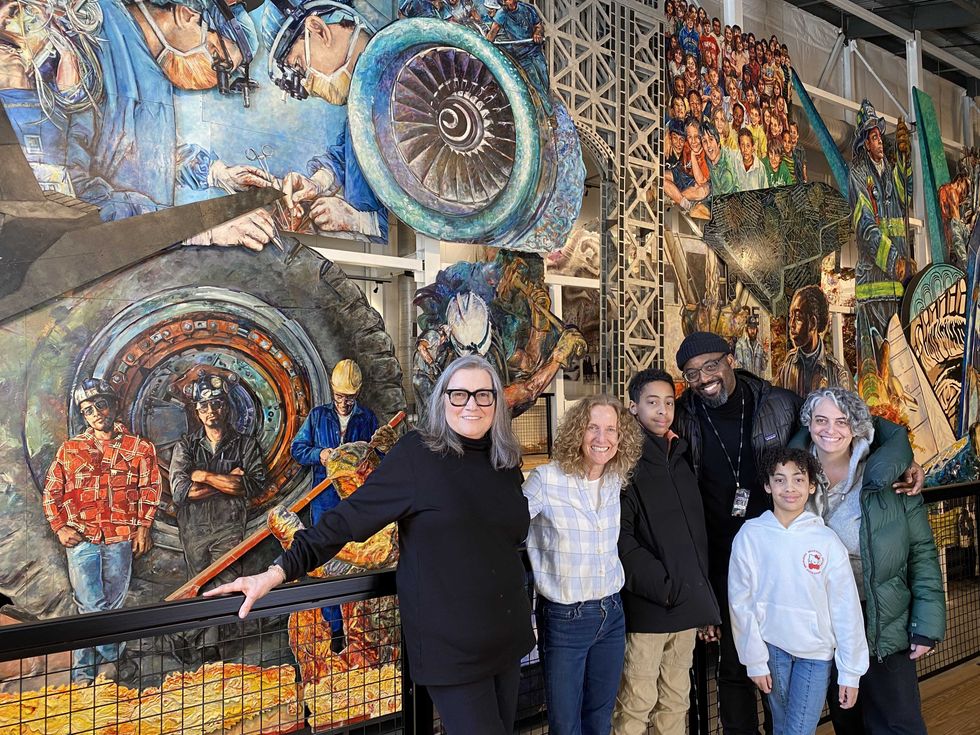 Sky Johnson
Even as AMP bids farewell to Wynn, its focus remains on the future. The next phase of development will focus on converting a second mill building into expanded programming and community space.
“The next step has got to happen,” Griesedieck said. “It’s absolutely what the Northwest Corner needs — a place for the community to congregate.”
The proposed expansion would create flexible areas for performances, workshops and public events, further establishing AMP as a cornerstone of the regional arts scene.
With community support and grants, AMP hopes to carry forward Wynn’s momentum into a new era.
“She is not leaving,” Griesedieck said. “Amy will always be here for us.”
Founded in 2001, the American Mural Project was conceived as a tribute to the American worker — a celebration of skill, creativity and perseverance. The mural, the largest indoor collaborative artwork in the world, was created with contributions from thousands of children, artists, teachers, tradespeople and volunteers nationwide.
Today, AMP offers tours, workshops, lectures and performances, all rooted in its mission: to inspire, invite collaboration and reveal the contributions people of all ages can make to American culture.
As Wynn turns the page, her legacy — from her calm, strategic leadership to the collaborative spirit she fostered — remains woven into the fabric of AMP’s story.