The Great Falls at Falls Village is a place most of us visit to watch the water cascade over the rocks when the Housatonic River rises after a rainstorm. It is hard to believe that those same falls were once the center of extensive industrial activity. Today there is the power plant downstream from the falls that still generates electricty when the flow of the river supports it, but that is all.
In the past, the same site has supported a forge, iron works and railroad shops. Of those, the railroad operation was the final enterprise actually at the falls. It operated during the last three decades of the 19th century and supported the operations of the Housatonic Railroad.
One obvious question is why any business would locate a facility on a waterfall. In the case of the railroad there were two reasons: First, the site offered abundant water power and second, the railroad could buy the fully developed water power system there at an unbeatable price due to the closure of the Ames iron works.
The water power was actually not from the Great Falls as we know them today, but from the "Little Falls" that were once located upstream from them. Our ancestors chose the upstream site because of limitations in the water power technology of their time. The simple fact was that the Housatonic was too big and too powerful to control at the Great Falls and no attempt to do so was made until the middle of the 19th century.
Water power sites in the 18th and early 19th centuries concentrated on smaller streams like the Blackberry River in Norfok and Canaan, the Salmon Kill in Lime Rock and the lake outlets at Lakeville and Taconic in Salisbury because they were easier to control. The smaller falls at Falls Village were a workable compromise and came into use in the 19th century for the Ames iron works.
u u u
The story of the Ames works is a tale for another time, but among its notable products were large bore cannon and locomotive tires. When the owner/operator of the Ames works died, the plant was put up for sale. In the fall of 1871 the Housatonic Railroad bought the property and began converting it into a repair/construction facility to support its operations. The purchase of the Ames works was a wise choice as indicated by the following article in the Oct. 6, 1871, issue of the Connecticut Western News:
"Ames Iron Works. — We are enthusiastically informed that the Housatonic railroad company, have already sold over 800 tons of iron taken from these works, and which has brought them about $50,000. There is now remaining a great quantity, and it is thought that when all sold, the ‘old iron’ of the works, will nearly pay the entire expense of their original cost, viz $75,000. The largest of the steam hammers ‘Thor,’ was sold to the Silver steel works in Bridgeport, and the smaller one has gone to an iron establishment in High Bridge, New Jersey. The main building is now entirely removed, and the ground on which it stood is cleared, and will be graded or raised about 3 1/2 feet, and on which will be placed the ‘Round house’ for the locomotives. This grading will soon be commenced, and the work of construction pushed as rapidly as possible."
u u u
The pace of work was not quite as rapid as this article implies; indeed, even by 19th-century standards it was close to glacial. Nearly a year later in September of 1872 the paper published this update:
"Falls Village. — The new locomotive and car shops of the Houstaonic Railraod Co. in Falls Village are rapidly assuming definite shape, and a very good idea can be obtained of what they are to be when completed. The building to be used for repairing cars is an immense structure, and will contain a large amount of machinery for car building and repairing. The locomotive repair shop, although a large building, is not nearly as large as that for the building cars. Conveniently located near the two structures mentioned is the ampitheatrically shaped building for housing locomotives when not in use. It is built sufficiently large to accommodate twelve locomotives. The two last structures are being built of brick, that portion of the job being done by that ‘brick’ of a genius, I. N. Bartram, of Sharon, who is said to be able to see through a larger pile of brick than any other man except Brick Pomeroy. The car building is built entirely of wood, but what is going up on the foundations so deeply laid in the ground between these two buildings ? The large force of men were so very busy at their work, and our time so short there last Friday, we concluded to deviate from our usual course and ask few questions. Where did all these men come from? Scarcely a familiar face among them: all strangers. They act as though they knew their business and are attending to it as hard as they can. The decision of the railroad company to erect these extensive works at Falls Village is, we think, not only a fortunate one for them, on account of the unlimited water power they get and the numerous other advantages of the location, but will add another to the number of heavy manufacturing establishments, which is making this section of so much importance."
u u u
The author promised to treat the shops in more detail at a later date, which led to this article published in January of 1873:
"Housatonic Locomotive Works. — The extensive works of the Housatonic railroad company in Falls Village, for building and repairing locomotives and cars, are slowly approaching completion. It is said the company will move into the works and commence operations sometime during March. Some months since we visited and wrote up something of an account of their doings, but the other day when there we found so much more had been done than was visibly apparent at the time of our other visit, a few words more concerning the conveniences being introduced may not be out of place, The three large structures, viz: the locomotive repair shop, the car shop and Round house for locomotives have a great number of gas jets, jutting out from the walls in the various departments, for the convenience of the workmen, which are supplied with gas from the gas house on the hill beyond, the company manufacturing all the gas to be used in the works. Near the locomotive shop, in a small building which covers an immense filter, into which by hoisting a gate water will pour from the Housatonic river, which in passing down through the charcoal, sand, etc., will become purified, after which a huge pump carried by a waterwheel near it, will throw it into a reservoir on the hill, from which, pipes are laid to run immediately over the tenders to the locomotives as they stand in the Round house, and from which with the ‘head’ obtained by the height of the reservoir, they can quickly be filled with pure water. In the car shop is a powerful pump, connected with which are pipes of hose leading to every part of the building, and in case of fire this pump can be instantly adjusted, and made to throw water over or through the works. Thus it is, these works, which will add so much to the importance of this region are nearly completed, and it is very generally remarked by those who visit them, that they are indeed very well and substantially built, possessing all the conveniences so essential to the most advantageous employment of the workmen."
u u u
A fire insurance map of the complex published by the Sanborn Map company in 1889 shows a well developed complex with three large buildings and many smaller ones. Also on the site were a number of tenements to house workers. The fire protection system, being of major interest to the fire insurance industry, was described in detail, as was the construction of each building. Also noted was the fact that two men and a night watchman worked all night.
The buildings had steam heat or stoves and the lighting was described as provided by "gasoline gas," which was a type of illuminating gas made from petroleum. The fire pump described in 1873 was water-powered so it could operate even if a fire affected the steam supply. This probably earned the facility high marks in the eyes of the insurance men as it made the fire supression system more robust.
What sort of work went on there? The complex had the facilities needed to perform just about anything related to the maintenance of railroad cars and locomotives. There was also the car shop that could produce new freight cars from scratch. There were buildings dedicated to heavy machine and foundry work, carpentry and painting. In addition, there was a roundhouse to store locomotives when not in use.
u u u
Steam locomotives required a great deal of maintenance, the rule of thumb being that a locomotive had to spend an hour in the shop for every hour it ran on the road. Worn metal parts had to be refurbished, boilers cleaned and tires replaced on the locomotive drive wheels. Yes, steam locomotives had tires. They were large metal hoops that were mounted on the cast iron wheels by a process of heating and shrinking. These tires wore out from the friction of pulling trains and rubbing on the rails in corners. When worn out, they were cut off the wheels and new ones mounted. Many used locomotive tires were recycled as alarm gongs for fire companies and you can still find one now and then in front of a firehouse.
Beside locomotives, the shops at the falls repaired wheel sets for cars (called trucks), replaced brakes and kept the entire fleet of freight cars serviceable. Cleaning and maintenace of passenger equipment also occurred here, keeping the fancy varnished cars in good order.
Work at the shops hummed on for nearly three decades with a few improvements made now and then as shown on the successive maps of the site.
u u u
The end of the shops at Falls Village came as the result of the acquistion of the Housatonic Railroad by the New York, New Haven & Hartford Railroad. As is still the case today, the "acquired" company can expect to suffer from consolidation efforts aimed at streamlining the new merged company. The acquiring company, it seems, always gets the benefit of such efforts and so it was with the Housatonic.
Locomotive repair and car construction were consolidated at the New Haven’s facilites and the Falls Village operation was closed. The 1904 Sanborn map shows a vacant complex that only had a few years left to exist. When the power plant was built in 1913, the railroad shops and all that surrounded them were completely obliterated. Even the "Little Falls" were removed to permit maximum river flow to the new power plant. Today there is absolutely no trace of the once busy railroad shops and visitors have to rely on interpretive signs placed on the site to imagine what once was there.
Richard Paddock lives in the Taconic section of Salisbury and volunteers at Beckley Furnace in East Canaan.

 Models walk the organic runway at HVSFW. Ilan Harel
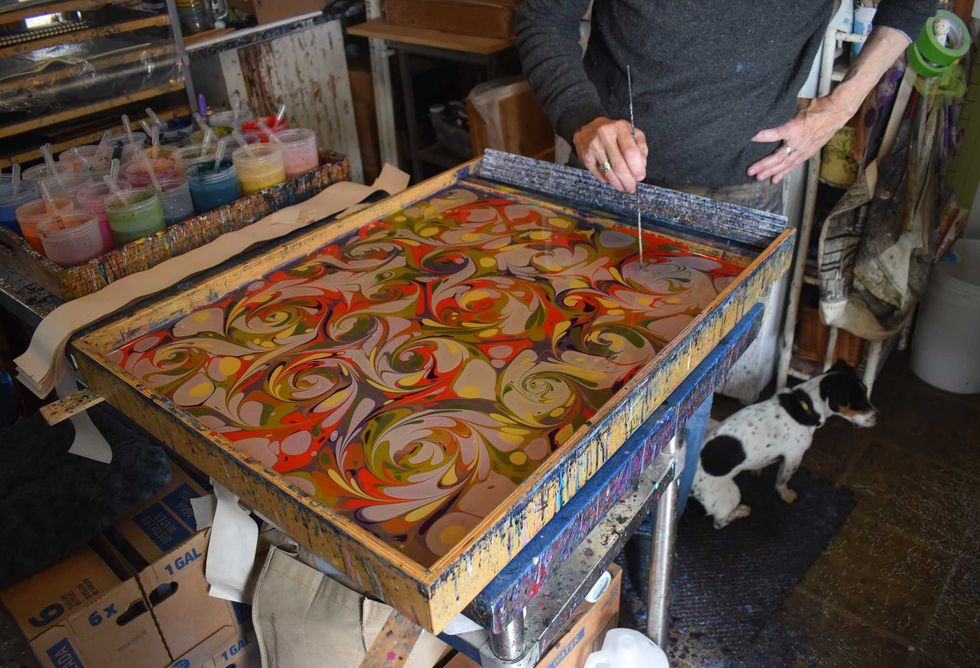 Susan Schneider, owner of Shandell’s, creates a variety of products with marbleized surfaces in her Ashley Falls studio.L. Tomaino



 Roger McKee naming the winners with the first place entry over his left shoulder. Patrick L. Sullivan
 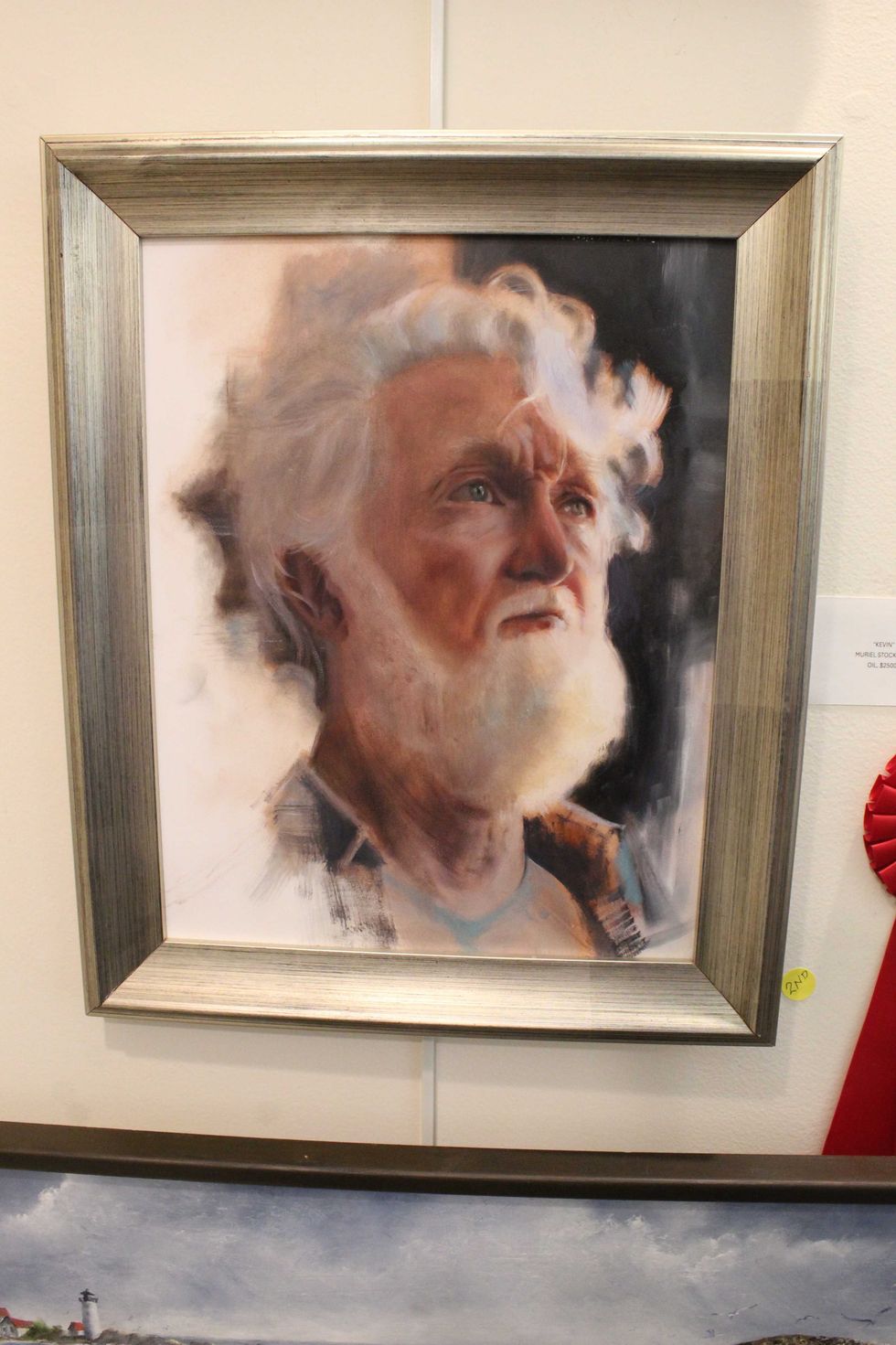 Muriel Stockdale’s “Kevin” took second place in the juried art show at Trinity Episcopal Church.Patrick L. Sullivan