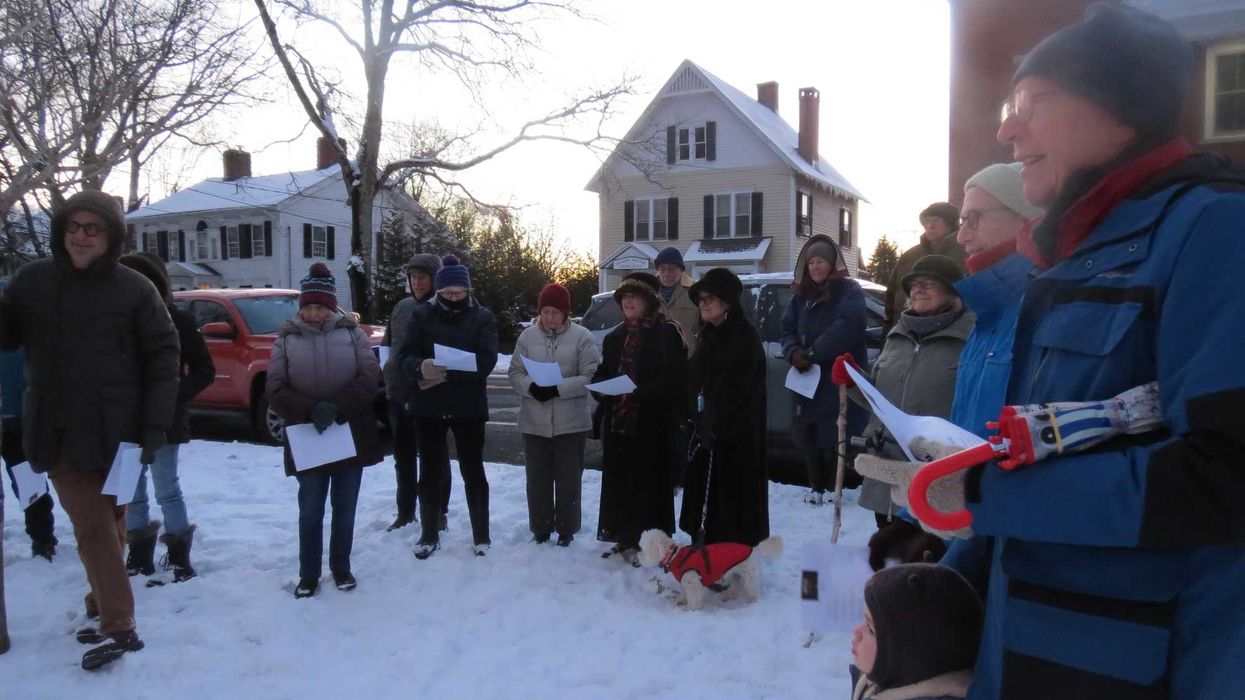
Sharon gathers to light menorah

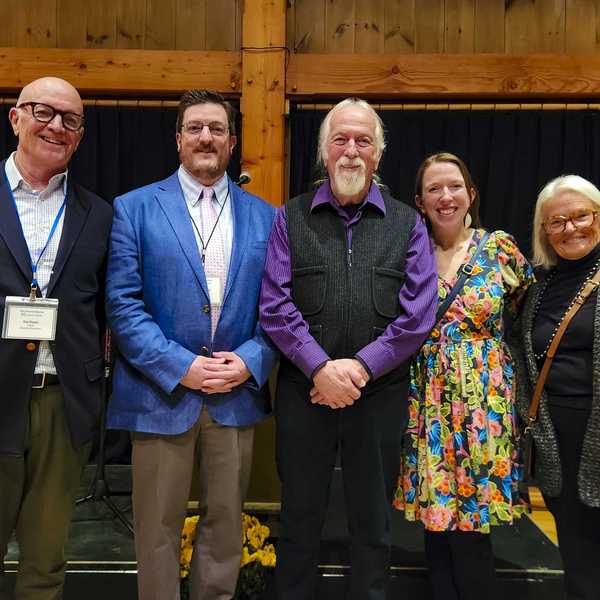
A group joins together to share in the lighting of the menorah on the first night of Hanukkah on the Sharon town Green Sunday, Dec. 14.
Ruth Epstein

A group joins together to share in the lighting of the menorah on the first night of Hanukkah on the Sharon town Green Sunday, Dec. 14.
SHARON — In an ecumenical atmosphere, the menorah on the Town Green was lit Sunday evening, Dec. 14, for the start of Hanukkah.
Carl Chaiet, who has been marking the Jewish holiday for several years, noted the candelabra used to observe the Festival of Lights, stands between the town’s Christmas tree and the creche, the latter sharing an electrical connection with it.
During the lighting ceremony, attended by close to 30 people, Chaiet lit the first candle. He had found the pieces of a candelabra about 20 years ago in his father’s basement, saved from a closed synagogue. As an artist, he saw the opportunity to reconstruct the disassembled piece of brass and bronze and erect it on the Green, with the approval of the then-Board of Selectmen.
Since then, he and his wife, Selectman Lynn Kearcher, lead a ceremony on the first night of Hanukkah. An additional light goes on each following night.
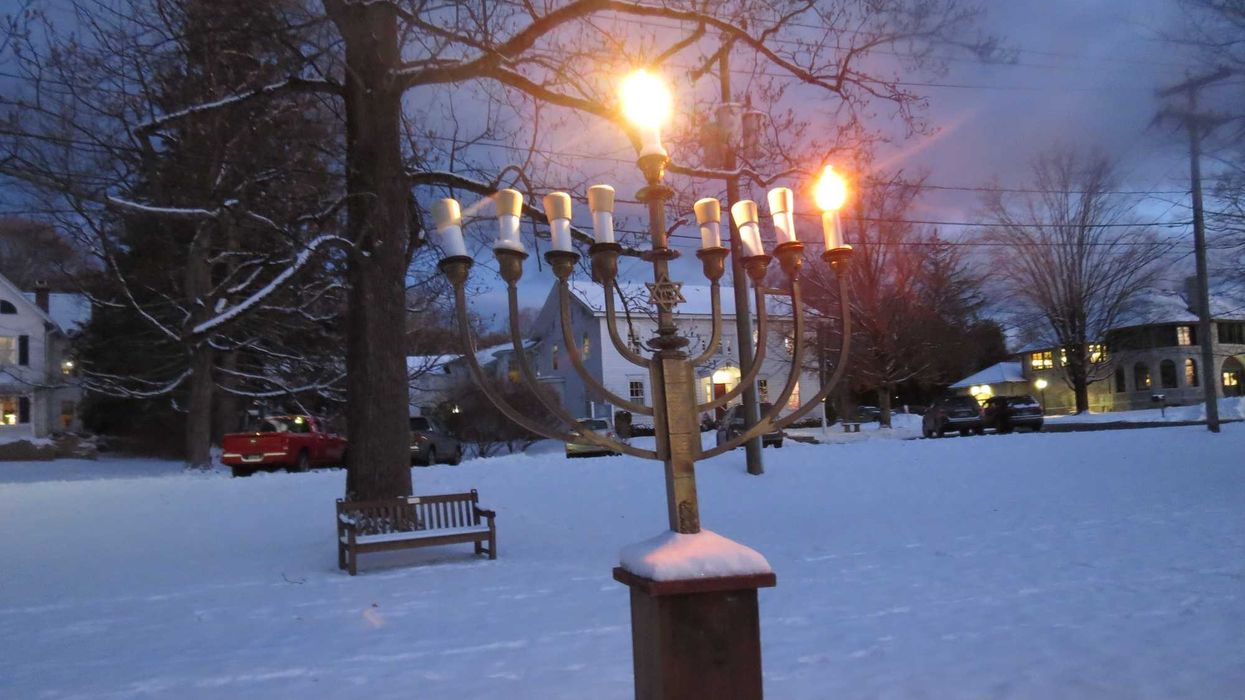
“The celebration of Hanukkah is a celebration of strength, determination and resilience,” he said. “Each year the message seems pertinent to all of us and we invite all faiths to join in the lighting.” One woman noted the importance of that message more so this year because of the mass shooting that took place in Australia that weekend with the killing of several people celebrating Hanukkah.
Chaiet recited some prayers and led the group in singing holiday songs. Since the Hanukkah miracle involved oil, it is customary to eat foods fried in oil. A favorite is the potato latke. Kearcher gave out their version—bags of potato chips—along with samples of circular pieces of chocolate wrapped in gold, known as Hannukah gelt, another holiday treat.
These skills that are developed with animal care transfer to owning personal animals or a career that works with animals.
— Madison Melino, 2025-26 Housatonic Valley FFA Historian
HVRHS’s agriculture education program is abundant with unique experiences and opportunities for students, one of which is the barn. This barn, located next to the Science and Technology Center, has seen a wide variety of animals; from the typical sheep and goats, to the occasional heifer, alpacas and miniature ponies.
This barn looks a little different, however, when the grass dies and the wind turns frigid.
Care for these animals during the more ideal seasons is split between a couple of the ag-ed classes. “Students in agriculture classes learn about all aspects of animal care in the classroom and take shared responsibility over weekends and breaks for the care of the animals,” said Madison Melino, the 2025-26 Housatonic Valley FFA Historian. While both the teachers and the students are involved in the animals’ care, students lead in most of the work. “Teachers buy the supplies for the animals, but I would say it’s mostly students feeding and caring for them all year round, not just in the winter,” said Hannah Johnson, the 2025-26 Housatonic Valley FFA Vice President. “These chores are delegated mostly to students in the Vet Science class.”
Students even organize who does what chores among themselves. “They take care of the animals and everyday they volunteer to do the different tasks necessary.”
While the delegation of these chores remains the same throughout the year, the supplies and care plans used differ. There is one main priority in the winter; keep the animals warm. “In the winter we have to really make sure that [the animals] water is not frozen, so they always have something to drink. We also have to make sure that they have enough hay to keep them warm,” Johnson said.
Winter care also requires additional supplies — leading to higher costs through the season. “Additional costs include bedding material like shavings and straw,” Melino said. “They go through more hay in the winter which is an additional cost,” Johnson said. In addition to extra straw and shavings, Melino said barn animals can require heat lamps, water heaters, blankets and extra bedding to stay warm in the cold.
For the sheep specifically, it’s important that they go into winter with extra weight to keep warm. “In the winter we check the body condition of the animals every week to ensure a healthy weight,” Melino said. “It is always a good idea to go into winter with a few extra pounds on the sheep.”
“The number one priority … ensuring that they don’t get frostbite,” Johnson said. Blankets and extra bedding can help, but snow gets in the way of animal care in more ways than one may think. “The biggest struggle in the winter is the weather if it gets extremely cold or a lot of snow is on the ground preventing the opening of the stalls,” Melino said. “Closed stalls are hard for humans because it takes additional work to keep the area clean inside.”
Winter brings some benefits along with the challenges, FFA members said. “One benefit during the winter is that there’s little to no mosquitos and bugs which creates less worry about disease transmission,” Melino said. There is also little impact on the animals’ general lifestyle. “For the animals we have at the school they are pretty acclimated to the winter from past seasons so we don’t really notice a change in behavior,” said Melino.
Students learn valuable lessons and skills while taking care of these animals. “Students learn about nutrition, health, vaccination schedules, behavior, breeding, and more,” Melino said. “These skills that are developed with animal care transfer to owning personal animals or a career that works with animals.”
Peter Vermilyea, right, teamed up with sophomore Logan Miller in a game of dodgeball during the Turkey Olympics on Friday, Nov. 21.
The senior class at HVRHS won the Turkey Olympics on Friday, Nov. 21, the week before thanksgiving. Unlike previous years, the competition against the seniors was minimal as the three other grades all had fewer than 10 representative students each. The teachers had about the same attendance as usual, while also adopting the single sophomore that came to represent his entire grade.
The Turkey Olympics is made up of a collection of games from dodgeball, tug-of-war, knockout, and more. All of the games took place after school and the grades competed against each other in each game, trying to win the most points. First place wins five points, and last place wins one point. At the end of the afternoon, the student government tallied up the points and declared an overall winner.
Even with the senior population dominating the event, the other classes represented to the best of their ability.
The biggest competition this year was between the juniors and seniors. Representatives from those classes dominated the competition, with either a junior or senior winning every challenge. Back and forth they went, until eventually it was clear that the seniors would be the ones to take the glory.

HVRHS students offered some explanation for the lackluster participation from underclassmen.
“I think that the underclassmen did not show up because there was some lack of advertising and the upperclassmen had already been involved previously,” said Celeste Trubucco, a member of student government. “Next year they should work towards advertising more in advance so that people, specifically the underclassmen, can plan.”
The student government made fliers, instagram posts, and school announcements. But the efforts didn’t seem to drive more underclassmen to the event.

After reading Ken Kesey’s “One Flew Over the Cuckoo’s Nest,” the AP English literature class agreed to get together at 5 p.m. on Tuesday, Nov. 4, and watch the movie. Fueled by Goshen Pizza supplied by Mr. Osora, blankets, and a newly finished novel, the 12 students settled in and watched the film in room 133.
“The premise of ‘One Flew Over the Cuckoo’s Nest’ teaches students ideas of conformity and compliance to people of power,” Osora said. “These messages are more important today as ‘Cuckoo’s Nest’ can reveal to people the importance of not being a silent witness when power is abused.”
Watching the movie is important to understand the messages. The students compared the film to the novel by looking at what they left out and why the movie deemed it unimportant. This way, a comparison can be made between the ideas and messages either discarded or highlighted in the movie. “They can look at whether the movie preserved the most important ideas and themes,” Osora said.
Some of the students stuck around after school to watch the girls’ soccer team play, and didn’t have time to go home before watching the film.The movie, being 2 hours and 18 minutes long, did not provide for a short night as the students got home roughly around 7:30 p.m.
But the academic and social experience it provided the students negated the cons of their thirteen-hour day.
Watching the movie outside of school meant that the students did not need to waste multiple class periods watching and dissecting the movie. Instead, they took two hours out of their night to watch it all together.
“I liked being able to compare and contrast the movie, especially because there were so many changes, and that we got to discuss these changes after the movie,” Sara Ireland said.
At the end of the night, the class agreed they would like to do it again with other books the class reads together.
HVRHS offers courses at four levels: college prep (CP), honors, Early College Experience (ECE) and Advanced Placement (AP). Students can choose between these different levels, but their trajectory is largely dependent on what their middle school teachers recommend them for.
The major differences between AP/ECE classes and CP classes are rigor and the credits received from taking that particular class. AP/ECE classes are weighted more when a student’s GPA is calculated. “There is also an increased rigor in AP/ECE curriculum, with an emphasis on preparing students for college level expectations,” said Karen Littau, HVRHS’s Counseling Department Chair.
While AP provides more credits and harder classes, CP classes allow for subject exploration. “It provides students with the ability to try many of the courses we offer — both to reach graduation requirements and also the opportunity to use elective space for class exploration,” Littau said. These classes are also a lower-stress alternative to AP or ECE courses. “If a student has no plans of pursuing a career that has to do with one of the higher level courses, they can take a lower level that will still give them information on the course and the skills needed to grow as a learner without taking on the intense stress of a higher level class,” said Sara Ireland, an HVRHS senior.
In terms of what these classes have to offer, it varies from student to student. “I think that all of the classes have something to offer, it really just depends on what a student is willing to put in and what they’re looking to get out of a class,” said Elizabeth Forbes, an HVRHS senior.
The variety of offerings gives students the ability to tailor their schedules to their goals and interests. “It really depends on the student specifically and their interests/ post graduation goals,” said Littau. They also allow a student to pick classes that fit their academic abilities or styles. “Each level of rigor for CP and AP classes will reflect a student’s ability to remain organized and on task with course understanding and work completion,” Littau said.
Students may find that, as they grow throughout high school, their needs are not being met where they were initially placed. Students can request more or less rigorous courses if needed. “To switch to a higher level class, first you need an approval from the teacher that you’re ready to take the classes and that they think you can handle it. Then you need to fill out a Level Change form from the Counselors, informing them of what classes you wish to switch into and a signature from your parents affirming that they want you to be in the higher level classes,” Ireland said.
Students reported some differences in their experience changing levels to more rigorous classes. “I think that when you are put in a class level, you really have to advocate for yourself and say ‘I’m ready to move up or down in this class,’ because teachers will just recommend you for the same class levels for the next year, sometimes without talking with you about it beforehand,” Forbes said “You really have to tell them yourself.” While some students feel they had to self-advocate, others felt completely supported in their efforts. “I felt supported by my teachers when I changed levels,” Ireland said. “They were very accommodating to my switch, giving me extensions on the earlier projects to help me adjust to both the curriculum and the pace the Honors kids worked at.”
Among the student body, class levels perpetuate some harmful stereotypes. “AP students have a lot expected of them,” Ireland said. “There are less chances to try again and the classes generally contain a harder curriculum.” Ireland further explained there is a stigma around CP classes. “CP classes and students generally have a stereotype of being ‘dumb’ or ‘taking the dumb classes.’ This is unbelievably incorrect,” Ireland said. “While it was not the right pace for me, the CP level courses still taught me a lot. There’s nothing ‘dumb’ about the CP classes or those who take them.”
While competition and bias may persist, it’s important to recognize the importance of both AP and CP classes. “Enrolling in a variety of classes opens the door to new opportunities for students,” Littau said. “It allows them to take a plethora of courses offered at HVRHS, and to educate themselves with many different learning pathways.”