Steam power meets spring showers

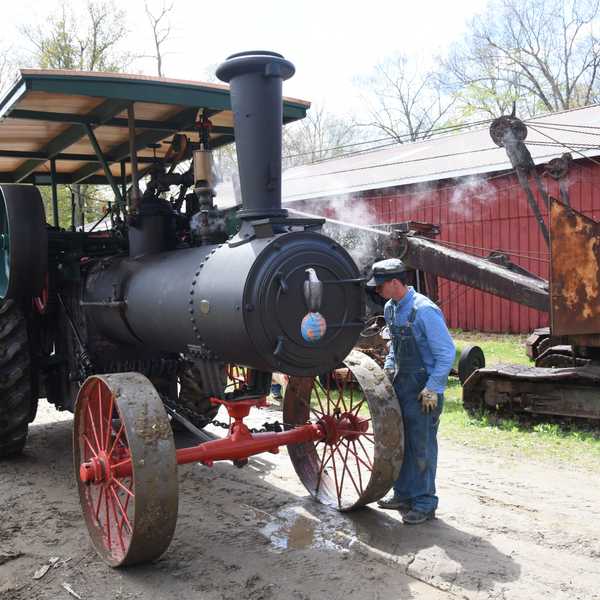
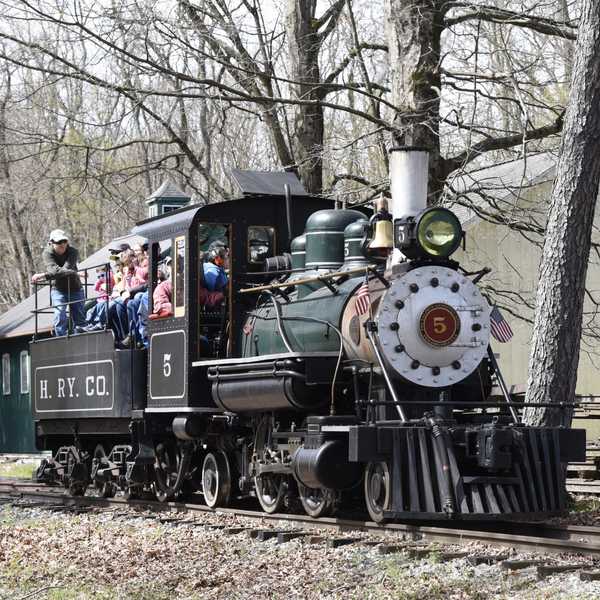
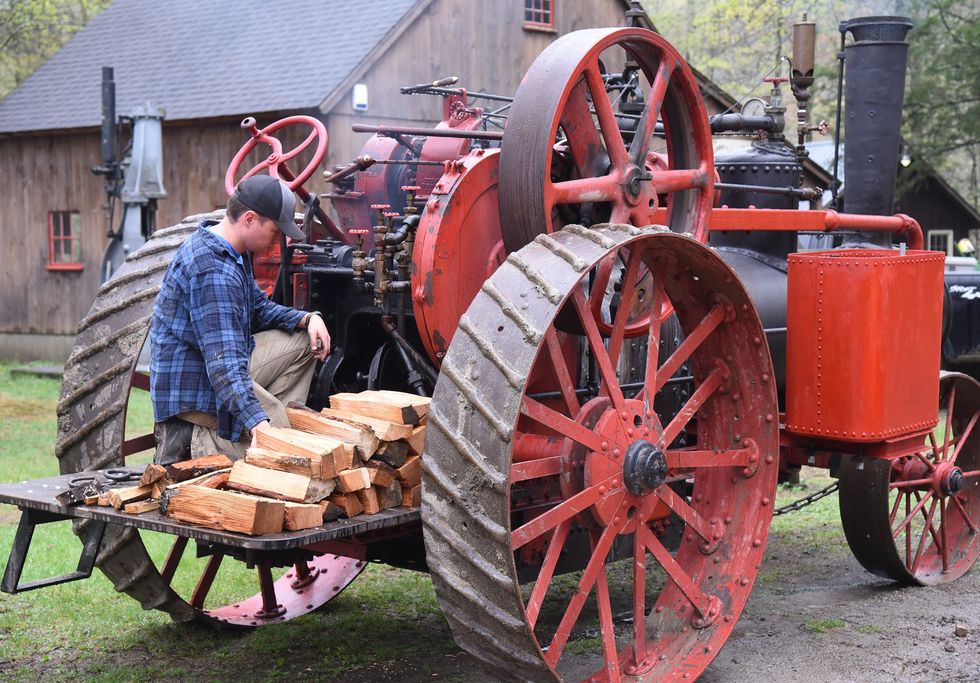
Passengers enjoy a ride on Engine No. 5 through the CAMA grounds, April 27.
Lans Christensen


Passengers enjoy a ride on Engine No. 5 through the CAMA grounds, April 27.
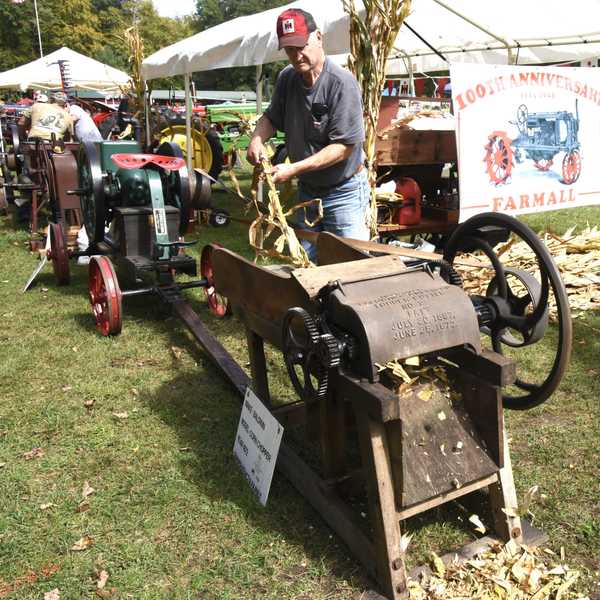
KENT — Connecticut Antique Machinery Association opened the season with its Spring Power-Up on Saturday, April 26, and Sunday, April 27 .
Intermittent rain showers kept crowds to a minimum on Saturday,while Sunday brought strong winds and chilly 50-degree temperatures.
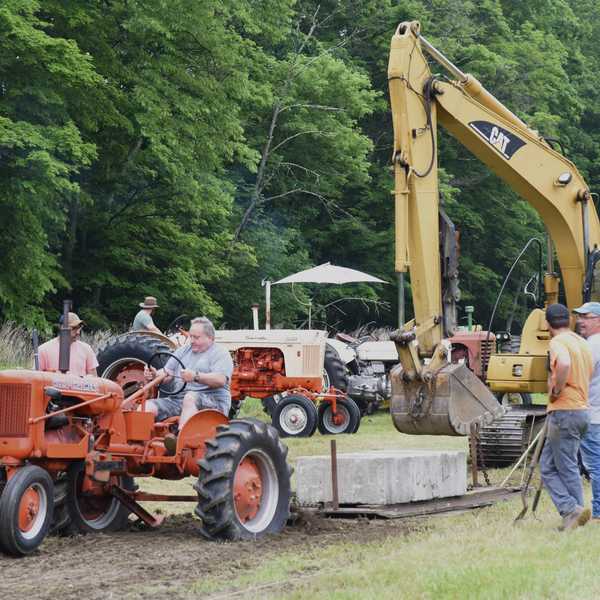
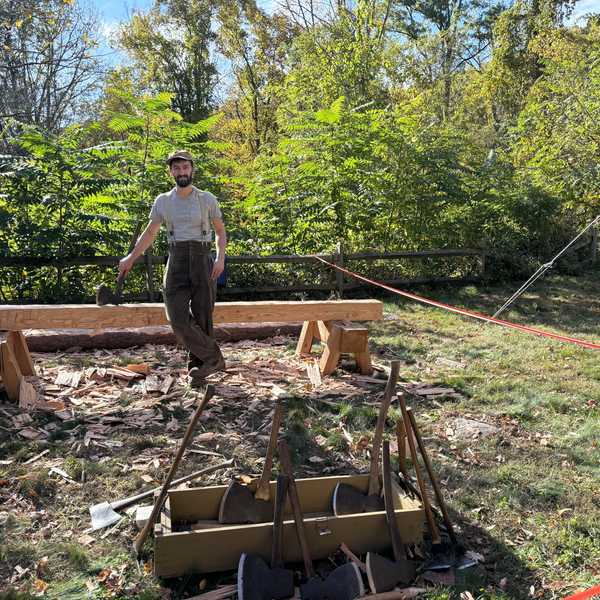
Despite its smaller scale compared to CAMA’s fall festival, the Power-Up had plenty of steam-pumping and chug-chugging machinery in full operation.
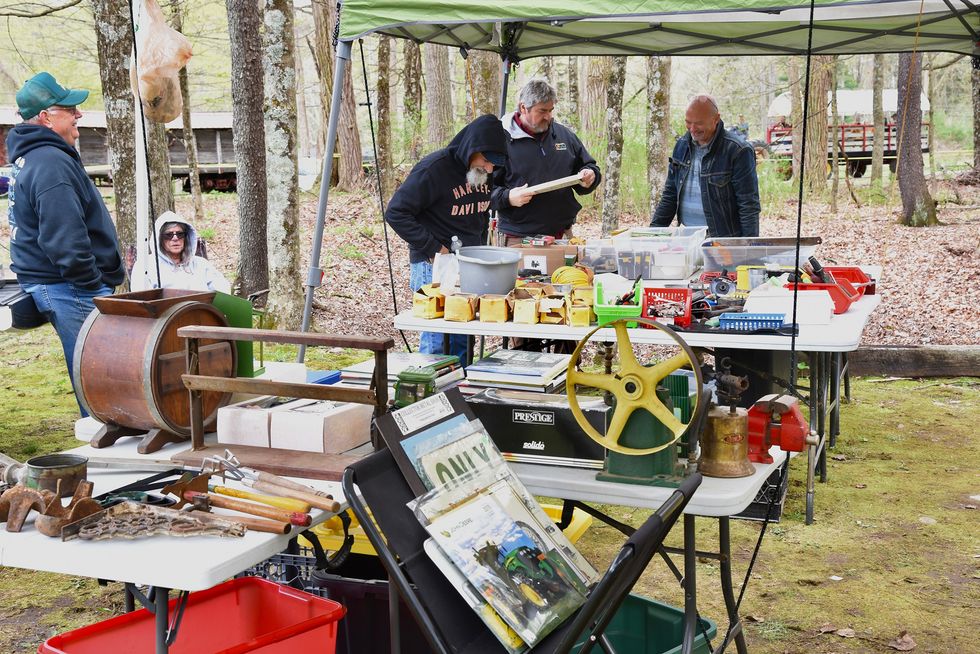
The tag sale area was downscaled by weather, but enough vendors were there to give everyone a chance to find that must-have rarity.
Dee Salomon
This brief period in the spring, before the mosquitoes and poison ivy proliferate, is irresistible to me. I want to do everything all at once: plant, remove invasives, examine what is coming into leaf and tend to plants that need protection, whether from deer or downy mildew.
Amid the nonstop gardening work, I recently made time to join a tour of two nearby gardens. Each had a fascinating history, and we looked at photos to see how much had changed and what was still there and flourishing, including a stand of large yellowroot with delicate brown-and-yellow flowers that look like a cross between an orchid and a lilac. It has been there for decades, a lesson in successful gardening with native plants.
As we toured, I overheard someone grumble about having too much wild strawberry in their garden. I secretly laughed, as I have worked for several years to encourage the spread of this sweet plant with its pert white flowers and miniature fruit. I have planted it under trees, encouraged it along woodland paths, and sat on the edges of the lawn for hours pulling out the very similar mock strawberry, Potentilla indica, to allow the native one to proliferate.
One of its characteristics is that it spreads readily, given room. As a groundcover, it also controls erosion. According to Native Plant Trust, Fragaria virginiana supports 75 different species of butterflies and moths throughout their life cycles and supports numerous other insects, as well as mammals and birds. This makes it a “keystone” plant, a designation that means without it, an ecosystem is vulnerable to collapse. That is a big responsibility for a small plant.
One person’s trash is another’s treasure. On the very same garden tour, another person was extolling the flowering lily of the valley, Convallaria majalis, situated in a stone-walled bed. I used to feel the same way until I noticed large swaths of it growing in the woods.
This romantic and fragrant flowering plant is a wolf in sheep’s clothing. Its deep rhizomatous roots crowd out native groundcover neighbors. Lily of the valley is highly toxic to mammals and, as a nonnative, supports only a few insects that use its pollen. I have tried digging and pulling it out to no avail. This year, I am using a strimmer, aka weed whacker, even though I risk damaging nearby plants. I am hoping that after doing this a few times over the next several years, I will succeed in getting rid of it. I will keep you posted.
Native groundcover may not be our first thought when we garden, but it is an easy and fundamental way to tie together a garden bed, especially when garden plants are still immature, while helping nature at the same time.
In addition to wild strawberry, another keystone groundcover in our area is violet; it is the exclusive larval host plant for dozens of fritillary butterfly species. They are flowering now in numerous shades of their namesake color. I find them to be a native treasure, too long taken for granted and eschewed for fancier plants.
In shady areas, two gorgeous native options are foamflower, Tiarella cordifolia, which has a delightful early spring flower — a 4-inch spike of tiny white foamy blooms — and wild ginger, Asarum canadense, a dignified option that creates a bed of overlapping semicircles completely covering the soil beneath.
If you are looking for something that forms a clump, the species Heuchera americana and Heuchera villosa are known as alumroot or coral bells. Finding the original species version can be difficult, as there is an abundance of colorful cultivars at nurseries. Aside from being too flashy for my taste, the versions with red and purple tones will be largely ignored by the native insects we are trying to protect. Stay away from those and stick with the green-leaved versions.
Where do you find these and other useful and beautiful plants? The Cornwall Garden Club is hosting its annual native plant sale Saturday, May 23, from 11 a.m. to 1:30 p.m. on the terrace at The Pink House Restaurant, 34 Lower River Road in West Cornwall. I will be there, as will Michelle Paladino from Lindera Nursery and Heidi Cunnick from the Cornwall Conservation Commission. Come visit and say hello.
Dee Salomon ‘ungardens’ in Litchfield County.
Lakeville Journal
Dahlia Daze is a multi-farm dahlia tuber festival and seedling sale featuring local growers, rare varieties, and plant starts, plus a Dahlia Talk on Saturday at 2 p.m. at Foxtrot Farm & Flowers, 6862 NY-82, Stanfordville. Reservations required at foxtrotfarmflowers.com
Riley Klein
WINSTED – Northwestern Regional High School hosted varsity track teams from Housatonic Valley Regional High School and Terryville High School Tuesday, May 5.
The sunny afternoon of competition featured 18 events for boys and 17 events for girls – there were no female pole vaulters.
The meet was well attended with spectators lining the fence around the track.
In team scores Northwestern won, followed by Housatonic and then Terryville. As for individual winners, Housatonic placed first in 18 events, Northwestern won 14 events and Terryville won three events.
Many competitors set new personal bests and season bests. For full results, visit athletic.net/TrackAndField/meet/663562/results/all

Want more of our stories on Google? Click here to make us a Preferred Source.
Alec Linden
The swimming pond at Emery Park, which has been out of use for six years, will get an upgrade under the plan.
KENT — The Kent Board of Selectmen accepted a $37,000 proposal for a master project plan for the redesign of Emery Park during a special meeting Tuesday, May 5.
The proposal was brought to the town by the Parks and Recreation Commission, which has been discussing a comprehensive survey of the site with Meriden-based firm Cardinal Engineering since early March. The rehabilitation project for the park has centered around a defunct swimming pond – a stream-fed, man-made basin that has been out of use for six years – but Cardinal’s plan intends to address general accessibility and compliance with the Americans with Disabilities Act, which is requisite for municipal park facilities.
During the May 5 meeting, Parks and Recreation Director Matt Frasher said redesigning the swimming area without accounting for access would be irresponsible for what is intended to be a public resource. “If we’re limiting access, we’re really doing a disservice to the community,” he said.
The plan is meant to address features of the lower section of the park beyond the swimming pond, including a playground, sloping grassy field and proposed future installments such as toilets and showers.
Emery Park features a lower area with a pond, playground and several fields, surrounded by steep wooded hillsides with a growing network of hiking trails.
Late last year, an RFP was put out for just the swimming pond, but was later repealed due to issues with guidelines surrounding funds from the American Rescue Plan Act, $100,000 of which had been granted to the town for the project.
These funds, known by the acronym ARPA, are highly regulated and have to be spent before the end of the year, or they will be retracted by the federal government. Treasurer Barbara Herbst reported on May 5 that she has been in communication with the state as to whether the funds can be used to finance the plan itself.
Cardinal’s Vice President Timothy Cermola and engineer Roy Seelye were confident the funds will be applied to some aspect of the project that could be completed before the year’s end, and will not go to waste.
They anticipate the survey will be complete by the end of summer, which will act as a guideline for more specific construction and design plans down the road.
Alec Linden
The Swift House Investigative Committee recommended the town place a preservation easement over the historic façade of the Swift House facing Route 341.
KENT — After two months of deliberation, the Swift House Investigative Committee presented its recommendations to the Board of Selectmen for the future handling of the historic – and controversial – downtown building: protect it with a preservation easement, build a nonprofit to steward it, and if all else fails, sell it.
The temporary committee was established by the selectmen in February to formulate a plan for the town-owned structure before the May budget vote, which is scheduled for the 29th. The late 18th century building has been owned by the town since 1974, but has been effectively defunct for several years with no clear path forward, sparking disagreement between residents who wish to keep it as a historic town asset and others who view it as a tax burden.
During a special meeting held by the BOS on May 5, James Anderson, chair of the committee and co-owner of Kent-based letterpress card outfit Saturn Press, suggested that the first step is to protect the iconic façade of the building that faces Route 341.
“Recognizing that future ownership is uncertain, there was a desire on the part of the committee to ensure that the exterior façade of the house is preserved as part of the streetscape,” he said, recommending that the town place a preservation easement on that aspect of the structure.
The next move would be to initiate the process of finding the building a placement on the National Register of Historic Places, which Kent Historical Society President Christine Adams, who also sits on the committee,said is a crucial step in applying for external support. “Many won’t look at an application unless it’s registered,” she said of the various grant-writing institutions who may consider funding such a project.
If the town is to retain ownership, outside funding must be the priority, Anderson stated. He noted that there is a large gap between projected renovation costs, estimated at about $2 million in a 2024 report by architecture firm Silver Petrucelli & Associates, and town capital funds available for the project.
Much of that sum would be dedicated towards bringing the building into compliance with the Americans with Disabilities Act, which is “nonoptional” if the building remains under public ownership, Anderson said.
After the Board of Finance voted on April 14 to move $200,000 over the line to 2032 in the Five Year Capital Plan, $225,000 remains in the taxable part of the proposal. With the change, $375,000 sits beyond the five year line for the Swift House, used for planning purposes but not actionable.
Part of the Investigative Committee’s recommendation report was that any capital funds allocated towards the project be should kept, since most grants for this type of project are matched, meaning the town must contribute funds as well: “If we wish to secure these grants, then we’re going to have to show that the town is willing to spend some of its resources to help… if we come in with zero, we’re not going to get a warm reception is my prediction,” Anderson said.
Anderson noted, with Selectman Lynn Harrington’s support, that an additional way to appeal to grant makers is through a nonprofit rather than the municipality itself.
“A 501(c)(3) is a much better place to apply for grant money and go after resources that are external to the town,” he said, explaining that with this approach, ownership could remain public.
He compared the approach of town support, nonprofit management and external funding to a “three-legged stool.”
“That kind of three legged stool,” he said, “is much more powerful than either a two legged stool, or a one legged stool, which is very unpowerful – you fall off it.”
The report stipulates that if the nonprofit model proves dysfunctional after a year, the town should seek to sell the building.
Anderson urged that the town include in its 2026-2027 operating budget $5,000 for a consultant to apply for a position on the Registry, as well as $5,000 to fund a grant writer to kickstart the nonprofit effort.
The 2026-2027 municipal operating budget proposal contains a line of $19,600 for general maintenance and basic repairs of the building, but “nothing that’s going to make a dent in the work that needs to be done to make it usable as a town facility,” Anderson said.
Selectman Lynn Worthington suggested the group should present its case to fund the two initiatives and bring the capital back over the line to the Board of Finance during the annual budget hearing on Friday, May 15.
“We’ll beat the bushes and get as many people there as we can,” said Marge Smith, curator at the Historical Society and a member of the Investigative Committee.
The BOS will review the Committee’s recommendations during its next scheduled regular meeting on May 19.
Patrick L. Sullivan
SALISBURY — The Salisbury Handmade group of artists and craftspeople planned to host their spring sale on the lawn of the White Hart Saturday, May 9. Mother Nature had other plans, delivering a chilly and rainy day.
Karin Gerstel of Undermountain Weavers – and one of the event organizers – thanked the White Hart for accommodating the group inside, even though the inn was extra busy hosting a wedding.
One vendor, Leslie O’Neill of Lakeville, showcased her unique jewelry using seed beads, crystals, semiprecious stones and pearls. Some of the pieces on display had clean, geometric lines while others, O’Neill, said, were intentionally more “free form.” She has been making and selling her jewelry since the 2010 Salisbury Fall Festival.
“I believe the urge to adorn is so ancient,” she said. “It’s a primal instinct.”
Gina Amoroso showcased organic, plant-dyed, block-plated accessories for sale from her shop, Hettle. Scarves, wraps, napkins, socks and even scrunchies were made from leftover material. Amoroso, who lives in Becket, Massachusetts, said she has been in business since 2008 and is part of the Railroad Street Collective in Great Barrington.
Laura Hammond of Millbrook presented greeting cards using her encaustic paintings in beeswax of natural settings, such as vernal pools or landscapes in different seasons.
Hammond said she doesn’t have to travel far for inspiration. “And I am very grateful for that,” she said.
The Salisbury Handmade website is www.artisansale.org. The next sale is Saturday, Oct. 10, at the White Hart.

Want more of our stories on Google? Click here to make us a Preferred Source.

Want more of our stories on Google? Click here to make us a Preferred Source.