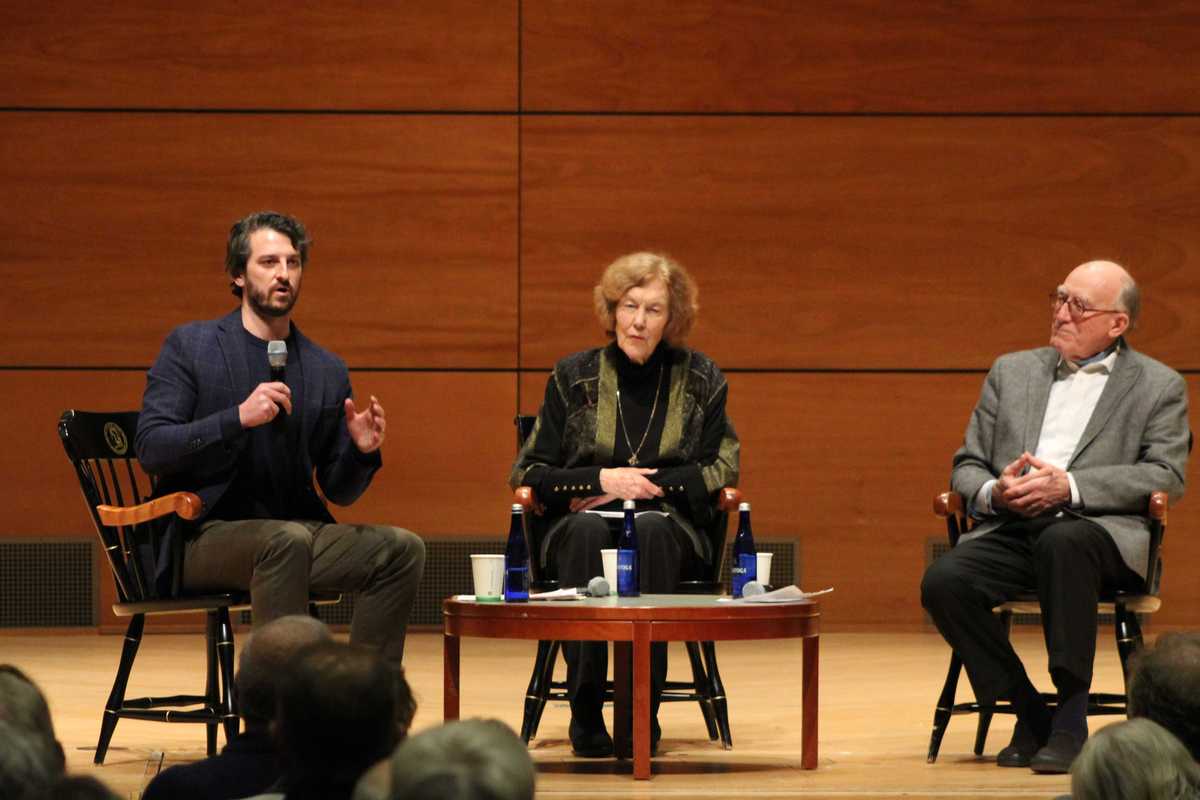
FALLS VILLAGE — Every installment of the Tuesdays at Six lecture series begins with a musical prelude. But those performances never end with the entire audience singing along.
At least, they never had until Aug. 4, when the audience joined in to sing a rousing rendition of “John Brown’s Body.� The Civil War march introduced a talk by Falls Village resident Mary Atwood called “John Brown: Abolitionist.�
Atwood’s lecture featured a comprehensive history of Brown and the events leading up to his famous raid in 1859 on Harper’s Ferry, W. Va., which many historians believe hastened the start of the war.
Atwood pointed out that most of the material in her lecture came from a biography by David Reynolds. “What you get this evening is basically a book report,� she said. Atwood is a retired history and English teacher.
Although Brown is best known for his work in the Midwest and South, his roots are in New England. He was born in Torrington in 1800 and his father was a farmer in Norfolk. He also studied briefly at a seminary in Litchfield.
Brown renewed his connections to New England in the 1850s when he began planning the raid on Harper’s Ferry. He was introduced to Henry David Thoreau and Ralph Waldo Emerson, two of the leading intellectuals of that time.
Because of their support, said Atwood, Brown was able to obtain funding for his raid from a group who called themselves the “Secret Six.�
Brown had imagined that the slaves he freed in Virginia would trigger a slave rebellion across the South and end slavery. Instead, he was surrounded in the town’s arsenal by the U.S. Army, forced to surrender, and executed for treason.
“There is irony in the fact that, though John Brown was a man of action, in the end his actions failed,� Atwood said. “But it was his words and words about him that helped him achieve his ends.�
The lecture included excerpts from some of Brown’s better-known documents, including a “declaration of liberty� modeled on the Declaration of Independence, expressing the views of slaves at the time.
Brown’s calm demeanor during the period between his arrest and his execution, and particularly his address to the court at his trial, helped sway public opinion to his side, said Atwood.
“America began to realize John Brown was a Christian, John Brown was an American,� said Atwood. “The North began to see Brown as a hero.�
The final Tuesdays at Six lecture was held Aug. 11 and featured Jim Dresser.