Underground pedestrian tunnel approved for Route 44 in Salisbury

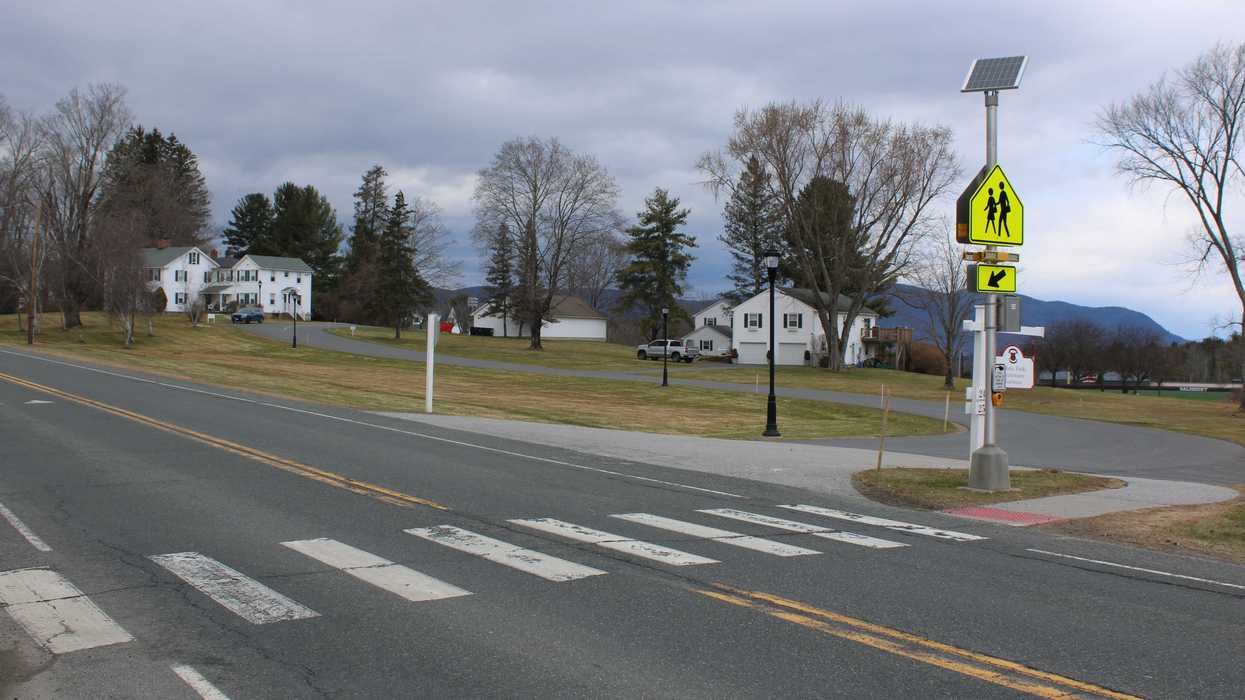
The tunnel is to be installed just beyond the current crosswalk, providing a safer way for Salisbury School students and staff to cross the busy roadway.
Alec Linden

The tunnel is to be installed just beyond the current crosswalk, providing a safer way for Salisbury School students and staff to cross the busy roadway.
SALISBURY – A proposal to build a pedestrian tunnel beneath Route 44 at the Salisbury School was approved by the Planning and Zoning Commission April 6, a move that would allow students and community members safer and more efficient passage across the busy roadway.
The tunnel is meant to provide a permanent fix for what has been a documented safety issue at the crossing, which connects the private boarding school’s main campus with sports fields and access to Washinee Lake on the north side of the road. Speaking at Monday’s meeting, Salisbury School Associate Director of Facilities Dawn Marti said that there have been three incidents of vehicles hitting students or community members in the past several years.
She added that the tunnel will also improve traffic flow, since the large sports teams that need to cross the road to travel between athletic facilities and the campus will no longer hold up vehicles.
The 15-foot-wide, 9-foot-tall concrete culvert is planned to be installed just west of the current crosswalk across the roadway, and will run just under 90 feet in length.
Following a nod from the Inland Wetlands and Watercourses Commission in late March and several reviews by the town engineer Tom Grimaldi, the April 6 unanimous approval marks the final town hurdle for the project.
Project engineer Robert Barneschi Jr., of WMC Consulting Engineers, told the Commission during Monday’s meeting that pending a final review by the state Department of Transportation, construction could begin as soon as mid-May and is expected to be completed within four to five months.
Construction is planned to take place in two phases. The first will involve excavation on the north side and is expected to have only a minor impact on the roadway. During the second phase, Barneschi said Route 44 will “shift to the north” for a short distance using temporary pavement and jersey barriers. The road is planned to remain open to two-way traffic throughout the construction process.
Mike Cobb
On Sunday, April 19, at 4 p.m., Close Encounters With Music (CEWM) presents On the Wings of Song at the Mahaiwe Performing Arts Center in Great Barrington.
The program focuses on Robert Schumann’s spellbinding song cycle Dichterliebe (“A Poet’s Love”), a setting of sixteen poems by Heinrich Heine that explores love, longing, and the redemptive power of beauty. Featured artists include John Moore, baritone; Adam Golka, pianist; Miranda Cuckson, viola; and Yehuda Hanani, cello.
In a recent interview, Artistic Director Yehuda Hanani said,“Audience members will bask in the glow of Romanticism at its apex with Robert Schumann, Clara Schumann, Felix Mendelssohn and the poet whose verse underlies their music—Heinrich Heine.‘In beautiful May, when the buds sprang, love sprang up in my heart: in beautiful May, when the birds all sang, I told you my desire and longing.’”
Dichterliebe strips away the distance between singer and listener, capturing the age-old themes of love and betrayal with exquisite sensitivity. Romanticism here is at its most personal and refined.
Heine’s poetry also captivated Felix Mendelssohn, who set several of the poet’s verses to music, including the iconic “On the Wings of Song,” which lends the concert its title. Mendelssohn’s majestic Piano Trio in D minor—one of the towering chamber works of the nineteenth century—completes the program. Radiant, urgent, and expansive, the trio reflects the composer’s unwavering belief in the possibility of a harmonious, enlightened world and the triumph of beauty through music.
“How can you not fall in love with a song cycle about a sorrowful knight that begins with these beguiling sentiments? This is the start of Dichterliebe, or Poet’s Love, Robert Schumann’s musical rendering of Heine’s Lyrical Intermezzo.Alas, like many love stories, it does not end well. Cupids weep and mourn, and the poet packs his love andhis suffering into a coffin that will be thrown into the sea—so heavy that twelve giants must carry it. All the various states of Poet’s Love—a hothouse of responses to flowers, dreams and fairy tales—end in anger, bitterness, resignation and bewilderment. Yet, despite love betrayed, ardent faith in the power of art leads the way to a harmonious and better world. A timely message,” Hanani added.
On the Wings of Song weaves together poetry and music, intimacy and grandeur, offering audiences a rare opportunity to experience Romantic masterpieces in the uniquely close, immersive spirit that defines Close Encounters With Music.
After each performance, audiences are invited to an “Afterglow” reception to meet the artists and mingle with fellow music lovers. Select concerts will also be available online, extending CEWM’s reach to listeners far beyond the Berkshires.
For tickets and information, go to mahaiwe.org
Alec Linden
Photo by Alec Linden
A climber explores Great Barrington’s renowned bouldering areas, reflecting the growing local interest in the sport ahead of the planned opening of Berkshire Boulders.
Berkshire Boulders, a rock climbing gym, is set to open in the Berkshires later this year, aiming to do more than fill a gap in indoor recreation — it could help bring climbing further into the region’s mainstream.
Its co-founders already have their sights set beyond the roughly 2,000 square feet of climbable wall planned for a site off Route 7, just north of downtown Great Barrington.
“There’s an opportunity that I felt was on the table to bring outdoor recreation and these other sports into the public domain,” said Nick Friedman, a Sheffield resident behind the project, alongside Dan Yagmin.
Friedman said that while underground communities in the region around more adventurous outdoor sports, such as rock climbing and mountain biking, have long existed, they have often been overlooked compared with more traditional pastimes like hiking.
With the gym, “I feel like we could make a start in formalizing these forms of outdoor recreation,” Friedman said. He described it as a way to create a more tangible connection between the broader community and a climbing scene that has developed quietly for decades.
Berkshire Boulders is the brainchild of Friedman, who began climbing 20 years ago on the gneiss boulders and bluffs that dot the hills around Great Barrington, and Yagmin, a climber with three decades of experience originally from central Connecticut who now lives between Winsted and Colebrook.
Both bring entrepreneurial experience to the project. Friedman co-founded Theory Wellness, a cannabis dispensary in Great Barrington where he now serves as chief strategic officer. Yagmin combined his passion for climbing, training in fine arts and years as a climbing gym route setter to start Decoy Holds, producing nature-inspired climbing grips.
Yagmin is shaping the climbing experience at the new gym at 325 Stockbridge Rd., which will focus on bouldering, a form of ropeless climbing on walls typically under 15 feet tall, with padded floors for protection. His holds take cues from real rock types, including the granitic gneiss found across the Berkshires and prized by climbers
Even though the gym is indoors, the connection to the rock outside is central to its mission. Friedman serves on the board of the Western Massachusetts Climbers Coalition, which works with governments, landowners and land managers to keep climbing areas open and accessible.
He said the project is structured so that any profits from the gym will support organizations that advance access to climbing.
“I have no investors, no lenders, and I’m self-financing,” he said. “So I plan on donating any available profits to an organization that aligns with the mission, which is really to make climbing more accessible.”
Accessibility, he added, also means affordability. He plans to offer reduced memberships for those facing financial hardship.
“Then hopefully as the gym gets going and grows,” he said, “that can become a bigger and bigger component.”
Yagmin said the gym could become both a hub for local climbers and an entry point for newcomers.
“I think a lot of people just don’t really understand the sport,” he said. With the gym, “hopefully people stop in, start getting familiar with it and see that it’s a positive thing.”
Friedman said that when he and Yagmin were introduced through the local climbing network, the idea of a gym had been “percolating around the Berkshires for decades.”
Until Berkshire Boulders opens — which he estimates will be this summer — the closest dedicated climbing gyms are roughly an hour away, including those in Poughkeepsie, Kingston, Albany and West Hartford.
Until then, Friedman and Yagmin have their plates full. Since announcing the project last month, Friedman said interest from prospective members has been strong.
The pair are in the process of gathering information to plan adult and children’s programming, though details are still to come.
In addition to bouldering walls, the gym will include climbing-specific training equipment and a standard fitness area. An FAQ page on the website, berkshireboulders.com, also references a hangout space, retail section, outdoor area overlooking a bend in the Housatonic River, and possibly a sauna and cold plunge.
Friedman said the final product will reflect the needs of its users.
“This gym is really oriented to be there for the community,” he said, “so we want to reflect that community as best we can.”
Alec Linden
Mat Jobin teaches the group how to use a permanent platform to rig a tent. The privy and lean-to of the Appalachian Mountain Club’s Limestone Spring Shelter are visible in the background.
A happy day on the trail all starts with a good night’s sleep the night before. That’s local trekking guide Mat Jobin’s mantra, and he affirms that a good night’s sleep is possible even if it has to be on the trail itself – with the right preparation, that is.
Jobin, of Simsbury, Connecticut, is a 16-year professional guide and the founder and owner of Reach Your Summit, an outdoor experiences company that promotes self-confidence and leadership skills through a variety of excursions and educational workshops in the forests of New England. On Saturday, April 11, Jobin hosted the inaugural Campsite Selection & Skills workshop just off the Falls Village section of the Appalachian Trail.
While preparing for the course, Jobin said that the underlying principle of his workshops is to help make the outdoors more accessible and enjoyable for people by teaching them the skills they need to be prepared. He explained that the point is to make mistakes, “but doing it in a safe environment rather than making all the mistakes I made growing up without having anyone to provide me with guidance and feedback.”
Saturday’s course was all about “how you can get a better night’s sleep” when you overnight on the trail, Jobin told Mike, Karen and Andy, the three attendees whose experience varied from beginner to experienced shelter-setters.
Even though the weather was fair, fast clouds hid the sun overhead and blustery winds tore through the spacious grove surrounding the Limestone Spring shelter site, a hiker’s resource managed by the Appalachian Mountain Club. Jackets were zipped and arms crossed as the group braced against the chill.
Jobin explained that while not the most comfortable conditions to spend a day standing around in the forest, the weather made for a good learning opportunity. If a camper set up a tarp shelter the wrong direction that evening, he said, it would mean a ruined night’s sleep, and subsequently a wrecked next day.
Jobin began with fundamentals, running through the essential figure 8 and clove hitch knots as well as the “bearmuda triangle,” a cheeky term for a campsite tenet that combines Leave No Trace sensibilities with wildlife safety.
The sleeping area should be positioned 200 feet from the cooking and food area, which should then be 200 feet from the bathroom site, forming a rough triangle. The whole system should be set back at least 200 feet from the nearest water source for minimal disturbance to the ecosystem, Jobin said.
He then instructed the group to account for weather and topography when choosing a site. On a cool, windy day like Saturday, use the landscape for shelter, he said, while during hot and buggy weather, campers may want to find a spot with more exposure. “Use nature to the best of your ability to provide comfort and safety,” he said.
Jobin then demonstrated several ways to use a simple tarp for a quick shelter on the trail, his preferred method given its versatility and that it offers a “deeper connection to the surroundings.”
While he hitched the tarp with some cordage to a system made of trekking poles and trees, the wind whipped through the site. “I’m going under this tarp when you’re done!” Karen announced over the sound of flapping plastic.
Once it was completed, she kept her word and huddled inside. “It works!” she announced.
For the remainder of the four-hour session, Jobin gave tips on how to set up a tent on a wooden platform, the reason he had chosen the Limestone Spring site for the course. He also taught the group how to rig a hammock system using trees and safe food storage using bear bags and bear boxes.
He urged the group to practice their shelter setups in a variety of weather conditions and locations as often as possible before debuting a system miles from the trailhead. Backyards and local parks, where allowed, are great options, he said.
“My whole thing is helping people feel more prepared and comfortable when they’re heading out, and not having to learn from really bad situations or mistakes when they’re out there for the first time,” Jobin said.
Saturday’s class was the first of its kind for Jobin, though he said he expects to run other similar campsite selection and safety workshops in the future. It’s just one of many experiences Reach Your Summit offers, which range from hiking essentials courses to 5-day backpacking adventures. A complete list of the company’s offerings can be found on its website, www.reachyour
summit.net.

Want more of our stories on Google? Click here to make us a Preferred Source.
Jennifer Almquist
The story comes full circle when educator, traditional storyteller and author Wunneanatsu Lamb-Cason (Schaghticoke/Ho-Chunk) comes to Litchfield County to read from her new book, Grandmother Moon, inspired by her grandmother, Indigenous educator Trudie Lamb Richmond, who lived on Schaghticoke land along the Housatonic River in Kent.
On Saturday, April 18, from 2-4 p.m., the Torrington Historical Society at 192 Main St. will host the book talk and sharing of traditional stories.
Lamb-Cason was named 2024 National History Teacher of the Year by the Gilder Lehrman Institute of American History, the first Indigenous person to receive the honor, and is now the Assistant Director of Native American and Indigenous Studies at Brown University. She will speak about the importance of oral tradition for Indigenous communities and of her efforts to write down the stories.

Lamb-Cason shared her story with the publication:
“The Northwest Corner is not just where my grandmother lived; it is our ancestral homelands. Our reservation was established near Kent in 1736. My grandmother grew up in Newtown and spent her childhood returning to Schaghticoke, visiting family and learning from her grandparents. In the early 1980s, she built her home on the reservation with my grandfather, and that is where I spent so much of my own childhood—learning with and from the land and waters that have sustained our people since time immemorial.
“As a historian, storyteller and educator, every moment with her was a teachable moment … and as her eldest grandchild, she felt a strong responsibility to impart as much as she could to me …
“A brief trek in the snow became ‘Wunneanatsu, what animal print do you think that is? Yes, you’re right, that’s Rabbit. That reminds me of a story about how rabbit got such long ears.’ …
“‘Wunneanatsu, do you hear the birds singing? That one sounds like blue jay. Let me tell you a story about how the birds got their songs.’
“My grandmother and those teachings guide everything I do; as an author, a storyteller, a relative and teacher; they inform my pedagogy and instructional style but also how I view and navigate the world. Grandmother Moon became an opportunity to honor her and her legacy of centering Indigenous ways of knowing in western academia and educational landscape. It was a way to carry her teachings forward for my children and future generations. It is, at its heart, a love letter to the woman who gave me so much. Essentially, my grandmother is and always will be everything I want to be when I grow up.”
Copies of “Grandmother Moon” will be available and the author will sign books. Native baskets from the collection of the Torrington Historical Society will be on display during the event.
Please register to reserve a spot: torringtonhistoricalsociety.org
D.H. Callahan
“Everything Everywhere All At Once,” a photo from David Ricci’s book Hunter Gatherer.
David Ricci will bring his exploration of American materialism to the Five Points Arts Center in Torrington on Saturday, April 18, at 2 p.m., where he will discuss his new book, Hunter Gatherer.
Ricci is fascinated by America’s obsession with objects. In Hunter Gatherer, he examines a distinct strain of materialism—one rooted not in the new, but in the items that endure.
When people talk about materialism, the focus often falls on the latest smartphones, gaming systems, designer bags or plush furniture. Ricci, however, turns his attention to objects that cycle in and out of people’s homes through flea markets, antique stores and curio shops.
The book features a selection of photographs from the thousands Ricci has taken while visiting more than 200 such venues across the United States. His work adopts an anthropological lens, exploring the meanings culture and society assign to these objects as they are bought, sold and recirculated over time.
Why are these items considered worthy of another life? What do they reveal about Americans’ relationships with racism, misogyny and social norms? Ricci argues that the chaotic marketplace of secondhand consumerism reflects a distinctly American mindset: “I own, therefore I am.”
Lakeville Journal
“WHATSTOCOMEHASALREADYBEEN” by Richard Marr 40x30 (2021)
Tyte Gallery, located on the 2nd floor at 3280 Franklin Ave. in Millbrook, presents NEAR and FAR, a solo exhibition of new work by Richard Marr, opening with a reception April 18 from 6 to 9 p.m. Marr’s immersive landscape paintings explore the movement and force of water—from ocean waves to the Hudson River—while reflecting on nature’s interconnected rhythms and humanity’s place within them. On view through June 7.

Want more of our stories on Google? Click here to make us a Preferred Source.

Want more of our stories on Google? Click here to make us a Preferred Source.