Latest News
Two students, one lasting legacy at Lee H. Kellogg School
Patrick L. Sullivan
Jun 24, 2026
Edith Louise Losh (left) and Sophia Lynn Dudley take home awards, diplomas June 16.
Patrick L. Sullivan
FALLS VILLAGE – With just two graduating eighth graders – Sophia Lynn Dudley and Edith Louise Losh – the Lee H. Kellogg Class of 2026 was small in number but left a lasting impression on the school, a sentiment that echoed throughout the graduation ceremony Tuesday, June 16.
Principal Andrew Deacon said when he took over in the middle of the academic year, he turned to the two students for advice.
“I could not have asked for two better leaders,” he said. “Instead of guiding them, they guided me. Their leadership, heart and unique spirit filled the building.”
The students also reflected on their time at Lee H. Kellogg school.
Dudley said that while her time at the school is ending, she will carry her experience with her.
“I will never have to say goodbye to my memories,” she said.
She recalled how her friendship with classmate Losh grew over the years, even when the COVID-19 pandemic disrupted their second grade year with remote learning.
“It was a difficult change for our teachers and our friends but we made it through,” she said.
Her final piece of advice for younger students was to “slow down, look around, appreciate what life has to offer.”

Losh said she also cherishes the memories and the stories that go with them, and looks forward to her next academic adventure.
“I feel ready to make more memories into stories in high school,” she said. “You all have a chapter in my book.”
Both students received the Peter G. Lawson Citizenship Award. First Selectman David Barger praised the pair for their “dedication to the community in quiet and insightful ways.”
English teacher Christine Dascanio praised the students' selfless spirits and relayed a joke about the pair.
“We can’t be a sandwich because there’s nothing between us!”
Dudley won the Superintendent’s Award, Losh won the Connecticut Association of Boards of Education Leadership Award, and they both won the Presidential Award of Educational Excellence.
Keep ReadingShow less
Cornwall Consolidated School graduates praised for shining light on local history
Lakeville Journal
Jun 24, 2026
Eighth-grade graduates at Cornwall Consolidated School toss their caps into the air June 16.
Aly Morrissey
CORNWALL – The sun set on both the eighth grade graduation ceremony and the Class of 2026’s time at Cornwall Consolidated School on Tuesday, June 16, with a lineup of speeches, awards and a celebratory pizza truck.
Wearing blue graduation gowns and caps adorned with gems, drawings and personal flair, the class of eight received both individual and group accolades from school leaders and community members.
CCS principal Leanne Maguire reflected on her three years with the class, saying she had watched the students grow from sixth graders into confident young adults. She said the school’s theme, “Out of this Word,” was about more than just academic success or awards – though many were distributed during the ceremony.
“A school’s culture doesn’t become ‘out of this world’ just because of data points or awards on the wall,” Maguire said. “It happens because of the people who set the gravity.”
Calling the graduates leaders and role models, she said, “You have been the gravitational pull of our school this year. You didn’t just hold a title. You built genuine, connected relationships and showed our younger students what kindness, inclusion and true leadership look like in action.”
The students’ Troutbeck Symposium project was highlighted by several speakers, who praised their work researching Naomi Kane Freeman.
“You unearthed history and brought profound recognition to our town,” Maguire said, referencing the section of Great Hollow Road that was given the honorary designation of Naomi Freeman Historic Road in recognition of the woman believed to be the first Black landowner in Cornwall. She purchased an acre of land in 1828, according to the Cornwall Historical Society. Student work also led to the placement of a headstone for Freeman at Calhoun Cemetery.
Student speakers were Halley Villa-Arip and Izabella Francesca Coppola, while Tom Brown, Class of 1970, was the guest speaker and delivered humorous and poignant remarks.
The graduates were Claire O. Barbosa, Willow B. Berry, Skylar Corinne Brown, Izabella Francesca Coppola, Vivienne Laurie DiRocca, Willa Elizabeth Lesch, Franco Aburto Nenen, and Halley Villa-Arpi.
Keep ReadingShow less
Storyteller shares ‘Legacy of a Wealthy Slave’ at Center on Main
Patrick L. Sullivan
Jun 24, 2026
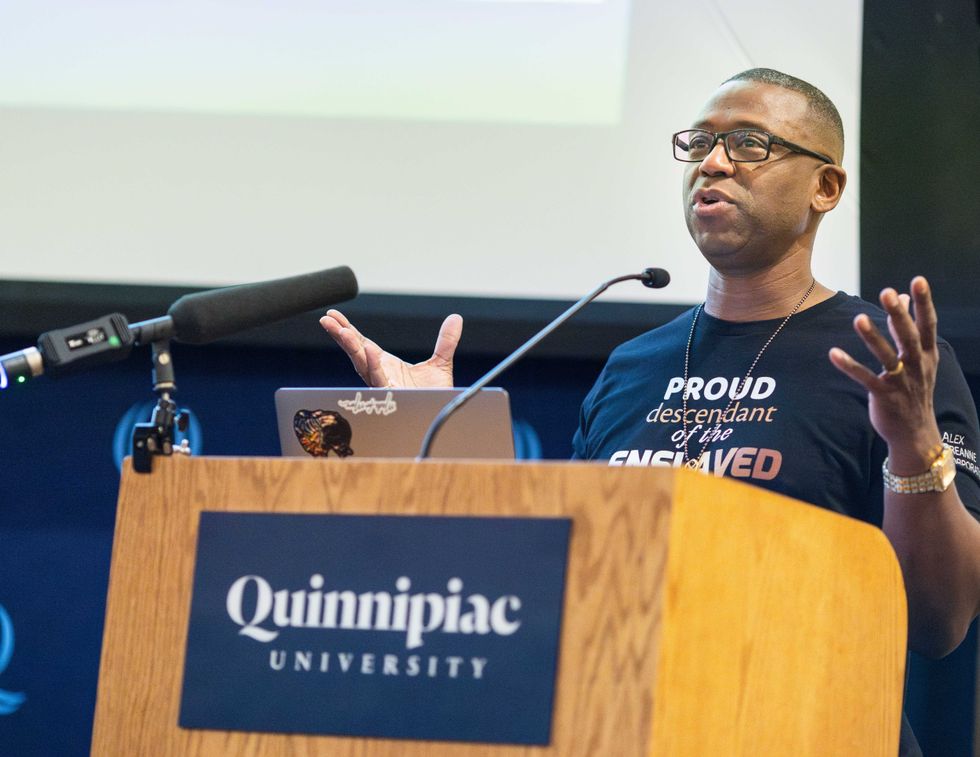
Denise Manning Keyes Page presents Legacy of a Wealthy Slave in Falls Village June 20.
Patrick L. Sullivan
FALLS VILLAGE – Connecticut storyteller Denise Manning Keyes Page spoke at the Center on Main on Saturday, June 20, engaging an audience with the first two parts of her trilogy, “Legacy of a Wealthy Slave,” which traces her journey to learn about her ancestors and family history.
Page described herself as a storyteller, which she said is different from writing a memoir or delivering a lecture. Storytelling is performance, she said, and brings information to life.
In that spirit, she opened with the first installment of her trilogy, Midnight Mariah, assuming the voice of her late mother, Dorothy, and transporting the audience to a small, dark room in 1927.
As a young girl, Dorothy lay awake, frightened. Her mother – Page’s grandmother – was battling breast cancer, and Dorothy listened for the sound of her breathing, just to know she was still alive.
Then a train that regularly passed through at night, known to Dorothy as “Midnight Mariah,” approached.
The beds began to rock and sway, a big bright light filled the dark room, and the train’s horn pierced the darkness.
“Mommy, did you hear her?” she asked.
“Yes, Dorothy,” her mother replied weakly. “Now you must get some sleep.”
The story served as more than a childhood memory of her mother’s. It also illustrated how little Dorothy knew about earlier generations of her family, in particular her great-great grandfather, Alfred C. Manning, who had been enslaved in North Carolina and worked as a ship carpenter before the Civil War.
According to Page, Manning eventually purchased his freedom and moved to New Haven, where she said he secured a patent for a device used to dock ships. His invention was successful, and he sent two of his sons to Yale University.
Page said she spent decades asking her mother for stories about the family. It was only at the end of Dorothy’s life that she mentioned an uncle and an aunt.
Page recalled that in 2002, she was seized by a sudden urge to go visit her mother and try once again to glean information about her ancestors.
Page attributed this urge to what she called “the Divine Whisperer.”
During that visit, Dorothy mentioned “my father’s brother and sister.”
“All my life she told me her father was an only child,” Page said.
She theorized that Dorothy had suffered a childhood trauma that led to memory loss or suppressing part of the family’s history.
The second part of the performance, The Archivist’s Gift, begins in 2024 when Charles “Chaz” Warner Jr. of Yale contacted Page with information about the Manning family in Edenton, North Carolina.
At long last, she said, pieces of the puzzle began to fall into place.
Research revealed that there were three Mannings at Yale: John Wesley Manning, Class of 1881; Henry Edward Manning, Class of 1880; and William Edwin Manning, Class of 1915.
The story is not complete, Page said, leaving audience members wanting to learn more. Part three about Alfred Manning is still in progress.
But Page’s theme is consistent. “It’s not about the longing to be free of trauma,” she said. “It’s about the longing to be free to be.”
Keep ReadingShow less

Want more of our stories on Google? Click here to make us a Preferred Source.
HVRHS Graduates reflect on resilience, importance of community
Ruth Epstein
Jun 24, 2026
Ibby Sadeh, the Class of 2026 Valedictorian, gives a speech to her classmates emphasizing the importance of diversity and understanding.
Nathan Miller
FALLS VILLAGE – Under a mostly clear summer sky, with only occasional clouds and threatening rain, 80 seniors at Housatonic Valley Regional High School marked their final day of school during the annual graduation ceremony on Friday, June 19. As always, the school lawn was packed with family and friends gathered to watch a group of teenagers fulfill a rite of passage.
Student speakers acknowledged the importance of community, as several reflected on overcoming significant adversity in their young lives.
In his welcome remarks, Principal Ian Strever said a milestone was reached in a school known for its distinguished statue of Abraham Lincoln that greets visitors at the entrance. It has been four score and seven years since the school’s first graduation.
Several students talked about their challenges and how the school community helped them.
Class president Madison Graney, in an emotional speech, spoke about her father who has battled brain cancer for the past two years.
“One only needs to know Joe Graney’s signature traits are determination and selflessness,” she said.
She thanked Housatonic and Falls Village communities for the immeasurable impact they’ve had on her family’s life. She also expressed deep gratitude to all her friends “who gave me the joy of laughter and unforgettable memories that brought light into the darkest time in my life.”
Graney, fighting back tears, said of the Housatonic community, “This small yet mighty place has allowed me to be vulnerable with you all, stand on this stage and share something that, for months, I refused to acknowledge or talk about. This community has made me confident in my ability to ask for help and advocate for myself.”

Essayist Hannah Johnson also praised the supportive community, explaining that her high school experience has been largely consumed by various health conditions that impacted her both physically and mentally.
“At these times when I was at my weakest, I used what little strength I had left to cling tightly to my friends, family and passions, using them to propel myself forward,” she said.
Johnson also related that one person who had a profound impact on her life was her grandfather, who suffered from dementia and died before she arrived at Housatonic.
Valedictorian Ibby Sadeh described her capstone project in which she set up a little library at the entrance to the Appalachian Trail in Falls Village. It was stocked with books that had been banned in several states.
“I chose this project not only because I love to read, but because of my passionate support of free speech, intellectual freedom and a diversity of perspectives,” Sadeh said.
As a Jewish student at Housatonic, where representation of her religion can be hard to find, Sadeh said she never felt alone.
“Students here understand the importance of individuality. It is what makes us the way we are, what makes ours a strong and diverse community.”
Salutatorian Alexa Meach, who plans to study political science, said education should be used with a purpose and applied to achieve a greater good. She encouraged her classmates to work with people who are different from them and collaborate to achieve any goal worth pursuing.
Noting the country is going through a deeply divided time, she said, “I feel an obligation to acknowledge the lack of empathy I’ve seen and endorse a return to the needed morality across our globe.”

Guest speaker Lori Bucco, an English teacher at the school, advised the graduates to embrace humanity and live their story. “Make it epic,” she said.
Superintendent Melony Brady-Shanley shared advice she received from her father.
“Don’t look for a job,” she said. “Look for a purpose in life. When you find what you love, it will feel more than a job — it will be a calling.”
The following awards were presented during the evening:
· Good Sportsmanship Medals: Wesley Allyn and Madelyn Johnson
· Good Citizenship Medals: Madison Graney and Shanaya Duprey
· Chamberlain Arts Achievement Awards: Victoria Brooks and Alex Woodworth
Judi Moore, who had a distinguished 40-year career at the high school, was presented with the Community Award of Merit.
Julie Lang, the longtime principal’s executive secretary who is retiring this year, was also recognized for her service.
Keep ReadingShow less
Historic Colonial Theatre goes on market after three-year revival
Aly Morrissey
Jun 24, 2026
The Colonial Theatre lights up the North Canaan sky.
Rebecca Bloomfield
NORTH CANAAN –The owners of the historic Colonial Theatre have put the century-old landmark on the market, seeking a new steward for one of the community’s most recognizable buildings.
After restoring and reopening the 27 Railroad St. venue in 2023, the Mallett and Fiorillo families have listed the property following three years of operating the theater as a community gathering space and event venue.
“After three fantastic years of being the lucky stewards of the incredible Colonial Theatre, we’re ready to pass the torch,” said co-owner Lenore Mallett, a local real estate salesperson who is listing the property through William Pitt Sotheby’s International Realty.
The venue is listed for $695,000 and features three floors totaling more than 10,000-square-feet, including two separate adjoining retail units.
Built in 1923, the theater has served as an entertainment venue and cultural centerpiece for generations. Originally known as The Casino, the building housed a movie theater, bowling alley and second-floor ballroom. The building was revamped in 1929 and its name changed to the Colonial Theatre.
The current owners purchased the property in April 2023 for $325,000, after it had been closed for years.
“We got the doors open to the public and showed the space can be used for everything from fundraisers and movies to book tours and comedy shows.”
Since reopening, the theater has seen an eclectic mix of events and tenants, including retail businesses, an art studio, a photography studio and a bakery.
“The space is incredibly versatile, and we can’t wait to see what comes next,” Mallett said.
Prior to the 2023 purchase, the building underwent a $1 million restoration in the early 2000s that brought the building back to its earlier Art Deco design.
The sale comes as North Canaan continues to see renewed activity downtown, with several new businesses opening in recent years. The owners said they want to see the “contagious energy continue to spread.”
The Colonial Theatre will remain open during the sales process, and the owners encouraged residents and visitors to attend community movie nights and other events throughout the summer.
Beyond restoring the building itself, the owners sought to reestablish the theater as a gathering place. Through community events, neon marquee messages and an active social media presence, they worked to bring new energy and personality to the historic venue and create opportunities for residents to connect.
Keep ReadingShow less
Northwest towns to take control of Torrington Transfer Station July 1
Christian Murray
Jun 24, 2026
The entrance to Torrington Transfer Station.
Photo by Jennifer Almquist
A newly formed regional waste authority will take control of the Torrington transfer station on July 1, capping a year-long effort by Northwest Connecticut towns to keep the facility in public hands.
The Northwest Regional Refuse Authority (NRRA), representing several Northwest Corner towns, will assume ownership of the transfer station following legislation signed by Gov. Ned Lamont in May transferring the property to the consortium.
The authority was created in 2025 after a proposed $3.25 million sale of the Torrington Transfer Station to a private waste company alarmed local officials, who feared the loss of a public disposal option could eventually lead to higher costs and a monopoly on waste services in the region.
Municipal leaders argued that private ownership could result in higher tipping fees — the per-ton charges municipalities pay to dispose of household trash — a major expense that directly affects local budgets and taxpayers. The state ultimately blocked the sale, prompting municipalities to organize a regional authority to take over the facility instead.
The NRRA includes Salisbury, Sharon, Cornwall, Falls Village, North Canaan, Norfolk, Goshen, Colebrook and Torrington. Kent is not participating because it already belongs to the Housatonic Resources Recovery Authority, a separate regional waste authority that NRRA plans to emulate.
The Torrington Transfer Station has served as a key disposal hub for Northwest Connecticut communities for decades. Its future became uncertain after the state announced plans to end its operation of the facility more than a year ahead of schedule.
Officials across the Northwest Corner quickly embraced the NRRA proposal. Voters in member towns approved ordinances to join, creating a coalition aimed at maintaining local control over waste disposal.
“The concern that a lot of people have is that if the site were sold to a private hauler, there could potentially be a monopoly in the Northwest Corner when it comes to garbage,” Sharon First Selectman Casey Flanagan said when the town approved the ordinance. “That might not be an issue today, but five or 10 years from now it could be a major problem for communities like ours.”
Cornwall First Selectman Gordon Ridgway said the authority will allow towns to work together on disposal contracts, recycling initiatives and grant opportunities while maintaining local oversight.
“We will hopefully get the lowest price possible,” Ridgway said. “We’re not in it to make money. We’re in it to manage costs.”
The NRRA is still in its infancy and has yet to finalize tipping fees, though officials expect them to remain largely unchanged.
Falls Village First Selectman Dave Barger said preserving local control was a key reason his town joined the authority.
“It provides us with an opportunity to stabilize tipping fees,” Barger said. “It provides us with local control. We can also set our own recycling policies.”
Barger said the authority’s broader goal is to preserve a public option for waste disposal rather than relying entirely on private contractors.
The governing board, made up of the first selectman from each member town, will oversee future decisions regarding disposal contracts, recycling programs and operations at the Torrington facility.
For residents, little is expected to change immediately. Local transfer stations will continue operating as they do today, and existing collection systems will remain in place.
The difference, local officials say, is that decisions about the region’s waste disposal system will now be made by the municipalities that use it rather than by the state or a private operator.
Keep ReadingShow less

Want more of our stories on Google? Click here to make us a Preferred Source.
loading