Connecticut crowns football state champs

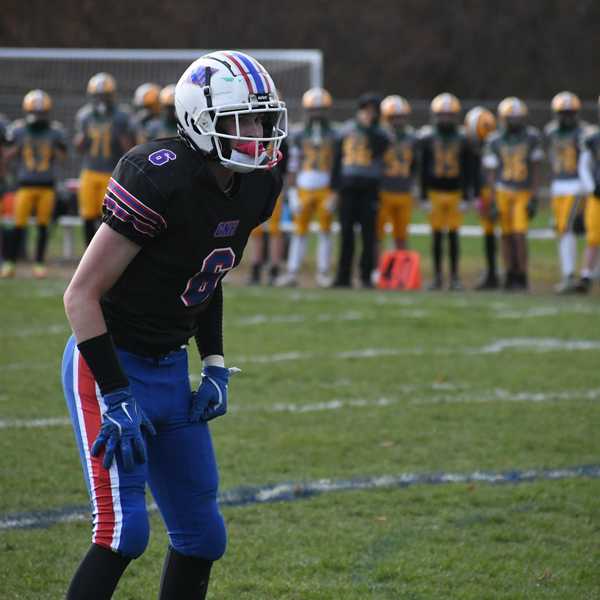
Berlin High School’s football team rejoices after a last-minute win in the Class M championship game Saturday, Dec. 13.
Photo courtesy of CIAC / Jada Mirabelle

Berlin High School’s football team rejoices after a last-minute win in the Class M championship game Saturday, Dec. 13.
In December’s deep freeze, football players showed their grit in state playoff tournaments.
Connecticut Interscholastic Athletic Conference named six state champions in football. The divisions are based on school size: Class LL included schools with enrollment greater than 786; Class L was 613 to 785; Class MM was 508 to 612; Class M was 405 to 507; Class SS was 337 to 404; and Class S was fewer than 336.
Eight teams qualified for each tournament and all championship games were played on Saturday, Dec. 13.
Class LL was won by Greenwich High School for the second straight year. Greenwich beat Southington High School 45-6 to win the tournament. Jack Kelly rushed in three touchdowns for the Cardinals and caught a fourth.
Class L was won by New Canaan High School, which completed an undefeated season. New Canaan beat Cheshire High School 34-13 for the school’s fourth-straight state title. In the regular season, New Canaan defeated Greenwich 14-7.
Class MM was won by Windsor High School, which defeated Bunnell High School 23-13. Windsor quarterback A.J. Robinson threw for 140 yards with a passing touchdown and two rushing touchdowns.
Class M was won in the final minute by Berlin High School 20-15 over Brookfield High School. The thriller came down to the wire. Brookfield went ahead with a late touchdown. Then on the kickoff that followed, Berlin’s Eli Rice ran it 80-yards to the house to take the lead with 33 seconds remaining and secure the state trophy.
Class SS was won by Daniel Hand High School, marking its 15th state title in school history. Hand defeated reigning champion Killingly High School 37-13. Killingly was previously on a 25-game win streak that stretched over two seasons.
Class S was won by Sheehan High School, defeating Northwest Catholic High School 21-7. Running back Joshua Durant ran for 215 yards and three touchdowns in the win for Sheehan, which was the first state title since 2019 for the school.
Details and photos from each championship game can be found at ciac.fpsports.org

Salisbury Central School
SALISBURY — Below is the honor roll for Salisbury Central School’s first trimester of the 2025-26 academic year.
Highest Honors
Evelyn Adkins
Aria Belter
Ella Emberlin
Theodore Kneeland
Jillian Murphy
Allegra Najdek
Ethan Nellson
Owen Sayler
High Honors
Victoria Bellanca
Madeleine Carr
Mia Dunlavey
Hanna Eisermann
Evelyn Hall
Shane Higgins
Elizabeth Johnson
Brooke Kain
Rozelynd LaChance
Sarina Lemmy
William Nichols
Eden Ohmen
Miguel Santiago-Leyva
Brennan Sisk
Eliza Tarsia
Kaelyn Tompkins
Augustus Tripler
Honors
Leah Wilcox
Highest Honors
Annabelle Bunce
Timothy Cunningham
Jackson Farr
Luna Forero
Maris Jenter
Kellan Lockton
Natalie Merwin
Leah Simboli
High Honors
Sofia Casadei
Zeira Collins
Samuel Hahn
Sam Hamlin
John Hensley
Cole Lidstone
Jackson Magyar
Max Namer
Guinevere Robinson
August Schaufelberger
Norman Schmidt
Lucas Wang
Graeme Warder
Emilie Webster
Olive Webster
Honors
Jaycob Sherwood
Highest Honors
Camille Adams
Leif Brann
Marshall Cheney
Dylan Goodwin
Avina Jack
Nicole Lucas
Juniper Terni
High Honors
Blair Barbato
Isabella Bellanca
Emmett Charles
Faye Emberlin
Assane Fall
Westyn Golden
Samuel Goshen
Henry Kneeland
Max Lang
Maximilian Lins
Ava Lounsbury
Oliver Maier
Quinn McNiff
Thomas Nichols
Rowan O’Reilly
Willow Ohmen
Kevin Santiago-Leyva
Lewis Sayler
Colin Warder
Most Region One students say they feel safe at school, have a trusted adult in their lives and are confident about their future. At the same time, significant numbers continue to report stress, anxiety and, in some cases, thoughts of self-harm, according to the 2025 Youth Voices Count Survey released Wednesday, Feb. 11.
The districtwide survey of students in grades 7 through 12 was conducted in May and June and gathered responses from 422 students — a 75.4% participation rate. The findings are used to guide prevention efforts and student support strategies.
Superintendent Melony Brady-Shanley said the results show both strong support systems and rising emotional strain among students.
“For the most part, our kids feel like they have a trusted adult in their life, whether it’s a school member, a family member…that they trust, that they can speak to,” Brady-Shanley said, noting that was a very positive finding.
However, “I think the one thing that stands out for me is, you know, the amount of anxiousness that our kids are feeling.”
Conducted by Weyland Smith Consulting, LLC, a Wethersfield-based firm specializing in youth behavioral health research, the survey measures student perceptions related to mental health, substance use, school climate, bullying, social media and other behavioral indicators.
Strong safety and support indicators
The survey found high levels of connection and safety among students.
More than 94.6% said they have at least one trusted adult they can turn to. Similarly, 94% reported feeling safe in their community, and 88.6% said they feel safe at school. More than 92.4% said they know how to get help if they need it. About 73.8% said their life is headed in a positive direction, and 79.7% reported confidence in their future.
“It is very positive, you know, I think anytime we can say that that percentage of kids have a positive outlook, and they, you know, have hope about where they’re going, that’s a great thing,” Brady-Shanley said.
Ian Strever, principal of Housatonic Valley Regional High School, said the survey remains an essential planning tool.
“This report and its predecessor, the Developmental Assets Survey, have always been incredibly useful tools for assessing not only our students’ risk-taking and social behaviors, but also how we support them through school programs and the larger community of Region 1 town services,” Strever said.
Stress, anxiety and emotional health indicators
Despite the positive indicators, emotional strain remains a concern.
More than half of students in grades 7 to 12 — 57.1% — reported experiencing stress or anxiety “some of the time” in the past year. Another 14.5% reported feeling stress or anxious “almost always” and 6.5% reported feeling that way “always.” Only 21.8% reported feeling stress free.
About 18.3% said they felt sad or hopeless for two consecutive weeks during the past year.
Brady-Shanley said these findings reflect what teachers have been seeing in recent years.
“You know, if we were to go back 10 to 15 years, I don’t think that we would be seeing the percent of anxiety that we see right now,” she said. “I think there are two main triggers: COVID-19 that did not help anyone, with social isolation. And I think number two, social media has had a huge influence on kids’ anxiety.”
The survey also found troubling data: 15.4% reported thoughts of self-harm in the past year, 7.8% reported engaging in self-harm behavior and 9.8% reported having considered suicide in the past 12 months.
Brady-Shanley said these figures highlight the importance of support systems, and are being taken very seriously.
Speaking of the suicide figure, she said: “Any number with the exception of a zero is concerning.”
The percentage considering suicide was highest among grades 7–8, where 10.9% considered it, compared to 9.2% for grades 9–12. Among students who considered suicide, 23.1% said they made a plan, and 13.8% reported attempting suicide.
Brady-Shanley said the district has implemented annual training programs to help staff recognize and help students with mental health issues.
“Part of what we’re doing is giving staff the tools to be able to recognize when a kid is in crisis.”
She added that the district recently secured funding to continue three additional social workers at the elementary school level.
The goal, she said, is to ensure schools are prepared to respond quickly when students show signs of crisis.
At Cornwall Consolidated School, Principal Leanne Maguire said the middle school findings are particularly concerning.
“The survey results for our 7th and 8th graders are particularly startling. When we see that 94% of middle schoolers in our region have experienced anxiety in the past year — and that [nearly] 11% have considered suicide, while 20% of those have reported self-harm, it moves beyond a ‘trend,’ and into a call for immediate action. These aren’t just statistics; they are the daily lived experiences of our students.”
Maguire said she will ask town officials to support expanding the school counselor position to full time.
Early access to smartphones and screen use
Most students receive their first smartphone between the ages of 11 and 13, with social media accounts typically beginning between 12 and 14.
“I would love to see the access to social media going to like 16 and above,” Brady-Shanley said. “I think the little brain of a 12- to 14-year-old is not ready to handle the very adult world of social media.”
Currently, more than 97% of students reported having a social media account prior to age 16, according to the study. Nearly 90% had smartphones before reaching 14 years of age.
Approximately 58% of students said social media helps them feel connected. At the same time, about one-third reported difficulty stopping scrolling, and roughly 25% said they felt left out at times because of social media.
Substance use remains below state, national levels
High school students in Region One continue to report substance use rates below Connecticut and national averages.
For the month prior to the May 2025 study, 10.7% reported drinking alcohol — roughly half the statewide rate of 21.1% and the national rate of 22.1%. Marijuana use was reported by 8.1% of students, compared with 14.7% statewide and 17% nationally. Meanwhile, 7.4% reported vaping, lower than Connecticut’s 11.5% rate and far below the 16.8% national figure. Cigarette use was low at 2.9%.
“Fantastic. I think it speaks to what parents are teaching their children at home. It speaks to what we’re, you know, encouraging from the school perspective,” Brady-Shanley said. “Kids do listen when their parents talk to them about this kind of stuff.”
Strever said the high school has seen measurable progress.
“One of the most encouraging takeaways from the 2025 report is the continued downward trend in substance use among HVRHS students. When comparing this data to the 2023 report, we observed a notable decrease in 30-day vaping rates, which dropped from 10 percent to 6.9 percent. We also saw slight declines in the reported use of alcohol and marijuana. These shifts suggest that prevention education and the healthy choices being made by our student body are trending in a positive direction.”
Bullying still present
While bullying remains present, the survey suggests it is not pervasive for most students. About 39.4% said they have never been bullied, and 43.5% reported having been bullied at some point — but not within the past 30 days.
Still, 10.3% reported occasional bullying in the week prior to the survey, and 6.8% reported frequent or near-daily bullying in the three weeks leading up to the study.
While bullying remains a concern, the vast majority of students did not report recent incidents.
“So I think 40% of our kids reporting that they’ve never been bullied is honestly … a strong number,” Brady-Shanley said.
She said adult intervention appears consistent when incidents occur.
“If adults are seeing something, they’re not just passively letting it go by,” she said. “I think you’ll see that more frequently at the younger levels. You know, high schoolers tend to be a little bit more reserved with their requests, sometimes for assistance, yeah.”
The most common forms of bullying were name-calling, rumors and social exclusion.
High school sexual behavior and communication
Among high school students, 48.4% reported having talked with a parent or guardian about birth control, sexually transmitted infections or delaying pregnancy.
Brady-Shanley said this number needs to be higher.
“Parents need to talk more to their kids and I need that number to be 100%,” she said. “We want our kids and our families having conversations about their children’s physical health and ultimately their mental health. Kids listen when their parents talk.”
Brady-Shanley said the survey ultimately reflects both progress and ongoing work.
She said the district will continue reviewing the findings with administrators and staff, using the data to guide prevention programs and student support services.
“For the most part, our kids feel like they have a trusted adult in their life,” she said. “But we still have some work to do.”
Riley Klein contributed to this article.
Dr. Kristin Newton, coordinator of the Sharon Hospital rotation of New Milford’s Hospital’s Family Medicine Rural-Track Residency, and Dr. Michael Roman, a first-year resident of the program.
SHARON — A new program bringing medical residents to Sharon Hospital aims to show young doctors what working in rural healthcare is like — and hopefully convince them to stay.
“There is such a need for primary care doctors here,” said Dr. Kristin Newton, a family medicine practitioner at Sharon Hospital who coordinates Sharon’s participation in the program, which is based out of New Milford Hospital’s Family Medicine Center.
The Northwest Corner is in the midst of a decades-long primary care shortage, and Newton said that family medicine doctors bring holistic “cradle to grave” care to underserved communities.
Sharon Hospital is in its second month hosting family medicine residents as they rotate between departments at different hospitals throughout their three-year residency. A residency is essentially an intensive training period for medical school graduates — “their transition period where they learn a specialty,” as Newton put it.
Residents spend one month working directly with Newton and other attending physicians in internal care in Sharon between other core rotations back in New Milford or at other Connecticut hospitals, such as Danbury. Newton said that bringing early career physicians to the Northwest Corner offers a different perspective than programs at the bigger, more urban hospitals in the state, and also may encourage young doctors to put down roots in the area.
“Having residency programs in locations where people want to settle and raise their families and practice long term, I think, is so important,” she said.
Tuesday, Feb. 10 was Michael Roman’s first day in Sharon. During a pause in his orientation, Roman, a first-year resident also known as an “intern,” said he was drawn to family medicine for its interpersonal nature.
“I like the relationships you build with patients — you get much closer to them,” Roman said. “You see them much more frequently.
“You’re just kind of more known in the rural setting as opposed to an urban setting.”
Family medicine practitioners also need to be nimble, with a “broad scope of practice” he said — an important asset for a primary care doctor in a rural setting where specialized consultants may not be immediately available.
“You really don’t know what’s coming through the door at your office. It’s different every day.”
The Sharon rotation, where there are far fewer residents and consultants on hand than at larger hospitals like Danbury, is less “compartmentalized” than rotations at those facilities, Newton said. The residents are exposed to a much wider breadth of care, which is a “great experience learning wise.”
Most residency programs are urban based, she explained. Roman said that was a motivation for him to seek the rural track at New Milford, which offers the educational breadth he was seeking. Transitioning from a background in rural care to urban is relatively simple, he said, but it’s much harder to go the other way.
Roman, who was born in Egypt, raised in Winnipeg, Canada, and went to medical school in Dublin, Ireland, has only been in the area since July when he started his residency. He isn’t positive yet that he’ll remain in the area when it’s done, “but it’s never something I’d rule out.”
Newton said that she’s optimistic that the program will appeal to residents who are motivated by close patient-physician relationship and a broad spectrum of care.
“I’m hoping that some of the residents will love it here and want to stay, because we really, really need primary care doctors!”

Want more of our stories on Google? Click here to make us a Preferred Source.
FALLS VILLAGE — The Region One Board of Education is reviewing early 2026-27 budget numbers that indicate a 6% increase, or about $1.1 million, over the current fiscal year.
At the board’s regular meeting Monday, Feb. 2, Region One business manager Sam Herrick reported that the initial stages of crafting the new budget are underway.
Herrick said he and the board’s budget committee started at a 9% increase. At the Feb. 2 meeting the figure was 7.07%, and Herrick said Tuesday, Feb. 17 that the number was down to 6%.
The current budget is $18,485,210.
On Feb. 2, Herrick explained that Region One has contractual obligations — including salaries and benefits — that are up between 4% and 4.5%, and a health insurance increase of 13.5%. Together those two categories account for 53% of the increase.
Pupil Services, which includes special education, accounts for another 37% of the increase, mostly for outplacements and transportation.
“That gets you to 90%” of the increase, Herrick said, adding that supplies and equipment accounts for another 5%.
The budget committee and administrators are continuing to search for potential savings. Herrick said two retirements in the special education department could provide an opportunity to leave one position unfilled.
“There are a lot of things in play,” he said. “The goal is to reduce the budget and avoid impacting student learning.”
Herrick said the budget committee will present the budget proposal to the board in early April.
The public hearing will be held a couple of weeks after that, and the districtwide referendum will be on Tuesday, May 5.
KENT — Calorie counting was put aside on Wednesday, Feb. 11, as the Kent Center School Scholarship Fund held its 29th annual Chocolate Fest.
When the event opened, a line was nearly out the door as participants readied to fill a plate of confectionary treats not only to satisfy a sweet tooth, but help local students offset some college costs.
For $5, patrons could fill a red paper plate from a huge assortment of mouth-watering cookies, candies, brownies, chocolate-covered pretzels and more, all donated by individuals and local businesses. For an extra fee, fest-goers could have a skewer of fresh fruit or marshmallows soaked under a fountain of sweet liquid, with the treat resulting in a sea of chocolate-covered faces.
As would be expected, the room was filled with abundant smiles as folks of all ages indulged, with several comments about the joys of chocolate being heard.
The event was the brainchild of the late Charlotte Lindsey, who served on the board of directors of the fund. She had lived in Maine for a time, had seen such a fundraiser there and proposed it be tried. It found immediate success and has become a tradition since its inception.
Tim Paradise, who moved to Kent with his family seven years ago and whose daughter Emily is in kindergarten, said, “We came last year and really enjoyed it. And my daughter loves chocolate.”
Board member Debbie Moerschell, who was busy wrapping plates in plastic bags, said her daughter was a recipient of the scholarship. “We are very grateful. It helped tremendously.”
Christina Memoli was there with her 9-year-old son Rowan. “He was excited to find my photo on the poster that showed scholarship winners,” she said. “I received one from 1995 to 1998. I absolutely support this event every year. And everyone loves chocolate.”
Well, not everyone. Nine-year-old Kaelyn Saunders is not a fan. She scouted out items, such as a lollipop and pretzel, to eat. “She’s never liked chocolate,” said her mother Marci Saunders, the school’s physical education teacher. “When she filled a plate, I told her to be sure to get something her mother would like,” she said with a smile.
Board members Carol Spelbos and Lee Sohl are the main organizers of the fest. Spelbos expressed her gratitude to the many businesses who contributed items, which included B.D. Provisions, Wilson’s, 45 on Main, Kent Kitchen, Cozzy’s, Old Oak Tavern, Bulls Bridge Inn, Marvelwood School, Kent School students, South Kent School, Swyft, IGA, KPG, Stop & Shop, JP Gifford and 109 Cheese. Nonprofits, such as the Kent Land Trust, the KCS PTA and Project Sage had booths to dispense information about their causes.
Since the fund’s establishment 65 years ago, 1,512 grants totaling more than $2 million have been awarded. Students who have attended seventh and eighth grade at the school and are seeking college degrees, are in post-graduate programs or pursuing technical or vocational school certificates are eligible to apply.
Funds are raised through an annual letter of appeal and through the redemption and recycling of beverage containers. The beverage container recycling program alone has raised nearly $232,000 over the past 32 years.
Thirty-five scholarships are awarded each year. The average grant is $2,500. Post graduate awards are generally higher.
For further information about the fund, go to KCSSF.org.
CANAAN FIRE DISTRICT
WARNING
All persons eligible to vote in meetings of the Canaan Fire District are hereby warned that the Annual Meeting of the said District will be held at the North Canaan Town Hall on Tuesday, March 3rd, 2026 at 7:00 p.m. to consider and act upon the following items:
1. To name the legal depositories for the funds of the Canaan Fire District for the fiscal year beginning July 1, 2026 and ending June 30, 2027.
2. To name an auditor to inspect the accounts of the Canaan Fire District for such fiscal year.
3. To elect three members of the Executive Committee to serve for three-year terms.
4. To transact any other business proper to come before such meeting.
Dated at North Canaan, Connecticut this 20th day of February, 2026.
Anthony J. Nania
Warden
02-19-26
Notice of Decision
Town of Salisbury
Inland Wetlands & Watercourses Commission
Notice is hereby given that the following action was taken by the Inland Wetlands & Watercourses Commission of the Town of Salisbury, Connecticut on February 9, 2026:
Approved conditioned on Housatonic River Commission Approval - Application IWWC-26-5 by Jennifer A Wening to construct a new pool in the upland review area. The property is shown on Salisbury Assessor’s map 12 lot 32 and is known as 265 Housatonic River Road, Salisbury. The owner of the property is Jennifer Wening.
Any aggrieved person may appeal this decision to the Connecticut Superior Court in accordance with the provisions of Connecticut General Statutes §22a-43(a) & §8-8.
Town of Salisbury
Inland Wetlands and Watercourses Commission
Sally Spillane, Secretary
02-19-26

Want more of our stories on Google? Click here to make us a Preferred Source.

Want more of our stories on Google? Click here to make us a Preferred Source.