At the end of 2025 President Trump told the world that he was interested in acquiring Greenland and would take it by force if necessary, stating that it was a matter of national security.
His Cabinet officials and others began echoing his remarks regarding the national security need to better control the region, especially with climate change opening up the arctic area to shipping and possible submarine warfare for the first time. But in truth, the President’s interest in Greenland arose more from his life-long obsession with size; Greenland was by far the world’s largest island. As a child he he was in love with the Great Wall of China and it became the inspiration for his proposed wall between the US and Mexico. His giant ballroom for the White House continues his strange obsession.
In addition to his concern for national security and his obsession with bigness, Trump had been studying the history of American imperialism and was favorably impressed by our military capture and control of foreign territory. He was prepared to try his own foreign adventures.
During World War 2 the U.S. had several small military bases on Greenland and the relations with the Greenlanders and Denmark (whose colony it was then) were good. Over the postwar years the U.S. eventually closed all the bases save one but Denmark (who still controls Greenland’s foreign affairs) had been accommodating to any new American military proposals.
So what’s so different now? Global warming has melted much of the northern ice thus opening the area to at least limited navigation and both Russia and China have been interested. Without much elaboration, the U.S. Defense and State departments have told us that this poses a formidable security threat requiring U.S. control of Greenland to counter. But most security analysts consider this a shortsighted point of view. An even more vulnerable area to foreign intruders would be from northern Alaska to the Arctic Circle. As former Alaskan governor Sarah Palin was supposed to have said,“I can see Russia from my back porch!”However the U.S. has done little or nothing to fortify this area militarily. On the face of it, it would seem more appropriate for the U.S. to shift its defensive attention to the western side of the continent.At the same time it would make sense for NATO rather than the U.S. to oversee Greenland’s only partly frozen, more navigable waterway. The U.S. is still a most prominent member of NATO thus permitting us to have some say in what happens there but the considerable animosity between Trump and Greenland and Denmark would be largely avoided. And as a bonus, perhaps Canada (a NATO member) might be drawn into being a more active member of the Western military alliance.
During the past four months, closed door trilateral meetings have been held in Washington, at the behest of the US State Department with officials from both Denmark and Greenland to discuss the future of the island.
Over the past year Trump’s verbal tirades have scared and angered people and their governments all over the world. A variety of recent polls weighing popular feelings in eight western European countries toward the U.S. government have all shown major disfavor regarding American foreign policy, particularly because of threats against Greenland. Especially in Denmark and in Greenland where several hundred protesters gathered in the capital, Nuuk last week to protest continued US involvement in their affairs and specifically the opening of a much larger new USconsulate In Nuuk to “commemorate” its opening. Protesters carried signs with messages such as “Greenland is not for sale” and “Dump Trump”. The U.S. sent over an uninvitedSpecial Envoy, Louisiana Governor Jeff Landry, a notoriously impolitic individual who, shortly after arriving told everyone that could hear him “it’s time for Washington to put its foot back on this Arctic territory” and other insulting remarks.
Meanwhile back in Washington talks continue. The American demands are sosteep; Greenlandic officials fear that they amount to a major imposition on their sovereignty, such as a possible veto over what businesses might be permitted to operate in the territory. Meanwhile, the former Danish Prime minister Mette Frederiksen, a strong supporter of Greenland,is about to be replaced and is no longer in the discussions.
The parties are discussing cooperation on the development of natural resources. The island is loaded with oil, natural gas, uranium, rare earths and other critical minerals. However, much of it is buried deep beneath Greenland’s glacial ice. The Trump administration is especially interested in the island’s buried wealth and wants to make sure that other nations, particularly China and Russia, are kept away from it.Although he likes to denythe significance of global warming, Trump knows that Greenland’s underground riches are becoming more accessible year by year.
Trump’s war in Iran is going badly with no real end in sight and he is looking to get out. He wants a new, more promising theater for his international adventures and is hoping to capture Cuba next (although he has already nearly done so by an economic siege).Then many think he may indulge his continuing obsession and make another attempt to take Greenland.
Can you believe it?
Architect G. Mackenzie Gordon, A.I.A., lives in Lakeville.



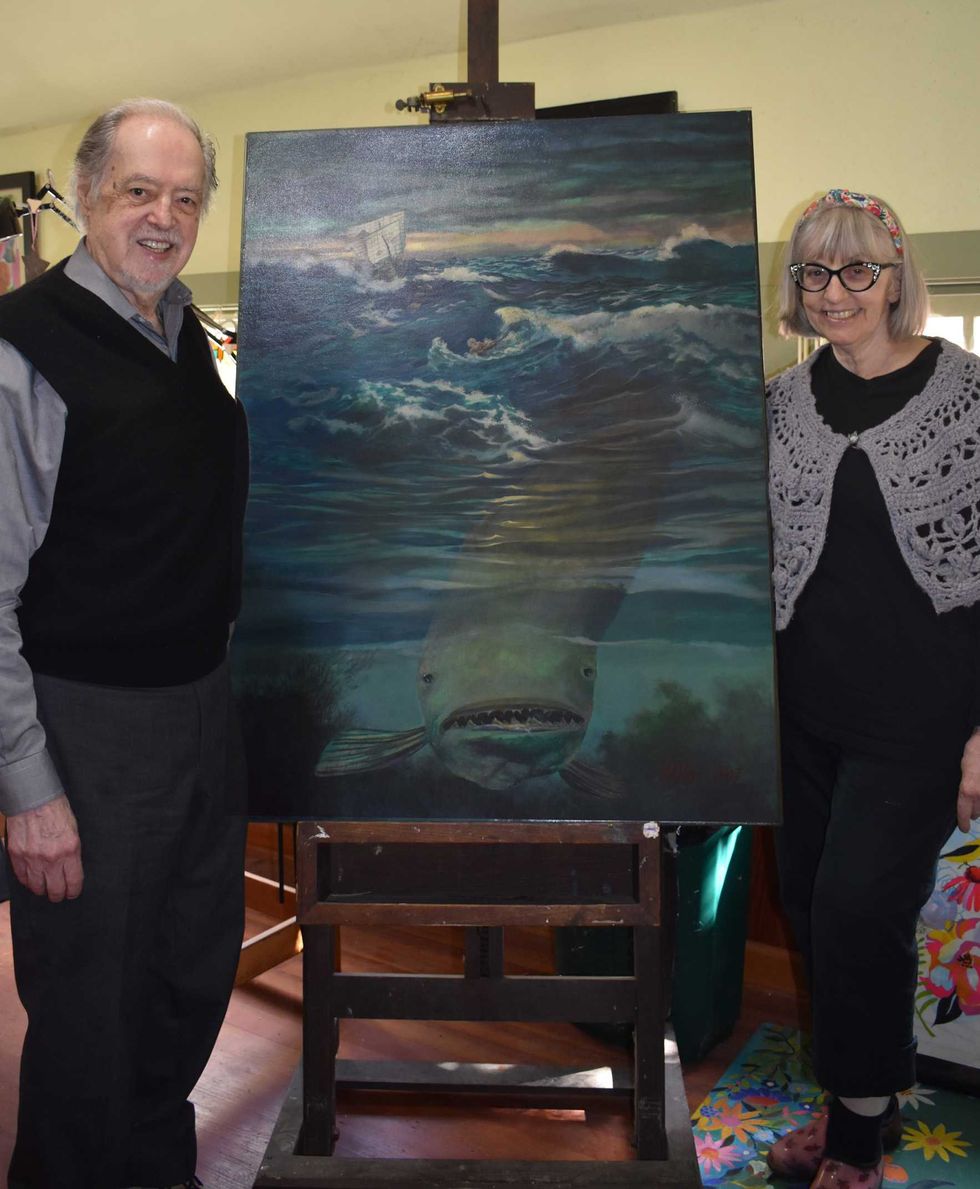 Justine and Victor Valla in their studio with a painting of Victor’s,”Jonah and the Whale.” Robin Roraback

 A ceramic vase by Kathleen Heidemann.Provided
  Joy Brown’s delightful ceramic sculptures.Provided