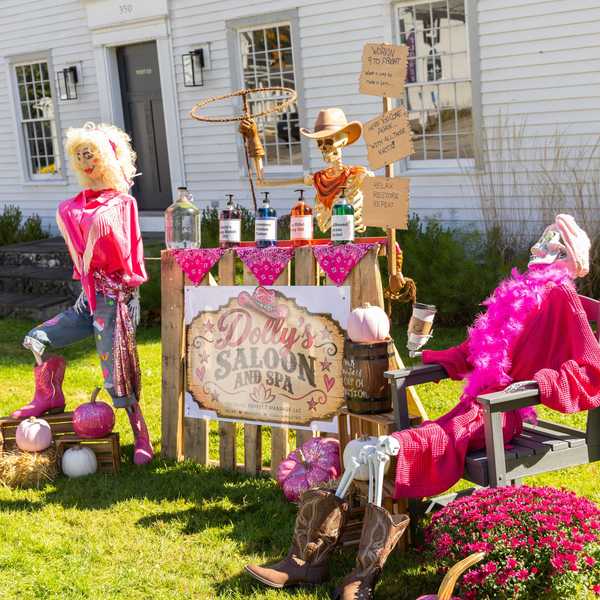
American Mural Project and Real Art Ways present the 1980 workplace comedy starring Jane Fonda, Lily Tomlin and Dolly Parton in her film debut. The screening takes place against the backdrop of AMP’s five-story mural celebrating the American worker. 7 p.m. Reservations recommended at AmericanMuralProject.org/amp-films.
Latest News
The art of getting into art school
Natalia Zukerman
Oct 14, 2026
Hudson Valley Regional Portfolio Day returns to Poughkeepsie.
Provided
For a young artist considering college, the question isn’t simply whether the work is good enough. It’s which work to show, which school might be the right fit and even whether a creative life can lead to a sustainable career.
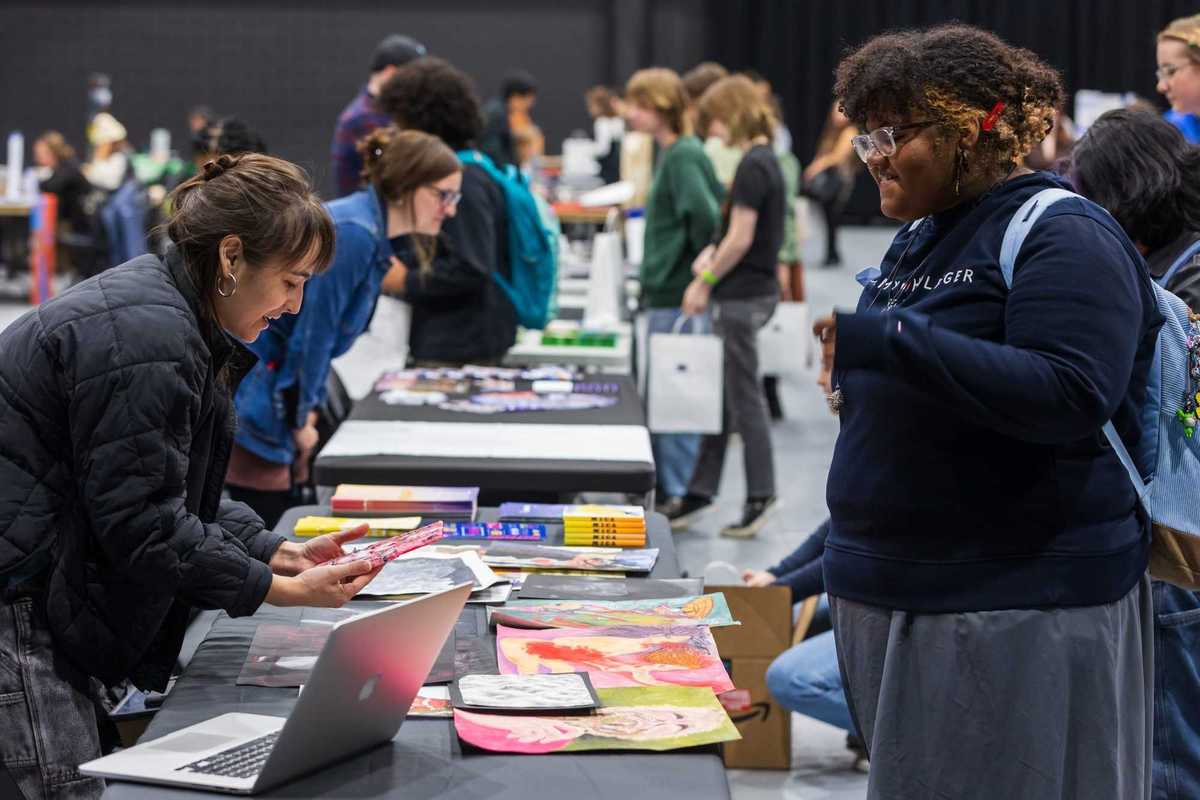
On Friday, Oct. 16, hundreds of aspiring artists will have the opportunity to explore those questions at Hudson Valley Regional Portfolio Day, presented by The Art Effect at the MJN Convention Center in Poughkeepsie.
Now in its 26th year, the free event brings representatives from more than 30 art colleges and universities together with students seeking feedback on their portfolios, guidance through the admissions process and, occasionally, an acceptance on the spot.
Nicole Fenichel-Hewitt, executive director of The Art Effect, said the event typically draws between 300 and 400 students, with organizers hoping for about 400 this year. Some travel several hours to attend.
“We’re the only portfolio day between New York City and Boston where you can get all of these really major art universities in one shot,” she said.
For students, that means a rare opportunity to sit across from admissions representatives, show them their work and learn what individual schools are looking for.
“Every school is different,” Fenichel-Hewitt explained. “This school wants sketches, this school wants three different types of work. Sometimes they want to see a whole body of work.”
The feedback can be exhilarating, illuminating and sometimes difficult.
“It’s really amazing to see the students respond to the feedback,” she said. “At times, colleges will make acceptances on the spot.”
She’s witnessed students celebrating unexpected admissions offers, as well as others struggling with the realization that their portfolios need more development.
“Sometimes you’re even just told, ‘Yeah, you need to develop five more pieces,’ and that’s overwhelming for some students.”
For young artists enrolled in The Art Effect’s programs, critique is already a familiar part of the creative process. But Fenichel-Hewitt emphasized that admissions representatives are generally interested in encouraging students rather than discouraging them.
“They’re there because they’re marketing their schools. They want students to be applying,” she said.
The relationships students establish at Portfolio Day can also make a difference later. Fenichel-Hewitt has seen students return year after year, developing their portfolios and getting to know admissions representatives before applying.
“I’ve seen kids go to portfolio day year after year, and then apply to seven schools and get into all of them,” she said.
Even something as simple as introducing yourself to an admissions representative and getting your name on the school’s contact list can demonstrate a level of interest that may help during the application process.
And unlike the enormous portfolio events in New York City and Boston, where students can reportedly spend hours waiting to speak with representatives from popular art schools, the Hudson Valley event offers a more manageable experience.
“We usually have such a nice flow,” Fenichel-Hewitt said, “so you will get in front of the reps you want to see.”
Of course, getting into art school is only part of the equation. Paying for it — and figuring out what comes afterward — can be equally daunting.
The event includes tables dedicated to helping students navigate college applications, scholarships and financial aid. The Art Effect also works with students who receive awards to help them understand their options.
Then there’s the question that has followed aspiring artists for generations: How are you going to make a living?
“I think that’s always been a question for artists, right?” Fenichel-Hewitt said.
To help answer it, The Art Effect has offered students — and perhaps more importantly, their anxious parents — a handout called “Careers in the Arts,” listing an extensive range of creative professions.
“It’s double-sided, four columns on each side, teeny font,” said Fenichel-Hewitt, describing the sheer number of possibilities.
“Going to art school doesn’t just mean that you’re going to try to be a famous painter,” she added. “There are so many types of careers.”
And those careers aren’t necessarily confined to galleries, museums or studios.
“Anything, any object that you’ve purchased or looked at, it had to get designed first. It involved an artist.”
Fenichel-Hewitt also pointed out that a strong arts portfolio can benefit students who have no intention of majoring in art.
She recalled one student who went on to study astrophysics at Harvard University with substantial scholarship support connected to her art portfolio. Others have pursued business degrees, using their creative work as a supplemental component of their applications.
“It really sets them apart because it shows such a well-rounded approach to being a healthy, young, confident person,” she said.
Ultimately, she sees the event as something more than an audition for admission.
“It’s an opportunity to not just receive feedback, but to really explore the kind of setting and atmosphere and culture that you thrive in.”
Hudson Valley Regional Portfolio Day takes place Friday, Oct. 16, at the MJN Convention Center in Poughkeepsie. The event is free. For more information, visit thearteffect.org.
Keep ReadingShow less
A colorful life together at Atelier Valla
Robin Roraback
Oct 14, 2026
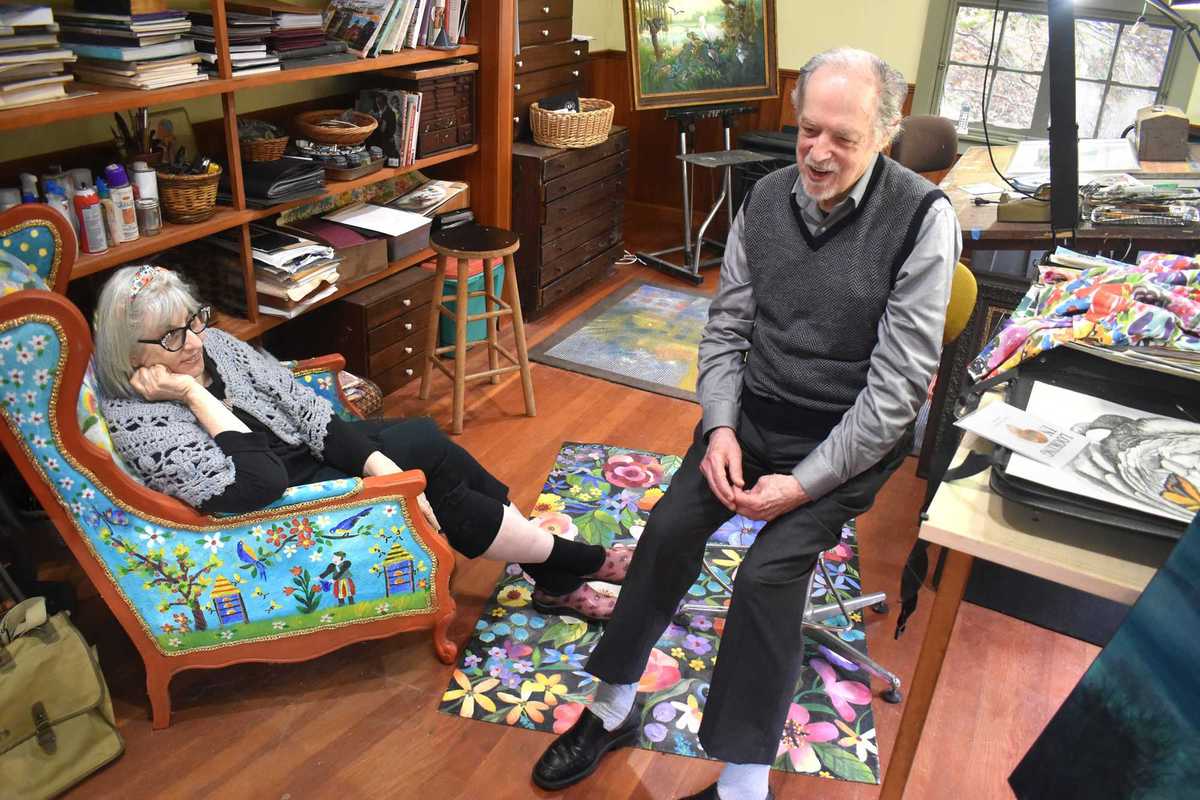
Textile designer Justine Valla sits in her father’s chair, which she painted, alongside her husband, illustrator and muralist Victor Valla, in their Atelier Valla studio.
L. Tomaino
I lost the ability to paint after the accident. I struggled to paint again.
— Justine Valla
Husband and wife Victor and Justine Valla share a lavender and pink studio, Atelier Valla, across the driveway from their pink house, nestled into a hillside in Salisbury. The colors, said Justine, “were inspired by Monet’s house at Giverny.”
Creating art has been a lifelong pursuit for both.
“I was always drawing as a child,” Justine recalled. Victor dreamed of illustrating magazine covers like those of the “Saturday Evening Post.”
Victor studied design and illustration at Rochester Institute of Technology, then received a fellowship to study painting and printmaking at the University of Illinois at Urbana-Champaigne. He graduated in 1967. The following year, he received a grant from the Tiffany Foundation to study printmaking in Paris at Atelier 17, an experimental graphic arts workshop founded in 1927.
“What a great experience that was!” he recalled.
Returning home after the Paris uprisings of 1968, he discovered that the magazine covers he’d hoped to paint had largely given way to photography. His agent suggested trying record covers, which he pursued along with illustration and graphic design.
He also began teaching at Kean University in New Jersey.
“Kean had a wonderful graphic design and illustration department. I loved teaching Graphic Design, even though I never thought I would.”
He later taught at Syracuse University and Pennsylvania College of Art and Design.
In the late 1980s, he decided to stop teaching and concentrate on his own art. He moved to Falls Village, to a house on the corner of Minor and Prospect Streets.
“I used to call the studio ‘Minor Prospects Atelier,’” he said.
He continued working in illustration and graphic design, creating book covers for stories by H.P. Lovecraft and other authors, along with magazine covers, logos, advertising and murals.
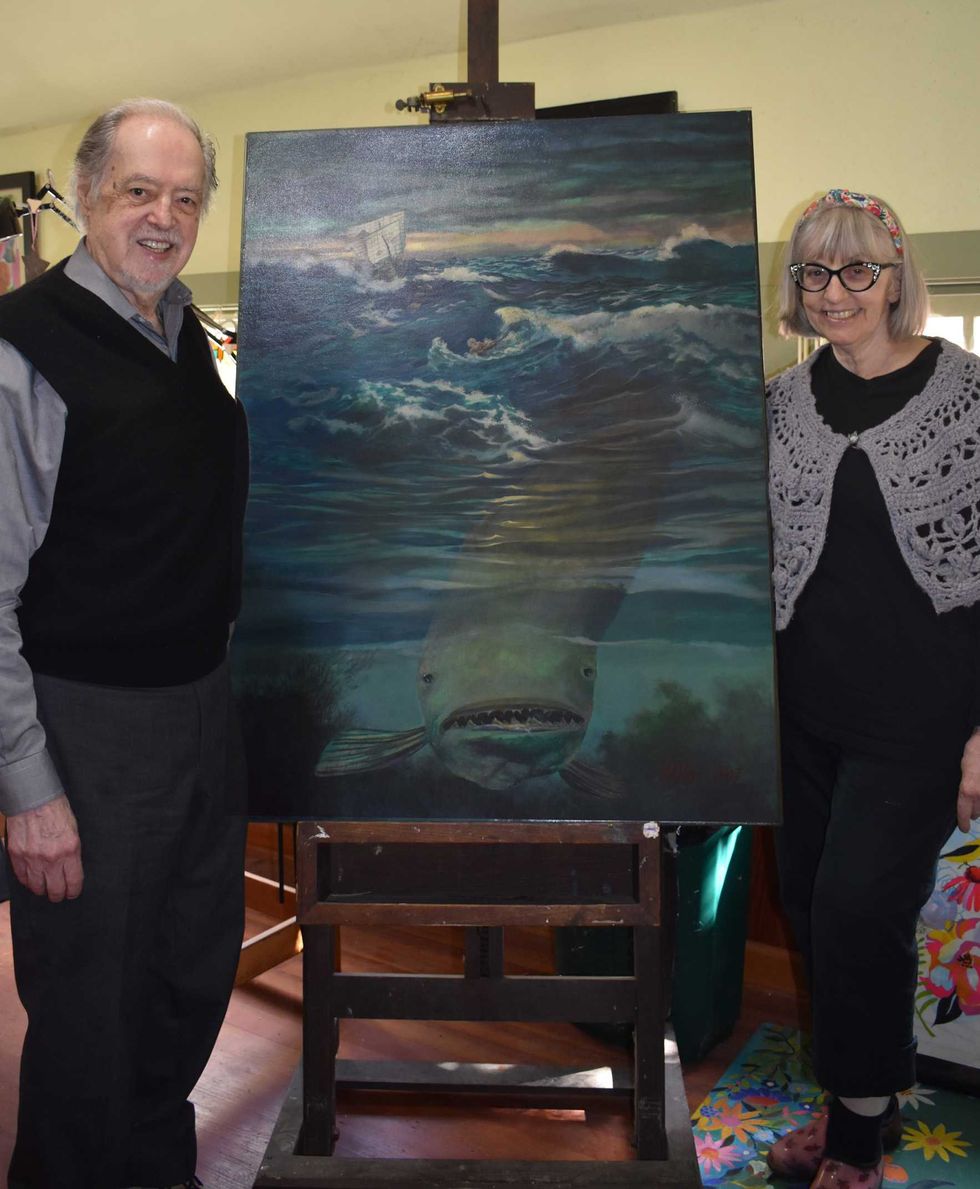
His local commissions include the green and gold Noble Horizons signage and wall murals for the Stockbridge Inn, the Spa at Norwich Inn, Orchards Hotel in Williamstown and the David M. Hunt Library’s children’s section.
Justine grew up in the Bronx and studied at the Fashion Institute of Technology. After graduating, she took on whatever work she could find, including designing toys and novelty items for Russ Berrie. But her true calling was textile design.
She moved to Los Angeles to pursue that calling, where she learned silkscreen printing from 1960s design icon Corita Kent.
“I was in her program at Immaculate Heart College. All fabric design at that time was silk screen. My first job in textile design was in L.A., creating wallpaper for Bob Mitchell Design.”
Justine returned to New York City, where the advent of computers required her to learn new design techniques. She enrolled at Parsons School of Design, studying Photoshop, Illustrator, Lectra U4ia and Kaledo.
Around this time, she met Victor online and moved to Falls Village.
A recruiter found her a job in Arkansas at Dillard’s, a department store chain operating in 30 states and known for its exclusive designer collections.
“They had the best equipment I’d ever seen,” she said.
She became a senior computer-aided design designer there, designing fabric and preparing purchased designs for production.
The Vallas left Falls Village for Little Rock.
“It was a big move,” she said. “It was a different culture, but Little Rock was very progressive.”
The originally planned to stay in Arkansas for five years but ended up remaining for nearly 10.
Then Justine was hit by a car. She suffered injuries to her leg and head and required four years of rehabilitation.
“I lost the ability to paint after the accident. I struggled to paint again.”
The Vallas returned to Connecticut, this time settling in Salisbury, where they’ve lived since 2013.
After leaving Dillard’s, Justine had planned to sell her work through Printsource in New York City, an international showcase for surface and textile design. But after the accident, she no longer had the mobility or energy to travel back and forth to the city.
Instead, she began selling her work locally at craft shows, including clothing, hand-printed tea towels and floorcloths.
She is currently working on selling her collection of textile designs.
In December, Justine will have a show of her tea-themed watercolors at the NorthEast-Millerton Library.
Victor recently exhibited “The American West: A Pictural History” at the NorthEast-Millerton Library. The series, created in the early 1990s, was part of a commission from the Postal Commemorative Society for which he completed 100 paintings in two years.
He hopes to place the series in a museum and has created books from its images, complete with text. Over the years, he has designed many other books that are ready for publication, including “Looking In, Looking Out,” a cosmic view of the universe.
Reflecting on his career, Victor said, “It’s about doing what you love”.
Justine agreed.
To see, purchase or commission work, contact Justine at justinevalla@gmail.com or Victor at victorvalla@comcast.net, or call 860-596-4282.

Keep ReadingShow less
David Ruchman’s “Acquired Taste”
D.H. Callahan
Oct 14, 2026
Filmmaker David Ruchman
Bleacher and Everard Photography
In a region known for its vibrant but geographically scattered arts community, discovering something new can require a little effort. The same might be said for finding a new place for an extraordinary meal. While the Northwest Corner, Berkshires and Hudson Valley have no shortage of creative talent, opportunities to experience it — whether on a stage, in a gallery or on a plate — aren’t always just around the corner.
In David Ruchman’s short film “Acquired Taste,” that challenge becomes the premise for an unlikely friendship between Nick, an aspiring young food critic living in an area with limited dining options, and a gruff New York City master chef.
On Sunday, Oct. 18, the film will act as the dessert course in an afternoon of culinary programming, when it will be paired with award-winning documentary “Jiro Dreams of Sushi” at the Moviehouse in Millerton.
Alongside the two food films will be Ruchman, who wrote, directed and produced “Acquired Taste,” and actor Richard Mover. Mover stars as chef Jamison Gellar, who takes a liking to young Nick and decides to help him see the forest for the trees.
Ruchman, who acts as quizmaster at the Moviehouse’s monthly trivia night, grew up in Washington, Conn., close enough to the Mayflower Inn to have experienced some incredible meals right in his own hometown. The next wrung down on the culinary ladder, however, wasn’t exactly what many consider gourmet. In addition to those rare meals at the Mayflower, Ruchman had the opportunity to travel and get a sense of what was out there in the wide world of dining delights. It gave him a stark understanding of what it could be like to execute a creative vision in an otherwise utilitarian environment.
The screening is part of a Repertory Spotlight at the Moviehouse, ahead of Hudson Valley Restaurant Week, which runs from Nov. 4-16. But there’s more food programming coming after the “Acquired Taste” and “Jiro” event.
On Oct. 24, the Moviehouse will screen “Julie & Julia,” starring Meryl Streep and Amy Adams, about the life and food of Julia Child. After the film, audience members will be treated to a discussion with former Food & Wine editor-in-chief Dana Cowin, celebrated Brooklyn-based cookbook author Jessie Sheehan and Chefs Table founding member Kristen Essig. While at Food & Wine, Cowin would assign work to Julie Powell, who wrote the story the movie is based on.
Two days later, on Oct. 26, a showing of “Babbette’s Feast” will precede a Q&A with film and television executive and local teacher and mentor Paul Wagner, who worked at the film’s studio, Orion Pictures while it was being produced.
For tickets, visit themoviehouse.net
Keep ReadingShow less

Want more of our stories on Google? Click here to make us a Preferred Source.
Follow the Clay Way for ceramic delights
D.H. Callahan
Oct 14, 2026
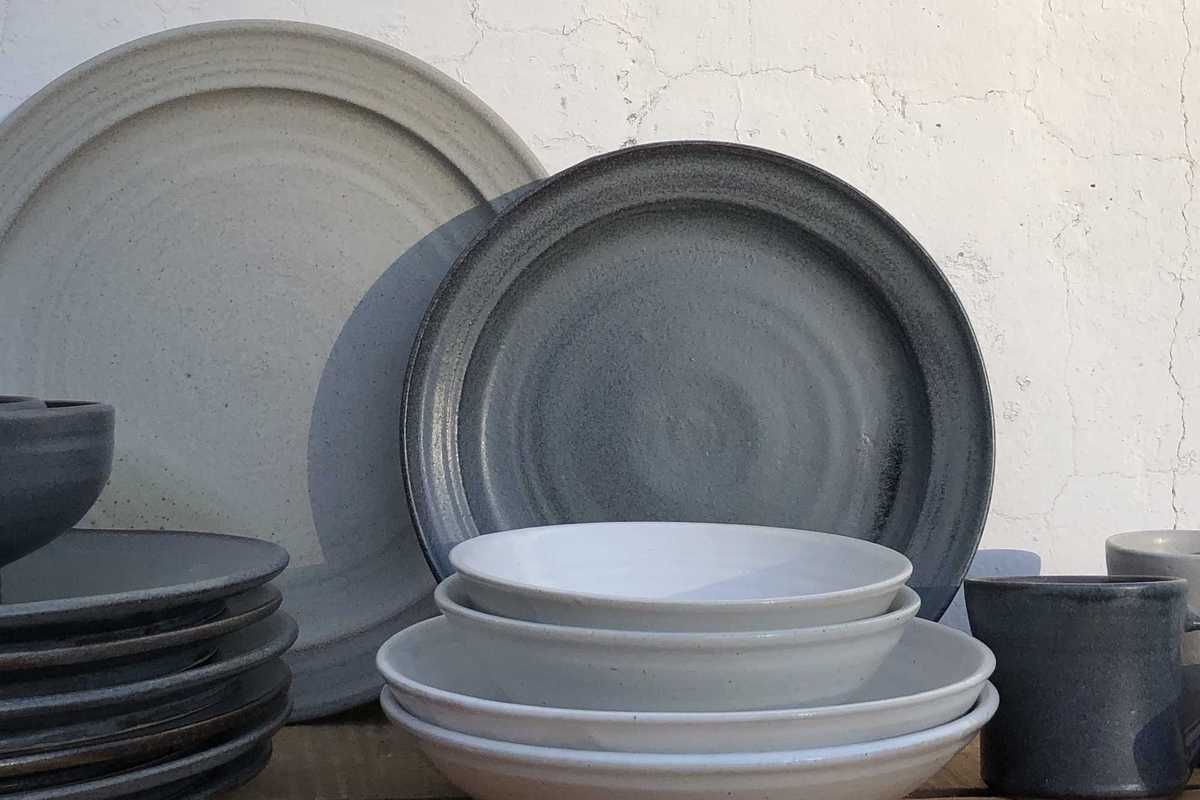
Jane Herold’s beautifully simple dinnerware.
Provided
As the leaves across Litchfield and Dutchess counties rush to make it to the ground, your last chance to peep autumn is fast approaching. On Oct.17 and 18, the 10th annual Clay Way offers peepers a route to follow lined with unique art that rivals the area’s natural beauty.
The two-day event is a ceramics-focused open studio tour through northwestern Connecticut, with a few studios peppered in just over the border in Dutchess County. Featuring nine open studios and 25 participating artists, the tour promises a wide variety of work, from decorative objects to grand vessels and a whole world in between.
Cornwall ceramicist Jane Herold explained that there’s quite a lot of enthusiasm for Clay Way among the region’s ceramic artists.
“We all need work space, which is hard to find or afford in urban areas. The wood-fire crowd needs lots of wood and outdoor space. This area is great because it’s rural enough for us, but has a wonderfully enthusiastic and supportive population of pottery [patrons].”
While many of the artists are returning from previous years, the loose collection of unofficial organizers likes to keep the event manageable for the public, limiting the number of artists and studios each year. A direct drive from the southernmost point at Ann Heywood’s studio in Wingdale to Herold’s big barn in Cornwall is under 40 minutes. But if you want to catch it all, plan for a full day’s worth of art exploration along some of the most beautiful roads in New England.
Starting at its northernmost point, Herold’s studio will host Matin Malikzada of Afghanistan, whose polished, modern interpretations of traditional forms are instantly recognizable. They’ll be joined by wood-fired ceramicists Steve Johnson, with his raw, organic forms, and Harry Levenstein, whose works relate closely to Johnson’s while making even more direct references to nature.
Herold herself creates work that is both beautiful and utilitarian. Her prolific output of objects is intended to be used by everyday people as part of their daily lives.
Moving south is Todd Piker of Cornwall Bridge Pottery. Piker has been making pots in his giant wood-fired kiln since 1971. The kiln looks more like an ancient blast furnace than something designed to transform clay into ceramics, but over the years, he’s mastered its intricacies and produces an impressive amount of fine work.
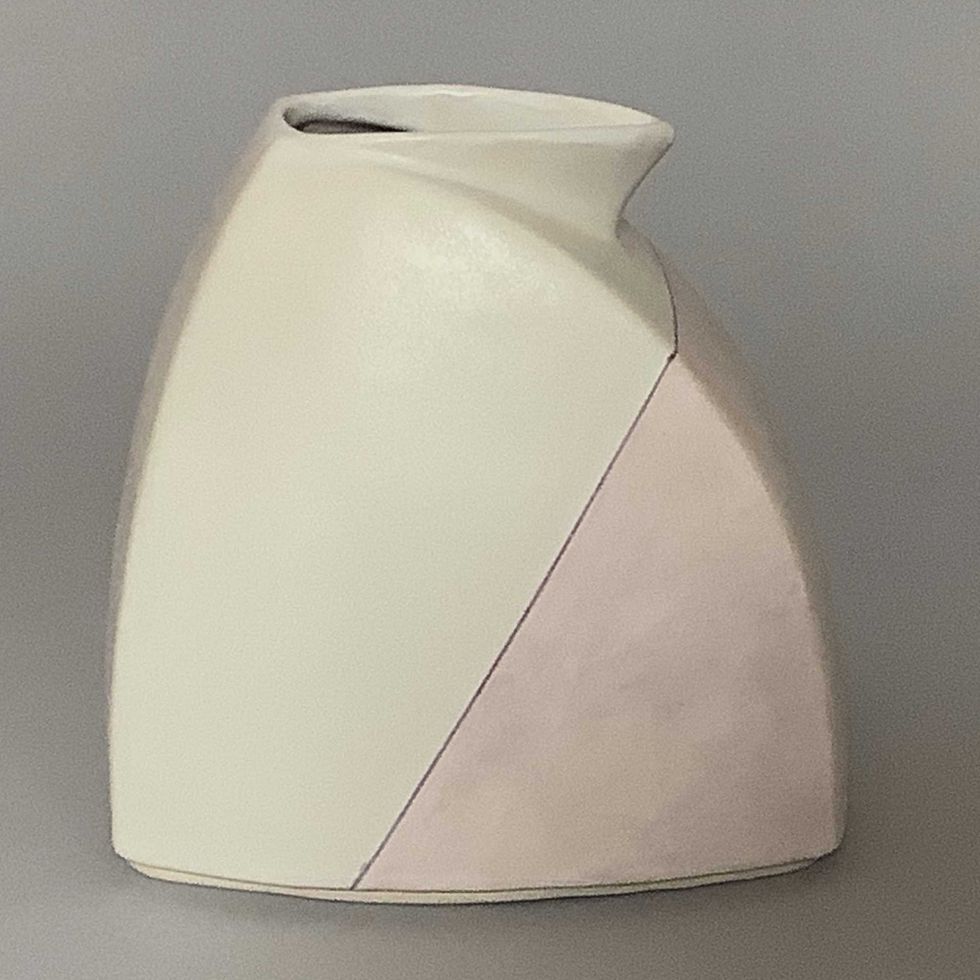
Piker will host Sanah Peterson, who works at Cornwall Bridge Pottery and draws inspiration from both her time with Piker and her time traveling the globe as a child. They’ll be joined by Stephanie Haines, whose vibrant, eye-catching work features underglaze illustrations of birds, fruit and the bounty of nature.
Further along in Warren, Jessica Dubin’s pieces will be on display at the studio of Christine Owen. Both artists seem to appreciate the chaos and unpredictable nature of clay but find ways to refine it all using their own unique methods.
Heading east to Washington, Conn., Will Talbot’s creates intricate work while allowing for the unpredictable nature of clay to play a role. His studio will house Tom Knox and his wide variety of textures and forms, as well as New York City-based Alex Lebedev, who lets music and the nature of improvisation guide his work.
There will be two studios participating in South Kent. Alison Palmner, whose page on the Clay Way website states she “strives to achieve a lighthearted meld of human forms, animals and the vessel.” Her studio will host Ben Eberle, who trained under the guidance of legendary potter Toshiko Takaezu; James Guggina, whose intricate work can appear both deliberate and whimsical; and Paula Shalan, who blends rough, unrefined surfaces with polished precision in individual pieces.
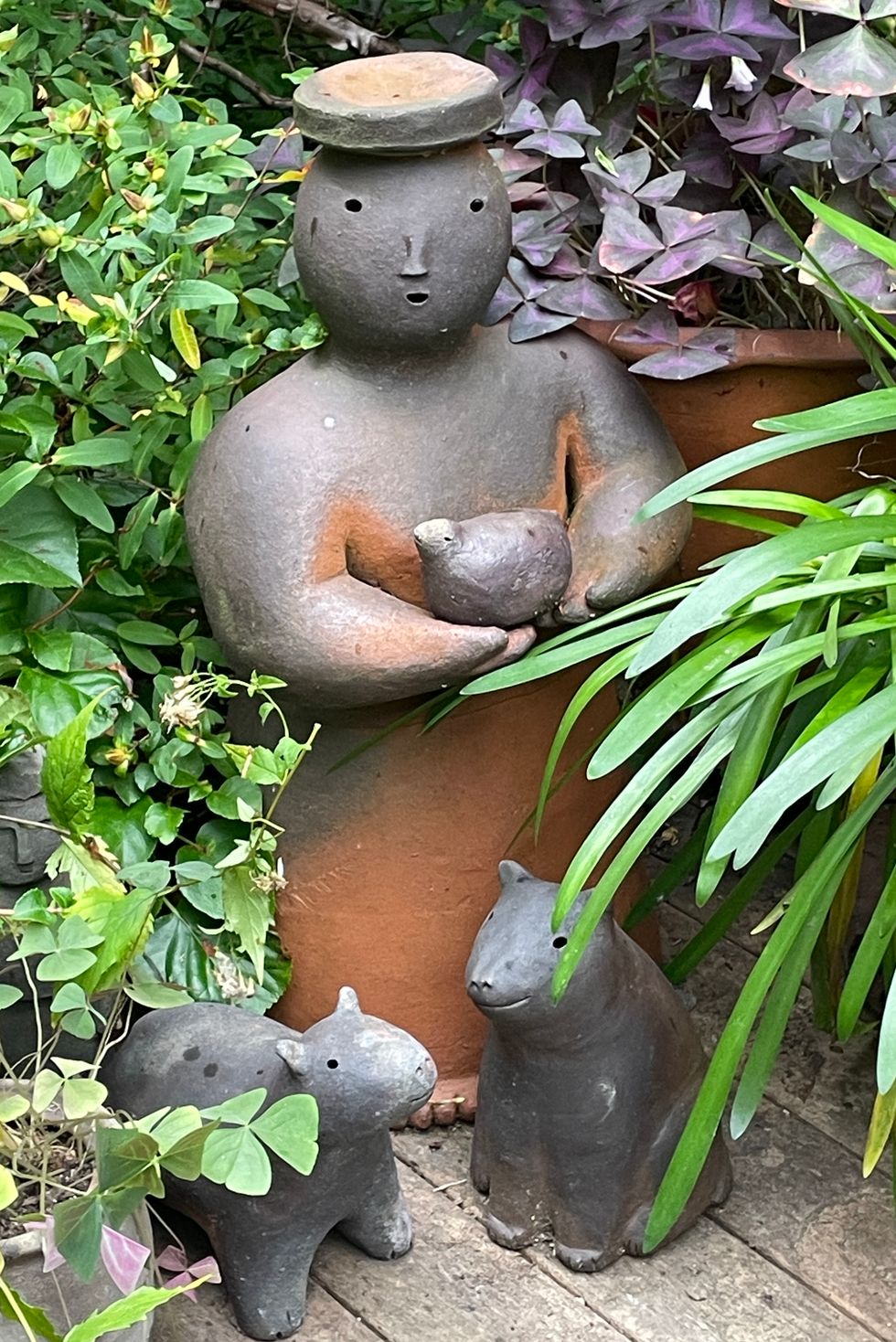
Nearby is Joy Brown, whose work have become a staple of the area, with her figurative sculptures dotting the Northwest Corner. Brown’s studio will also feature Bonnie Levine, who taps into the beauty of chaos and destruction in her work, and Brendan Moore, whose more utilitarian forms are perfect for everyday use.
Finally, the tour crosses the border into Wingdale, New York, where the studios of Drew Montgomery, Ann Heywood and Amy Brenner will host Jackie Sedlock, Lynn Behrendt,and Kathleen Heidemann.
Brenner creates some of the most colorful and vibrant pieces on the tour, while Behrendt’s work is among the most studied and precise. Heywood creates carefully considered, intuitive forms, while Heidemann moves from simple minimalism to intricate textures. Montgomery and Sedlock both find new ways of playing with traditional forms, producing delightfully distinctive pieces.
To learn more about the artists and download a map of participating studios, visit clayway.net
Keep ReadingShow less
A new home for the unexpected at Kent Fine Art
Natalia Zukerman
Oct 14, 2026
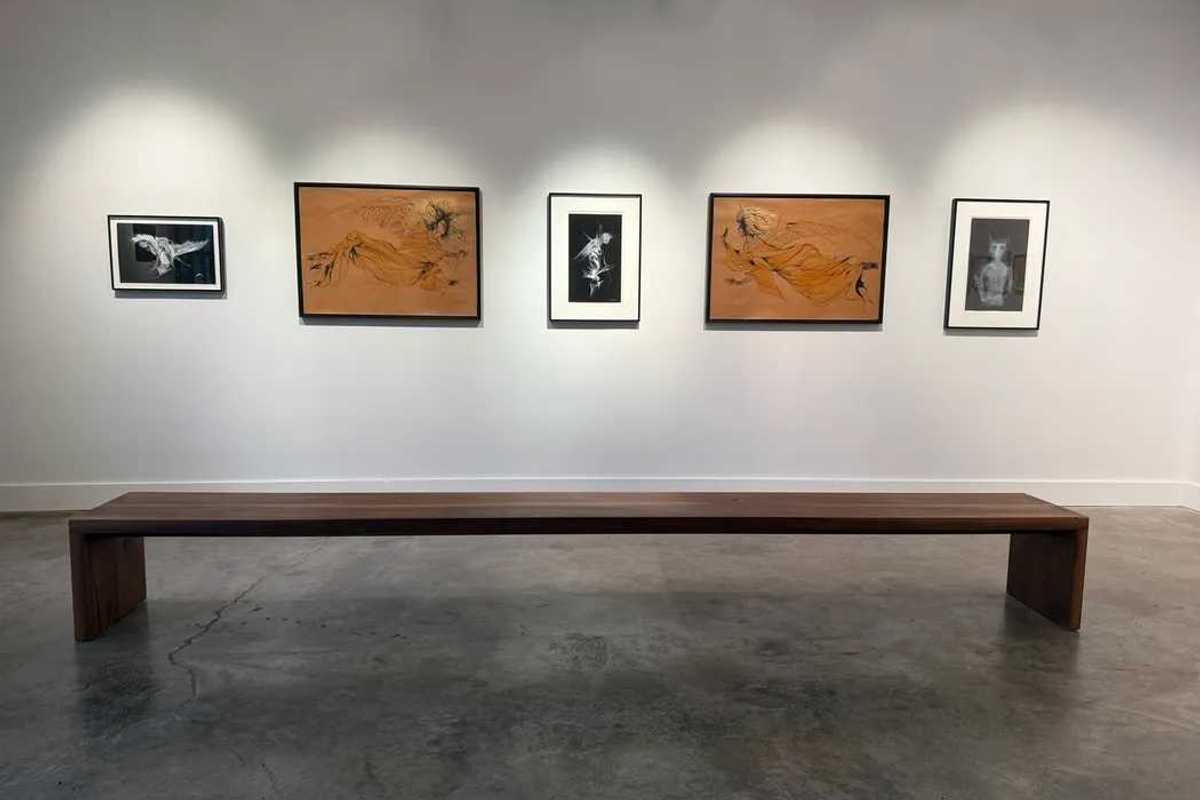
CAMERON (1922-1995) is on view at Kent Fine Art in Pine Plains through Nov. 14.
Provided
Where can one find the work of an artist associated with occult rituals, surrealist visions and the underground California art scene? In a beautifully renovated former carriage house in Pine Plains, of course.
Unexpected discoveries are, after all, part of what Doug Walla has spent his career making possible. The longtime New York City art dealer and founder of Kent Fine Art, has brought the work of Marjorie Cameron Parsons Kimmel, known simply as Cameron, to his new gallery space. The exhibition, on view through Nov. 14, introduces visitors to an artist whose life and work moved between mysticism, poetry, film and the avant-garde.
Born in 1922, Cameron was a gifted draftsman whose intricate drawings explored spirituality, sexuality, mythology and the mysteries of the subconscious. Her work occupied a world somewhere between surrealism and the occult, informed by her interest in theosophy and the possibility of unseen forces shaping human experience.
Cameron also appeared in experimental films, including Kenneth Anger’s “Inauguration of the Pleasure Dome” and Curtis Harrington’s “The Wormwood Star” and “Night Tide,” the latter starring Dennis Hopper.
Her reputation was as unconventional as her art. In 1957, her drawing “Peyote Vision” appeared in an exhibition at Los Angeles’ legendary Ferus Gallery. The work was considered so provocative that police shut down the exhibition and arrested artist Wallace Berman, who had included it in his show.
Both Cameron and Berman subsequently vowed never to exhibit in commercial galleries again.
Although she continued making art throughout her life, much of it remained largely unseen for decades. Her work resurfaced in major exhibitions, including a 2015 retrospective at the Museum of Contemporary Art in Los Angeles. Curator Philippe Vergne described it as existing on “the edge of surrealism and psychedelia.”
For Walla, bringing Cameron’s work to Pine Plains reflects a larger desire to return to the experience of looking at art rather than treating it primarily as a commodity.
“I wanted to get back to looking at art and to get away from the finance, get away from the asset class, get away from the branding, get away from the fashion, get away from the celebrity status,” he said during a recent visit to the gallery.
Instead, he wants to encourage a more personal encounter with individual works.
“Here, getting to live with it, there’s an opportunity to have a more intimate way with the work,” he said.
Walla began his career as a curator in California, organizing Alex Katz’s first retrospective in 1975. He subsequently joined Marlborough Gallery, where he worked with artists including Francis Bacon, Larry Rivers, Katz and Frank Auerbach.
In 1985, he established Kent Fine Art at Madison Avenue and 57th Street in Manhattan. Over the following decades, the gallery moved through SoHo and Chelsea, presenting hundreds of exhibitions and publishing more than 70 scholarly books on artists ranging from surrealists Dorothea Tanning and Meret Oppenheim to contemporary figures including Chris Burden and Antoni Muntadas.
After the COVID-19 pandemic disrupted the gallery business, Walla returned to Marlborough in an executive role. But with the couple’s two daughters heading off to college and many of their artist friends already living in the Hudson Valley, Walla and his wife, painter Nicole Pilorge, decided to make the move north.
They wanted a live-work arrangement, somewhere they could be surrounded by art without the demands of operating a conventional commercial gallery.
The Pine Plains property offered that possibility, although the building that would become Kent Fine Art required a substantial transformation.
When Walla first entered the space, it was essentially a raw woodworking shop, with unfinished walls and a single light operated by a pull chain. Electrical service was rudimentary, and the building needed insulation, windows and proper wiring.
“We had to trench and electrify the building, and then we insulated the whole thing,” he said.
For someone accustomed to pristine gallery walls, the transformation was particularly satisfying. The ability to install Sheetrock and create proper surfaces for hanging art was, in itself, a revelation.
Walla opened the space with an exhibition of Japanese artist Teruko Yokoi, whose work he has long admired. The Cameron exhibition is only the second presentation in the newly completed gallery.
“I don’t run a gallery per se,” he explained.
Instead, he envisions a more flexible approach, mounting exhibitions when there is an artist or body of work he particularly wants to share.
He also writes a weekly newsletter for a mailing list of approximately 3,000 people, generally focusing on a single work of art. The essays are gradually being added to the Kent Fine Art website, creating a growing collection of observations and reflections drawn from decades of experience.
“Maybe they’re more like memories,” he said.
The property also accommodates Pilorge’s studio upstairs, adding another dimension to the couple’s live-work vision, a reminder that the property is as much about making art as presenting it.
Walla said the arrangement allows them to remain connected to the creative community while working at a different pace.
That spirit of discovery seems especially appropriate for an exhibition devoted to Cameron, an artist who resisted easy categorization and whose work remained outside the mainstream for much of her lifetime.
The exhibition offers a chance to encounter her drawings in a setting far removed from the commercial pressures of the New York art world but informed by someone who has spent decades working at its center.
After a career devoted to exhibitions, publications and the business of art, Walla is interested in something both simpler and more elusive: spending time with the work itself.
“It’s a very modest proposal,” he said.
“CAMERON (1922–1995)” is on view at Kent Fine Art in Pine Plains through Nov. 14. The gallery is open Saturdays and Sundays from 11 a.m. to 5 p.m. For more information, visit kentfineart.net.
Keep ReadingShow less
A new home for Stateline Auctions
D.H. Callahan
Oct 14, 2026
D.H. Callahan
If you’ve driven through North Canaan in the last month, you may have noticed that the big storefront windows at the intersection of Main and Railroad Streets, usually packed with antiques and art, are empty. Stateline Auctions has moved.
Stateline was started by Tommy Matteo and Bruce Kolbacher in 2011. Matteo had already been in the auction world for 15 years and had worked with Kalbacher, an antiques store owner, before they set up shop in North Canaan.
Matteo works as the ever-enthusiastic auctioneer, and he puts on a real show. In just a few hours, he presents and sells hundreds of items, from antique furniture and rugs to art and decorative items, even taxidermy, jewelry and other odds and ends you probably wouldn’t expect. Community is part of the show, with Matteo joking around with regulars. Attendees congratulate each other on their purchases, and even educate each other about the items as matteo keeps the momentum going. If items aren’t moving, Matteo will remind the room that he’s got alimony to pay, and it’s up to everybody in the room to help him raise the funds.
For the past 15 years, this has all happened in that highly visible building at the main intersection in North Canaan. Now, Mattea, Kolbacher and their Stateline Auctions crew have moved off the beaten path. For some frugal bidders, this might seem like a good thing. After all, the fewer people who know about the auction, the fewer people they have to bid against when their lots come up.
Unfortunately for those who consistently show up, the competition these days is less in the room and more online. Stateline has been running simultaneous auctions through the real-time auction website and app LiveAuctioneers.com, where the entire event is streamed live. Throughout the eight-hour event, the online viewership rarely, if ever, dips below 600 individual users. This technological development creates more potential buyers for Stateline and also allows busy bidders to keep an eye on their lots while out and about.
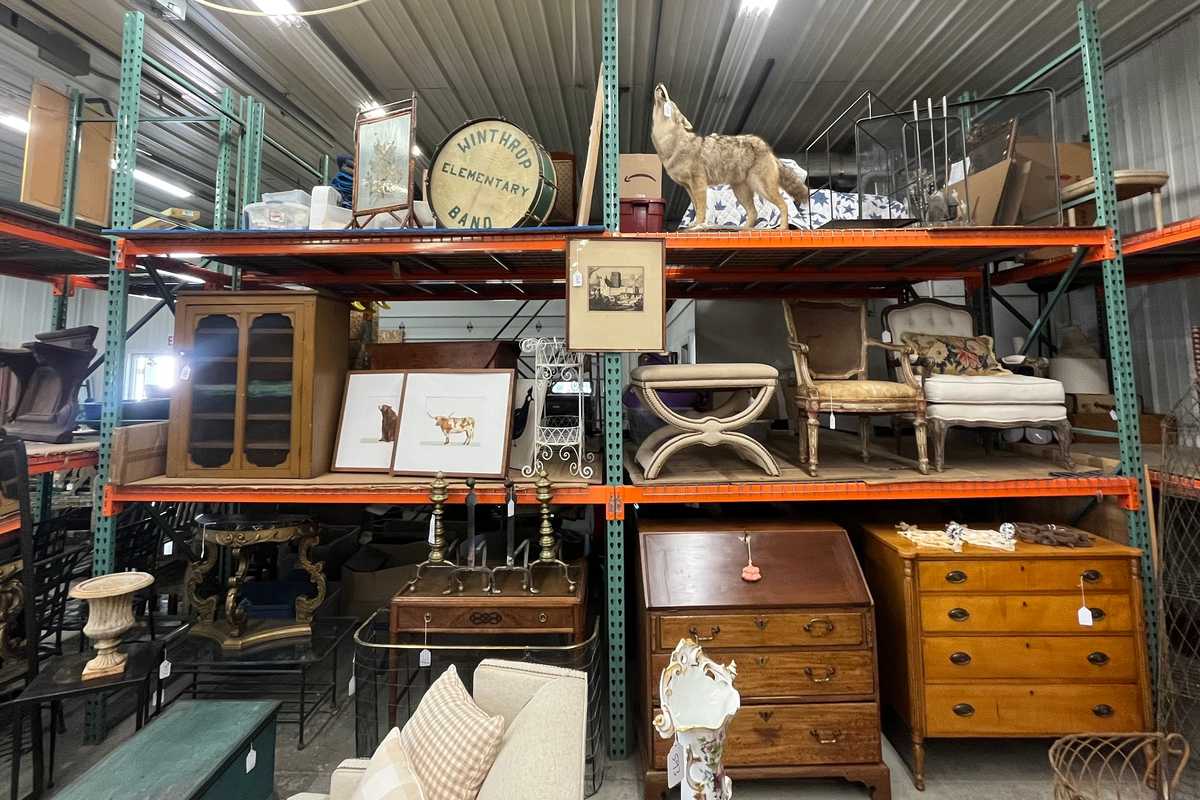
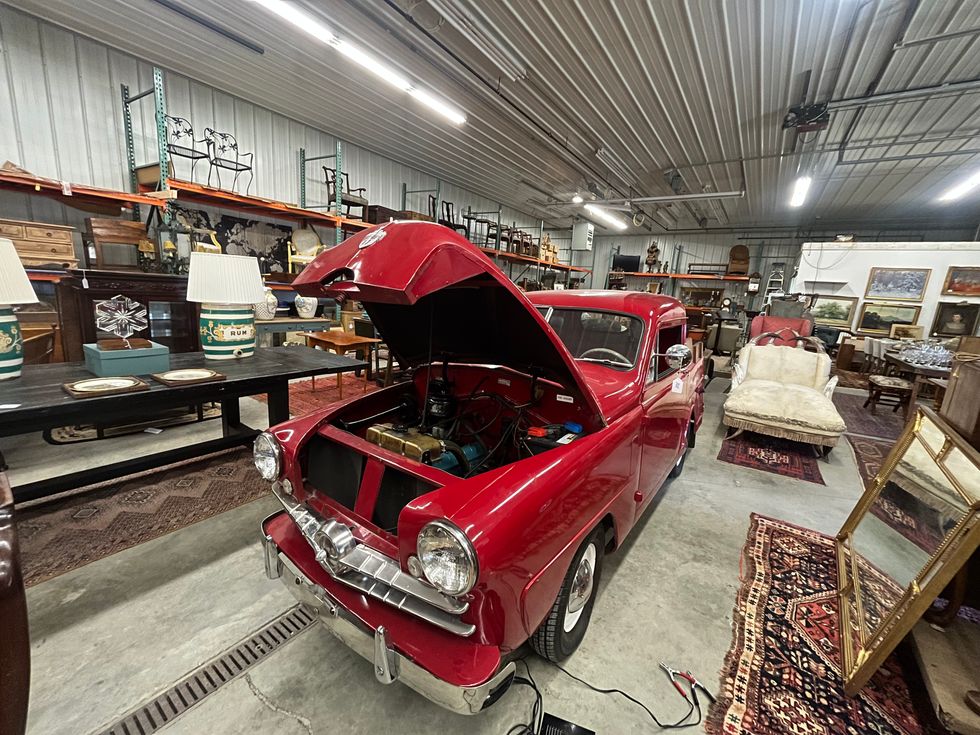
The new space, still in North Canaan, just barely south of the Massachusetts border, is a sizable warehouse packed to the ceiling with precious finds. It’s bigger, brighter and has ample parking.
The auction on Oct. 11 featured all kinds of lots, including three cars. A candy-apple-red Crosley pickup truck grabbed every eye in the room and even more attention online. Amid all the enthusiasm, it was heartwarming to witness the entire audience erupt in applause as young bidder Molly Seitz burst into tears after winning the truck. The beautiful vintage vehicle had belonged to her grandfather, who had given her driving lessons in it before he died.
Between resellers, collectors and the casually curious, the performance that is a Sunday at Stateline Auctions is a delightful way to breathe new life into old items. There’s rarely a set date for the next auction, but it generally takes about six weeks before they’re ready with their next round of goods. This time, Matteo predicts a sale after Thanksgiving, but if you want to be safe, follow their auction on liveauctioneers.com.
Keep ReadingShow less

Want more of our stories on Google? Click here to make us a Preferred Source.

loading