I watched carefully as the elderly tourists struggled with weighty luggage; they stumbled dangerously across the thick wooden ties of the vintage railroad bridge leading to the mainland from what was referred to as the northern (now) territories of Hong Kong. They were headed for a train that would continue their trip onto mainland China and though it was damned scary to me, they loved every minute of this retirement adventure.
It was 1979, I was a “kid” in that crowd, amazed by the physical skills of wealthy elderly Americans. I’d been traveling on assignment, mourning the moments away from my wife Dona and newborn baby, Jennifer.
The trip, in retrospect, was well worth it. I can actually recall yesterday’s China caught in the time warp of Communism. As a GI, I’d been stationed in Cold War Germany with a view of East Germans living in that standstill that avoided progress of a free Western culture. Discharged in the early 1960s, I was an army photographer with photos of East and West Germany that were very much images of yesterday and today.
In 1979, visiting China was like going back in time, experiencing a historic view of what it was as opposed to the high-speed, high-tech machine it’s become. A train window’s moving image through rural China was a 2000-year-old time trip of barefoot people herding flocks of geese; poles across shoulders held balancing buckets at each end. Rice paddy workers with pointed straw hats offered no indication of the 20th century beyond the lone site of a man on an out-of-place bicycle.
There were carts pulled by all kinds of animals and in one particular place an entire “city” of people were dwelling in limestone caves on each side of the train as it moved through a hand-carved limestone canyon. Hand carved! Incredible. Each mark on the canyon wall indicated the use of a lone chisel.
We rumbled on in a coal-fed 19th-century locomotive in pristine condition past an entire country that wore the same civilian uniform. It was an Orwellian style center, a heart attack for Vogue magazine editors, was the dress code of China in 1979. The entire country, men and women, wore Mao caps and jackets and what appeared to be tennis shoes.
An article in the only English language newspaper I’d seen mentioned an armed robbery. Other than the gun used in the stick-up, the perps were described as wearing “Mao caps, jackets and tennis shoes and surgical masks.” Round up the usual billion suspects.
This image was right in line with the magnificent artwork of the cartoonist, Milt Caniff, the genius who’d created and illustrated a masterpiece of a comic strip called “Terry and the Pirates.” The style and characters of his art work had suddenly come to life for me in this real-life view of what was probably Caniff’s 1930s and ‘40s view of China, but the real view went further back in time and good ole Communism’s lack of social progress scores brownie points for decorating this “set.”
A casual stroll through the train cars offered ominous views of Chinese military men seated near windows, smoking, heads tilted backward, glaring angrily within slow-moving clouds of smoke surrounding our movement, wisps of gray exiting slowly from nose and mouth, anger in their eyes. I could sense the presence of Milt Caniff, sketching his “Terry” masterpiece from a seat on that train.
China was opening up in ‘79 and the Chinese were working on tourist money in a big way. That called for an about-face in their image; this tour group was offered an impression of religious freedom. We were offered a tour of what they called a Muslim mosque, really just a group of small buildings holding a few Middle Eastern features; laundry-filled clotheslines occupied the courtyard area between buildings, ouch... there were no prayers, just another gift shop.
They were milking the tourists again. Bought a few trinkets, walked out to the dirt road leading back to the bus and I noticed the limestone wall across from the “mosque.” Opening in the wall indicated a dwelling. As I turned to walk toward the bus a person stepped out of an opening in the wall. There she was, long-limbed in boots and tan wool tunic, her movement was slow motion, living ballet as she bent to comb her long golden brown hair. She stared at us, the tourists moving toward the bus.
The trip was grueling, I lost weight, I was tired and lovesick but now, before me was this wonder of a lady right out of “Terry and the Pirates,” a momentary glimpse of a cartoonist’s treasure. Caniff has been here, he’s seen her or the likes of her, she’s embedded in my thoughts, my memory.
Hey, Milt Caniff, she really exists. I’ve seen her as you described her, a powerful, beautiful Chinese woman who shunned the Mao garb even in 1979.
Bill Lee lives in Sharon and New York City.


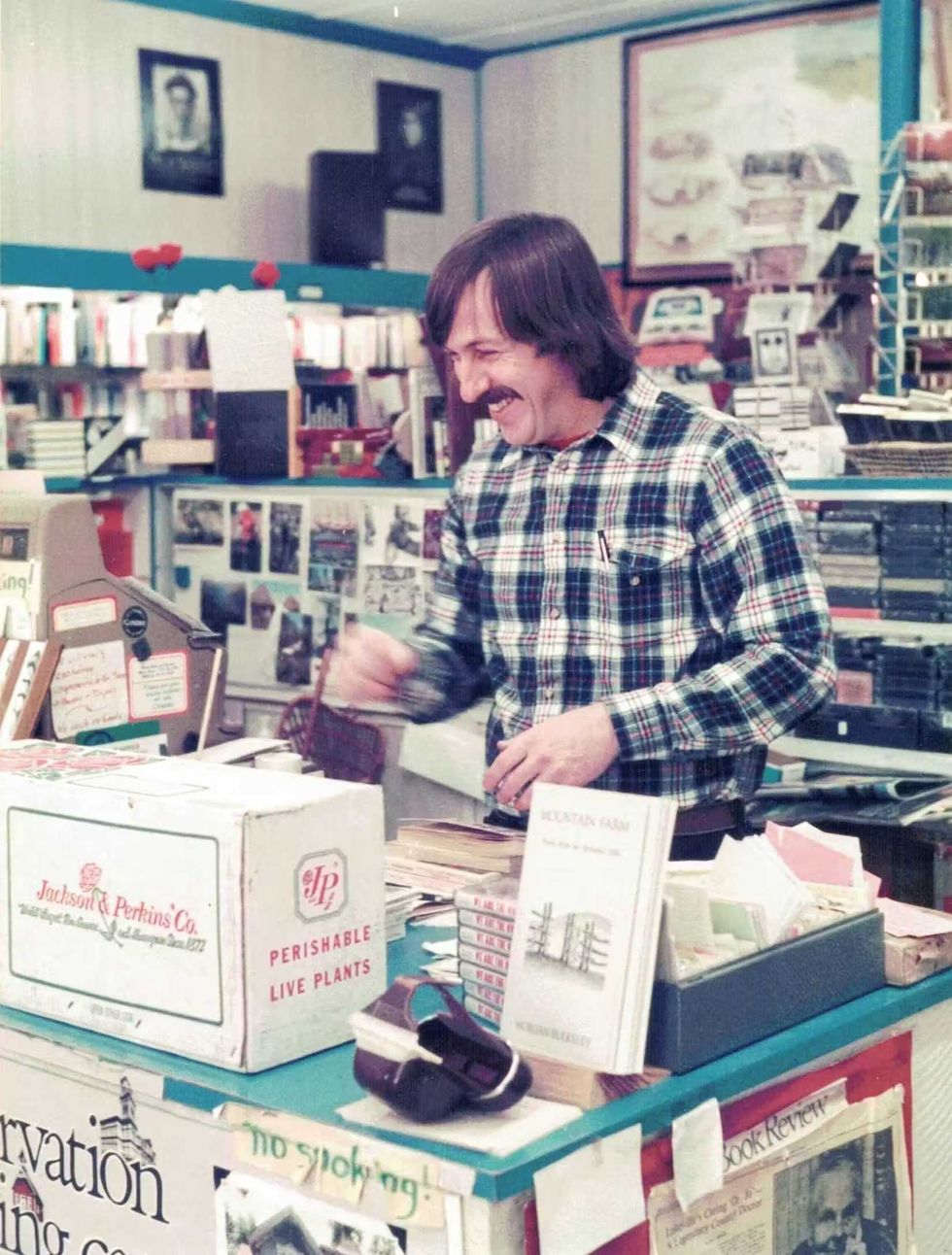 Dick Hermans in the Oblong Bookstore on Millerton’s Main Street in 1985.Provided



 Fall storage crop harvests amid soil building cover crops at Adamah Farm in Falls Village. Janna Siller