Catching and kvetching in the Catskills

Catching and kvetching in the Catskills
Patrick L. Sullivan

I recently returned from a week’s vacation at the ancestral manor in the Catskill village of Phoenicia.

Few things are as tedious as kvetching about the weather, but kvetch I must.

During my week off the weather went from a good impression of the Northeast in late September to Las Vegas in August.

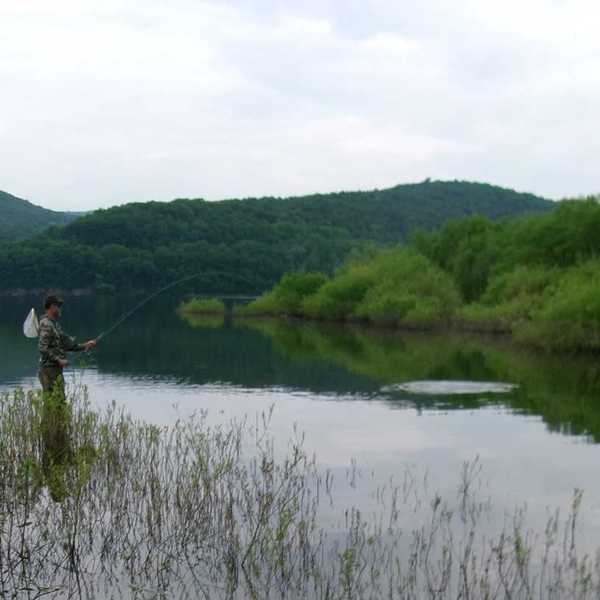
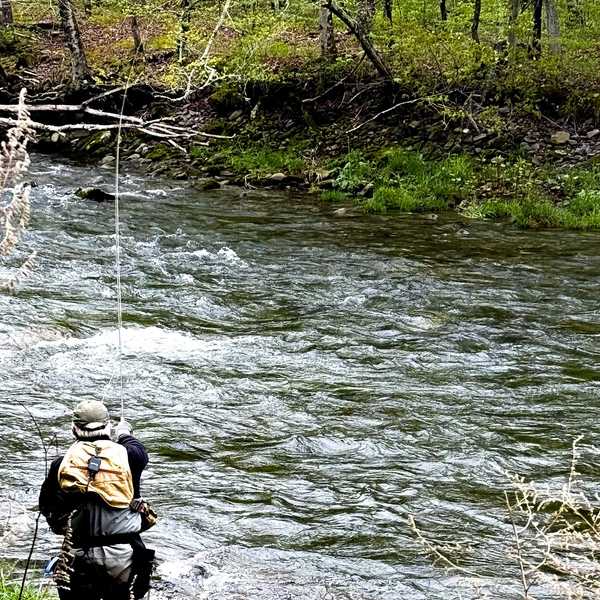
The first day dawned clear and positively chilly at 55 degrees. I went to a nearby stretch of Woodland Valley Creek where I had unfinished business in the form of a brown trout I hooked last year and failed to bring to the net. In Tangled Lines parlance, this is called a “compassionate release.”

It’s a tricky bit of stream that comes down in riffles and pockets and empties into a wide basin hemmed in by a modest cliff on the river right side and a couple of boulders on my side.

You can stand on the boulders and scare everything, or you can creep around and crouch behind the boulders, peering over them in the vain hope of seeing what you’re doing.

After conventional tactics failed, I rigged up two heavy nymphs, one drab and one sparkly, on a 10 foot Tenkara rod.

The length of the rod gave me barely enough leverage to keep the line tight while perched behind my boulder.

The third time through something tugged at the other end. I thought it was a rock at first but then it moved around.

Fish on!

(I never say “fish on!”)

Patrick L. Sullivan

At this moment the Zen simplicity of the fixed-line rod went out the window as I was confronted with a) keeping the fish hooked while b) getting upright from a baseball catcher’s crouch and savoring the resulting back pain while c) scrambling around the boulder in order to d) step into the deceptively deep hole, almost falling face-first into the water.

Somehow I kept this 15 inch or so brown trout on until the very last moment, when it came unbuttoned but e) hung there in the soft water for a split second, just long enough for me to slide the net under it.

The brown took the sparkly nymph, in case you were wondering.

My main fishing buddy Gary Dodson took the wheel the next day for an extended tour of the Beaverkill watershed, with a pit stop beforehand to play with wild rainbows in a small brook near the Pepacton reservoir.

Along the way we stopped in Livingstone Manor at Dette’s fly shop, which is halfway between a retail business and a shrine. I bought some isonychia patterns I didn’t need for the good of the house.

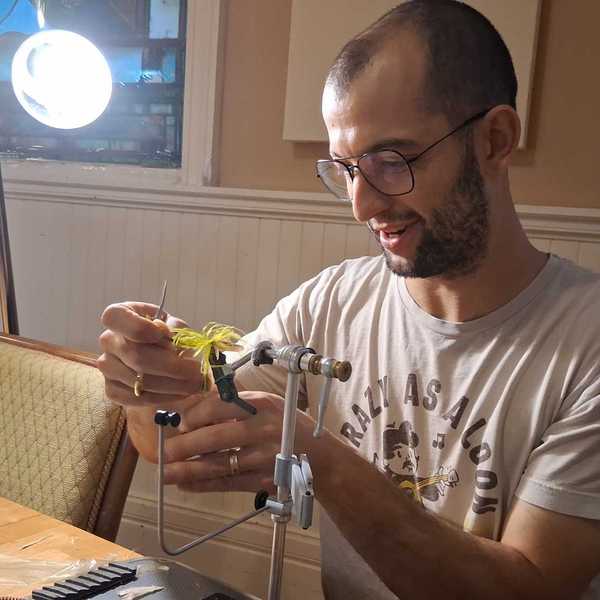
And we visited another fly tyer, Quinn Still-Zinsel of Quinn’s Fly Box (see his shop on Etsy).

Of course this made me think of the Bob Dylan song “The Mighty Quinn.” Instant earworm.
Patrick L. Sullivan

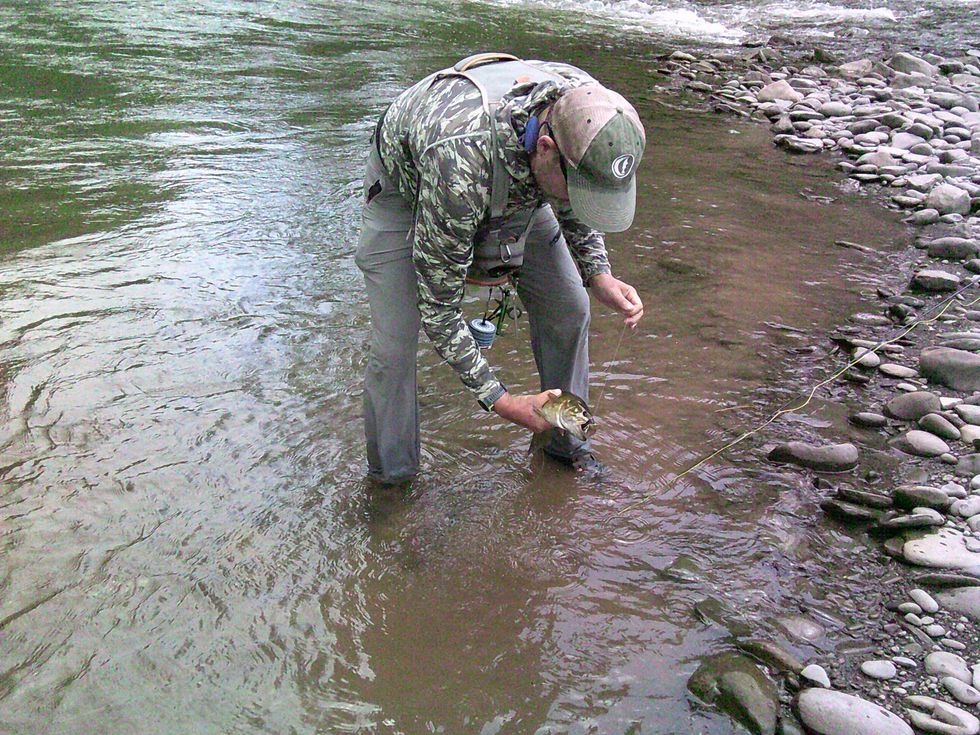
We hit a lovely stretch adjacent to the state campground on the Beaverkill, where I was pleasantly surprised by a couple of decent-sized brown trout that grabbed my Chubby Chernobyl in lieu of the nymphs and wet flies I had tied on a dropper.

This is why I prefer a dry-dropper rig, where the big bushy and highly visible dry fly serves as an indicator, to indicator rigs.

Indicators don’t have hooks in them.

My nomadic attorney Thos. showed up the next day, and we investigated a little blue line. I caught wild brookies and browns, half a dozen of each, and all on a size 10 Parachute Adams that was subsequently retired to the Chewed-Up Fly Hall of Fame. The white post was completely gone, and most of the tail. Makes me wonder just how picky these fish are, anyway.

Then it got hot.

Way up in my valley, it’s usually five to 10 degrees cooler than it is down in the cities of the plain.

Well, on the second day of the heat wave it was 102 in the shade. That means it was worse down below. I don’t know for sure because I didn’t go anywhere.

Instead I read Lee Child’s Jack Reacher novels and hydrated.

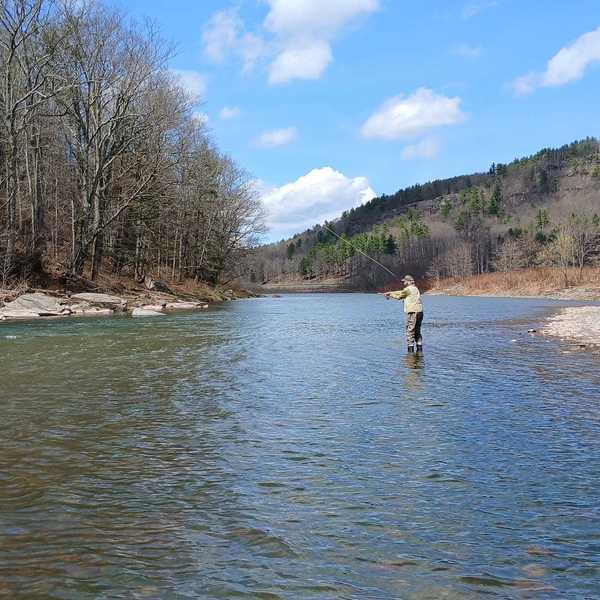
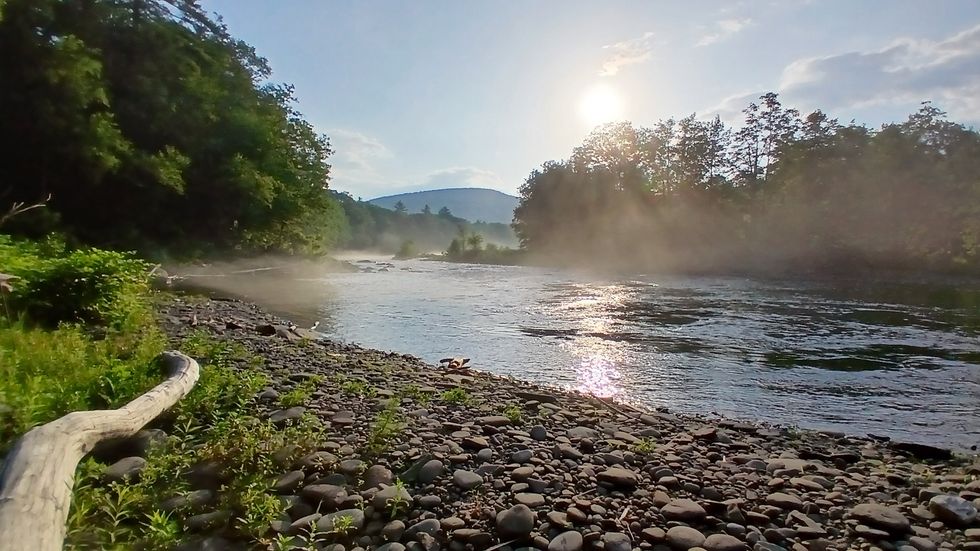
There were two smallmouth attempts, a stupid and futile effort at dawn at Chimney Hole on the Esopus, and an afternoon assault on the Schoharie in Prattsville.
Patrick L. Sullivan

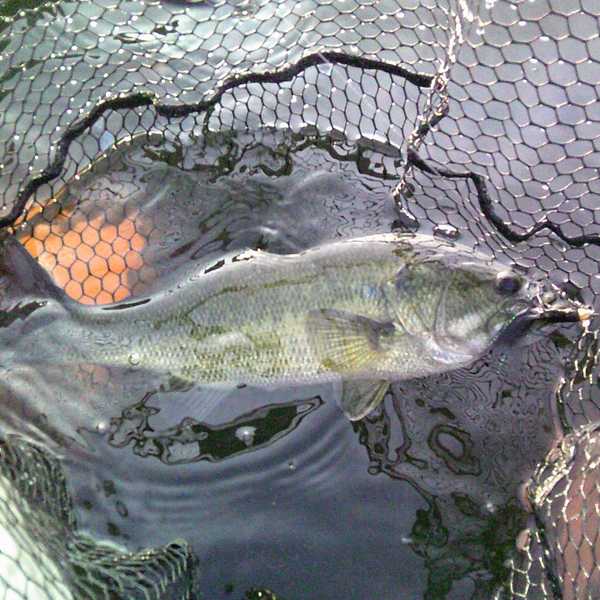
Just as the 2025 Colorado Rockies occasionally win a ballgame, Thos. outfished both Gary and yours truly on the Schoharie. The final score was one smallmouth to two compassionate releases to zilch, in the order specified above.

Long-time readers will want to know about the Bad Cinema lineup over this vacation. At the ancestral manor we are unafflicted by internet or cell phone signal, so we must watch DVDs.

We watched episodes of the 1941 Republic Pictures serial “The Drums of Fu Manchu,” as an appetizer before the main events, which were:

“Shatter,” a 1974 epic about an international assassin trying to make sense of Peter Cushing’s wind-swept hair; “The Big Bird Cage,” a 1972 women in prison flick that is thoroughly appalling in every possible way; “The Legend of Hell House” (1973) with Roddy McDowell pursing his lips and a revealing visual essay on the state of British dentistry; and “The Devil Rides Out,” a 1967 devil movie with Christopher Lee as the hero for a change.
Latest News

Living art takes center stage in the Berkshires

Contemporary chamber musicians, HUB, performing at The Clark.

D.H. Callahan

Northwestern Massachusetts may sometimes feel remote, but last weekend it felt like the center of the contemporary art world.

Within 15 miles of each other, MASS MoCA in North Adams and the Clark Art Institute in Williamstown showcased not only their renowned historic collections, but an impressive range of living artists pushing boundaries in technology, identity and sound.

Keep ReadingShow less
Persistently amplifying women’s voices

Francesca Donner, founder and editor of The Persistent. Subscribe at thepersistent.com.

Aly Morrissey

Francesca Donner pours a cup of tea in the cozy library of Troutbeck’s Manor House in Amenia, likely a habit she picked up during her formative years in the United Kingdom. Flanked by old books and a roaring fire, Donner feels at home in the quiet room, where she spends much of her time working as founder, editor and CEO of The Persistent, a journalism platform created to amplify women’s voices.

Although her parents are American and she spent her earliest years in New York City and Litchfield County — even attending Washington Montessori School as a preschooler — Donner moved to England at around five years old and completed most of her education there. Her accent still bears the imprint of what she describes as a traditional English schooling.

Keep ReadingShow less
Jarrett Porter on the enduring power of Schubert’s ‘Winterreise’
Baritone Jarrett Porter to perform Schubert’s “Winterreise”
Tim Gersten

On March 7, Berkshire Opera Festival will bring “Winterreise” to Studio E at Tanglewood’s Linde Center for Music and Learning, with baritone Jarrett Porter and BOF Artistic Director and pianist Brian Garman performing Franz Schubert’s haunting 24-song setting of poems by Wilhelm Müller.

A rejected lover. A frozen landscape. A mind unraveling in real time. Nearly 200 years after its premiere, “Winterreise” remains unnervingly current in its psychological portrait of isolation, heartbreak and existential drift.

Keep ReadingShow less
google preferred source

Want more of our stories on Google? Click here to make us a Preferred Source.

A grand finale for Crescendo’s 22nd season

Christine Gevert, artistic director, brings together international and local musicians for a season of rare works.

Stephen Potter

Crescendo, the Lakeville-based nonprofit specializing in early and rarely performed classical music, will close its 22nd season with a slate of spring concerts featuring international performers, local musicians and works by pioneering composers from the Baroque era to the 20th century.

Christine Gevert, the organization’s artistic director, has gathered international vocal and instrumental talent, blending it with local voices to provide Berkshire audiences with rare musical treats.

Keep ReadingShow less

Leopold Week honors land and legacy

Leopold Week honors land and legacy

Aldo Leopold in 1942, seated at his desk examining a gray partridge specimen.

Robert C. Oetking

In his 1949 seminal work, “A Sand County Almanac,” Aldo Leopold, regarded by many conservationists as the father of wildlife ecology and modern conservation, wrote, “There are some who can live without wild things and some who cannot.” Leopold was a forester, philosopher, conservationist, educator, writer and outdoor enthusiast.

Originally published by Oxford University Press, “A Sand County Almanac” has sold 2 million copies and been translated into 15 languages. On Sunday, March 8, from 3 to 5 p.m. in the Great Hall of the Norfolk Library, the public is invited to a community reading of selections from the book followed by a moderated discussion with Steve Dunsky, director of “Green Fire,” an Emmy Award-winning documentary film exploring the origins of Leopold’s “land ethic.” Similar reading events take place each year across the country during “Leopold Week” in early March. Planning for this Litchfield County reading began when the Norfolk Library received a grant from the Aldo Leopold Foundation, which provided copies of “A Sand County Almanac” to distribute during the event.

Keep ReadingShow less

Erica Child Prud’homme

Erica Child Prud’homme

WEST CORNWALL — Erica Child Prud’homme died peacefully in her sleep on Jan. 9, 2026, at home in West Cornwall, Connecticut, at 93.

Erica was born on April 27, 1932, in Doylestown, Pennsylvania, the eldest of three children of Charles and Fredericka Child. With her siblings Rachel and Jonathan, Erica was raised in Lumberville, a town in the creative enclave of Bucks County where she began to sketch and paint as a child.

Keep ReadingShow less
google preferred source

Want more of our stories on Google? Click here to make us a Preferred Source.

google preferred source

Want more of our stories on Google? Click here to make us a Preferred Source.