
Thank you!
Your support is sustaining the future of local news in our communities.

Tangled: Trout unlimited, bass optional

Tangled: Trout unlimited, bass optional

Eddie Curtis of New Jersey casually caught and released a Housatonic River smallmouth bass of modest size during a Trout Unlimited smallmouth bass event at Housatonic Meadows State Park Saturday, Aug. 16.

Patrick L. Sullivan

I moseyed down to Housatonic Meadows State Park late Saturday morning on Aug. 16 for a Trout Unlimited smallmouth bass event put on by the Mianus chapter.

“Wait a sec,” you say. “If it’s Trout Unlimited, why are they fishing for smallmouth bass?”

The answer is two-fold.

First, the Housatonic River in summer is primarily a smallmouth fishery. The water is too warm for trout but it doesn’t bother the bass much.The trout are hiding out in the thermal refuge areas and are off-limits until mid-September.

Second, the word “unlimited” suggests wiggle room.

When I rolled in there was a small pop-up tent with the words “Trout Unlimited” on it set up by the upper parking lot. Being a trained observer, I spotted this vital clue almost immediately.

There was a folding table under the tent. It was empty, but it seemed likely there would be food on it at some point.

Trained observers are also patient. I tabled the food question and motored down to the lower parking area, where I beheld half a dozen men with fly rods casting into the low, slow river with varying degrees of proficiency and enthusiasm.

The nearest to me turned out to be Eddie Curtis, who hails from southern New Jersey. “About 15 minutes from Philly,” he said.

Curtis was a fortuitous choice of subject. Chatty and easy-going, he embarked on an angling monologue that included adventures on salt and fresh water and an incisive critique of fish and game practices in his home state.

All the while he chucked lazy downstream casts. On about every tenth one, he hooked a smallish smallmouth bass.

I asked him what fly he was using. The answer -- a black Wooly Bugger -- wasn’t surprising. That’s a standard pattern for this kind of fishing. Almost a cliche.
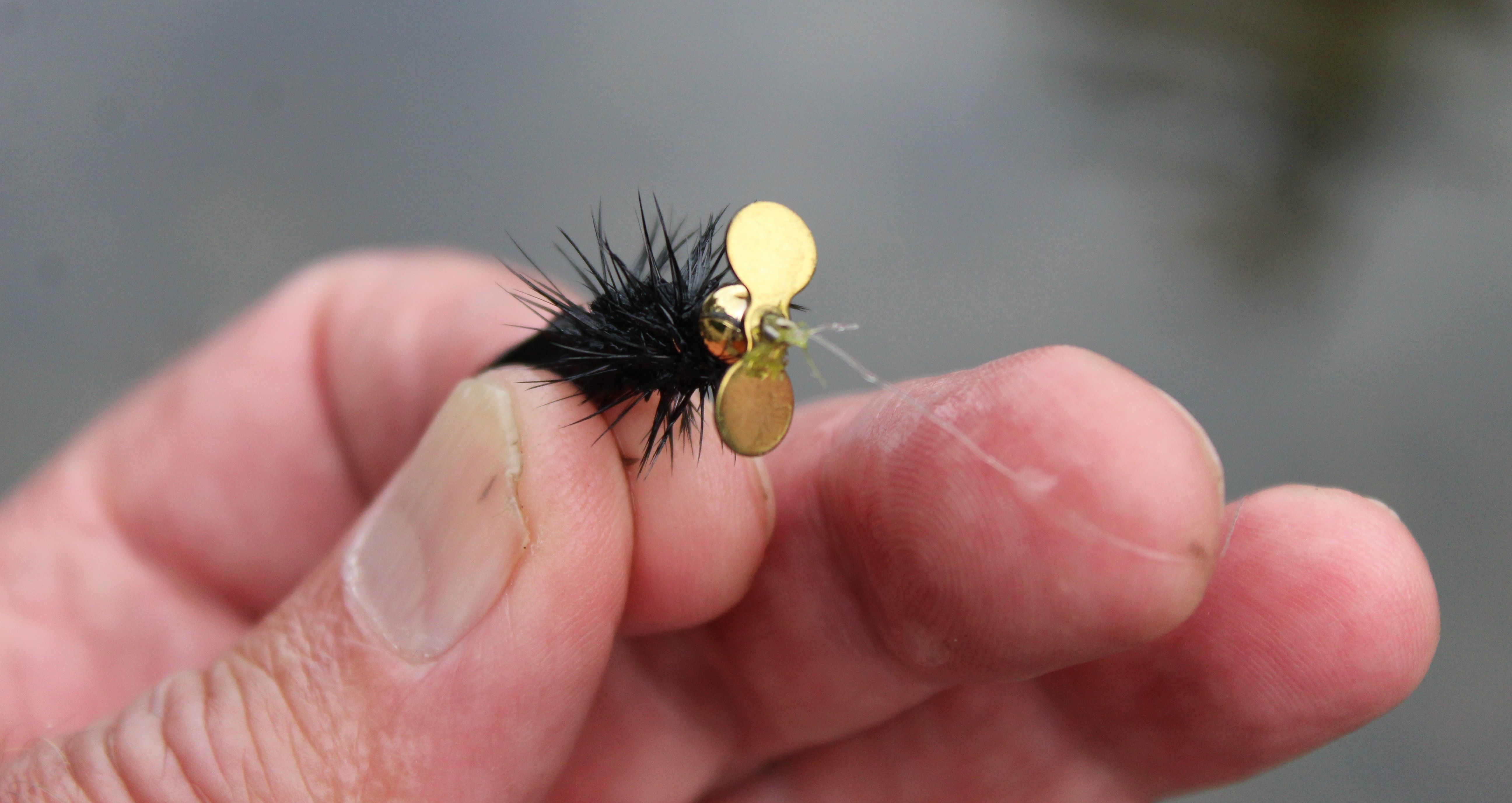
Curtis was using a black Wooly Bugger with an unusual feature — a little propeller or spinner.Patrick L. Sullivan

But this was different in that it had a little propeller attached just below the hook eye.

I last saw something like this in the mid-1990s in New Mexico, where a rustic saloon I just happened to be in had a small display case of standard trout flies with the same kind of propellers attached. The brand name was “Pistol Pete.”

Curtis said they work almost too well. He jerked his thumb behind him and said “He ties them for me.”

I resolved to catch up with “he” when everybody took a break.

I ambled back to the car and exchanged camera and notebook for rod and vest.

I tried four different flies, two surface and two subsurface, and failed to move anything.

Not anxious to perform the Walk of Shame, I tried a black Wooly Bugger, no propeller.

That did the trick.

Back up at the tent my finely honed instincts proved correct.Food had materialized, in the form of two giant submarine sandwiches, a couple of jumbo bags of potato chips, and sodas.

Gerald Berrafati was in charge of this. He is the chapter coordinator for the Mianus Trout Unlimited chapter, and he was talking a mile a minute about various dam removal and stream reclamation projects in his bailiwick.

Since the state of Connecticut east of New Hartford and south of Torrington is a complete mystery to me, I had only a vague idea where these places were.

But it sounded good.

Antoine Bissieux, who does business as “The French Fly Fisherman,” made a cameo appearance. Some years back he was with a couple of sports on the Hous in similar circs — warm, low, late summer -- and I swapped him a handful of mop flies for a sampler of his perdigon nymphs. If he remembered this he didn’t let on.

The six or eight of us at the tent did a number on the chow and talked some guff between bites. The sandwiches were good. So was the guff.

Warren Nesteruk of Southbury (I think) said his wife was giving him a hard time about having so many fly rods.

I asked how many he had.

“Fifteen,” he replied.

When I informed him I had something like 80 rods, he grew thoughtful, as if my awful example might buy him some space.

Then it struck him.

“You’re not married, are you.”

One loose end remained. I hate loose ends, and I wanted to find the fellow who added propellers to his flies.

But they had left.

So if you read this, Eddie Curtis of south Jersey, drop me a line. I’d like to find out if they really do work almost too well.

Latest News

Angry bees close Mudge Pond Beach

Angry bees close Mudge Pond Beach

Officials closed the Sharon town beach at Mudge Pond on Wednesday, July 15, after a fallen tree limb exposed a large beehive. The beach is expected to reopen Thursday.

Alec Linden

SHARON – The town beach on Mudge Pond closed on Wednesday, July 15, but the cause wasn’t the smoky haze drifting in from Canadian wildfires – it was angry bees.

According to Sharon’s Parks and Recreation Director Bryan Failla, a large limb fell from an old tree near the lifeguard stand overnight, exposing a hole that houses a large beehive. He said the town made the decision to close the beach Wednesday morning “out of an abundance of caution.”

Keep ReadingShow less
Millerton dressmaker forged path as early businesswoman
Mary Kisselbrack, left, and her husband, George.
Provided

If you’ve driven down Main Street in Millerton, you’ve passed the former home and shop of one of the village’s earliest female entrepreneurs. At a time when most businesses were owned by men, Mary Kisselbrack made a name for herself in the late 1800s as a well-respected milliner and dressmaker.

On April 11, 1891, train conductor George Kisselbrack purchased a 124-by-232-foot vacant lot at 54 Main St. and hired locally renowned builders Beers and Trafford to design what would become their home and Mary’s business.

Keep ReadingShow less
Wastewater project coming to fruition after decades of debate

Millerton’s business community will soon see the completion of a public wastewater system, addressing what local officials and business owners have called a major constraint on commercial development in the community for decades.

The $13.8 million project, which is expected to serve the core of the Village of Millerton and a commercial stretch of the Town of North East along U.S. Route 44, represents one of the largest infrastructure investments in the community in decades, and brings an end to calls for a sewer system that stretch back to World War II. Officials say the system will safeguard local waterways while creating a foundation for long-term economic stability.

Keep ReadingShow less
google preferred source

Want more of our stories on Google? Click here to make us a Preferred Source.

Millerton Moviehouse marks 120 years with structural upgrades

Wooden beams made from tree trunks comprise the load-bearing structure under Millerton’s Moviehouse.

Graham Corrigan

There are a handful of buildings that have stood the test of time over Millerton’s 175-year history. But if there’s one that stands out as a singular representation of the town, it’s the Millerton Moviehouse and its iconic clock tower.

Built in 1903 as a grange hall, it was soon converted into a movie theater with a second-floor ballroom. It was one of a handful of buildings that came to define the town in the following decades, standing tall across the street from the Episcopal Church and Millerton Inn, next to Terni’s, and up the hill from Millerton’s train station.

Keep ReadingShow less
Irondale Schoolhouse: a piece of living history

Ralph Fedele sits at a desk in the historic Irondale Schoolhouse, which he led the effort to relocate to downtown Millerton.

Aly Morrissey
“It was in dire straits. Right on the road, but beautiful. I remember thinking, ‘Wouldn’t that be a great building to move into the village?’” —Ralph Fedele

A one-room schoolhouse sits on Main Street along the Harlem Valley Rail Trail, offering an opportunity for locals and visitors to step inside a piece of living history.

The Irondale Schoolhouse that now sits in downtown Millerton was not originally located on Main Street. The building was first constructed in 1858 along what is now Route 22 in the Irondale section of town, defined by Irondale road and the Old Mill that still sits along Webatuck Creek. At the time, the schoolhouse was one of 14 that served the Town of North East’s children.

Keep ReadingShow less
New Water Department building expected by summer’s end

Millerton’s former Water Department building, ravaged by fire, as it awaited demolition in summer 2025.

Aly Morrissey

Nearly 18 months after a fire destroyed Millerton’s Public Works building, which housed the Highway Department and Water Department, construction is expected to begin within weeks on a new Water Department facility and pumphouse.

The new building would restore the village’s full water pumping capacity and allow officials to end the state of emergency declared after the fire. Village officials are also planning a separate Highway garage, with details of that project still being finalized.

Keep ReadingShow less
google preferred source

Want more of our stories on Google? Click here to make us a Preferred Source.

google preferred source

Want more of our stories on Google? Click here to make us a Preferred Source.