Fire damages second floor of Kent home, draws multiple fire crews

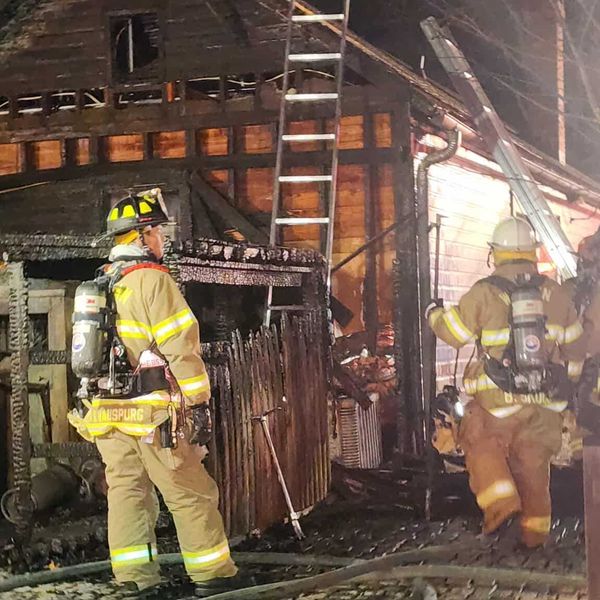
A fire at 190 Bulls Bridge Road in South Kent destroyed the second floor of the two-bedroom house.
Photo by Ruth Epstein


A fire at 190 Bulls Bridge Road in South Kent destroyed the second floor of the two-bedroom house.
SOUTH KENT – A fire broke out Saturday afternoon at a home on Bulls Bridge Road, causing extensive damage to the second floor but resulting in no serious injuries, according to the Kent Volunteer Fire Department.
Fire Chief Tim Sneller said firefighters received a report of a house fire at 190 Bulls Bridge Road at about 4 p.m. The department’s first engine arrived on scene approximately 13 minutes later.
Sneller said two occupants were treated at the site, as was one firefighter. The home is owned by Joseph Sario.
“We pushed up the stairs with a hose line in order to knock the fire down,” Sneller said. “It was a good save.”
Additional crews assisted with ventilation and salvage operations while also addressing overheating within the structure. Sneller said firefighters had no difficulty maintaining a water supply using tanker trucks.
The blaze was extinguished quickly. Kent firefighters were back at the firehouse by 5:30 p.m. The cause of the fire has yet to be determined.
Fire departments from Gaylordsville, Sherman, Warren, Cornwall, Northville, New Milford (Water Witch), Dover and Wassaic responded to assist at the scene.
“Even Pawling ended up at our firehouse,” Sneller said of the team effort.

Ruth Epstein
The Hotchkiss Library of Sharon kicks off its Summer Book Signing event with author signings and meet and greets.
SHARON — The lawn at the Hotchkiss Library was transformed into a literary wonderland Friday during the 28th annual Sharon Summer Book Signing event.
Twenty-four authors were seated under a large tent, greeting guests, discussing their work, and signing copies of their books, which were available for purchase throughout the event.
A new feature this year was a series of author readings, with seven writers sharing excerpts from their books and discussing their work with audiences inside the 133-year-old library.
First to be introduced was Scott Siegler, who serves on the nonprofit board of LJMN Media, which publishes The Lakeville Journal and The Millerton News. Siegler, an American television executive, media investor and Emmy Award winner, discussed his short story collection, “Mobsters in the Mansion,” describing it as a mystery with comedic overtones.
He focused on the main character named Bobby Weigel, who is one of three sons with the same name. “It’s loosely based on a guy I met,” Siegler said, adding the man was delusional and went to jail. “The story is about murder which wouldn’t have happened if [Gerald] Ford had not been president and Bobby Weigel wasn’t so stupid,” he said.
During the follow-up conversation, Siegler said, “I like stories with lots of pivots. You think you’re going in one direction, and it goes to another. The plot is, to some degree, less important than the characters. If a book doesn’t service characters, it’s pretty thin.”
Asked why he gave the three sons the name Bobby, Siegler said he knew boxer George Foreman, who named all his sons George, and he liked that idea.
He said he enjoys the short story form for its emphasis on condensation. “In some ways, they’re closer to a poem than a novel.”

Another speaker was Alex Wright, whose narrative history, “Empire of Ink: The Printers, Rogues, and Radicals Who Invented the American Newspaper,” traces the evolution of American journalism from the Revolutionary War through 1900.The book explores the legacy of smaller, forgotten newspapers, which he referred to as “untold history.”
Wright, a former journalist, said, “In some ways, the world we live in now is the way it was then. Now it’s easy for everyone to write, publish and create videos. The definition of what is community journalism is up for grabs.”
Another featured author was Anne Mackay-Smith, known locally as Anne Vance, who discussed her debut novel, “Death at Bittersweet Clearing: A Civil War Mystery.”
The setting is in Virginia, near where she was raised, and tells the story of a woman who has to keep the farm going while her husband is fighting in the war.
“She finds two bodies in the woods and then a mystery man appears,” Smith said. “Some people think it’s a war death, but she doesn’t think so.”
Smith, who wrote about finance and education for the Wall Street Journal, said, “I always wanted to write fiction, so I’m getting back to where I want to be.”
Asked if there is another book on the horizon, she gave a big smile, a clear impression that there will be another one coming.

Alec Linden
A speed camera is posted on Route 109 in Washington, the first Connecticut town to install the technology more than a year ago.
LITCHFIELD — The hot-button issue of speed cameras continues to draw mixed feelings from Northwest Corner town leaders as municipalities consider implementing the traffic enforcement technology to address rampant speeding in the region.
The Northwest Hills Council of Governments hosted an informational session for officials on July 29 with Dacra Tech, a firm that has rolled out camera installations in multiple towns and cities across Connecticut since legislation passed in 2023 that first legalized their use. Brandon Knox, the company’s business development director, said that from his observations, Connecticut could benefit from slower driving.
“I probably see at least three to four crashes every time I’m here,” he said. He explained that the state’s winding, narrow roads and complicated intersections make for more dangerous driving than on the flatter and straighter roads of Illinois, where he and the company are based.
Since the law was passed, residents in the Northwest Corner have demonstrated a mixed response to the technology. A proposed ordinance to install two cameras in Kent was soundly defeated by voters in early 2025, with nearly 400 votes against and 100 in favor.
Elsewhere, town leaders have hesitated to push the systems, citing a lack of public enthusiasm, operating costs and residents’ concerns about data privacy and overburdening low-income drivers.
Salisbury, Falls Village, North Canaan and Cornwall are not currently pursuing speed cameras. Kent First Selectman Eric Epstein said that given the outcome of the 2025 vote, he had no immediate plans to revisit the issue.
Sharon recently completed a study that found widespread speeding at locations across town, but First Selectman Casey Flanagan has said the town is not yet prepared to move ahead with a speed camera ordinance.
Meanwhile, Washington, just south of Kent, was the first town in the state to implement a speed camera program. The town rolled out the first of its three cameras in January 2025 after receiving approval by the state Department of Transportation the previous year.
A year and a half later, Washington remains the only municipality in Litchfield County with active cameras, though Winchester is in the final stages of installing two cameras on Route 44 as it turns into Main Street in Winsted. Winchester’s plan was approved by the DOT on April 9.
Litchfield has held two public meetings to discuss a potential speed camera program, including an informational presentation on the technology in January. However, the town has not adopted an ordinance or received state approval to install the devices.
First Selectman Denise Raap said the community appears evenly divided on the issue.
The question will return to residents at a town meeting in late September, where voters will decide whether the town should begin drafting a speed camera ordinance. If approved, the proposed ordinance would still require additional public hearings and another town vote before it could be adopted.
Knox said that in Washington, which is a client of Dacra’s, citations totaled between 150 and 200 per day after cameras were installed, but are now down to about 50.
Dan Jerram, first selectman of New Hartford, asked if the data could be skewed. “Does it change behavior a quarter mile down the street after they pump the brakes at that one location?”
Knox said the goal is to strategically place cameras in key locations to encourage drivers to slow down both at those sites and throughout town.
The town of Fairfield in Fairfield County, for example, placed 16 cameras all within school zones around town. The program generated approximately $1.3 million in revenue in June, the first month it actively issued citations to drivers. Officials expect that figure to decline as motorists become more familiar with the cameras.
The issue of revenue as part of a speed camera program has been a central focus of public forums across the state as the technology rolls out.
The 2023 statute, known as Public Act #23-116, stipulates that first-time violations must not exceed $50, while all subsequent violations carry a maximum $75 fine. Knox explained that Dacra takes a $13.50 flat fee per ticket, regardless of the amount.
The statute also declares that revenue generated from speed cameras must be used exclusively for road safety enhancements.
Warren First Selectman Gregory LaCava, who attended the July 29 meeting, said the town is evaluating the program and believes it could be a “win-win” for Warren. If approved, the town plans to dedicate citation revenue to a road improvement fund.
Before any cameras can be installed, however, state law requires municipalities to adopt a local ordinance, which includes holding a public hearing and putting it up for a town vote.
Warren has not yet reached that stage, but LaCava said a recent public presentation and discussion at Town Hall was well received. Knox, who has worked with LaCava on the initiative, said growing frustration over speeding has fueled local interest.
“Eventually people got fed up that people were speeding,” Knox said.
Knox also clarified that speed camera citations are civil violations, unlike citations issued during a traffic stop. They do not result in driver’s license points or affect insurance rates.
Before a citation is issued, each potential violation is reviewed by a trained processor from Dacra and a designated municipal employee to ensure it contains sufficient evidence and meets the legal requirements for enforcement.
That collected data, which Knox said is limited to the make and model of the car and the plate number, “resides and stays within this one system,” he said, noting that Dacra does not share data outside the organization.
Knox added that it is up to towns to decide how they want to implement their ticketing system. Some opt to not charge the same vehicle twice in a day, while others may only issue violations every two days, or once a week.
Still, Barkhamsted First Selectman Meaghan Cook questioned how automated enforcement might function effectively in small Northwest Corner communities that are built on direct relationships.
“There is a personal accountability to a resident trooper and disconnected accountability to a camera,” she said.
Christian Murray
NORTH CANAAN — North Canaan Selectman Brian Ohler resigned last week after a five-month medical leave, saying he could no longer justify remaining absent while the town’s three-member Board of Selectmen continued operating with only two active members.
Ohler’s resignation, effective July 31, follows a medical emergency in February that initially appeared to be a stroke. Although he has undergone extensive testing, doctors have not determined the cause, he said, and the search for answers continues.
“I have come to a very hard decision,” Ohler wrote in a Facebook post after filing his resignation. “It would be selfish of me to remain on such a prolonged medical leave when the residents and businesses of the Town of North Canaan deserve a full and active Board of Selectmen.”
He thanked residents for their support throughout his recovery and said he hopes improved health will allow him to return to public service.
“My love for the Town of North Canaan and the good people who also call it home is eternal,” he wrote. “The prospect of returning once again to elected municipal service in the future will remain the fuel and strength that lives within me.”
Ohler first announced his leave in March after describing symptoms that included double vision, slurred speech and paralysis on the right side of his body. While neurologists have not identified a definitive diagnosis, he has said physicians are also examining whether traumatic brain injuries sustained during his military service in Iraq and Afghanistan may have contributed to his condition.
Ohler notified First Selectman Jesse Bunce on Thursday, July 30, that he was stepping down.
“I wish him the best in his health, and I hope he can find out the cause of his issues,” Bunce said.
His absence had left the three-member Board of Selectmen operating with only Bunce and Selectman Melissa Pinardi. Although the two-member board could continue conducting business since it still met quorum requirements, the arrangement left little flexibility and created the potential for deadlocked votes.
“It’s a tough thing to run the town with two people,” Bunce said. “I do appreciate Brian giving us his resignation so we can move forward.”
Pinardi said it must have been difficult for Ohler to step down.
“Brian put his whole heart and soul into the town,” she said. “I know it was very hard for him to come to that decision. But he didn’t feel like he could give 100% right now.”
Ohler could not be reached for comment.
Replacement process begins
With Ohler’s resignation now official, town officials have begun the process of filling the vacancy for the remainder of his term, which was to end in November 2027.
Under Connecticut law, the town has 30 days from the date of the vacancy to appoint a replacement, according to Town Attorney D. Randall DiBella, a partner at Cramer & Anderson, who represents several towns. The appointment will be made by a vote of Bunce and Pinardi.
Since Ohler was elected as a Republican, DiBella said his replacement must be either a Republican or an unaffiliated voter. In this case, the Republican Town Committee is likely to recommend a candidate for the board’s consideration.
However, if Bunce and Pinardi cannot agree on an appointment, DiBella said the town’s elected Republican officeholders would choose the replacement.
Bunce said he plans to ask the Republican Town Committee to recommend a candidate and noted that Ohler did not suggest any potential successors before resigning.
Residents who disagree with the appointment may circulate a petition to force a special election. However, DiBella said that in his 40 years of representing municipalities, he has never seen a vacancy filled that way.
Long record of public service
Ohler has spent much of the past decade in public service. He represented Connecticut’s 64th House District from 2017 to 2019, before being defeated by Democrat Maria Horn by a thin margin in November 2018, losing by 61 votes. In November 2023, he was elected first selectman in North Canaan, succeeding Charles Perotti, who did not seek re-election.
He served one term before narrowly losing his bid for re-election to Bunce in November. Bunce prevailed by just two votes, 572-570, following a recount. However, Ohler was re-elected to the board of selectmen, just not as first selectman.
Beyond elected office, Ohler served 12 years in the U.S. Army as a military police officer, volunteering for three combat deployments — two in Iraq and one in Afghanistan — before receiving an honorable discharge in 2013.
A lifelong fifth-generation North Canaan resident, Ohler comes from a family with a long history of service to the town.

Want more of our stories on Google? Click here to make us a Preferred Source.
Lakeville Journal
The following information was provided by the Connecticut State Police at Troop B. All suspects are considered innocent until proven guilty in a court of law.
Stop and Shop larceny
Early in the afternoon on July 29, troopers arrested David Whitman, 80, of Colebrook for the theft of groceries from Stop and Shop in North Canaan. After receiving the call from the store, troopers followed Whitman’s vehicle as he drove away on Route 44 and arrested him for 6th degree larceny. He was released on a $500 non-surety bond and is scheduled to appear at Torrington Superior Court on Aug. 13.
Parked car rear-end
On July 29, a Rivian R1S belonging to Amanda Wilson, 50, of New York City was parked on Route 44 near Town Hall in Salisbury. At approximately 3 p.m., a Ford van belonging to Kenneth Ball, 72, of Creswell, Oregon parked directly behind accidentally rolled into the rear of her vehicle, which was unoccupied. Both vehicles suffered minor cosmetic damage.
Single vehicle boulder accident
On the evening of July 29, Michel Desousa, 22, of Naugatuck was driving south on Route 63 in Falls Village when his Honda Civic drifted off the roadway, striking a boulder. After the impact, the vehicle flipped onto the driver side and slid across the roadway, where it ultimately impacted the embankment on the other side of the road and flipped back onto its wheels. Desousa evaded the scene, and at the time of report it was unknown if he sustained any injuries.
Evading accident scene summons
Troopers were dispatched at approximately 6:45 p.m. on July 29 to the report of a motor vehicle accident on Route 63 near the intersection with Cobble Road in Falls Village. Upon arriving, troopers found that the driver had evaded the scene, but ultimately made contact with Mauricio Souza, 45, of Naugatuck, who admitted to being the operator of the vehicle. Souza was issued a misdemeanor summons for evading responsibility, failure to maintain lane and operating a motor vehicle without a license. Souza was released with a promise to appear at Torrington Superior Court on Aug. 12.
Failure to yield crash
At approximately 7:45 p.m. on July 29, two vehicles collided at the intersection of Route 44 and North Elm Street in North Canaan. Sherrie Heath, 61, of North Canaan was attempting to make a right turn onto North Elm Street from Route 44 in a Toyota Camry but did not yield to a Ford F350 already in the intersection, driven by Walter Hewins, 70, of Ashley Falls, Massachusetts. The two vehicles collided, and both sustained functional damage. No injuries were reported from the incident.
The Lakeville Journal will publish the outcome of police charges. Send mail to P.O. Box 1688, Lakeville, CT 06039, Attn: Police Blotter, or send to editor@lakevillejournal.com.
Patrick L. Sullivan
Cristin Rich, left, and Brenda Fife discuss end-of-life care at the Scoville Memorial Library on July 28.
SALISBURY — Every adult should have an advance directive — a legal document that outlines future healthcare wishes — regardless of age or health, according to two end-of-life care professionals who spoke at the Scoville Memorial Library on Tuesday, July 28.
Cristin Rich, executive director of East Mountain House in Lakeville, a residential hospice that provides end-of-life care, joined Brenda Fife, a certified dementia practitioner and admissions coordinator at Geer Village in North Canaan, to discuss the benefits of the “Five Wishes” advance directive. Together, they encouraged attendees to begin conversations about their healthcare wishes before a crisis occurs.
An advance directive is a legal document that specifies what medical treatments a person wants if they become incapacitated and unable to make those decisions. It also typically designates someone to make healthcare decisions if needed on the person’s behalf.
Fife said advance directives are not just for the elderly or the sick.
“Every adult over the age of 18 should have one.”
Meanwhile, Rich added: “If you don’t make choices, the choices are made for you.”
The pair explained that there are five common types of advance directives: healthcare proxy, living will, POLST/MOLST (physician orders for life-sustaining treatment and medical orders for life-sustaining treatment), a dementia directive, and the Five Wishes.
The Five Wishes combines elements of those directives into a single document written in plain language that also addresses emotional, personal and spiritual preferences.
Rich and Fife walked the audience through each of the document’s five sections.
The first wish focuses on choosing a healthcare proxy — the person who will make medical decisions if the patient is unable to do so.
Fife said the ideal person is someone who will remain calm under pressure. “You should also name an alternate as well,” in case something happens to the first person.
The proxy “does not speak for you unless you are unable to speak for yourself.”
Fife said when picking the person to be the healthcare proxy, the question to keep in mind is “who is the best person to follow your wishes?”
The second wish addresses the kind of medical treatment a person wants or does not want if they are unable to communicate, such as whether they would want life-sustaining treatment or other medical interventions.
Fife added that this is not the same thing as a Do Not Resuscitate (DNR) order, which is issued by a physician. She said in general a healthy person cannot get a DNR order, and Rich added that a DNR “should not be in contravention of your wishes.”
The third wish focuses on comfort care.
Fife said this comes down to whether a person would prefer to have pain relief treatment that leaves them sleepy or if a person would rather be alert but experience more pain.
Rich noted that situations can change. “We had a patient who wanted to be awake and alert until the family members had been there. After that, pain medication was ok.”
She added that there are options other than opioid pain medications. “Distraction can be effective,” Rich said.
The fourth wish addresses how a person wants to be treated during their final days.
Fife said some patients prefer to have music playing, or enjoy flowers, or appreciate people coming to pray. It all depends on the individual.
“Me? If I’m not feeling well, I don't want people around me,” she said.
During the discussion, an audience member asked whether East Mountain House allowed pets.
Rich said pets are welcome as long as certain conditions are met. If the pet gets along with the resident therapy dog and can’t escape, then it’s usually okay.
“It’s not a hard yes or no.”
The fifth wish allows people to communicate what they want their loved ones to know.
“This is the most emotional wish,” Fife said. Some people write letters of gratitude or forgiveness.
Rich said that personal messages like those are what distinguish the Five Wishes document from more traditional legal forms.
“Sometimes these are words that family members will remember forever,” Rich said.
People interested in completing a Five Wishes document should first determine whether it is legally recognized in their state.
Rich said in 46 states the Five Wishes are legal, and in four more states (including Connecticut and New York), the Five Wishes require some additional legal provisions.
The pair also said it is important to keep the document up to date. One audience member said she prepared a Five Wishes document only to pull it out some years later and realize the proxy she had designated had died.
Fife encouraged people to revisit the document as life circumstances change.
“So don’t just put it in a drawer.”
Annie Prinz
Writers seek and share advice during the third and final workshop for aspiring children’s book authors and illustrators at the Scoville Library July 29.
SALISBURY — Around a table in the Wardell Room at Scoville Memorial Library, an assortment of characters and stories began to take shape Wednesday, July 29, as six aspiring children’s book writers and illustrators gathered for a third and final workshop session.
Titled, “Lights! Camera! Action! A Theatrical Approach to Writing and Revising Picture Books,” the three-part workshop was led by award-winning author Caroline Nastro.
The participants’ discussion revealed just how many decisions go into each page, and each author and illustrator had the opportunity to reflect on the many different steps involved in making a children’s book.
Topics included how to keep an illustrated character’s appearance consistent, how research can strengthen a story and how familiar subjects can be approached from an unexpected angle.
The final session focused on sharing work, offering feedback and developing ideas in a supportive environment. Participants arrived at different points in the creative process. Some had begun matching their words with images, while others had created sketches or were still deciding how to bring their ideas to life.
As the group offered feedback on Winsted artist Cheryl Ann Bartley’s work, she responded lightheartedly.
“I’m an artist; nothing hurts me,” she said.
Throughout the workshop, participants were encouraged to borrow techniques from theater and film to better understand their stories. During the first session, writers created a “toolbox” of ideas and techniques that could guide their work. The second session invited them to imagine their stories as film sequences, considering what readers would see on each page alongside the written text.
During the final meeting, participants listened to each other’s stories and tried to consider them from a child’s perspective. Rather than concentrating on whether a story made sense to an adult, the group considered what might capture a young reader’s attention, what emotions the story could evoke and where its characters could be developed more fully.
Nastro’s own work combines her experience in literature and theater. She studied at Stanford University, the Yale School of Drama and the Université de Paris-Sorbonne. Her debut picture book, “The Bear Who Couldn’t Sleep,” was named a Bank Street Best Picture Book of the Year. One of her later books, “Outside Amelia’s Window,” received the same recognition in 2023.
By the end of Wednesday’s session, no two participants had reached precisely the same point in their process. Yet each left with new questions, suggestions and possibilities.

Want more of our stories on Google? Click here to make us a Preferred Source.

Want more of our stories on Google? Click here to make us a Preferred Source.