Journalists decode modern-day news media landscape

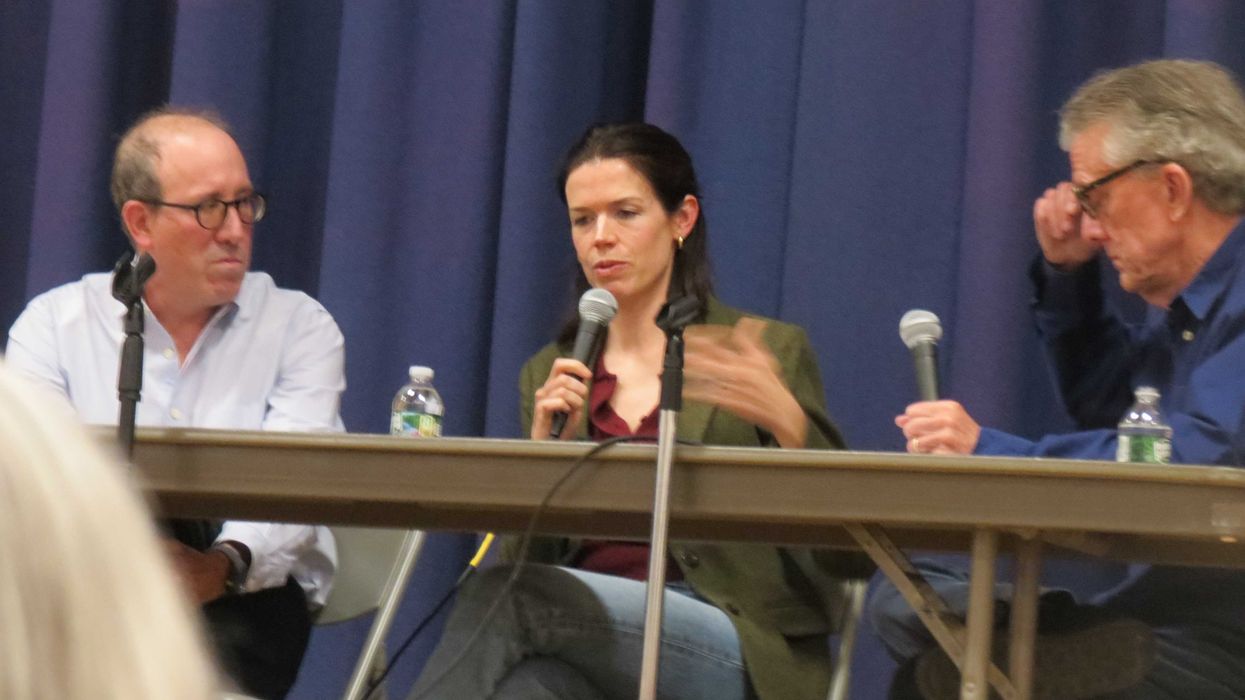
From left, journalists Joel Simon, Charlotte Howard and Kurt Andersen speak about the news industry at a program sponsored by the Cornwall Library on Saturday, Oct. 25.
Ruth Epstein

From left, journalists Joel Simon, Charlotte Howard and Kurt Andersen speak about the news industry at a program sponsored by the Cornwall Library on Saturday, Oct. 25.
CORNWALL — Three prominent journalists shared their outlook on the state of the news industry on Saturday, Oct. 25, at a talk sponsored by the Cornwall Library, offering a mix of pessimism and hope about journalism’s future.
The three panelists included Kurt Andersen, a bestselling author and regular contributor to The New York Times and The Atlantic, who also co-founded Spy magazine; Charlotte Howard, executive editor and New York bureau chief of The Economist, who also co-hosts the magazine’s Checks and Balances podcast; and Joel Simon, founding director of the Journalism Protection Initiative at the Craig Newmark Graduate School of Journalism at City University of New York, who is the author of four books and writes frequently about media issues for a range of publications.
When Andersen asked the other panelists what they were reading, Simon began by urging the country to take back control and not be passive consumers of information. “We have to have news sources,” he said. “And for me, it’s The New York Times. I find some criticism with it, but I still read it first. But once grounded, it can be fun to be on social media.”
Howard recalled a time when she was responsible for covering a region stretching from North Dakota to Ohio, noting the stark contrasts in how liberal and conservative outlets approached the news. “You have to pay attention not just to mainstream media, but other outlets as well,” she said.
Andersen added, “Opinion without fact is a big mistake.”
Simon noted that his generation could decipher opinion from fact, while Howard said different generations consume their news from different sources. She said at The Economist, they source plain, spoken accurate information. Andersen said he’s not sure he buys the theory that young people are not at all interested in news.
Turning to the topic of podcasts, the trio agreed they are popular. Andersen said they are basically comprised of long conversations that young people enjoy listening to. “I see great hope in them.”
Howard said she finds a wealth of podcasts to be wonderful, but cautioned they have a potential for problems if they are made up of commentary and not factual reporting.
Asked about the emotional benefit of seeking out news, Howard said people are looking for some comfort in chaos, while others want to know where the world is heading.
Simon said people base their news assumptions based on the community from which they come. “Part of it is the social community that we want to be part of and be accepted in,” he said. “Also there is a resurgence of news avoidance; a high level among young people.”
Howard broached the subject of click bait, noting that papers know if they write it one way, they’ll get people to come back. “We need to be level-headed; sensationalizing news is a downer. That’s our strategy at The Economist. Not tugs.”
Andersen chided the Republican party, saying many of its members pay such little attention to facts, pointing out such fallacies as Portland is burning down, he asked what does the media do?
Howard responded, noting that “During Trump’s first term, his lies were the news. This term his actions are the news. It’s about how open he is; not pretending. It’s an expansion of presidential power. He’s moved beyond truth and is redefining his power.”
Simon said he finds the blowing up of boats to be terrifying and what that can lead to. He urged the media to rally their communities. “Do your job. Defend your right as an institution. Journalists have the same rights all citizens have. They are under assault.”
During the comment period, one woman said she wanted to know what is not being reported. Howard said investigative reporting is very expensive. “I think most things are being covered, but there is so much out there.” Simon said such reporting is demanding, rigorous and time-consuming. “But we need more.”
When talking of Trump, Simon said, “I’ve never seen anyone more hungry for publicity. He has that strange, unending desire to be the star of the show.”
Howard said she both agrees and doesn’t agree with that. “Trump makes people feel they’re understood. But he couples it with animus. All his policies are horrible and don’t help him. His popularity is very low. But he is successful in driving the news and causing reactions.”
Simon said there’s a belief that if people knew the truth, they’d change their perspective. “I don’t think so.”

The Community Closet at HVRHS is open for students to take clothes for any reason during the school day.
What started with one unexpected donation of clothes has grown into a quietly impactful resource for all students at HVRHS: the Community Closet. Now located in a spacious area above the cafeteria, the closet offers free clothing to any student for any reason.
The idea began a few years ago when a community member reached out to the former superintendent wondering if anyone at the school could benefit from used clothing that would otherwise go to waste. The superintendent then got in contact with Rachel Novak, the school social worker. “Once I had all those bags of clothes in my room, I was like, ‘I should put this in a space,’” Novak said. Her simple idea eventually became a full-sized closet accessible to all students.
From the beginning, Novak envisioned the closet as an inclusive space. “It’s open to anybody, it’s not just based on economic needs,” she said. Sustainability also plays a role. “Thinking about the environment, some students like to thrift and just get clothes that way,” Novak said.
After the initial donation, contributions continued to grow. “I reached out to our staff members and faculty,” Novak said. The most consistent donations come from the faculty at HVRHS and a few community members who learned about the closet. Finding teenage-appropriate clothes has been a challenge. “I get a lot of donations that are nice, but I don’t think teenagers would want to wear them,” Novak said.
Another ongoing obstacle has been awareness. Many students don’t know the closet exists at all. “That’s been the hard part,” Novak said. “Getting it out to the wider community of the school.” Novak is looking for students and staff to spread the word. “It helps because our school nurse knows and other faculty members,” she said. “When they know a student needs something, they just bring them up.”
Looking ahead, she hopes to promote the space more actively. “When we come back from this break, I do plan to … get fliers and all that up and going,” Novak said. There may even be an upcoming expansion — she has discussed the possibility of turning part of the area into a food pantry. “That would be more of a need-based system for students,” she said. “But right now, promoting it is where I’m at.”
The Community Closet is well-stocked currently. “Just because of the amount of clothes I have, I’m not accepting any more donations until I clear some stuff out,” Novak said. She is still willing to make room for more fashionable, teen-friendly items donated by students. “That way I’ll have more teenager approved clothes.”
Above all, she wants students to know that no one is limited to using the space. “Sometimes there’s a stigma around it … like, ‘I don’t need help. I don’t want to take away from anybody else that may need it,’” Novak said. Due to the amount of clothes, students should feel welcome to use the closet for any reason. Some students even grab items last minute for sports and activities. “It’s important for kids to know it’s for everyone.”
Whether a student wants to thrift clothes sustainably, forgot to pack clothes for an after-school practice, or is in need of a new outfit, the Community Closet is a resource for all.
Sophomore Eliana Lang enjoys her Housy Shack cookie.
Now in its second year, the Housy Shack is a hit among students. The special education department-run store that sells warm cookies, drinks and other snacks to students and teachers draws people to a room in the back hallway every time it’s open.
The smell of warm cookies welcomes visitors to the store with snacks, drinks and even Housy merchandise for sale. The cookies are definitely the favorite, sometimes lines go out the door to get one before they sell out.
The cookies are so popular that the store had to increase prices from 50 cents to a dollar and implement a four cookie per person maximum. The Shack sells about 40-100 cookies per day and has about 20-60 HVRHS customers visiting per day.
Julie Browning and Heather Strid, two of the HVRHS faculty members that help run the Shack, said their goal was to create real-world job experiences as well as real-world shopping experiences for students at HVRHS. “Learning the skills to work in the world can be taught in a classroom, but the lessons are more meaningful and valuable when they are applied in real work situations, which is what we create through the school store,” Browning said.
The original purpose for the store seems to be working, as several students are learning important skills. Students said the store taught them skills like counting money, checking inventory and cleanliness along with social skills and customer service that could help in the professional world after high school.

As the store quickly became a hit, organizers were faced with the challenge of finding funding. “When we started planning to start the school store two years ago we needed money to buy equipment, supplies and food to start it up but were not sure how to get it,” Browning said. “Mrs. Strid came up with the idea of applying for a grant from the 21st Century Fund to help us get started and they were so generous.” That grant has been crucial to the success and growth of the school store.
Not only does the Housy Shack benefit the special education department, students said it fosters a sense of community throughout the school. “School store cookies are my favorite thing ever. They brighten up my day,” said Eliana Lang, a sophomore at HVRHS. Dayana, one of the student staffers at the Housy Shack, said her favorite part of working in the school store is when students come in to make purchases. She enjoys talking to them and ringing up their orders on the cash register. The Housy Shack brings people together and offers the opportunity for students to connect with each other.
As the school year continues, the members of the school store look forward to expanding their inventory by creating and selling a variety of Housy merchandise — t-shirts, sweatshirts, water bottles, and more. “I have had several students put in requests for certain hats, key chains, etc. … so there will be more of that to come,” Browning said. Last school year, profits were all invested back into the school store. “This year we are hoping to make more of a profit and will look to use the money that we make for field trips, outings as well as opportunities to donate and give back to the community,” Browning said. They also would like to use the school store to fundraise for other causes. “Right now we are collecting donations for The Little Guild Animal Shelter, so if anyone has pet supplies they would like to donate please drop them off in exchange for a cookie,” Browning said.