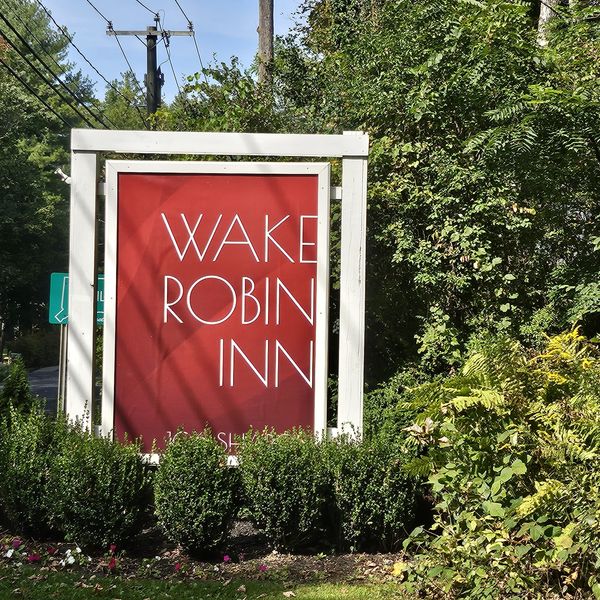
SALISBURY — Despite a difficult final year marked by the contentious Wake Robin Inn application, longtime Planning and Zoning Commission Chair Michael Klemens said he looks back with pride on 15 years of work to safeguard Salisbury’s livability, affordability and ecological health. But he emphasized that the town’s challenges are far from over as he steps down.
“Salisbury is one of the most beautiful, biologically diverse towns in the state,” Klemens told The Lakeville Journal last week. Nevertheless, he added, “We have tremendous pressures.”
Klemens, who had formally announced his retirement at the Nov. 3 P&Z meeting — two years before his term was set to expire — is currently in Tucson, Arizona, where he plans to remain for at least a year.
While the past year — his 19th since joining the Commission as an alternate in 2006 — was clouded by controversial applications to expand the Wake Robin Inn, he maintained his decision to resign was primarily personal.
A move to the desert
In his resignation letter, Klemens wrote that the Aradev applications, which pertained to the proposed Wake Robin expansion, had “unleashed, from certain individuals within our community, a level of vitriol and bigotry that was, in my experience, unprecedented.”
While the unpleasantness had expedited his move, he said that he had long been considering a life change to account for health issues and housing difficulties he’d been experiencing in Salisbury.
“At this point in my life, I had to do what was best for my well-being,” he said. He noted that the humid, often chilly climate of the Litchfield Hills has aggravated various joint issues, which have been compounded by chronic Lyme Disease he’s had since the 1970s. Plus, as a herpetologist — a biologist of reptiles and amphibians — Klemens said the move brings him closer to a “whole new professional circle” of wildlife and plant experts.
Additionally, the desert lets him pursue his longtime passion for succulents, an interest he developed while working in Tanzania as a MacArthur Fellowship–funded research fellow with the American Museum of Natural History, where he has been associated since 1979. His work there, done in partnership with government officials and the University of Dar es Salaam, aimed to broaden biodiversity studies in East Africa beyond “the animals that tourists came to see,” he said.
Zoning as balance
That same holistic outlook carries into his philosophy of zoning, in which no one element of town planning should be weighed without being balanced with other important considerations.
Klemens said that across his career, which includes positions with the Wildlife Conservation Society, The Cary Institute of Ecosystem Studies, Adirondack Wild, Scenic Hudson, the Connecticut Siting Council and his own private green development consulting practice, among other roles, his approach to land use has “always been about balancing human needs with a healthy environment.”
Among those needs is diversified and affordable housing, which, although a major focus of Klemens’s while on the Commission, was ultimately one of the contributing factors to his leaving town.
“Salisbury is not the Salisbury that I knew 20 years ago,” he said, referring to affordability.“It’s very, very difficult to find reasonably priced housing.”
He pointed to the “Poland Report,” a 2010 study by planner Donald Poland, which concluded that Salisbury’s land-use pressures more closely resembled those of “very wealthy towns in southwestern Connecticut” than of a typical rural northwest community. “And the real estate has only gotten much more valuable in the 20 years I was serving on the Commission,” he added.
“I think basically we have to really think about a community that is welcoming as a place for many different types of people,” Klemens said, emphasizing that beyond strictly “affordable” designated options, a diversified market should account for multi-generational housing and residences for seniors, too.
Tenure highlights
While the continued housing struggle in town was a factor that contributed to his departure, Klemens maintained that some of his high points on the Commission were breakthroughs in bringing more affordable options to town.
The addition of two housing overlay districts in downtown Salisbury and Lakeville to the town’s zoning regulations in 2019 was a breakthrough, Klemens said. He is also proud of his Commission’s close and productive cooperation with the Salisbury Affordable Housing Commission since its inception in 2010.
The newly updated Plan of Conservation and Development, which was adopted late last year after painstaking development and editing by P&Z and the Land Use Office, further encodes the town’s commitment to housing affordability, Klemens added.
Overall, though, Klemens expressed that his legacy is best defined by his role in building the “special development of an independent land use office” that is staffed by “two very, very skilled individuals,” referring to Land Use Director Abby Conroy and Land Use Technical Specialist Miles Todaro. But the volume of work required of them is comparable to that of a larger town with 4-5 employees in the land use office, said Klemens: “They need more assistance.”
An appeal to courtesy, participation
As a final note, Klemens advocated for civility and public participation as Salisbury continues its march into the future.
“I think people should be kind,” he said. “Think twice before going after the Board of Selectmen, the Planning and Zoning Commission, the Wetlands Commission. All these people work very hard. They may not be perfect, but they’re taking on responsibilities that a lot of people just don’t want to do.”
He encouraged younger people who may be put off by drama and controversies to view public service as an opportunity to make a positive change: “Despite all the nastiness and the battles, at the end of the day it’s an incredibly satisfying thing to try and make where you live a better place.”
A new panel of executives will be voted in during P&Z’s Dec. 10 meeting.