

When I got my first Standard Poodle, years ago, I’d asked the breeder for a black female with a quiet disposition. She gave me the calm and lovely Beedle, from a bloodline known for that trait. Later I bred calm Beedle and kept her calm daughter, Millie; after Beedle died I got Lacey, from the same line. Lacey was a calm alpha; when I drove her home she lay quietly beside me for two hours, her head in my lap.
After Lacey died, I didn’t get another dog because we were living mostly in the city. Poodles are one-man dogs, and when you take one on you sign a compact for life. It is emotionally draining to part with one, even if it’s just to go to the drugstore. So for a decade we had no dog, but when quarantine took us deep into the country again I found out that my breeder was still in business, and she had puppies.
“What kind of dog do you want?” she asked.
“A black female,” I said. “When can I come to choose her?”
“I don’t let the owners choose,” she said. “I’ll choose for you, and I’m never wrong. What kind of personality do you want?”
I thought of Lacey. “My last dog was an alpha. I’d like another.”
Did you notice what I left out? The word “CALM.”
On the day of the pickup, my husband and I were to call the breeder from the bottom of her driveway. She had a nervous mom with a new litter, and she didn’t want strange voices in the house. She’d meet us in the lower-level garage. Our puppy would be in the back of an SUV. It was like a drug deal.
The breeder came down and opened the SUV. Inside the crate was a tiny black fur bundle. When the crate was opened the bundle charged at us, barking and snapping.
“Katie!” I picked her up, squirming. I had already named her after my grandmother, who had built the house we were to live in together. On the trip home I held Katie on my lap: she was never still. She wriggled constantly, digging her sharp little nails into my legs. Twice she threw up, copiously.
Fortunately I’d brought along an old towel; unfortunately I’d only brought one.
At home, Katie set out at speed to explore. She raced down the walk, across the lawn, into the underbrush. Indoors, she scurried busily from room to room.
She was beautiful, with dark soulful eyes and a long elegant muzzle. Her thick black coat was like lambswool. Her tail was a little joke. Poodles’ tails are docked to about two-thirds of their length, and the remainder stands up straight, like an exclamation point. Katie’s tail curled over like a comma, as though she would never finish her sentence.
In our bedroom I put a crate, carpeted with thick towels.
That first night, when I turned out the light, at first there was silence, then a small whimper. No barks, just soft whimpers.
Katie had never slept alone before. This was her first night without her mother.
“Go to sleep, Katie-Kate,” I said quietly. “It’s bedtime.
Go to sleep. We’re right here.” My voice was low and soothing.
“It’s bedtime.” She whimpered a bit more, then quieted.
We had begun knowing each other.
Katie was always cheery and always in motion. She was hilariously funny. Her task was to move things about: boots, scarves, hats, socks, towels, anything she could carry. Wherever you’d put your slippers, they were not there now. At night, while my husband and I watched a movie in the library, Katie arranged objects on the living room rug. Then she galloped up the steps and burst through the doorway, eyes alight, tail high, carrying something in her mouth. She especially liked socks, because they smelled so good.
She was never calm.
I often took her to a clearing in the woods where she liked to play. She was acrobatic, leaping, twisting and whirling. She had diamond-white teeth, and liked to bite things: moss, sticks, bushes. Leaves fluttering in the wind. She harassed a sapling, seizing its trunk, stripping its branches, toppling onto it, leaping up for another assault.
It was fun to watch her when she attacked the tree, less fun when she attacked me. She was mouthy, as trainers say, and when she was excited — and she was often excited — she would snap at me, grabbing the hem of my bathrobe, or the bottom of my jeans. She growled and leapt and mock-bit.
The word “No,” drove her wild.
She hated the sound and she hated the meaning. When I said no she stood upright, front paws tucked against her chest like a kangaroo. She thrust her muzzle at me like a weapon, punching the air like a nose-boxer. If I put a leash on her she grabbed it in her mouth. She didn’t care about food, so treats didn’t work for training. She was high-strung. She was hyper. She was anything but calm. She wasn’t fearful or mean, and she never bit me. She didn’t want to hurt me, but she did want to challenge me.
More difficult was her emotional detachment.
The whole point of a dog is unconditional love: a dog who’s indifferent to his owner is an insult to the universe. Katie didn’t much care about me. During the day she often sat on the back porch, looking out. When I opened the door and called she didn’t even turn. She didn’t care if I patted her, and she never curled up next to me when I was working. At night, when I sat on the sofa she sometimes jumped at me for no reason, lunging, snapping, growling, mock-biting.
“I’ve given her the wrong name,” I told my husband. “My grandmother was a very nice person.”
One night we went to the woods for the midnight pee. As I walked across the lawn Katie ran around me in circles. Behind my back she grabbed my bathrobe with her teeth. I turned to scold her. “Stop it!” I said crossly. “No!” Wild with excitement, she bucked and pranced, snapping and growling. She was never abashed, never apologetic, never remorseful.
I’d always assumed that she was just being a puppy, that she would grow out of this. She’d calm down and come to love me.
But that night, as she snapped and growled at me, I thought, Why do I have this dog?
The woods were pitch black, there was no moon. I heard Katie rustling in the underbrush, but I couldn’t see her. My flashlight was useless: she was black. I waited for her to pee, hoping I’d know when she had. As I stood waiting I heard suddenly, very close, the high soprano howl of a coyote. Thin, cold, piercing as a needle, it soared into the sky. He was ten feet away. My heart rocketed up to my throat and I flashed my light desperately on the bushes. “Katie!” I shouted. Couldn’t she hear my panic? Didn’t she know what a coyote was? Didn’t she know that she was a seven-pound snack?
A-oooooow, called the coyote, his voice eerie and terrifying, so close that my skin went cold.
I found Katie and grabbed her. I held her against my chest and hurried down the path. Behind me the coyote gave its keening cry, and at each moment I expected to feel the shock of its body against my back. Katie squirmed in my arms.
Inside, I set Katie down. At once she trotted off, eyes bright, looking for socks. My heart was still pounding, adrenalin was still drenching my system. I could still feel the coyote’s presence, the darkness of the woods, the sense of peril, Katie’s frightening insouciance.
She wouldn’t accept my authority and she didn’t love me.
Now she had nearly gotten herself killed, and didn’t seem to understand even that.
How were we going to become partners?
COPYRIGHT ROXANA ROBINSON
Roxana Robinson is the author of ten books, including six novels, and the biography of Georgia O’Keeffe. She lives in Cornwall.

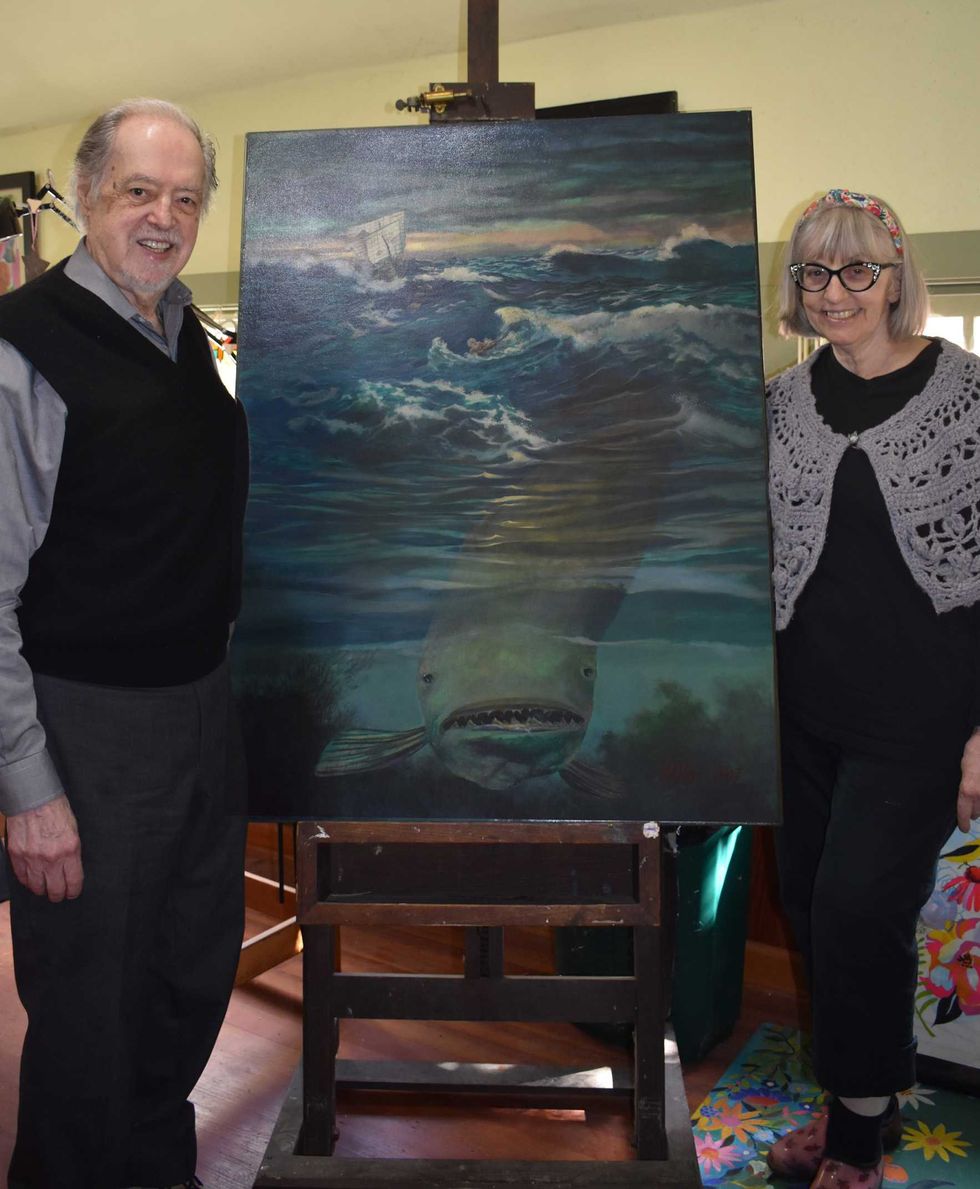 Justine and Victor Valla in their studio with a painting of Victor’s,”Jonah and the Whale.” Robin Roraback

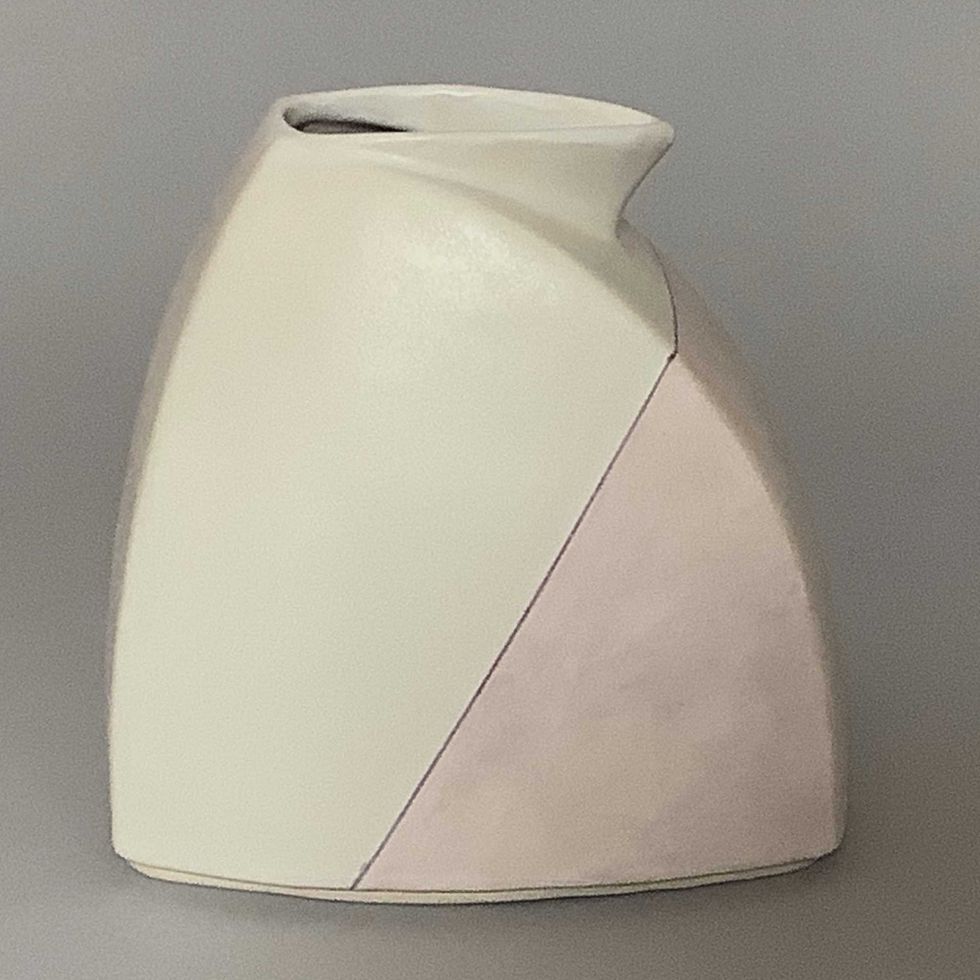 A ceramic vase by Kathleen Heidemann.Provided
 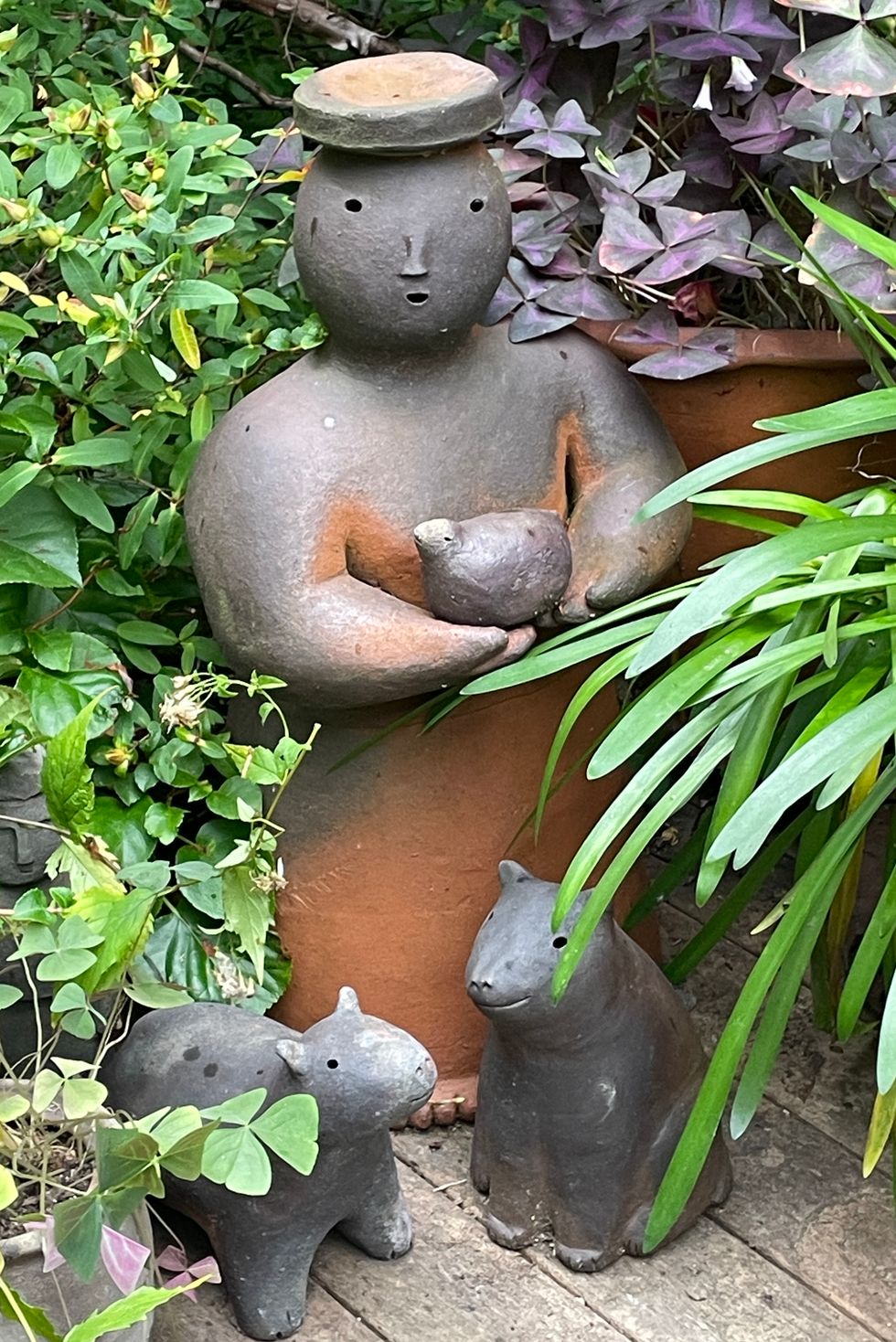 Joy Brown’s delightful ceramic sculptures.Provided




Getting Katie
My Dog: Part Two