HARTFORD — Tradition-bound Connecticut, a laggard among states in modernizing voting practices, would offer 14 days of early voting next year under a bill passed Thursday on a 107-35 vote by the House of Representatives.
“It’s not for nothing Connecticut is called the Land of Steady Habits,” said Rep. Matt Blumenthal, D-Stamford. “For almost three centuries now, we have had some of the most restrictive voting laws in the country.”
One of only four states not allowing early in-person voting, Connecticut can make the change only since November’s passage of a constitutional amendment that struck a prohibition against expanding the days of voting.
“We saw this not only as a policy decision that we support but also as a mandate and an obligation dictated to us from the voters,” Blumenthal said. “So that’s how we see it: The voters have given us a charge. We’re making good on it today.”
Fifteen Republicans voted with 92 Democrats for passage. No Democrat was opposed.
“This is a momentous occasion for expanded voting access for eligible voters in Connecticut, and it is the product of hard work on the parts of many individuals,” said Secretary of the State Stephanie Thomas, the chief elections official.
A four-hour debate began at 3:20 p.m. on House Bill 5004, a measure that still was being tweaked hours before being called for debate. Final passage in the Senate is assured, as is a signature from Gov. Ned Lamont.
House Minority Leader Vincent J. Candelora, R-North Branford, complained about the late availability of the final language and the length of early voting. Republicans urged a more modest start, with three days of early voting spread over five days.
“Take a few steps towards early voting. See how it works,” said Rep. Tom O’Dea, R-New Canaan. “See how it works for an election cycle or two, and then perhaps go to 10 days or 14 as is proposed.”
The 14-day window was the most expansive of four options proposed by the secretary of the state, based on a study commissioned by her predecessor, Denise Merrill, from the Center for Election Innovation and Reform.
A shorter early voting period would be offered for elections other than the November general election: seven days for state and local primaries, and four days for special elections and presidential primaries.
With a local option for additional sites, municipalities would have to offer early voting at a minimum of one location from the hours of 10 a.m. to 6 p.m. on 12 days and from 8 a.m. to 8 p.m. on the Tuesday and Thursday before Election Day.
“We didn’t want to force one version onto the towns, especially as we’re starting out here,” said Blumenthal, a key sponsor as the co-chair of the Government Administration and Elections Committee.
Legislative leaders have pledged to include funding in the state budget for municipalities to cover the added costs of early voting, including staffing over two weekends. Early voting is estimated to cost the state $4.5 million.
Republicans said even with state reimbursement, 14 days of early voting would be an unnecessary burden for small towns, which already struggle to recruit temporary workers for election day.
“I understand that we’re going to fund it, but it’s getting the people to work it, to run it and to make it safe,” said Rep. Jay Case, R-Winsted. “Some of our registrars are part time. How are they going to take 14 days to see this in a small town?
“That to me is the epitome of inefficiency,” said Rep. Doug Dubitsky, a Republican from Chaplin, an eastern Connecticut community with a population of 2,200.
Republican amendments to limit the length of voting to either three days or 10 failed on party-line votes.
Candelora, the House GOP leader, noted the strong Republican support for the constitutional amendment that gave the legislature purview over the days of voting but bemoaned what it produced Thursday.
“The legislation that we’re voting on today did not have bipartisan input,” Candelora said. “And so my no vote today is really a rejection of this process, and not a rejection of early voting.”
Blumenthal, House Speaker Matt Ritter, D-Hartford, and House Majority Leader Jason Rojas, D-East Hartford, said in a press conference before the debate that they expect changes to early voting as the state learns how it is used by an electorate used to voting in person on Election Day.
Thomas, a Democrat elected to her first term as secretary of the state in November, had recommended 10 days, which would have provided voting over two weekends. Ritter acknowledged there was nothing magic about 14 days.
“If we find, for example, that 10 is better, or maybe 21’s better, we can change it,” Ritter said. “That’s why it was nice to get the voters to approve the amendment and let us move it around. So maybe we’re wrong. Maybe it should be more, maybe it should be less, you can always be flexible. I think you’ll have data in a couple of years to know.”
U.S. Sen. Chris Murphy, a Democrat up for reelection in 2024, urged the General Assembly in an op-ed piece to be aggressive.
“We shouldn’t settle for a mediocre right to vote early,” Murphy wrote. “Fourteen days of early voting should be the bare minimum the state legislature accepts. In our high cost state, hundreds of thousands of voters work jobs with inconvenient, unpredictable hours and long commutes, so it’s crucial that we include early morning, evening, and weekend hours.”
Blumenthal offered another reason.
“We’re kind of at the end of the line getting to the early-voting party. We didn’t want to be the bottom of the barrel as well,” Blumenthal said. “Fourteen days is a significant amount of early voting, but it is less than the national average, which is 21 days.”
Early voting would be similar to absentee ballot voting with two key differences: Absentee ballots can be obtained only under certain circumstances, such as being away on election day, and the early ballots must be cast at polling places, not returned by mail.
Ballots cast early will be sealed in envelopes not opened until Election Day, similar to the process for handling, securing and tabulating absentee ballots.
“It’ll be very similar in many ways, which is why … arguments you might hear today really don’t seem to apply,” Ritter said.
The Journal occasionally will offer articles from CTMirror.org, a source of nonprofit journalism and a partner with The Lakeville Journal.


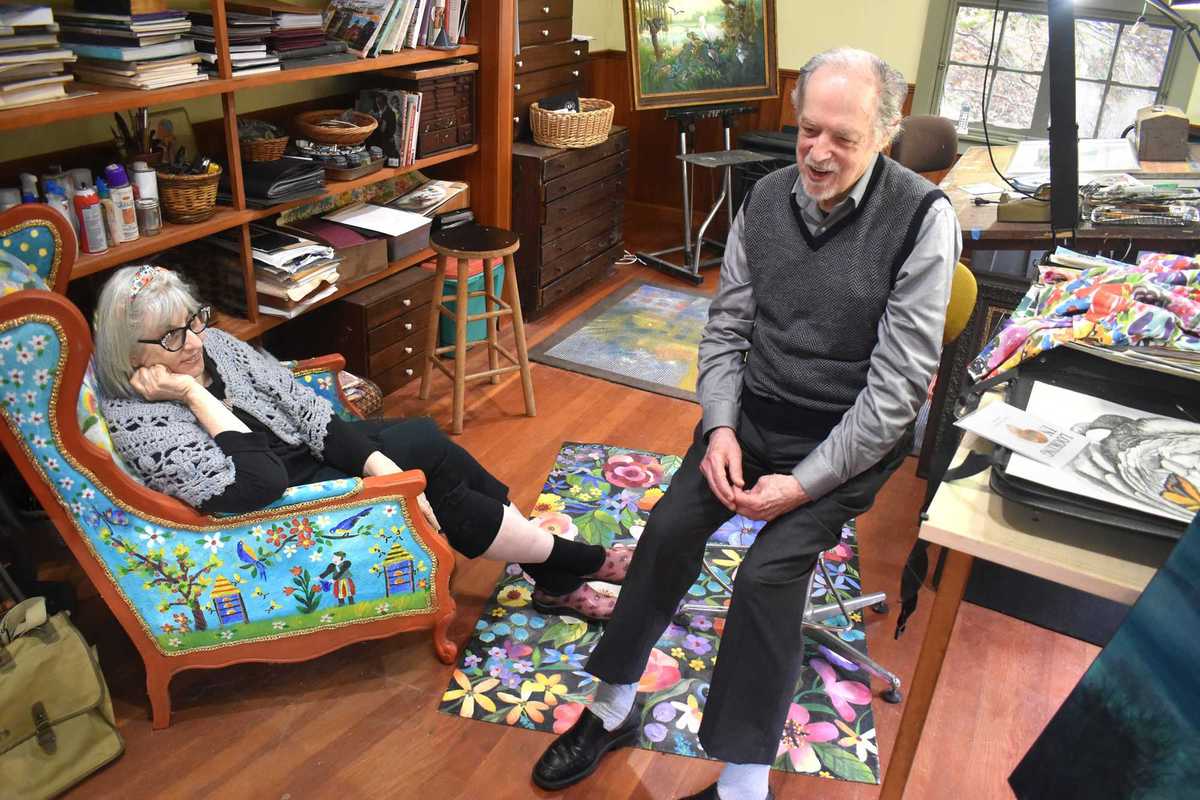
 Justine and Victor Valla in their studio with a painting of Victor’s,”Jonah and the Whale.” Robin Roraback


 A ceramic vase by Kathleen Heidemann.Provided
  Joy Brown’s delightful ceramic sculptures.Provided