Latest News
Tangled specks: tiny flies, big ambitions
Patrick L. Sullivan
Feb 25, 2026
Here is a sample from a recently purchased assortment of specks. From left: Black speck, Parachute Adams dry fly speck, greenish sparkly speck.
Patrick L. Sullivan
I need to get my glasses checked
My fingers fumbling like heck
I have become a nervous wreck
Must be the season of the speck…
(With copious apologies to Donovan).
I’m still on the injured reserve list following replacement right hip surgery. Right now the plan is to come off the IR June 1, but I’m going to ask if we can’t shave something off that.
And yes, the rehab is going very well, thank you for asking.
What this means in practical terms is I am scheming and plotting like nobody’s business about all the fishly things I am going to do once Ye Doctor blows the all-clear.
I have glaring weaknesses in my angling game. I stink at roll casting. I’m hopeless with 12-foot leaders.
And I am really lousy at fishing with the kind of tiny little flies I refer to as “specks.”
I define a speck as anything smaller than size 20. Speck experts will disagree, as they think a size 20 is huge. Maybe I will think so too some day.
One of the perils of sitting around after surgery is scrolling through social media and buying things. For preference, things I don’t need.
I got some weird t-shirts. One sports the logo of the Shenandoah (Pa.) Hungarian Rioters, a 19th century minor league baseball team. Another reads “Surely Not Everyone Was Kung Fu Fighting.”
Among these idiotic acquisitions was an offer of 72 specks for about $50. This was a rock-bottom price, and it wasn’t coming from a fly-by-night outfit either, but from an online company, The Catch and the Hatch, who provided me with some very good perdigon nymphs a few years back.
So the specks arrived, and they are everything I feared.
Tiny. Hard to see. Did I say tiny? Infinitesimal. You know.
SPECKS!
Here’s why an angler needs to know how to use specks. In between the nice hatches of large, easily identifiable bugs, which is most of the time, trout eat little bugs.
If it’s a cloudy day, chances are there will be blue-wing olives on the water. Then there is a category called midges which contains multitudes.
I look at the river for five minutes, see nothing happening bug-wise, and I start trying to provoke a reaction somehow.
What I am missing is the trout happily eating specks beneath the surface.
So how am I going to do this?
What little speck success I’ve had has been with a dry-dropper rig. I use a big Stimulator or Chubby Chernobyl, a large, very visible, very buoyant dry fly, and tie a piece of fluorocarbon tippet to the bend of the dry fly’s hook with an improved clinch knot and attach the speck to that. A bass or panfish popper works as the dry fly too.
Here’s the problem. The speck hook eyes require a very fine tippet material — 6x, 7x, even 8x.
I dislike fine tippets even more than specks. The stuff is devilish. It curls up. It refuses to knot. It’s just awful to work with.
Some years back I discovered one brand of fluoro tippet with a 5x tippet that was somehow able to get through the eye of a size 22 hook. That made a difference.
But this moderately successful method is very one-dimensional. I need to be able to construct a leader with a dropper or two and get my specks down in the water column.
That’s going to mean 6x or worse, probably. I might have to add some weight, another thing I dislike and am not good at.
But that is the plan. I hope to report great things as I master the speck this season.
Or until my left hip goes out.
Keep ReadingShow less
Suzan Scott sees every detail in ‘This Beautiful Place’
Patrick L. Sullivan
Feb 25, 2026
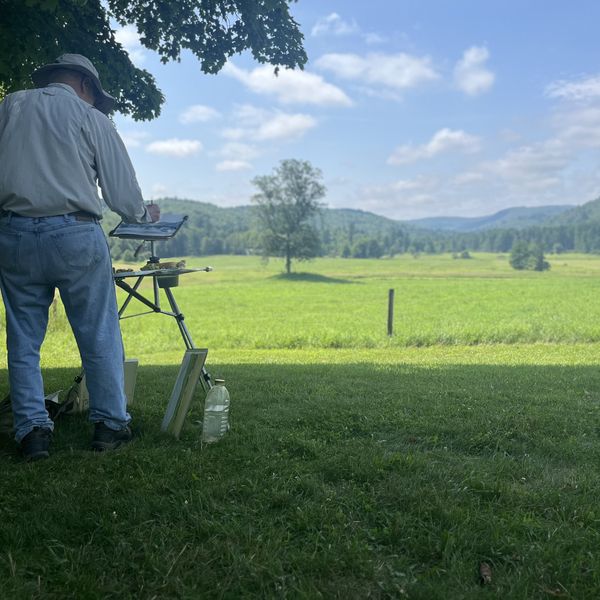
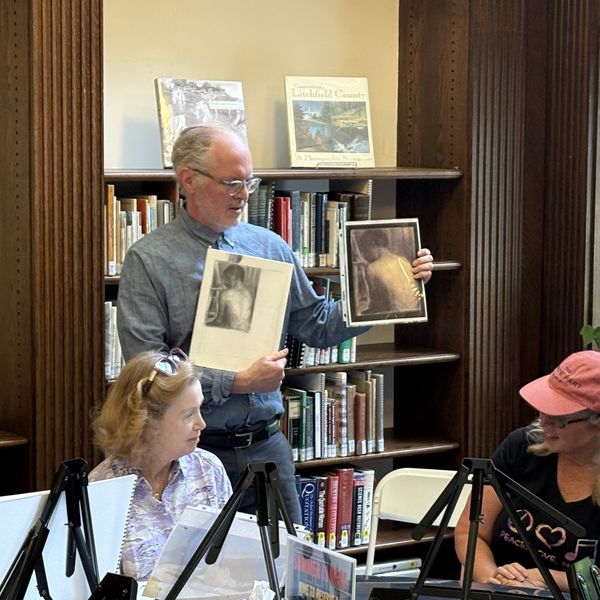
Torrington artist Suzan Scott talked with visitors at a reception for her show “A Beautiful Place” at the David M. Hunt Library Saturday, Feb. 21.
Patrick L. Sullivan
Landscape painter Suzan Scott said, “I see every leaf on every tree, every blade of grass,” when she assesses a particular view. Her paintings are her effort to “distill it to the essence.”
Scott said she has been painting for 30 years, and she moved from central Connecticut to Torrington a few years ago to be closer to the landscapes she prefers. “I just get in the car and drive.”
One painting, with dramatic clouds and light, was the result of a group project. The leader suggested a protest theme, and Scott was not initially enthused. But that was the summer of 2023, when smoke from wildfires in Canada drifted into the Northeast U.S. The phenomenon yielded spectacular sunsets, among other things. So Scott was able to comment on the situation in a subtle manner without taking an overtly political stand.
Scott’s paintings are on display at the David M. Hunt Library in Falls Village through Friday, March 13. She will give a talk at the library on Thursday, March 12, at 5:30 p.m.
Keep ReadingShow less
From black market to Main Street: cannabis grower plans Millerton dispensary
Nathan Miller
Feb 25, 2026
Cannabis farmer Douglas Broughton, left, and Glenn Hilliard of Newtown, Connecticut, label plastic containers filled with cannabis at Broughton’s home in Wassaic on Friday, Dec. 19.
Nathan Miller
WASSAIC — Tucked into the hills just off Old Route 22, Douglas Broughton operates an indoor cannabis farm — and this spring, he plans to open a dispensary in downtown Millerton.
The Wassaic-based grower signed a lease Dec. 1 for the former Demitasse storefront at 32 Main St. He aims to reopen the space as the Black Rabbit Farms cannabis dispensary following modest renovations.
The work will include cosmetic updates and the installation of freestanding, custom-made display cabinets.
Broughton said he hopes to open in April, but red tape at the New York Office of Cannabis Management could delay the opening.
The Millerton storefront marks another milestone for the 63-year-old farmer, who has been growing the formerly illegal plant since the 1990s.
“I just loved the plant and how it grew,” Broughton said. “It’s a very alien plant — it seems like it came from a different planet.”
In the early 1990s, Broughton was bartending in Brooklyn and couch-surfing after becoming disenchanted with the television broadcast industry. As an Asian American, he said his dreams of becoming a leading man or primetime news anchor were dashed by what he described as discrimination in the industry.
Broughton, who was raised in Washington state, initially moved to New York City in the late 1980s, when a series of internships brought him out east.
Rather than return home to complete his degree, he opted to stay and try to make it on his own.
By 1995, Broughton was regularly growing multiple plants on the roof of an apartment building in Williamsburg, Brooklyn, selling small quantities of the plant on the black market to customers at the bar where he worked.
“Bartending in the city is pretty good,” Broughton said. “It was just that I didn’t want to bartend.”
His chance to leave bartending came in 2000, when he met Joe Murray, known in New York City’s cannabis scene as “AJ Sour Diesel” for pioneering the Sour Diesel strain, prized for its strong effects and pungent odor.
Broughton said Murray helped expand the operation, allowing him to rely on cannabis cultivation as his primary source of income beginning in 2000.
Broughton moved to his home in Wassaic in 2016, where he continued to operate a black market farm until New York state legalized cannabis and began accepting license applications in 2021.
He said his age was a factor in deciding to get a license and form a legitimate enterprise.

Broughton, nearly 60 at the time New York legalized cannabis for recreational use, had been running illicit grow operations for decades and said the anxiety of avoiding law enforcement had worn him down.
“Every aspect of what you did had to be hidden,” Broughton said. “You couldn’t tell anybody.”
After legalization, however, he said he faces a different set of challenges brought on by bureaucracy and corporatism in New York’s cannabis industry.
Broughton said New York’s tax scheme hits small growers the hardest. He said he has to pay taxes on each plant he grows, and then again when he sells to retailers or, eventually, directly to consumers.
Despite those hurdles, Broughton said he is eager to bring a high-quality product to consumers in Millerton.
Over the past 30 years, he has developed a growing technique that relies entirely on artificial light and strict control of nutrients and moisture.
He maintains a level of oversight that borders on obstinance.
“I’m more of a purist when it comes to this stuff,” Broughton said. “I’m not very forgiving.”
That rigidity pays off with better product, he said, even when it means destroying an entire harvest.
“We cut down an entire crop of amazing Sour Diesel like two years ago because we got mites,” Broughton said.
Keep ReadingShow less

Want more of our stories on Google? Click here to make us a Preferred Source.
Winter Cheney wins gold in varsity ski finals
Riley Klein
Feb 25, 2026
Winter Cheney sports three gold medals after a victorious performance in the Berkshire Hills Ski League championships Wednesday, Feb. 18.
Provided
CORNWALL — Housatonic Valley Regional High School skier Winter Cheney won 1st overall in the boys varsity ski championships Wednesday, Feb. 18.
Cheney earned gold in the Berkshire Hills Ski League finals in both the slalom and giant slalom events.
Cheney is a second-generation HVRHS skier, following in the tracks of his father, Ted Cheney. Both skiers learned from HVRHS coach Bill Gold.
In team scores, the Mountaineers took first place in slalom and second in giant slalom.
Other HVRHS skiers performed well, including Danny Lesch’s 3rd place overall finish in the boys rankings. Elden Grace, Ian Thomen, Logan Dolan, Ishaan Tanin, August Olsen, Jonas Johnson and Donald Polk III all contributed to the team’s success.
The championship meet was held at Mohawk Mountain in Cornwall. The league includes HVRHS, Washington Montessori School, Rumsey Hall, Indian Mountain School and Marvelwood School.
Keep ReadingShow less
41st Polar Bear Run wraps up before snowstorm
Lans Christensen
Feb 25, 2026
Runners depart on the 7.8-mile course around Lake Waramaug for the 41st Polar Bear Run held on Sunday, Feb. 22.
Lans Christensen
KENT— Blizzard warnings did little to deter most of the 700 pre-registered participants from competing in the Polar Bear Run on Sunday, Feb. 22.
On race day, 526 athletes ran the 7.8-mile course around Lake Waramaug, along with a large number of participants in the walking event.
Cloudy, breezy and cold conditions defined the day with the thermometer steady in the 30-degree range. The race started promptly at 11 a.m., and 40 minutes and 19 seconds later— a new record — Hiro Kawakatsu crossed the finish line.
Complete results available at FastTrackTiming.com
This 41st edition of the Polar Bear Run was as popular as ever, thanks to the efforts of Stephanie and Ed Raftery of TrailHeads, a performance accessories retailer based in Kent.
The race benefits Guiding Eyes for the Blind. As always, one of the best parts of the day was meeting and spending time with the organization’s dogs.
Keep ReadingShow less
Budget season begins in Cornwall
Riley Klein
Feb 25, 2026
Cornwall Town Hall
Riley Klein
CORNWALL — Municipal spending in Cornwall is expected to increase by more than 5% next year.
First Selectman Gordon Ridgway presented the proposed spending plan for 2026-27 to the Board of Finance on Thursday, Feb. 19.
The bottom line was $2,654,985, an increase of 5.61% compared to 2025-26.
“Of our roughly $150,000 increase, $42,000 is for the health insurance,” he said.
Ridgway explained the town is under contract with the highway union to provide a certain level of insurance. The current plan is through the state insurance pool, which covers all state employees and many municipalities.
Finance chairman Joe Pryor questioned if there was any way to address the insurance hike. “It’s obviously way past inflation,” Pryor said.
“The program that we’re under now had the best price,” Ridgway said. “But we can dig in, see if there’s some options there.”
In the spending plan, municipal employees were given a 3% raise.
The plan showed a 35.42% increase, about $11,500, to wages for the Zoning Enforcement Office. Ridgway said the new officer, Spencer Musselman, is working more hours than the previous ZEO and processing more permits.
There was a new line for $20,000 under the Town Office Administration section in order to pay for a new “.gov” website, which all town governments in Connecticut are required to transition to by mid 2027.
The capital spending plan showed a net hike of $75,000 compared to the current fiscal year. Capital spending is separate from the municipal budget and the money allocated to each line can carry over into future years, such as a fire truck fund.
The primary increase in capital spending was $40,000 for town building improvements. There was also $20,000 added to property revaluation assessments, which will next be completed in October 2026.
The next step in the budget process will be March 19 when Cornwall Consolidated School presents the elementary school’s spending plan.
Keep ReadingShow less

Want more of our stories on Google? Click here to make us a Preferred Source.
loading