Rehab of Kent's defunct swimming pond will take time, officials say

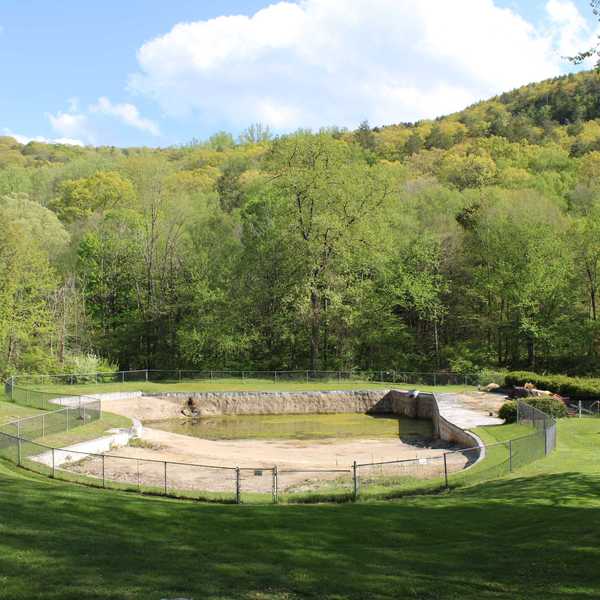
Cardinal Engineering Vice President Timothy Cermola points out the crumbling concrete lining of the defunct Emery Park swimming pond Wednesday, June 17.
Alec Linden


Cardinal Engineering Vice President Timothy Cermola points out the crumbling concrete lining of the defunct Emery Park swimming pond Wednesday, June 17.
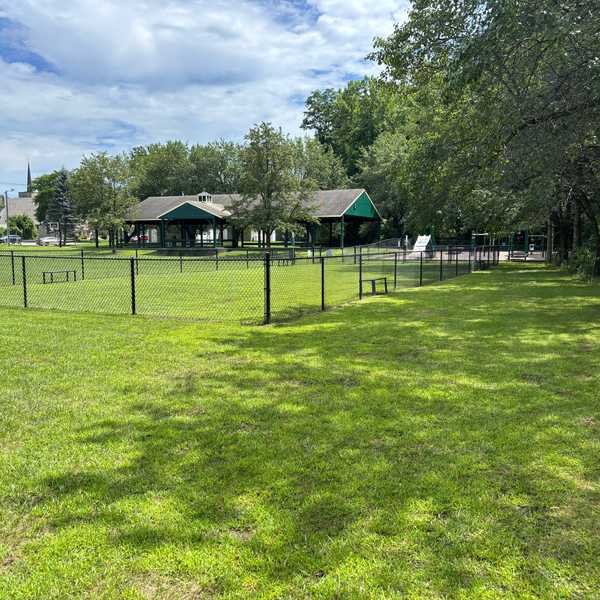
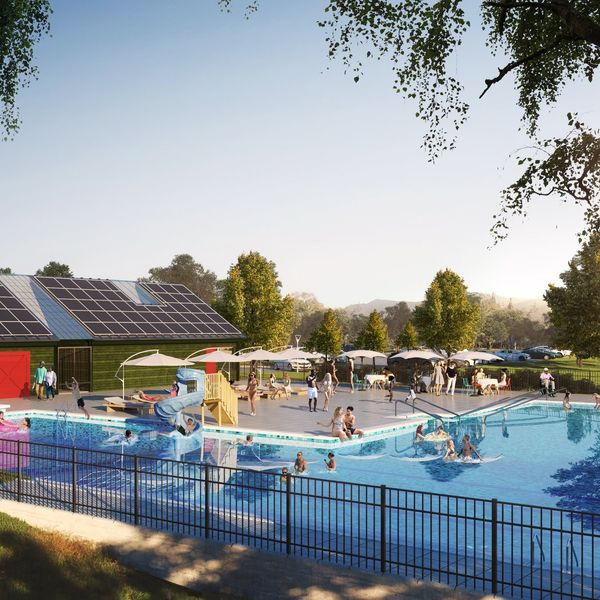
KENT – Efforts to restore Emery Park's long-closed swimming pond took a step forward last week, as engineers reported the decades-old foundation appears stronger than some expected. Even so, they said, it may be several summers before the swimming hole is back in working order.
Despite the longer than anticipated timeline, Parks and Recreation Commission Chair Rufus de Rham said during the June 17 meeting that the town remains focused on bringing back a place for residents to cool off.
“I know we have pipe dreams,” said De Rham, referring to long-term intentions to install a pavilion, upgrade the playground and even build an office for the Parks and Recreation Department at the park, among other proposed projects. “But the pond is our No. 1 mission here.”
Luckily, its bones are mostly solid, reported Cardinal Engineering Vice President Timothy Cermola. “The masonry and stone walls are probably sound,” he said of the foundation. Officials had feared the entire basin would need to be re-excavated.
However, “anything concrete that was laid on the stone masonry has to be removed,” he said, gesturing at the pool’s lining, which is cracked and crumbling in places. Cermola noted that the first focus of a recently-commissioned study will be to determine how much of the masonry is suitable to keep, noting that anything unstable or at risk of becoming so will have to be replaced. The current concrete is intended to be upgraded to a long-lasting, rebar-supported gunite lining.
The pond, a stream-fed concrete basin that was dug out to its current shape in the early 1960s, served the town as a cooling off spot before shutting down during the COVID-19 pandemic. Currently, the only public swimming opportunity in town is at Lake Waramaug State Park.
Plans to bring the pond back into working order have been in the works for years with ample public support. The town sent out an RFP for its restoration late last year, but it was repealed due to complications with federal funds for the project.
Since then, officials have shifted their approach, opting to bring on Meriden-based Cardinal Engineering to survey the site and develop a master plan for the park, meant to guide the swimming pond restoration and the longer term projects. Part of the plan will be bringing the park’s facilities, which span somewhat rugged terrain below a steep hillside, up to compliance with the Americans with Disabilities Act, a requirement in public parks.
“This is where the money is well spent,” Cermola said, though he noted it will be a significant undertaking. “This is a million dollar project,” he predicted.
While the foundational structure may be more intact than some had feared, the finished product may look quite different to what’s there now.
The general shape of the pond is subject to change, said Parks and Rec. Director Matt Frasher as he perched on a sloping wall inside the basin. The curved flooris likely to be restructured with straight-down flat walls at the pond’s edges for safety reasons, he said, and the overall depth may be reduced to five-feet.
A wide, oblong section that once accommodated 75-foot lanes for the local swim team may also be narrowed in the new design.
The town currently has $400,000 in capital funds available for the swimming pond restoration, as well as an additional $100,000 in funds from the American Rescue Plan Act which will expire this year. Another $100,000 in capital has already been allocated towards upgrading the playground.
The Cardinal engineers anticipate the master plan will be complete by the end of summer, which will then act as a blueprint for next steps.
As the group dispersed, Commissioners were satisfied by the discussion, despite the temporal setbacks. “We want to do it right,” said Chair De Rham. “That’s the biggest thing.”
“While we’re working on the pond first,” added member Keith Johnson, “it won’t interfere with anything in the future… that’s what the master plan ensures.”

Ruth Epstein
Gov. Ned Lamont chats with residents outside 45 on Main in Kent during a visit Saturday, July 11.
KENT – Politics and ice cream shared the spotlight Saturday as Gov. Ned Lamont, a Democrat who is seeking reelection this fall, stopped at 45 on Main after a visit to Lime Rock Park.
The governor chatted with supporters who gathered at the popular Kent ice cream shop and treated them to ice cream or cold drinks, a gesture that was especially welcome in the hot, humid weather.
Accompanied by state Rep. Maria Horn, D-64, of Salisbury, Lamont fielded questions on a wide range of topics, including immigration, energy costs, housing and healthcare.
Referring to Republican gubernatorial candidate Ryan Fazio’s pledge to repeal the Trust Act — a state law that limits when local and state law enforcement may cooperate with federal immigration authorities — Lamont said the measure originally received bipartisan support before Republicans later backed away from it. He added that the law keeps ICE agents away from courthouses and schools.
“It’s called a Trust Act for a reason,” interjected Horn.
Energy costs also drew questions from the attendees. Lamont said Eversource’s operations were “a disaster” a year ago and believes the utility has become more responsive to public concerns, though he acknowledged the need to bring electric rates under control.
“The big problem is that there is not enough generation, but we’re making slow progress.”
Asked about nuclear power, Lamont said the Millstone nuclear power plant, owned by Dominion Energy, would like to increase the price of its power. “It’s clear you have to pay for overruns.”
He also discussed the growing number of large data centers around the country.
“They would use more power than Litchfield County times two,” Lamont said.
Mary Weber of Washington, a local activist and chair of the Board of Education, said Lamont’s Democratic primary opponent, state Rep. Josh Elliott of Hamden, wants to eliminate local property taxes and replace them with a single state income tax. She said that would mean owners of multimillion-dollar weekend homes would pay nothing, shifting the burden to local residents. “That’s insane,” she said.
Lamont responded, “You can make up stuff when you’re running for office.”
Turning to another proposal aimed at helping homeowners, Lamont said towns have the ability to adopt a homestead exemption, which protects up to $250,000 in equity in a homeowner’s primary residence, or $500,000 for married couples, from forced liquidation by judgment creditors. The protection applies to real estate, cooperatives and mobile homes.
“I want to really drill down on that to help all-year residents and others,” said Horn.
Asked about outward migration from Connecticut, Lamont said he would not pay large corporations to relocate to or remain in the state, as some of his predecessors had done.
“My focus is to grow small businesses. They create most employment,” Lamont said, adding that they are continuing to grow. He also said Connecticut ranks No. 12 in the nation for economic growth.
Housing also came up during the discussion. Horn said workforce housing is needed to help young people find affordable places to live, raise families and help stabilize school enrollment.
“We’ll do everything we can to make housing happen,” Lamont said, while noting that 80% of state housing funding goes to Connecticut’s 10 largest cities.
Looking ahead, Lamont said he is most concerned about healthcare when President Trump’s “Big Beautiful Bill” takes effect, estimating it could cost Connecticut $400 million. While some hospitals — including Sharon Hospital, he said — do a good job controlling costs, many residents could face large medical bills.
Lamont ended his visit by crossing Route 7 to greet the “No Kings” protesters who are on Main Street every Saturday afternoon. While sipping on a coffee milkshake, he praised them for their efforts, informing them that 18 of the Declaration of Independence signers were immigrants.
Alec Linden
Crowds gather along the banks of the Housatonic River in August 2025.
KENT –A popular swimming hole was closed over the weekend following reports of overcrowding, litter and other problems during the Fourth of July holiday weekend.
First Selectman Eric Epstein announced in an email Friday that the eastern section of North Kent Road, which provides access to a scenic bend of the Housatonic River just downstream from gentle rapids, would be closed from 3 p.m. Friday, July 10, through 8 a.m. Monday, July 13. Epstein said the closure was intended to protect the site from litter and pollution after neighbors reported loud music and parking concerns.
The order is the first closure of the spot since it was shut down for several weeks at the end of last summer following similar incidents that left the riverbanks and parking area strewn with trash.
On Friday afternoon, Epstein said the closure was a temporary measure while the site’s stakeholders work toward a long-term solution that protects the area while preserving it as a community recreation resource.
Epstein said more than 100 people were reportedly in the water at times during the Fourth of Julyweekend, though that number is unofficial. Beyond the crowding, Epstein said the site was impacted by trash, human waste, traffic and parking congestion, loud music and emergency vehicle access blockages.
“There’s a host of issues,” he said.
Regulating the site has been difficult due to the patchwork ownership of the river and the surrounding land. Organizations with ownership interests or management responsibilities include the town of Kent, the Wildlife Management Division of the state’s Department of Energy and Environmental Conservation, the Kent Land Trust, Eversource Energy, the Housatonic Railroad Company, the Housatonic Valley Association, the Housatonic River Commission, the Appalachian Trail Association and others.
Epstein said the various stakeholders have been meeting weekly to discuss a long-term plan for the site. “The overall consensus among these groups is that we want it open and we want people to be able to enjoy the area,” he said, “but not at this expense.”
Epstein noted that beyond swimming and leisure, the spot is valued for its fishing, boating and other outdoor activities.
While the weekend closure is temporary, Epstein said it could be reinstated for subsequent weekends if further problems arise. A total closure of the access road for the summer isn’t out of the question, either, though he said he wants to avoid that outcome.
“If we can come to an agreement and figure out a solution so that everyone can enjoy it and be respectful of the area, then I hope [access] can continue,” he said. “But we haven’t been able to come to that conclusion yet.”
Ruth Epstein
Ryan Fazio, the Republican candidate for governor, addresses supporters Thursday in Kent. The event was moderated by Tom Morrison, chairman of the Salisbury Republican Town Committee.
KENT — Republican gubernatorial candidate Ryan Fazio pledged to cut taxes, lower electric bills and return more authority to local communities during a campaign stop Thursday, telling more than 50 supporters that Connecticut’s problems stem from what he called failed state leadership.
Speaking at the Kent Community House, Fazio outlined a platform centered on a proposed $2 billion middle-class tax cut, reducing government spending, lowering energy costs and rolling back state policies he said have eroded local control over issues such as zoning.
Fazio, 36, represents Connecticut’s 36th House District and is challenging Democratic Gov. Ned Lamont in November. The event was hosted by the Republican town committees of Kent, Salisbury and Sharon and moderated by Salisbury Republican Town Committee Chairman Tom Morrison.
He said the first step, if elected governor, would be limiting the growth of state spending, arguing that Lamont’s budgets have grown by about 8% annually while Connecticut continues to take on more debt.
“I’m proposing a $2 billion middle-class tax cut,” he said.
Second, Fazio said he would work to reduce electric bills.
“We have the second highest bills in the country ahead of Hawaii and California,” he said. “The fault is in our state policies and the governor.” He criticized the public benefits charge on electric bills, saying while some of the programs it funds have merit, the costs have grown beyond what taxpayers should bear.
Fazio also argued that Connecticut’s tradition of home rule has been undermined by the governor, pointing to zoning policies as an example.
“I believe we need more housing, but developers and the governor shouldn’t override decisions by those who know their towns best,” Fazio said, drawing applause from the audience.
“This state could flourish like nothing else,” Fazio said. “Yet Connecticut is struggling. Why? Because of the failure of state leaders and their policies.”
He talked about citizens hurting due to what he deemed high taxation, making it difficult for them to put down roots, purchase homes or retire. “This election represents a turning point; gives us a chance to change the trajectory.”
Morrison, the moderator, asked Fazio a series of questions, including why he thought he could achieve his goals if the General Assembly is under Democratic control.
Fazio, who touted his ability to work with elected officials from across the aisle, replied, “We can always find common ground. For example, everyone can agree taxes and electric bills are too high.”
He also noted the governor has veto power for leverage, “but I will not promise anything that is not realistic.”
Asked to talk about education, Fazio said current reading scores among certain grade levels are unacceptable. He called for higher expectations, getting back to basics and more instructional time in the classroom.
Fazio touched on the Trust Act, a state law that limits local and state law enforcement from cooperating with federal immigration authorities (ICE), which Lamont supports. “Legal immigration is good and necessary, but we need laws to protect our safety,” Fazio said, stating if he became governor he would repeal it.
Morrison mentioned a recent poll showing Fazio trailing Lamont by 13 points and asked for his reaction. Fazio dismissed the survey, saying it did not accurately reflect the state of the race.
On a lighter subject, Morrison asked Fazio if Connecticut should have participated in the recent National Fair on the National Mall in Washington, D.C. “I regret he didn’t participate,” he replied.
The event concluded with questions from the audience.

Want more of our stories on Google? Click here to make us a Preferred Source.
Christine Bates
This compact 936-square-foot ranch on two acres on Prospect Mountain Road built in 2003 sold with two bedrooms and 1 bath for $430,000 in June.
SALISBURY – Home prices in Salisbury softened during the 12-month period ending June 30, 2026, while sales held steady and inventory remained limited.
The 12-month trailing median price for a single-family home, excluding condos, in Salisbury was $920,000 for the period ending June 30, 2026. That was 19% lower than the $1,136,000 median recorded for the 12-month period ending June 30, 2025, but 6% higher than the $865,000 median for the comparable period ending June 30, 2024.
A total of 52 homes sold during the 12-month period ending June 30, 2026, roughly four a month. The record on a 12-month trailing basis was set in May 2021 when 117 were sold in a year.
Sales were relatively stable compared with 44 homes sold during the 12-month period ending June 30, 2025, and 52 homes sold during the comparable period ending June 30, 2024.
Inventory of all listed residential properties for sale rose slightly to 21 in early July. High-end homes dominated with 15 homes listed for more than $1 million and only six below the current median price.
Furnished seasonal and academic rentals remained plentiful in early July with 32 homes available from $3,850 for the academic year to $65,000 for the summer. Eight houses are available on an annual basis, furnished and unfurnished, from $2,250 to $15,000 per month.
Salisbury transfers in June
299 Main St. – 5 bedroom/5 bath antique house on 5.07 acres transferred by Nina Disesa Goodall Trustee, Nina Disesa Revocable Trust and Brian Goodall Trustee, G Brian Goodall Revocable Trust to Daniel Scott Trustee and Nancy Prado Trustee Prado-Tucker Family Trust on June 5, 2026, for $3,410,000
9 Prospect Mountain Road – 2 bedroom/1 bath home on two acres transferred by Patricia Redmond Estate to Michaela and Quentin Kindred on June 10, 2026, for $430,000
26 Undermountain Road - 3 bedroom/2 bath home built in 2025 transferred by the Salisbury Housing Trust Inc to Benjamin Marhefki and Sarah Crossman on June 15, 2026, for $300,000
40 Interlaken Estates V – 3 bedroom/3 bath house built in 1972 transferred by Jeffrey May and Mary O’Neill to Peter Whitmore on June 16, 2026, for $915,000
420 Salmon Kill Road – 2 bedroom/2 bath ranch on .64 acres transferred by Mary Carroll Marden Estate to Strauss Bourque and Alexander White on June 16, 2026, for $457,500
* Town of Salisbury real estate transfers recorded between June 1, 2026, and June 30, 2026, provided by Salisbury Town Clerk. Transfers without consideration are not included. Current market listings from Smart MLS and market statistics from InfoSparks. Note that monthly recorded transfers may lag sales by a number of days and include properties not appearing on the MLS.Compiled by Christine Bates, Real Estate Salesperson with William Pitt Sotheby’s International Realty, Licensed in CT and NY.
Alec Linden
LITCHFIELD – Cornwall First Selectman Gordon Ridgway presided over his first meeting Thursday, July 9, as chairman of the Northwest Hills Council of Governments (COG), a regional organization representing 21 Northwest Connecticut communities. He opened the meeting by reviving a roundtable discussion among local leaders, prompting updates on storm recovery, speed cameras and infrastructure projects.
Ridgway, who was elected chairman last month and has served 35 years as a first selectman, said his goal is to strengthen coordination among member towns and ensure the organization focuses on issues that matter most to local officials.
The roundtable, discontinued several years ago because it often ran long, gives each first selectman and mayor one minute to share challenges, accomplishments and other news from their communities. Ridgway said he believes the discussion helps officials learn from one another and serves as a mentoring opportunity for newer municipal leaders.
The goal is to “make sure the COG is mutually supportive and relevant and is dealing with issues that are important to the town leaders,” he said.
During the roundtable, many of the first selectmen pointed to the value of mutual aid from neighboring towns following the July 4 storm, which carved a narrow path of destruction from Salisbury southeast into Hartford County.
Curtis Rand, first selectman of Salisbury, which was among the hardest hit communities, said he appreciated the support from fellow leaders. “Within hours, many of you sent me texts and emails,” he said.
Falls Village First Selectman Dave Barger said his town was similarly impacted, and also extended his gratitude to those who reached out with aid. “This is what the COG is all about,” he said – “the ability to share those resources.”
However, Barger added, “We’re not quite as happy with the Connecticut [Department of Transportation],” noting slow response times to state roads that were blocked by many downed trees following the storm. Several other community leaders echoed his dissatisfaction.
Torrington, Burlington and Harwinton were also heavily impacted by the storm, and several selectmen reported aid they had provided, especially to Harwinton, which included response crews from New Hartford and Starlink trailers for cell service from Burlington.
Aside from emergency storm updates, speed cameras were also discussed at length among the group.
Litchfield’s Denise Raap and Warren’s Gregory LaCava reported ongoing projects and investigations regarding the traffic enforcement measure, which has proved controversial in area towns.
Winchester Town Manager Paul Harrington said that the town was 30 to 45 days away from installing its own cameras, but that the process had been arduous. He offered his support and advice for any community considering implementing them – “It is a tremendous lift to get it over the finish line.”
Otherwise, several towns outlined ongoing capital projects, many of them related to downtown improvements and infrastructure updates.
Norfolk’s First Selectman Henry Tirrell said his main focus is a long-term ongoing construction of a retaining wall alongside Route 44 and several other bridge projects.
Warren’s LaCava spoke to a town center revitalization project in Warren, while Rand updated the group on two initiatives ongoing at Hotchkiss School, where sidewalks connecting campus to downtown Lakeville are in development, and Salisbury School, where a pedestrian tunnel is currently under construction. Both projects aremeant to get students off of busy state highways.
Kent First Selectman Eric Epstein announced that the second phase of a long term project to replace downtown sidewalks is moving forward, and that he hopes construction will begin later this summer. Phase one, completed in 2023, replaced sidewalks on both sides of North Main Street between the intersections with Route 341 and the railroad tracks. Phase two will focus on South Main Street and Maple Street.
He also reported that he had ordered access to a popular swimming hole on the Housatonic River to be closed the weekend of July 11 to 13 in response to overcrowding and litter during the Fourth of July holiday. “There were piles and piles of garbage,” he said.“It’s become unmanageable.”
Lakeville Journal
The following information was provided by the Connecticut State Police at Troop B. All suspects are considered innocent until proven guilty in a court of law.
Driver flees LaBonne’s lot fender bender
At around 3 p.m. on July 3, an unknown driver was reversing in the parking lot of LaBonne’s Market in Salisbury when the vehicle collided with the rear bumper of a parked, unoccupied BMW X5 belonging to Mary Riva, 57, of Salisbury, causing minor damage. The unknown vehicle left the scene, and the investigation remains open.
911 misuse and other charges arrest
On the evening of July 3, troopers were dispatched to an address on Echo Street in Salisbury on the report of a non-active disturbance. Troopers arrested Lia Casadei, 23, of Windham, Connecticut for three charges: third degree criminal mischief, misuse of emergency 911 number, and disorderly conduct. Casadei was released on a $2,500 non-surety bond, and was scheduled to appear at Torrington Superior Court on July 6.
Early morning animal avoidance crash
At around 4 a.m. on July 4, Heather Latour, 59, of Winsted was driving west on Route 44 near downtown Norfolk when she swerved to avoid an animal in the road and struck the guardrail end post. She was uninjured but the Subaru Forester she drove was disabled and towed from the scene. Latour was issued a written warning for failure to maintain lane.
Tree and live wires fall on moving vehicle
On the evening of July 4, Pauline Jamardo, 69, of Chicago, Illinois was driving south on Factory Road in Salisbury when, due to a heavy storm, a tree fell onto live power lines, causing both the tree and lines to fall on the roof of Jamardo’s Subaru Forester. Jamardo was not injured in the incident, but the car was disabled and towed.
Evading responsibility arrest
At around 2:42 a.m. on July 5, troopers were dispatched to the Patco gas station in Lakeville for a reported motor vehicle accident but found the operator had fled the scene. The troopers ultimately found that the accused – Sabrina O’Brien, 28, of Falls Village, had fled on foot to a nearby residence. She was taken into custody and charged with evading responsibility and the unsafe movement of a stopped vehicle. She was released on a $2,500 non-surety bond and is scheduled to appear at Torrington Superior Court on July 20.
Operating under the influence arrest
At approximately 6 p.m. on July 7, troopers responded to a report of a single-vehicle accident on Canaan Valley Road near the intersection with Route 44. Troopers found that a Mitsubishi Outlander had run off the roadway and collided with a tree. Upon investigating, troopers determined that Mary Morey, 33, of Great Barrington, Massachusetts was operating the vehicle under the influence of alcohol or drugs and arrested her for that charge and for restricted or unsafe turn. She posted her $2,500 non-surety bond and is scheduled to appear at Torrington Superior Court on July 21.
Protective order and burglary arrest
Near midnight on July 11, troopers were dispatched to an address on West Main Street in North Canaan on the report of a protective order violation. Upon arriving, troopers arrested Patrick Piljar, 31, of Canaan on a warrant for three counts of the violation of a protective order as well as third degree burglary and an additional count of a protective order violation from that night’s investigation. His total bonds amounted to $250,000, which he was unable to post. He was scheduled to appear at Torrington Superior Court on July 13.
The Lakeville Journal will publish the outcome of police charges. Send mail to P.O. Box 1688, Lakeville, CT 06039, Attn: Police Blotter, or send to editor@lakevillejournal.com.

Want more of our stories on Google? Click here to make us a Preferred Source.

Want more of our stories on Google? Click here to make us a Preferred Source.