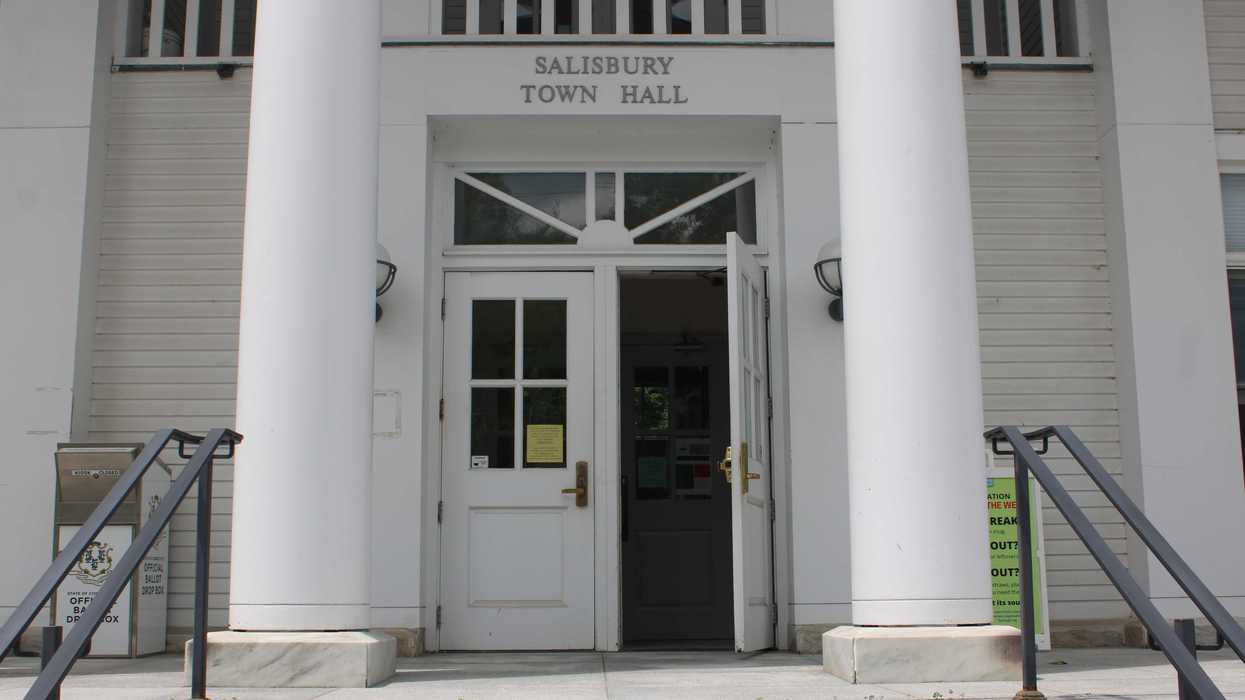
The telecoms regulations were established when Connecticut’s municipalities still had the authority to govern the location of wireless cell and internet infrastructure.
SALISBURY — Salisbury will retain its decades-old telecommunications tower regulations for now, citing the value of local input even as the town acknowledges it has limited authority over tower siting — a concern that arises because towers are typically placed on high ground, where they can be visible to residents.
The telecommunications regulations were set to be eliminated as part of a broader update to the town’s zoning regulations that was under consideration during the Planning and Zoning Commission’s Feb. 2 regular meeting. The edited document was intended to fix textual inconsistencies, update terminology and eliminate “obsolete references and regulations,” including the telecommunications regulations, explained Land Use Director Abby Conroy during the meeting.
After a brief public hearing in which several commissioners and members of the public advised against getting rid of the regulations, P&Z ultimately voted to pass the amended regulations draft but with the telecommunications section left intact. The remainder of the changes, which were largely minor corrections, will be adopted as the Commission and Land Use Office continue an extended push to rework and modernize the town’s regulations as a whole.
The telecommunications regulations were established when Connecticut’s municipalities still had the authority to govern the location of wireless cell and internet infrastructure. According to the statement of purpose of the zoning code, found in “Section 1000 — Communication Towers” of Salisbury’s regulations, the regulations were meant to “protect the aesthetic quality of the Salisbury skyline and ensure the safety of the community” — concerns that residents say remain especially relevant in a town defined by its hills and long-distance views.
This power is now ceded to the Connecticut Siting Council, affirmed by the federal Telecommunications Act of 1996. The elimination of the town’s regulations on the topic was meant to correct a redundancy, Conroy said, given that P&Z doesn’t wield any regulatory authority over locating this type of infrastructure anymore.
Conroy also read a statement into the record that was submitted by B. Blake Levitt, communications director at the Berkshire-Litchfield Environmental Council. The letter argued the town should keep the regulations as they give the town the only voice it has left in tower siting discussions, which can have significant impacts on viewsheds, watersheds and ecology — particularly in elevated areas where towers can be visible for miles.
Levitt’s statement was also published as an opinion piece in the Feb. 5 issue of this newspaper.
“To have no telecom regs can weaken a town’s rights to protect environmental, scenic and historic assets,” she wrote, describing telecommunications regulations as “the lowest hanging fruit any town can possess in case it’s needed.”
During the Feb. 2 public hearing, she added that while P&Z commissions may no longer govern where these facilities are located, having regulations at least enables the town to join the conversation which otherwise may be held solely between state officials and private companies.
The regulations “enable you to intervene when you have something you want to accomplish through the Siting Council,” she said, explaining that such a town code enables P&Z commissions to legally enter telecommunications siting deliberations. “It’s really the only way to get their attention — to file for intervenor status.”
Residents Lorry Shepard and David Bright shared similar concerns. “We have very special viewsheds as well as water sources and watershed,” said Shepard, while Bright maintained that “this is just another way for the community to stay involved in issues that have been part and parcel to, excuse the expression, the character of Salisbury for a very long time.”
After some conversation, the Commission ultimately voted unanimously to keep the regulations intact for the time being.
Levitt, Conroy and several commissioners agreed that the antiquated language and concepts will require rewriting, though, as today’s wireless landscape has evolved significantly from the time when the regulations were first adopted.