Swift House committee learns of potential buyer at first meeting

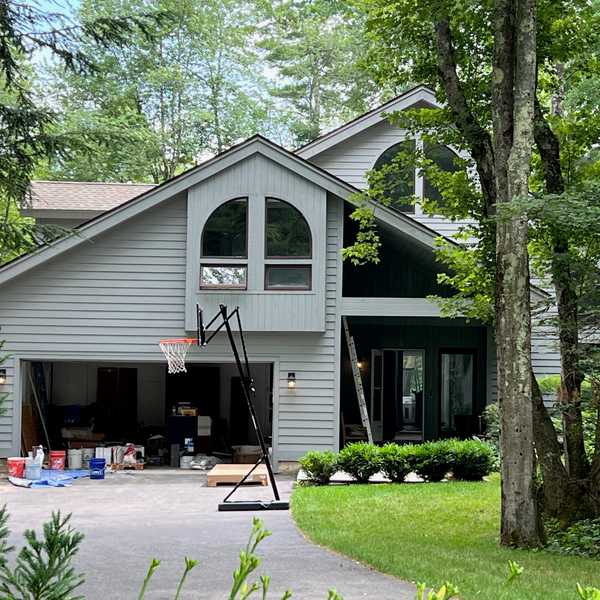
Swift House in Kent.
By Ruth Epstein


Swift House in Kent.
KENT — The fate of the Swift House is once again front and center after the newly formed Swift House Investigation Committee held its first meeting Tuesday, Feb. 24 — and learned that a local attorney is interested in buying the historic property.
At the meeting’s outset, committee member Marge Smith said local attorney Anthony Palumbo has expressed interest in purchasing the building. “He loves it and said he’d be honored to buy it and maybe lease part of it back to the town. He would be OK with a conservation easement.” She said he supports several previously proposed uses, including a welcome center and exhibition space.
In response, Jason Wright, a committee member and representative of the town's Board of Finance, said he would favor “anything that keeps it off our financial statements. That sounds like a sweetheart deal that needs to be explored. An aspiration for me would be to see the house restored and be a gateway to the town.”
But committee chairman James Anderson urged caution. “I don’t think we should focus on one deal,” he said. “We have an obligation to do something with that space. We shouldn’t overrate this proposal. That’s a bad process in my mind.”
The historic building on Maple Street dates back to the mid-1700s and changed hands several times before being acquired by the town in the 1970s. Its first floor has been used over the years by civic organizations, including the Kent Historical Society and the Kent Informal Club. But with funding needed for upgrades and to make the building compliant with the Americans with Disabilities Act, questions have resurfaced about whether it should be retained or sold.
A Swift House Task Force was established several years ago. Members conducted a town survey and hired the firm Silver Petrocelli to draw up restoration plans, which were estimated to cost more than $2 million. The previous administration later disbanded the task force, leaving decisions about the house’s future to the current Board of Selectmen, which established the new committee.
Members are charged with providing input and assistance to the selectmen on a redesign, updated construction plans and ADA-compliant upgrades, as well as developing a secondary comprehensive plan to sell the building if the town decides to dispose of the property. The committee is authorized to represent the town but may not enter into contracts without approval. It was given a deadline of April 30 to present its findings.
The committee includes Selectman Lynn Harrington; Board of Finance representative Jason Wright; Marge Smith and Christine Adams of the Kent Historical Society; and James Anderson, William Reihl and Margie Austell. Anderson was named chairman.
Committee members also discussed possible uses, including a visitor center, meeting space for local organizations and exhibition space. Harrington said the group must identify uses the broader community supports if it expects to secure funding.
Adams, the newly appointed executive director of the historical society, said securing a conservation easement in perpetuity — and determining who would hold it — should be a top priority. She added that listing the building on the National Register of Historic Places could help attract visitors. Adams said a consultant she knows has successfully guided other organizations through the process, with fees ranging from $2,000 to $5,000.
Wright also suggested that the building’s possible connection to singer Taylor Swift could generate interest. Smith said the artist is a descendant of the brother of Jabez Swift, who built the original portion of the house. Wright said he knows members of Swift’s family and would attempt to make contact.
The committee will meet again on March 10 at 6 p.m. to discuss a potential easement, Palumbo’s interest, and any contact with the Swift family.
Lakeville Journal
The documentary Bar None: Cannabis Redemption will screen at Stissing Center in Pine Plains Saturday, June 27 at 7:30 p.m. Although cannabis is now legal in much of the U.S., hundreds of thousands still carry the weight of past convictions — and tens of thousands remain behind bars. The film follows 13 people caught in the justice system who’ve turned their lives around by entering the legal cannabis industry. The screening will be followed by a Q&A with the film’s creator. Tickets are available at thestissingcenter.org
Lakeville Journal
This Week
Summer is here, bringing long days, local events, gardens, lake time, family visits and, for some, a chance to slow down.
What are you looking forward to this summer? Is there a place you plan to visit, a restaurant you want to try, a show or concert you hope to see, a trail you want to explore or a summer tradition you never miss?
Send your responses to social@lakevillejournal.com by Monday, June 29 at 10 a.m. or comment on Facebook or Instagram.
We’ll publish a selection in next week’s paper.
Last Week’s Question
Should communities hold on to fireworks, embrace drone shows or find room for both?
“Ask the dogs …”
— Heron Hill
“This is a tough question. Drone shows are much more expensive and mostly unaffordable to small towns who have yearly traditions of fireworks. However, fireworks really aren’t good for multiple reasons, including the environment, wildlife and our Veterans. Wish there was a happy-medium like a silent firework!”
— Jessie Lawrence, Canaan
“Perhaps instead of each individual town igniting fireworks we could combine resources for a regional drone show. It’s way past time we should take climate action & consider air quality & effects on animals & humans with PTSD.”
— Lisa Palmer
“Prefer drone shows. Safer and quieter. Drought conditions, wildlife, vets and first responders with PTS and anxious pets.”
— Chloe Keyzn

Want more of our stories on Google? Click here to make us a Preferred Source.
Lakeville Journal
Thanks to community and volunteers for Fix-it
The organizers of the second annual Salisbury Fix-it Pop-Up would like to thank the community and the volunteers for making this year’s event a wonderful community building event. On May 23, over seventy people attended with over 100 items in need of repair. Our skilled volunteers - Paul Bascik, Rob Buccino, Arthur Fort, Angela Lomanto, Shepherd Myers, Pastor John Nelson, Karin Noyes, Bob Palmer, Pat Palmer, Barbara Reeves and Steven Wolf - worked diligently to repair as many items as possible. A shout out to Karen Vrotsos for promotional emails and scheduling through the library and Sarah Curtis for assisting with registrations. Thank you to Barbara Bettigole and the Salisbury/Sharon Transfer Station for supporting the signage around town. Thank you to the Congregational Church of Salisbury for the use of the parish hall. Thank you to the Lakeville Journal for putting our event in your events calendar and for printing Patrick Sullivan’s photo and article that appeared in the May 28 issue of The Lakeville Journal.
Thank you,
From the Organizers:
Angela Lomanto and Pat Palmer, the Congregational Church of Salisbury
Karen Vrotsos, Scoville Memorial Library
Barbara Bettigole, TRAC (Transfer Station Recycling Advisory Committee)
Bill Schmick
The immigration policies of the Trump administration may have some unexpected consequences in an era when Baby Boomers are leaving the workforce. Couple that with the AI boom, and we may be in for decades of lower productivity and a declining workforce.
Illegal immigration has already fallen by over 80% since Trump took office, while legal asylum seekers entering the U.S. has dropped by 99.9%, according to the Cato Institute. The reduction in legal immigrant entry have also been effective and are 2.5 times lower than illegal entries.
Last week the Republican House passed an additional $70 billion in spending for an immigration crackdown bill. They passed their bill by 2 votes. Now the legislation moved on to the Senate. The money will fund immigration enforcement. Clearly, the war on immigration continues.
In retrospect, today’s anti-immigration policies collides with one of the enduring American myths; that of the ‘melting pot.’ It was a cornerstone of American identity for decades. Without immigrants, so the story goes, there would be no United States. In one sense that is true, since the only inhabitants of North America in the time of the colonies were native Americans.
Although America’s population makes up about 4% of the world’s total, it accounts for 17% of all international migrants. As of 2023, more than 47.8 million immigrants lived in the U.S. That was the largest absolute number in the nation’s history. This foreign-born population accounted for 14.3% of the total population, almost as high as its 1890 peak of 14.8%. Historically, when immigration numbers have reached this level, there has been a backlash in attitudes towards immigrants.
In past columns, I have delved into America’s love/hate relationship with immigrants. As early as 1751, Benjamin Franklin worried about the number of Germans “swarming” into the colony of Pennsylvania. Suffice it to say that in the most recent presidential election, the majority of voters approved of Donald Trump’s anti-immigration rhetoric.
One result of these efforts has been a steep decline in U.S. population growth. One of the steepest in many years. Why does that matter? For one thing, lower population growth equates to a smaller workforce over time. The Congressional Budget Office had projected that higher-than-expected immigration levels between 2024 and 2034 would have increased U.S. GDP by an estimated $7 to $8.9 trillion.
Their analysis, along with that of many economists, argues that immigration was vital to economic growth. It does so by expanding the labor force and boosting consumer demand. Today, as the number of new immigrants decline precipitously that rosy view of economic growth and productivity is no longer a sure thing.
The analysts at the Federal Reserve Bank closely monitor employment, since full employment is one of its most important objectives. This year, they found that the monthly job gains required to keep unemployment steady (the breakeven rate) have now dwindled to near zero. Few economists expected to see the results of this drop off crop up so soon in the monthly employment figures. The immigration slowdown seems to be having an outsized impact on labor force growth.
Normally, a decline in job growth would signal an economic slowdown, but not this time. Employment growth has been anemic, and yet GDP growth has forged ahead. The combination of lower immigration, retiring Baby Boomers, and the advent of labor-saving AI is impacting job growth but not GDP growth, or at least not yet.
As for the labor market overall and its impact on the economy, both the retiring Baby Boomer workforce and declining immigration do not bode well for productivity growth. There is a hope that artificial intelligence will reverse the hit to productivity, but others argue that it will only do so at the expense of labor.
In my next column, I will expand on the benefits of immigration and exactly how the lack of it can hurt U.S. productivity.
Bill Schmick is a founding partner of Onota Partners, Inc., in the Berkshires.Bill’s forecasts and opinions are purely his own and do not necessarily represent the views of Onota Partners Inc.None of his commentary is or should be considered investment advice.Direct your inquiries to his website at www.schmicksretiredinvestor.com. Investments in securities are not insured, protected or guaranteed and may result in loss of income and/or principal.

Want more of our stories on Google? Click here to make us a Preferred Source.
Want more of our stories on Google? Click here to make us a Preferred Source.
America’s 250th anniversary
Jeff Joyce
I have a small but real connection to America’s 250th birthday.
My six-times-removed great-grandfather, Elijah Joyce (1752-1804, b. Charlotte County, Virginia, d. Guilford County, North Carolina) fought the British as a Private in the Guilford County North Carolina Militia under Captain Alexander Hunter. He was at the Battle at Moore’s Creek Bridge, February 27, 1776, the first of the Revolutionary War in North Carolina. I do not know how much combat action he saw there. This brief but important battle effectively ended Royal rule in North Carolina (“First in Freedom” is the slogan on NC license plates). Elijah’s Continental Army pension stubs are in the State Archives in Raleigh.
I don’t take inordinate personal pride in this knowledge, but it is interesting. I can’t really know how Elijah viewed his service. It may be unfair to judge an ancestor’s actions through our knowledge of subsequent history. I suspect he knew Patrick Henry, as they were neighboring landowners in Virginia. I imagine Elijah scorned the British, given the bad treatment they had given his ancestors in the lowlands of Scotland and later in Ireland. Perhaps he wanted ‘the English’ just to get out of his immigrant father’s new home land. Elijah did not die in the fight for Independence, but probably of natural causes years later. He is likely buried somewhere on the land his father purchased along the Mayo River in North Carolina, but the exact location of his grave is not known. I do not know if he was wounded in battle. I will note and remember the man named Crispus Attucks (of both African and Wampanoag descent), the first person killed in confrontation at the Boston Massacre, and many Patriots after.
Branches of my family tree in America reach back to the 1640s in Virginia. Some people would call me a ‘Heritage American,’ a term I have no use for. There were already people from West Africa in the same colony who had arrived as early as 1619, in chains. And of course, there were the Powhatan, who had lived on that same land for perhaps 12,000 years.
Part of Elijah’s military service under Captain Hunter, perhaps the major part, involved attacks on the Cherokee (Tsalagi) people of western North Carolina. In response to colonist uprisings the British encouraged Native tribes to attack white settlements in western North Carolina, and then abandoned the tribes. Patriot militia retaliated against the tribes in the summer of 1776. In the 18th century, the Tsalagi Nation was huge, stretching across what is now western North Carolina, South Carolina, Tennessee, and Georgia. The Tsalagi were a highly developed society with a complex knowledge of their own history, language (Kituwah), and spiritual practice. The near complete extermination of this civilization by European settlers was a crime against humanity, a stain on our culture. Much as we might wish, we cannot change that history, but we should not forget it happened.
Now, here we are, Americans. Descendants of the Tsalagi, Mohican. Bantu, Igbo, Ashanti. Scots. Irish. Jews. Maya. Spanish. French Huguenots. Filipinos. Vietnamese. And many more.
The battle for independence we still must fight is the one against any notion that we not one people. Now, perhaps more than ever before in our history we need to act in solidarity.
Jeff Joyce is an artist who lives in Sharon.